
Lecture
False information, or a lie, is a deliberate distortion of facts, an intentional concealment of the truth, or the creation of false information with the aim of deceiving or manipulating others. Lying can be part of the communication process, and the psychological structure of a lie can be quite complex. Here are the main aspects of the definition and psychological structure of a lie:
Definition of a lie: A lie is a deliberate distortion of facts, a conscious withholding of information, or the attribution of false characteristics to events, objects, or one's own actions with the aim of deceiving other people.
Psychological structure of a lie: The psychological structure of a lie includes several key elements:
Motivation: The person who lies usually has a motive for doing so. Motives can vary widely, including the desire to avoid punishment, protect feelings, preserve one's image, gain an advantage, or manage others' perceptions.
Cognitive aspects: Lying may involve altering information in memory in order to create a consistent, false narrative. This can include inventing details, asserting false evidence, or recounting events in a distorted form.
Emotional aspects: False information may be accompanied by emotional reactions such as fear, anxiety, guilt, or even an emotional tone that matches the invented story.
Physiological manifestations: Physiological changes may occur during lying, such as rapid breathing, changes in heart rate, increased sweating, or nervous tics. These signs may be visible to others, although they are not always reliable indicators of lying.
Nonverbal means: Nonverbal means of communication, such as facial expressions, gestures, eye contact, and intonation, can betray a lie. However, they can also be controlled and used to mask a lie.
Level of attention: A person who is lying usually has to pay more attention to their communication and make sure it does not contradict itself or the truth. This can lead to longer deliberation and responses, as well as the use of more elaborate tricks.
Social aspects: Lying can depend on the social context and the evaluation given by society. For example, many people believe that lying in certain situations, such as protecting loved ones, can be justified.
V. V. Znakov defines an untruth as a statement based on
misconception or incomplete knowledge, a lie as the conscious distortion of
a truth known to the subject, and deception as a half-truth that provokes
a person who accepts it into drawing mistaken conclusions from genuine facts.
Paul Ekman defines lying as an act by which one person misleads
another, doing so deliberately, without prior
notice of his aims and without any clearly expressed request from the victim
not to be told the truth. There are two basic forms of lying:
concealment (withholding the truth) and falsification (communicating false information).
There are also other varieties of lying, such as: concealing the true cause of an emotion;
telling the truth as a form of deception; the half-truth and the confusing evasion. And
finally, there are two kinds of clues to deception: leakage of information (the liar
gives himself away inadvertently) and deception clues (the liar's behavior
shows only that he is not telling the truth).
W. Stern defines a lie as a conscious false statement
made in order to achieve certain goals by deceiving others.
At the same time, there are other kinds of false statements that are not
lies as such, and, unlike them, a lie is marked by three
features:
1) awareness of falsity;
2) intent to deceive;
3) purposefulness (aimed at obtaining some benefit
or avoiding a loss).
Words. Surprisingly enough, many liars are betrayed by careless
remarks — they simply did not bother to choose their words carefully.
Even a cautious liar can be undone by what Sigmund Freud
identified as a slip of the tongue.
A verifier must be careful, since far from every slip
indicates deception. Whether a slip betrays a lie or not can usually
be determined from context.
Tirades are another way liars give themselves away. Here
the slip is not one or two words but usually an entire statement. The emotion "carries"
the liar along, and he does not immediately realize the consequences of what he has revealed.
Some studies on the psychology of lying confirm that some
people, when lying, do not give direct answers, are evasive, or provide more
information than required. Other studies have shown just the
opposite: most people are too shrewd to be
evasive and to avoid direct answers.
Verbal slips and tirades can reveal any hidden
information: emotions, actions already taken, plans, intentions, fantasies,
ideas, and so on.
Voice. Here the most common signs of deception are
pauses. Pauses can be too long or too frequent.
Speech errors can also be signs of deception: interjections,
repetitions, extra syllables.
Evasive speech, pauses, and speech errors may mean that
the speaker is expressing himself very cautiously, because he has not thought his line of
conduct through in advance. These signs can accompany any negative
emotions.
A rise in pitch, loudness, and speech rate accompanies fear and anger, and
possibly excitement, while sadness and, perhaps, a sense of guilt
change the voice in the opposite way.
Body language
1. Covering the mouth
Covering the mouth is one of the gestures of deception. In children it is expressed
more clearly — small children may tell a lie and immediately cover their mouth
with their whole hand.
In adults this gesture may take the form of covering the mouth with a fist or
several fingers (imitating a cough is also fairly common). This
gesture does not necessarily signal deception; sometimes the other person
is trying to conceal something from you this way (most likely, their true point of view).
2. Touching the nose
When a person lies, the body releases special substances —
catecholamines, which irritate the nasal mucosa; blood
pressure also rises, blood flow increases, and the nose swells slightly. But
this is not noticeable; what is noticeable is that your interlocutor starts reaching toward the nose and
scratching it. Or he will simply touch the tip of his
nose from time to time. This may also mean that the person does not fully trust you.
3. Rubbing the eyes
When a child does not want to look at something, he closes his eyes
with his palms. In an adult this gesture is transformed into rubbing the eye. In this
way the brain tries to block out something unpleasant for us (deception,
doubt, or an unpleasant sight). In men this gesture is more pronounced —
they rub their eyes as if a speck had gotten into them. In women this gesture is less
noticeable and can easily pass for fixing one's makeup, since women usually
rub the lower eyelid carefully with a fingertip.
4. Rubbing the earlobe
Rubbing the earlobe, scratching the neck behind the ear, picking at the ear, or
twisting it into a tube. When a person rubs the earlobe, it means
that he has already heard enough and wants to tell you something.
5. Scratching the neck
As a rule, people do this with the index finger of the hand they
write with. This gesture means doubt. In other words, if a person tells
you something like "Yes, yes! I completely agree with you" while at the same time
reaching to scratch their neck, this means that in fact they do not agree and
have doubts.
6. Pulling at the collar
Deception leads to increased blood pressure and heavier sweating,
especially if the deceiver is afraid of being caught lying. The same gesture may
also be linked to anger or a depressed mood, with the person pulling at the collar to
cool off a little.
7. Fingers in the mouth
This is an unconscious attempt by a person to return to a state of
safety, which is usually associated with infancy and sucking the same
pacifier. An adult sucks on a cigar, a pipe, the temples of his glasses, a pen, or chews
gum. Most touches to the mouth are linked to deception, but this
also indicates that the person needs approval. Perhaps he
is lying because he is afraid that you will not like the truth.
As already mentioned, most authors of works devoted to the phenomenology of lying agree that lying and deception can be found in practically every sphere of human existence. Paul Ekman says that
"lying is so natural that it can quite plainly be attributed to almost every
sphere of human activity." Professor D. I. Dubrovsky, author of the monograph "Deception," argues that deception is a means of protecting and realizing
the interests of both individuals and groups, classes, peoples, and states. Deception can also be viewed as a function of a social institution (a government body, agency, public organization, etc.).
Deception can serve as one of the forms in which social contradictions manifest themselves,
expressing self-interested isolation, competition, and various ways of achieving one's own interests and goals at the expense of others or against others' wishes. "One of the most important social functions of deception is that,
it is able to preserve existing communicative structures under conditions of divergent or practically incompatible
interests."
The face is a very valuable source of information for
a verifier, for it can both lie and tell the truth, and do both at
once. Some facial expressions support a lie, giving us false
information; others — betray the truth, because they look fake, and
genuine feelings leak through all attempts to hide them.
A microexpression is a brief, involuntary facial expression
that appears on the face of a person trying to hide or suppress an emotion.
Microexpressions cannot be consciously controlled, i.e., they appear
independently of the person's wishes.
Microexpressions last no more than a quarter of a second.
However, microexpressions are not so simple, because,
despite how fully they inform us about hidden emotions, they occur
quite rarely.
There are three kinds of signs by which the falseness
of a facial expression can be judged: asymmetry, duration, and untimeliness of the expression.
In an asymmetric expression, the same emotion appears
more strongly on one half of the face than on the other.
The second of these three signs is duration (timing).
Genuine feelings are for the most part brief, and their display lasts
no more than a few seconds. Even in extreme states
external expressions of feeling rarely hold longer and instead occur
rather as a series of successive brief expressions.
Untimeliness of a facial expression in relation to speech, intonation,
and body movements is the third sign of insincere emotion.
Unlike a lie, deception is a half-truth that leads the person who takes it at face value to draw mistaken conclusions from genuine facts: by reporting some genuine facts, the deceiver deliberately withholds other, important
information for understanding.
Deception, like a lie, arises when someone's interests and moral norms come into conflict, and where, for the person resorting to deception,
achieving the desired result by other means is difficult or impossible.
"What chiefly unites deception with lying is a person's conscious striving
to distort the truth" (V. V. Znakov).
An untruth is "a statement based on the sincere misconception
of the speaker or on their incomplete knowledge of what they are talking about" (Yu. I. Kholodny). An untruth, like deception, rests on incomplete information, but,
unlike deception, the speaker does not withhold known information and pursues no other purpose than conveying a message containing incomplete (or distorted) information.
A few words should be said about cunning. Cunning is not an individual act of deception and not treachery at all. Cunning is people's adaptation of their own
skill to something that is bound to happen but is taking a long time to come about. There
is even the expression "to resort to cunning." Cunning is, on the one hand,
a combination of an individual's skills and qualities, and, on the other hand, the particular conditions and circumstances of surrounding reality. Perhaps the best
example of cunning is brilliantly shown in folklore: "Wife, hint to the soldiers that we have a machine gun buried in the field, and once they dig it all up and find
nothing, plant potatoes in the freshly turned soil."
On the whole, it can be stated that lying, deception, and untruth are ineradicable: they are inevitable socio-psychological components
of a person's life in society. Therefore, any attempts to eliminate
them from our lives are utopian, psychologically mistaken, and hopeless.
Ekman writes that there are two basic forms of lying: concealment and
falsification. "In concealment the liar hides true information but does not communicate false information. In falsification, however, the liar takes certain additional actions — he not only hides the truth but also provides false information in its place, passing it off as true" (Paul Ekman).
In discussing the concepts of lying, deception, and untruth, it has already been said
that opinions differ as to what constitutes a lie and what constitutes deception. In Ekman's view, they are synonyms. In Bok's view, there is a notion of secrecy, under which concealment can be moral and justified. Viktor Znakov maintains that lying and deception are different phenomena. Clearly, so simple a distinction is forced to allow for a great many qualifications and exceptions. A doctor may not only conceal the true picture of an illness, but also
mystify it by reporting false information, for the patient's own good. It is hard in
this case to call his actions lies. Znakov, for example, would call them
deception. A scout interrogated by the enemy may not only withhold a secret but also disinform, and his actions, too, are hard to call lies. On the other hand, in the legal sphere, withholding information is classified precisely as giving "false" testimony, i.e., the witness does not deceive
the investigator or the judge but genuinely lies, saying that something is unknown to him although in fact he does know it.
Therefore, an important parameter that can help determine whether
some act is a lie or a deception will be the parameter of intent,
i.e., the deceiver's willingness or unwillingness to mislead someone.
Kant and the present day
Deception is a fundamental factor of social and personal
relations; it is inevitably present in all forms of activity
of collective, institutional, and individual subjects. There is hardly any need
to prove the exceptional relevance of a philosophical understanding of this
phenomenon in the conditions of an information society.
Kant wrote: "This is a sacred, unconditionally commanding precept of reason, unrestricted by any
external requirements: to be truthful (honest) in all
one's statements."
The discussion of such a comparatively narrow topic as "the lie
of benevolence" has shown that important philosophical problems of our time
shine through it as well. The ethical evaluation of a specific act often requires
taking into account a number of ethical norms rather than a single one, and deciding on
the priority of one norm over another. R. G. Apresyan writes: "Truthfulness cannot be
preferable if it is a condition
of injustice." Everyone knows that truth, too, can be
malicious and even deadly. All this once again reveals
the untenability of abstract absolutist solutions.
Supporters of Kant's conception strive at all costs to defend
the absoluteness of the moral requirement "do not lie." They regard abandoning the
absolute prohibition as undermining morality, since this opens the gates
to permissiveness, to all manner of perversions and demagoguery. In this,
of course, there is a rational meaning. But could not absolutist appeals,
exhortations, demands, and prohibitions themselves serve as a convenient tool
of demagoguery and deceit? According to R. G. Apresyan, "the absolute" serves to
describe "a moral obligation whose concrete substantive
content may be socioculturally relative. In other
words, the absolute in morality is not a norm of direct action, but rather some
general framework for decision, action, and evaluation." A. P. Skripnik
stresses that the absolute excludes choice, whereas "morality
is an active and creative activity; it cannot be
extra-situational and supra-situational." B. G. Kapustin likewise speaks of
the impossibility of translating absolute moral requirements into "unambiguous
actions," and rightly notes the necessary logical (theoretical)
connection between the absolute and the relative.
The main question, as A. A. Guseinov sees it, is this:
"Is the normal, tolerable lie of everyday life and the categorically
unacceptable lie of moralists, Kant in particular, one and the same
phenomenon? Or are we dealing here with a not-uncommon situation in which one word
conceals different concepts?" A. A. Guseinov leans toward the latter.
"A lie for which moral sanction has been obtained ceases to be a lie. It must
therefore be called something else."
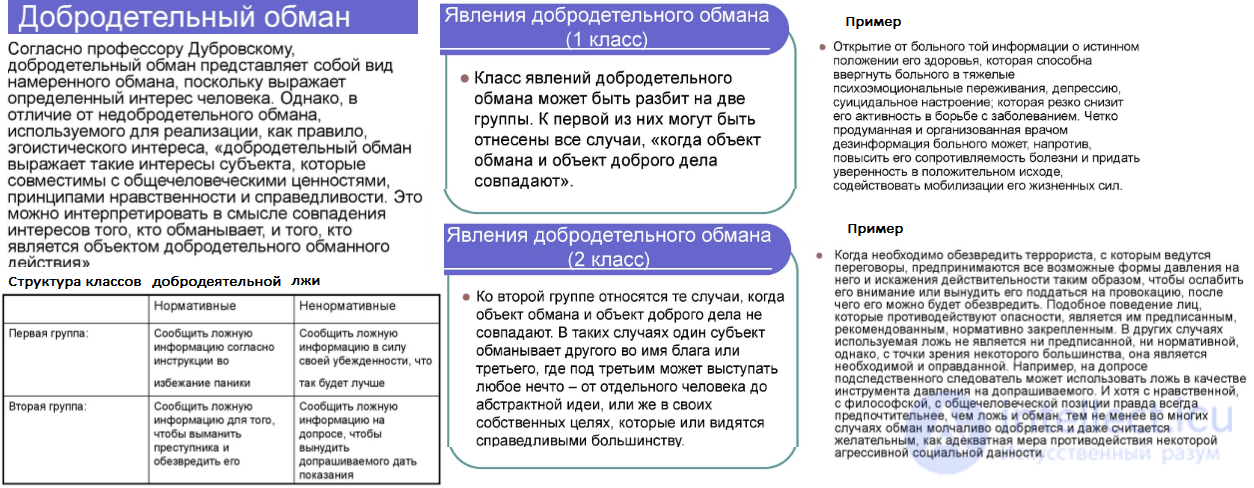
Here a clear, theoretically significant alternative arises: either
to remake the general concept of lying (and thereby of truth as well), which would contradict
the entire philosophical and sociocultural tradition; or to acknowledge that
different kinds of lying exist — in a first approximation, two kinds: a lie
that is malicious, existentially harmful, and a lie that is not malicious, including
one that is well-intentioned and existentially acceptable.
In Viktor Znakov's view, intent is what can indicate
whether a given act is a lie or is deceptive. If a stock trader reports information that certain shares will fall in price, then he
has the intent to mislead people. A scout has an entirely
obvious intent to deceive his enemies. But a certain witness who
withholds true information most likely has no desire at all to mislead the judge. He would probably be happy if he
were not asked about it at all, but asked about something else, where he would feel safe.
However, the scout will undoubtedly turn out to be a hero if he manages to deceive
the enemy, while the witness may himself turn into a criminal, since his testimony
will be judged false. It is likewise hard to call a doctor a liar, even though he
has a perfectly definite intent to distort the picture of his patient's illness
rather than simply keep silent about it. Thus, in order to clarify what a lie is
and what deception is, we will need the following important parameter, namely — to distinguish cases in which deceptive acts are normative, or socially sanctioned, or prescribed, from those in which such
acts are non-normative, i.e., lack social sanction.
A scout taken prisoner will display his best qualities, from society's point of view, if he manages to deceive his enemies, and will turn out to be a traitor if
he tells the truth. In some cases lying and deception are justified, and may
even be prescribed by society itself. A pilot fighting to save his aircraft may be instructed not to inform the passengers of what has happened, in order to avoid panic. Doctors know that in a significant number
of cases it is better to lie to a patient than to tell the truth, since the latter would worsen
the course of the illness. It is well known that a great many clinical and diagnostic experiments would become impossible if the subjects were told
the truth about the true aims and objectives of the research. And it would be strange if
a diplomat at international meetings and negotiations spoke only the truth about
the true state of affairs in his country.
From this point of view a witness lies, since he violates social agreements that apply to certain situations in which a deceptive act is a social necessity. In this case there is no such agreement,
so withholding information can be regarded as a lie. From this same point of view, the doctor's
deceptive act of distorting the picture of the patient's illness will, rather,
be deception, not a lie, since it has a normative character. At the same
time, a close relative of the patient who, on his own initiative, decides to cheer him up and conveys to him, word for word, the same information that
the doctor did, can have his actions defined as lies, since, unlike the doctor's, they do not have a normative character.
However, as Sissela Bok says, the concept of lying carries an obvious negative
presumption, i.e., in some sense people who lie or are called liars are, by definition, criminals. Is it always fair to call a person
a "criminal" when he lies? A witness may perhaps be driven by fear and the wish to protect his own life, and in such a case he is not so much lying as
cowardly, to put it in everyday terms. And a person who tells
a patient that he will soon recover is driven not by malicious intent at all, but, most likely, by the kindest and noblest of motives. Therefore, another parameter, proposed by Professor D. Dubrovsky, from whose standpoint
the deceptive act should be examined, is the purpose that the deceptive act pursues: malicious or virtuous.
It is important to note that detecting lies can be complex and requires a combined analysis of various aspects, including verbal and nonverbal means of communication, context, and knowledge of the person. Professionals in psychology and criminalistics can be trained in methods of lie detection for more accurate identification of lies in various situations.

Comments