Business etiquette, image and culture of behavior play an important role in the work environment and in interactions between people in business. Let us examine each of these aspects in more detail:
1. Business etiquette:
Business etiquette is a set of rules and norms that define acceptable behavior and interaction in the work environment. Etiquette helps create a professional and respectful atmosphere that fosters effective work and harmonious relationships. Some general aspects of business etiquette include:
- Punctuality: It is important to arrive at work and at meetings on time.
- Respect: A respectful attitude toward colleagues, subordinates and superiors.
- Confidentiality: Maintaining the confidentiality of information.
- Professional appearance: Compliance with the dress code and personal grooming.
- Respect for cultural differences: Understanding and respecting the cultural characteristics of colleagues and partners.
2. Image:
Image in business reflects your professional standing and how you are perceived as a professional. Important elements in creating a positive image include:
- Professional dress style: Clothing should meet the standards of your industry and your company's dress code.
- Confidence and charisma: Self-confidence and the ability to communicate with respect and attention to the interlocutor help create a positive impression.
- Communication skills: Clear and effective communication is important for establishing positive relationships.
3. Culture of behavior:
The culture of behavior within an organization determines which values and norms are recognized and practiced by employees. This includes:
- Corporate values: The values that a company puts forward as important to its activities, and expects employees to observe.
- Relationships with colleagues: Which relationships and interactions are considered acceptable within the organization.
- Responsibility: Employees are obliged to bear responsibility for their actions and the results of their work.
Etiquette (from the French étiquette) means an established order of behavior somewhere. This is the most general definition of etiquette.
Culture of behavior — the actions and forms of communication of people, based on morality, aesthetic taste, and the observance of certain norms and rules. True culture of behavior is an organic unity of a person's inner and outer culture, the ability to find the right line of conduct even in a non-standard, and at times extreme, situation. In this chapter the concept of "culture of behavior" will be treated as part of business etiquette, while fully understanding that the term "culture" itself, in the broad sense, is much more extensive than the concept of "business etiquette." The latter relates to the category of "culture" as the particular to the general.
Business etiquette — the most important aspect of the morality of a businessperson's or entrepreneur's professional conduct. Knowledge of it is a necessary professional quality that must be acquired and constantly improved. Almost 70% of profitable deals that fell through for domestic businesspeople failed to materialize because Russian businessmen do not know the rules of business communication and do not master the culture of behavior. This figure is also confirmed by world experience. Thus, back in 1936 Dale Carnegie wrote: "A person's success in their financial affairs depends about 15 percent on their professional knowledge and about 85 percent on their ability to get along with people." No small number of careers collapse and money is lost because of improper conduct or lack of manners. Knowing this, the Japanese spend hundreds of millions of dollars a year on teaching good manners and on consulting about etiquette and culture of behavior. They know well that the success of any firm largely depends on the ability of its employees, on their ability to work together harmoniously toward achieving a common goal. Knowledge of etiquette and culture of behavior are the key conditions for successful work in any organization — that is the opinion of leading company specialists.
Unfortunately, Russian businesspeople still do not attach serious importance to these aspects of their activity. It should be emphasized that observing business etiquette and knowing how to behave in a cultured manner is especially important when working with representatives of foreign firms, and when traveling abroad to conclude deals. Many of the "new Russians" display poor taste in clothing and in jewelry (whether it be massive gold chains with crosses around the neck, or other numerous items made of precious metals and stones on their fingers, wrists, and so on). And even more often, their patrons are "let down" by various secretaries and interpreters whom they take with them around "Europe."
As a result, the new Russians and their entourage become the subject of silent, yet nonetheless unflattering, criticism from negotiating partners. Foreign entrepreneurs who respect themselves and the honor of their firm often break off all negotiations after just the first meeting. The behavior of such new Russians can be assessed with the words from the famous fairy tale by A. S. Pushkin about the old woman who "could neither step nor speak properly."
To avoid getting into an absurd situation, one must know the rules of good manners. In the old days, Peter the Great taught them sternly. In 1709 he issued a decree according to which anyone who behaved "in violation of etiquette" was subject to punishment. Perhaps punishment should also be introduced for those domestic businessmen who make a laughingstock not only of themselves, but also cast a shadow on Russian entrepreneurship.
So, knowledge of business etiquette and the ability to behave in a cultured manner are the foundation of entrepreneurial success.
Etiquette is a historical phenomenon. The rules of people's behavior have changed along with changes in the conditions of society's life and of the specific social environment. Etiquette arose during the period when absolute monarchies were emerging. Adherence to certain rules of conduct and ceremonial was necessary to exalt royal persons: emperors, kings, tsars, princes, dukes, and so on, and to consolidate the hierarchy within class society itself. A person's career, and often even their life, frequently depended on knowledge of etiquette and observance of its rules. This was the case in Ancient Egypt, China, Rome, and the Golden Horde. Violation of etiquette led to enmity between tribes and peoples, and even to wars.
Etiquette has always performed, and continues to perform, certain functions. For example, distinguishing by rank, estate, nobility of lineage, title, and property status. Etiquette rules have been, and are, observed especially strictly in the countries of the Far and Middle East.
In Russia at the beginning of the 18th century, Western etiquette began to be actively introduced. Clothing, manners and outward forms of behavior were transplanted onto Russian soil. Compliance with these rules by the boyars and the noble estate (especially in the capital cities) was constantly and insistently, at times cruelly, monitored by Tsar Peter I himself. Violations were severely punished. Later, during the reigns of Elizabeth and Catherine II, the rules of etiquette that met the requirements and characteristics of Russia's national culture were selected — a culture which, as a Eurasian country, combined in many ways the opposites of Europe and Asia. There were many such opposites not only in the 18th century, but even now. The English writer Rudyard Kipling said that East is East and West is West, and never the twain shall meet. Thus, in Europe the color of mourning is black, while in China it is white. Even within the borders of the Russian Empire, the rules of behavior of different peoples differed significantly.
Of course, social progress also fostered the mutual interpenetration of rules of behavior and the enrichment of cultures. The world was becoming smaller. The process of mutual enrichment of rules of conduct made it possible to develop a mutually acceptable etiquette, recognized in its main features, enshrined in customs and traditions. Etiquette came to prescribe norms of behavior at work, on the street, when visiting, at business and diplomatic receptions, at the theater, on public transport, and so on.
Rules of etiquette
The rules of etiquette, embodied in specific forms of behavior, point to the unity of its two sides: the moral-ethical and the aesthetic. The first side is the expression of a moral norm: solicitous care, respect, protection, and so on. The second side — the aesthetic — attests to the beauty and grace of the forms of behavior. Let us offer some advice and recommendations.
For example, for a greeting use not only the verbal (speech) means "Hello!", "Good day," but also nonverbal gestures: a bow, a nod, a wave of the hand, and so on.
One can say "Hello" indifferently, nod one's head and walk past. But it is better to do otherwise — to say, for example, uHello, Ivan Alexandrovich!", to smile warmly at him and pause for a few seconds. Such a greeting emphasizes your kind feelings toward this person; he will understand that you value him, and besides, the sound of one's own name is a pleasant melody for any person.
Addressing someone without their name is a formal address: whether it is a subordinate or a superior, a neighbor on the landing or a fellow passenger on public transport. Addressing someone by name, and even better — by first name and patronymic — is an address to the individual. By pronouncing the name and patronymic, we emphasize respect for human dignity and demonstrate warm regard. Such a greeting speaks to a person's culture. Of course, people are not born with such qualities. These qualities are cultivated, and later become habitual. The earlier such upbringing begins, the better: the sooner it will become a habit. It is especially hard for first-generation businessmen to develop the good habits of an intelligent person, since they mostly have to go by trial and error. It is not for nothing that the English say that to become a gentleman one needs three university degrees in the family: the grandfather's, the father's and the son's.
But besides the rules of cultured behavior there also exists professional etiquette. In life there have always been, and will remain, relationships that ensure the highest efficiency in performing professional functions. Participants in any interaction always try to preserve the most optimal forms of that interaction and rules of conduct. For example, in an organization a newcomer will be required to strictly observe the established and tested rules of business communication, since they make it easier to perform professional functions and help achieve the goals set. In one or another collective, group of workers, employees, or businesspeople, certain traditions take shape which, over time, acquire the force of moral principles and constitute the etiquette of that group, that community.
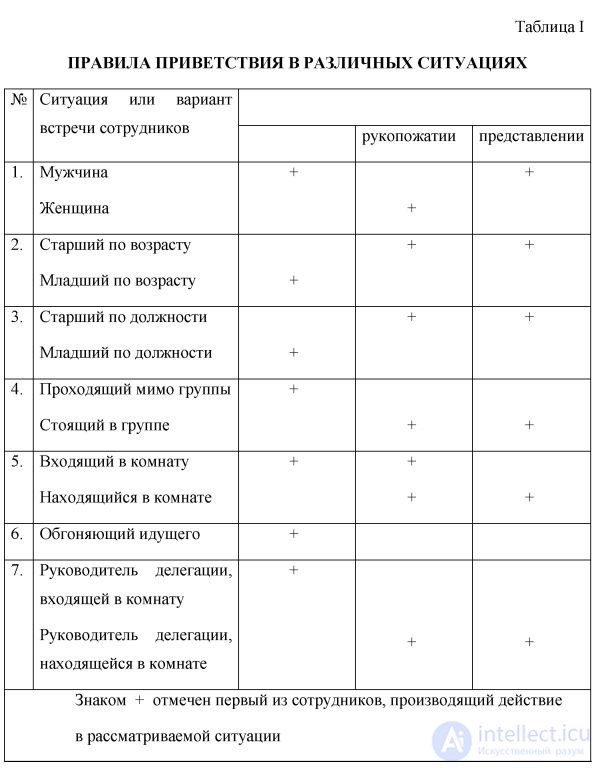
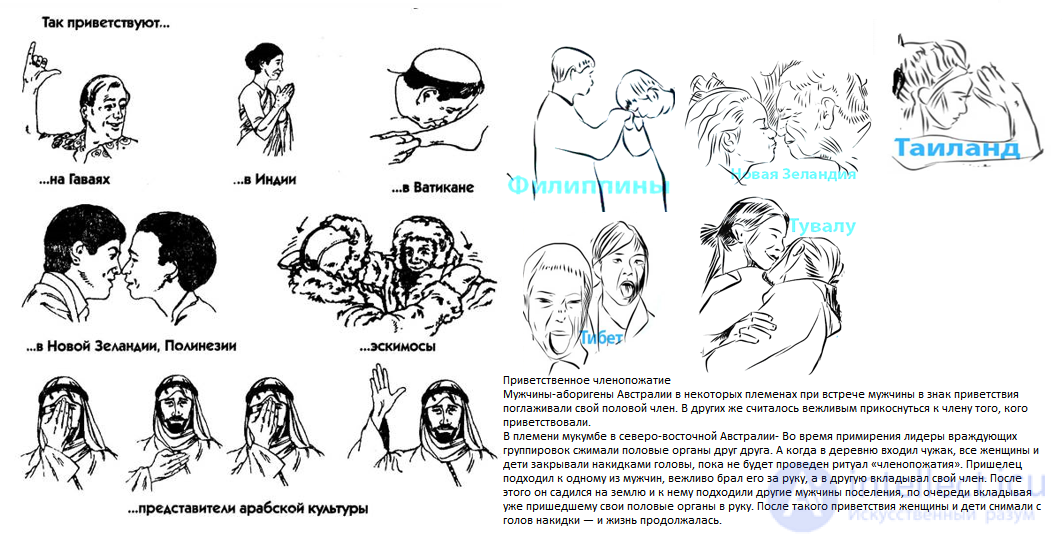
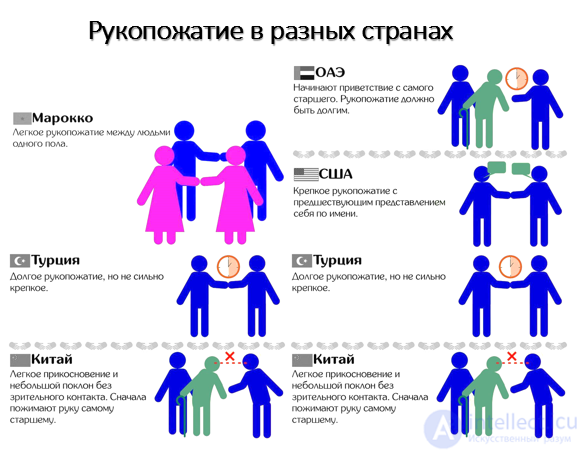
Fig. rules of greeting and handshaking in different countries
Fig. rules of greeting and handshaking in different countries
In the practice of business relations there are always certain standard situations that cannot be avoided. It is for these situations that forms and rules of conduct are developed. This set of rules constitutes the etiquette of business communication. The etiquette of business relations is defined, in particular, as a set of rules of conduct in business, which represents the outward side of business communication.
Business etiquette is the result of a lengthy selection of rules and forms of the most expedient behavior, which contributed to success in business relations. Mastering these rules was not always easy, so entrepreneurs "from the plow" often spoke of them not very flatteringly: "What do I need all this for?"
One can follow this very principle. However, if you want to establish solid business relations with foreign partners, then knowledge of the business etiquette of foreign countries is simply essential.
One might recall how trade relations were established with medieval Japan, which, until the well-known Meiji era (until 1868), was almost completely closed off from the rest of the world. A merchant or trader who arrived in the land of the rising sun to establish business ties would be presented to the emperor. The presentation procedure was so humiliating that not every foreign guest could bear it. The foreigner had to crawl on his knees from the door across the reception hall to the place assigned to him, and after the audience, in the same way, backing away like a crayfish, leave his place and disappear through the door.
But just as in those distant times, so too now, the rules of business etiquette and the culture of behavior help bring together the economic and financial interests of trading people and businessmen. For many, profit was and remains higher than all differences of national character, religion, social status, and psychological traits. These differences were subordinated to the etiquette of the country in which the businessman was interested. Submission to the rules of the game of the dominant party formed the basis for the success of a deal.
What rules of conduct, then, does an entrepreneur need to know? First of all, one should remember that business etiquette includes the precise observance of the rules of the culture of behavior, which presupposes, above all, a deep respect for the human personality. The social role played by one or another person should not be self-dominating, nor should it exert a hypnotic influence on a business partner. A cultured entrepreneur will treat a minister and an ordinary technical employee of the ministry, the president of a company or firm and the office cleaner, with equal respect, i.e., showing everyone sincere respect. This sincere respect must become an integral part of the businessperson's nature. He must learn to believe in people's decency. One must not, at a first meeting, reveal even the slightest sign that you regard him as a "dark horse" seeking to outmaneuver you on the straight or on the turn — or, put more simply, to deceive you. At the basis of one's conduct should lie the moral assessment: a business partner is a good person! Unless, of course, he has proven the opposite by his actions.
Rules of verbal etiquette
The culture of behavior in business communication is unthinkable without observing the rules of verbal (word-based, speech) etiquette, connected with the forms and manners of speech, vocabulary, i.e. with the entire style of speech, accepted in the communication of a given circle of businesspeople. There are historically developed stereotypes of speech communication. They were formerly used by Russian merchants and entrepreneurs, and now they are used by cultured Russian and foreign businesspeople. These are the words: "ladies," "gentlemen," "sirs" and "madams." Among other social groups such forms of address have not yet become widely established, and people often feel a sense of inner discomfort at meetings and gatherings, since they do not know how to address one another: the word "comrade" seems to diminish their dignity because of a certain attitude toward this word that has formed under the influence of the mass media. On the other hand, many have clearly not grown up to "gentlemen" because of their beggarly existence. That is why very often on public transport, in a shop, on the street we hear humiliating phrases: "Hey, man, move over," "Woman, punch the ticket," and so on.
Among businesspeople the form of address "sir" has a right to exist. This word emphasizes that these citizens, this social group, are free and independent in their actions to a greater degree than any other social group in contemporary Russia. Moreover, this form of address was not blindly borrowed from somewhere in the West or the East. Thoughtless borrowings, put into circulation most often by not very cultured television and radio journalists and reporters, as a rule grate on the ear and highlight the poverty and pretentiousness of such borrowings, for example: "a presentation took place," "a new mentality of Russians is being formed," or "sponsors of the vernissage," and the like. "Sir" is a genuinely Russian word. It has the most widespread meaning as a form of polite address to a group of persons and to an individual, one that was used in the privileged strata of society.
In a business conversation one must know how to give an answer to any question. Even to the simplest, asked daily several times over, "How are things?", one must always remember a sense of proportion. Not answering at all is impolite; grunting "fine" and walking past is also impolite, if not rude; launching into a long discourse about one's affairs earns one a reputation as a bore. In such cases business etiquette prescribes answering roughly as follows:
"Thank you, fine," "Thank you, no complaints so far, touch wood," and in turn to inquire: "I hope things are going well for you too?" Such answers are neutral, they reassure everyone, and follow norms established in Russia: "Don't jinx it when things are going well."
However, among Czechs, Slovaks, Poles and Yugoslavs, the rules of business etiquette do not forbid briefly describing difficulties in response to the question "How are things?", complaining, for example, about the high cost of living. But they speak of this cheerfully, emphasizing that the businessperson overcomes difficulties — there are not a few of them in their line of work — but he knows how to cope with them, and takes pride in it. And only an idler lives without difficulties and cares.
In verbal (word-based, speech) communication, business etiquette involves the use of various psychological techniques. One of them is the "stroking formula." These are verbal turns of phrase such as: "Good luck to you!", "I wish you success," well-known phrases:
"A big ship needs a big voyage," "Break a leg!" and the like, uttered with various shades of meaning. Widely used are such verbal signs of goodwill as "Cheers," "No problem," "OK" and the like.
But one should avoid such clearly caustic wishes as "May an evil wolf catch your calf."
In the speech etiquette of businesspeople, compliments are of great importance — pleasant words expressing approval, a positive assessment of activity in business, emphasizing taste in clothing, appearance, the balance of a partner's actions, i.e. an assessment of the business partner's intelligence. As the heroine of the film "The Elder Sister," popular in the 60s, used to say, even a cat likes a kind word. From this point of view, a compliment is not a mechanism of flattery. Flattery, especially crude flattery, is a mask behind which a mercenary interest most often hides. A compliment, especially if the partner is a woman, is a necessary part of speech etiquette. During business communication there is always a real opportunity for compliments. They inspire your business partner, give him confidence, and show approval. It is especially important to remember a compliment if you are dealing with a newcomer who, moreover, has suffered an early setback. It is no accident that open criticism of employees is forbidden in Japanese firms: it is unprofitable for the firm, since it lowers labor activity and initiative.
Business etiquette prescribes the strict observance, during negotiations, of the rules of conduct of the partner country in business. The rules by which people communicate are connected with the way and style of life, national customs and traditions. All this is the result of centuries of life experience, the everyday life of previous generations of a given people. Whatever the traditions or rules of conduct may be, they have to be followed if, of course, you want to achieve success. Here the proverb "You don't go to another monastery with your own rule book" is especially apt. One often has to observe all the rules even if they are not to one's liking. The interests of the matter are above your tastes and preferences.
Many examples can be given of the peculiarities of the rules of conduct of businesspeople from different countries. If, for example, Americans, emphasizing their goodwill, give you a friendly slap on the shoulder and readily accept the same gesture from you, then by patting a Japanese person on the shoulder, or trying to give a friendly hug to a Chinese or Vietnamese person, you may well ruin your deal.
During a business conversation with Italians, try not to show your distaste for their loud, overly animated speech and the passion with which they discuss even an insignificant issue, and when communicating with the Japanese do not be surprised by their use of extremely polite turns of speech. Extreme politeness toward a partner and self-deprecation of one's own "I" (for example, "I, unworthy as I am, together with my insignificant wife, invite You, the most honorable and noble one, to visit us") do not hinder the Japanese but rather help them conduct their business excellently. It is hard to find another business partner who would, in advance, calculate the most improbable variants of an upcoming deal with such thoroughness and set so many different (financial, legal, and other) traps for his negotiating partner, as a Japanese person does. Japanese excessive politeness — is a kind of drug that lulls a negotiating partner's vigilance. In any financial, technical, or other business deal, the Japanese, as a rule, get the better of our domestic businessmen, who are too susceptible to banal compliments and flattery.
Business etiquette requires special behavior in communication with clients. In every type of service provided to clients, there are professional subtleties of behavior. But you must always remember the main principle that defines relations with clients: the client — is the most valued and welcome person in your office (store, enterprise). If there are many clients, priority is usually given to serving women and the elderly. But in any case, when working with clients you need to be a good psychologist.
It is also important to observe certain rules regarding clothing and appearance. An ultra-fashionable suit is not at all necessary. What matters is that it be in decent condition, not hang like a sack, and that the trousers not look like a greasy old accordion. But the suit must suit the place and the time. If negotiations with partners are scheduled for daytime, a light-colored suit will do. The trousers and jacket may be of different colors. But if the negotiations take place in the evening, the suit should be dark, the shirt — must be fresh and ironed, the tie — not garish, the shoes — polished. The elegance of a businessperson is determined by the shirt, tie, and shoes, not by the number of suits he brought with him.
For a trip abroad, it is enough to have three sets of clothing: dark and light suits, a decent jacket, and a sweater for walks. If your travel route passes through the countries of the East, remember that women should not wear trousers, they should not appear on the street or in public places without stockings or tights (especially in countries that practice Islam), and men should avoid bright ties.
It must be remembered that in business relations there are no trifles. For business, etiquette means a great deal. Clothing and the behavior of an entrepreneur or manager — are his calling card. An impression of a guest begins to form in advance, as information about him is gathered. Sources of information include the businessman's behavior on the way to the business meeting, his behavior at the hotel, and during the meeting itself. Remember, you are surrounded everywhere by people who, with varying degrees of scrutiny, are studying you.
Observing the most important rules of behavior with strangers is a sign of your respectability, upbringing, and self-confidence. There is a whole set of rules of behavior on various types of transport, on a plane, a train, a car. A long journey inclines one toward unhurried conversation. One must know how to carry it on. Above all, one should not impose on fellow travelers' attention, should not strive to seize every side of the conversation as quickly as possible, and should not be excessively talkative: talkativeness — is a sign of bad manners. The other extreme — is reticence, a gloomy look, unsociability. It is also worth remembering that conversations during a flight or trip about accidents or transport disasters will not create a favorable image for you and do not help establish friendly or business contacts with those around you. After the plane lands, do not rush to hand the flight attendant a tip as a token of gratitude, she will not take it. You can thank the ship's crew with applause for their skill and standard of service.
Rules of telephone communication
Modern business life is impossible to imagine without the telephone. Thanks to it, the efficiency of resolving numerous issues and problems is multiplied many times over, there is no longer a need to send letters or telegrams, or to travel to another institution or city to clarify the circumstances of some matter. A great deal can be done by telephone: conducting negotiations, giving instructions, making a request, and so on. Very often the first step toward concluding a business agreement is a telephone conversation.
Humanity has been using the telephone for more than a century. One would think that would be plenty of time to learn to use this technical device wisely... But the ability to speak on the telephone is not passed down by inheritance. Not everyone masters the art of communicating by means of this device. It helps to have knowledgeable mentors or good role models from whom one can learn how to talk properly on the telephone. Relevant courses and various methodological manuals on this topic are widely available in various countries of the world.
A telephone conversation has one important advantage over a letter: it provides continuous two-way exchange of information regardless of distance. But you also need to prepare carefully for a business telephone conversation. Poor preparation and the inability to highlight the main point, and to express one's thoughts concisely, succinctly, and correctly, lead to significant losses of working time (up to 20—30%). This is what the American manager A. Mackenzie claims. Among the 15 main causes of working-time loss for businessmen and managers, he placed telephone conversations first. Psychologists note that the duration of telephone conversations depends on their emotional coloring. Excessive emotionality creates conditions for vagueness of speech and unbusinesslike phrasing, which increases the length of the telephone conversation.
It is also known that during a telephone conversation a phenomenon such as communication satiation is observed. It can become a source of tension between the parties. Therefore, moderation must be observed during the conversation. Otherwise, the meaning of the communication may be lost and a conflict may arise. Signs of communication satiation include: the emergence and intensification of unfounded dissatisfaction with the partner, irritability, touchiness, and so on. One should withdraw from contact with the partner in time in order to preserve the business relationship. Moreover, by conducting lengthy telephone conversations, you may acquire a reputation as a bore or a chatterbox. Such a reputation will undermine interest in you and your business proposals. To restore the firm's good name and your own reputation will require significantly more effort than establishing the first business contact.
The art of conducting telephone conversations consists in briefly conveying everything that needs to be said and receiving an answer. At a Japanese firm, an employee who cannot resolve a business matter by telephone within three minutes will not be kept on for long.
The foundation of a successful business telephone conversation — is competence, tact, goodwill, mastery of conversational techniques, and a striving to solve the problem efficiently and effectively or to help in solving it. It is important that an official, business telephone conversation be conducted in a calm, polite tone and evoke positive emotions. Even the seventeenth-century English philosopher F. Bacon noted that conducting a conversation in a benevolent tone is more important than using good words and arranging them in the correct order. During a business telephone conversation, it is necessary to create an atmosphere of mutual trust.
The effectiveness of business telephone communication depends on a person's emotional state and on his mood.
According to psychologists, positive emotions stimulate the activity of the brain and promote clear, rational thinking. Negative emotions lead to a disruption of logical connections in words and argumentation, and create conditions for an incorrect assessment of the partner and his proposals. Skillful display of expressiveness is also of substantial importance. It testifies to a person's conviction in what he is saying and to his interest in resolving the problems under discussion. During a conversation, one must be able to interest one's interlocutor in one's business. Here the correct use of methods of suggestion and persuasion will help you. How is this to be done, and by what means? Voice, tone, timbre, intonation tell an attentive listener a great deal. According to psychologists' data, tone and intonation can carry up to 40% of the information. One only needs to pay attention to such "trifles" during a telephone conversation. As for yourself, try to speak evenly, restrain your emotions, and not try to interrupt your interlocutor's speech.
If your interlocutor shows a tendency to argue, makes unfair reproaches in a harsh form, and his tone carries a note of conceit, be patient and do not respond in kind. If possible, shift the conversation to a calm tone, partially acknowledge that he is right, and try to understand the motives for his behavior. Try to state your arguments briefly and clearly. Your reasoning must be correct in substance and competently expressed in form. In conversation, try to avoid expressions such as: "deal", "OK", "fine", "bye", and the like. In a telephone conversation it is also better not to use specific, professional expressions that may be incomprehensible to your interlocutor.
It should be remembered that the telephone aggravates speech shortcomings; fast or slow pronunciation of words makes comprehension difficult. Pay particular attention to the pronunciation of numbers, proper names, and consonant letters. If the conversation includes the names of cities, towns, proper names, surnames, and so on, which are poorly perceived by ear, they need to be pronounced syllable by syllable or even spelled out letter by letter.
The etiquette of business telephone conversation has in reserve a whole range of stock phrases for correcting communication. For example:
- Can you hear me?
- Could you please repeat that... ?
- Sorry, it's very hard to hear.
- Excuse me, I didn't catch what you said, and so on.
Before calling anyone, remember: prolonged exposure to telephone ringing negatively affects the nervous system (so try to pick up the receiver yourself as soon as you hear it ring), unnecessary telephone conversations disrupt the work rhythm and interfere with solving complex issues that require deep analysis and discussion in calm conditions, i.e., they interfere with the work of those nearby.
A call to a business partner's or colleague's home telephone for a work-related conversation can only be justified by a serious reason, no matter whom you are calling — a superior or a subordinate. A well-mannered person will not call after 10 p.m. unless there is an urgent necessity or prior consent has been obtained for such a call.
As analysis shows, in a telephone conversation 30—40% is taken up by repetitions of words, phrases, unnecessary pauses, and superfluous words. Consequently, one must prepare carefully for a telephone conversation: gather all materials and documents in advance, keep the necessary phone numbers, addresses of organizations or the people needed, a calendar, a pen, paper, and so on at hand.
Before you decide to dial the number, you should precisely determine the purpose of the conversation and your tactics for conducting it. Draw up a plan for the conversation, write down the questions you want to resolve or the information (data) you want to obtain, and think through the order in which to raise the questions. Formulate them clearly so that your interlocutor cannot interpret them ambiguously. Try to interest your interlocutor with your very first phrase. Keep in mind the dates and numbers of documents and official materials relevant to the conversation, and try to anticipate your interlocutor's counterarguments and your own responses to them. If you are discussing several questions, finish the discussion of one question in sequence before moving on to the next. Use standard phrases to help separate one question from another.
A conversation on each topic should end with a question that requires an unambiguous answer.
A person's outward appearance
One often hears that one should not judge a person by first impression. However, according to psychologists' calculations, in 85 cases out of 100 people base their attitude toward another person on external impression. Features of a person's appearance inform us about age, social, national, and professional affiliation. That is why in communication both the words spoken and one's appearance matter.
Since ancient times, people have striven for perfection. The ability to create an image (persona) for oneself, to build in oneself and in others confidence in one's own attractiveness and vivid individuality — is an art that has been mastered over centuries. A person learns to create his image with the help of clothing, makeup, and hairstyle. The ability to dress attractively in accordance with life situations — is a talent. An evening outfit looks ridiculous in the daytime, and if one shows up for work in such an outfit after getting there on public transport, — that is a grotesque situation.
The main mistake, according to J. T. Molloy, a recognized specialist in the field of business attire, is placing excessively exaggerated importance on one's own attractiveness and diligently following fashion. Indeed, people, especially young people, forget that fashion offers a general direction, a faceless standard, which does not emphasize individuality. In choosing clothing, it is important to be able to select a wardrobe in accordance with one's appearance, age, taste, and situation, rather than blindly following fashion. A person must develop his own style in clothing, since fashion is changeable while style endures. You have probably noticed: an outfit is fashionable, fits your figure well, and is your color, but it does not please the eye or warm the soul, — this means the clothing does not fit into your style, does not correspond to your image and character.
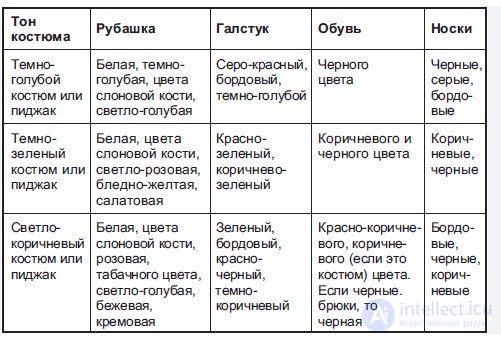
Fashion specialists advise wearing what truly flatters you, what makes you look elegant. An important condition for elegance is taking into account, when cutting clothing, the volumes of the body and the proportions of its individual parts. Clothing should be selected in accordance with one's body type and face. The main thing — is to see the flaws of one's silhouette and skillfully correct them with the help of clothing. Clothing is a kind of calling card that exerts a psychological effect on one's communication partners. It can say a great deal about our personality and position.
To create an outwardly attractive image, a person uses makeup, which helps not only to refresh the face but also to correct minor individual flaws in its features. When using decorative cosmetics, one must take into account the person's overall appearance, the color of their skin, hair, eyes, and clothing, the shape of the face, age, as well as the time and place where the person will be (everyday work, a formal evening, a discotheque, a theater). Specialists in decorative cosmetics advise adhering to the rules: «less is better than more»; «better none than done poorly». Good makeup — is makeup that is unnoticeable, which, as professionals say, should «fit the face well».
So, you have fashionable clothes, impeccable makeup, but an improperly chosen hairstyle, and you no longer make a worthy impression. Hair — is a natural adornment that needs daily care. Hair makes a person attractive through the correct choice of hairstyle. A hairstyle is chosen with regard to the person's figure, face type, and head shape. Hairdressing professionals have developed recommendations for how a well-chosen hairstyle can draw attention away from a stooped back and an unattractive neck.
All the details of your outfit — from shoes to a hairpin — must be in harmony with one another. An expensively but untidily dressed person with an unpleasant odor and greasy hair sticking out in different directions is unlikely to inspire sympathy. Neatness is the basic requirement of etiquette for appearance.
And one must always remember that outward beauty can only attract the attention of those around you, while to hold that attention, inner beauty is necessary. An outwardly beautiful but rude, ill-tempered, uncultured person with a vulgar vocabulary and behavior makes an unpleasant impression.
Observing business etiquette, cultivating a positive image, and maintaining a culture of behavior help create a professional and successful working environment in which respect and effectiveness go hand in hand.
Self-check questions:
1. What are the main requirements for a person's appearance?
2. What does «being elegant» mean?
3. What does the word «etiquette» mean?
4. Formulate the basic principles of business etiquette.
5. Why is a person's overall culture judged by their speech?
6. Prepare presentations (reports): «The Role of Etiquette in My Future Profession»; «The Importance of Speech Culture in a Professional Career».


Comments