
Lecture
The phenomenon of personal influence describes one person's ability to affect the opinion, beliefs, actions, or emotions of another person. This process plays an important role in interpersonal relationships, education, marketing, politics, and other fields. Here are some ways and types of influence, as well as techniques used to achieve this goal:
Ways and Types of Influence:
Authoritative influence: It is based on a position of power, status, or expertise. People submit to authority figures and follow their instructions out of respect for their knowledge or position.
Social influence: This influence comes from the surrounding social group. People may change their behavior to conform to the group's norms and expectations.
Emotional influence: Emotions can have a strong effect on decisions and actions. Positive emotions such as inspiration and joy, or negative emotions such as fear or guilt, can influence people's behavior.
Personal conviction and argumentation: People can be persuaded through logical arguments and evidence. This influence is based on the ability to persuade and to provide convincing arguments.
Forceful influence: Violent or threatening influence can lead to a change in behavior, but this method of influence often causes negative consequences.
Manipulation: This method involves the use of tricks, deception, or tactics to obtain the desired result. Manipulation can be covert or overt.
Techniques of Influence:
Persuasion: Persuading another person through argumentation and logical reasoning.
Modeling: Demonstrating desired behavior or an example for others in order to inspire or be imitated.
Persuasion through emotion: Using emotions, stories, or anecdotes to evoke certain feelings in others.
Support and approval: Supporting and encouraging desired behavior through praise, reward, or approval.
Social influence: Using social groups and norms to convince others of the necessity of action.
Authority and status: Relying on one's position or expertise to convince others.
Manipulation: Using tactics such as deception, instilling fear, or creating artificial uncertainty in order to gain influence.
Affiliation is the motivation to establish trust, a person's striving
to be in the company of other people.
Power is the ability of an agent to exert their will
against the resistance of other people; the potential for influence.
A "significant" other is a person with whom there is emotional closeness, providing satisfaction of the need for protection, support,
imitation, authority, friendship, and trust.
A charismatic leader is a charming person capable of inspiring awe in subordinates; he is able to gather a group of people who share this point of view, and through relationships with the team he develops
together with its members.
Personal influence is the ability to affect another person in a motivating,
restraining, soothing, or otherwise developmental way, changing
at the same time not only their behavior but also their views, motives, consciousness, and even character.

The psychology of influencing women, like men, has much in common,
since in the case of manipulation it is the personality that is targeted, so one needs to know clearly how exactly this will be attempted.
So, the main types of psychological influence on people include the following actions:
– persuasion,
– self-presentation,
– suggestion,
– request,
– coercion,
– criticism.
Self-presentation is a frank "display" of one's competence and
qualifications in order to gain an advantage in certain selection situations. This method is widespread in the psychology of political influence.
Request. A clear, polite phrasing can "disarm" even the most
aggressive person. This is most often used by young women pursuing a particular goal. Sometimes, however, politeness is feigned, so one should understand exactly what result is being sought from you.
Psychological coercion is a violent method of influencing people; it represents an informational impact on a person's consciousness that, as a rule, constitutes a threat of physical
violence against the coerced person themselves or their loved ones. The irresistible nature of coercion means that the person's will was completely suppressed, so that
the person, in performing whatever actions were suggested to them, had no other choice.
Coercion can be ethically justified only in exceptional cases.
Suggestion is a method of influence based on a person's uncritical perception of incoming information. Unlike persuasion, suggestion involves the object of suggestion assimilating the message without requiring
proof of its truth. Being accepted without due critical
reflection, behavior instilled in a person may not align with their
beliefs, habits, or inclinations, whereas persuasion, being
an impact that is largely intellectual, appeals mainly to the listener's knowledge and experience.
Suggestion of an emotional-volitional character is based on faith (or on trust – the difference here lies only in the degree of uncritical perception
of the words and actions of the significant other). In everyday life, suggestion occurs routinely in the process of communication between people. It is characterized by the fact
that one person, without substantiating the propositions they put forward, achieves real, rather than merely formal, acceptance of them by another person. The degree of an individual's suggestibility is determined by the level of development of their personality, their self-awareness, and
self-esteem, willpower, as well as the characteristics of interpersonal relations within
the group, and in particular their attitude toward the subject of the suggestion.
Persuasion is a method of verbal influence that includes a system of arguments related according to the laws of formal logic and
substantiating the thesis put forward by the individual. Successful persuasion leads to
the acceptance and subsequent incorporation of new information into an established system of views, to a certain transformation of worldview, and consequently the motivational basis of behavior.
Persuasion is effective when the content and mutual arrangement of arguments correspond to the basic principles of oratory: due account is taken of the placement of the most vivid examples, the ratio of arguments "for"
and "against," the emotional background of the associations that arise when key words
are pronounced, and so on. The success of persuasion depends on the intellectual
level of the person being persuaded. People with flexible thinking more readily absorb others'
arguments, integrating them into their own system of knowledge. Individuals with low self-esteem who are primarily oriented toward adapting to the social environment rather than individualizing themselves within it are also the most easily persuaded. Those who are hostile toward others and strive above all to dominate those around them are the hardest to persuade.
Unlike suggestion, persuasion is based on the meaningful acceptance
by a person of certain information or ideas, on their analysis and evaluation. In this case, the conclusion can be reached either independently or by following the persuader.
As a rule, persuasion requires a considerable investment of time and the use of varied information, whereas suggestion can occur almost
instantaneously.
Criticism. People are very sensitive to even the slightest hints of criticism.
This happens because, in general, negative information turns out to be more significant for people than positive information, since, being less common, it attracts more attention.
The psychological mechanism of the "own name" technique is the emergence of a pleasant sensation (in the subconscious) that arises when a person hears their own name addressed to them. When a person is addressed and
their name is spoken at the same time, this, whether intentionally or not, shows attention to that individual, which amounts to an affirmation of that individual. From
this arises a feeling of satisfaction associated with positive emotions and, as a consequence, an attraction to the source of positive emotions and the achievement of goodwill (the formation of attraction).
The "mirror of relationships" or "mirror of the soul" technique is based on the use of life experience, which shows that a kind and pleasant
facial expression and a light smile have the ability to "attract" others to oneself,
to form attraction. Indeed, a person more often smiles kindly and pleasantly
at people toward whom they feel genuine sympathy.
The psychological technique of "golden words" (compliments) is based on the use of the psychological phenomenon of suggestion. So, if a person hears many
times that they have "golden" hands, "an amazing ability to see
the beautiful where others do not see it," "one can learn a great deal by talking with
you," and so on, they will come to believe it. In the effect of suggestion, there occurs, as it were,
an "in absentia" satisfaction of the need to improve some trait of one's own. In fact, the need itself may not be fully satisfied, but the sense of its satisfaction will be real, giving rise on
this basis to positive emotions. When addressing students with "golden words," it is necessary for the compliment to remain a compliment and not turn into
banality.
There are such basic techniques of persuasion as refutation, proof, clarification, and informing, but this is merely the tip of the persuasive influence on a person, giving only a
general idea of the specific procedure. In everyday practice we have to deal with
the need to attach importance to the situational background state in
which persuasion takes place.
Consequently, persuasive influence tends to be absorbed against
a specific psychological background. Here we distinguish "concert mood," identification, emotional tension, and relaxation. For any particular background, a corresponding technique of persuasion is assigned.
The guidance technique. This technique occurs when there are positive relations between the leader and the interlocutor. The specificity of guidance lies in the fact that a word expressed in the imperative form determines a person's executive behavior. Verbal instructions can take the following forms: prohibitions, directives, instructions. Unlike orders and commands,
which are designed to trigger an already existing skill, an instruction
creates a unified orientation for activity. Like any verbal influence, the content of the instruction is also quite important. Therefore, before
applying such a technique of persuasion as instruction, one needs to carefully
think through the material to be included in it. It should be kept in mind that effectiveness is
not tied only to meaning here. Verbal instruction requires an appropriate manner of delivery and style of speech. This means gestures, facial expressions, intonation, and emotionality. Everything must correspond to an imperative and concise sentence structure.
The technique of indirect approval. It is designed for the emotional perception of the speaker's words. The essence of this technique does not lie in directly
telling a person, "Your success in this matter is undeniable." This resembles
flattery. But while some people are very fond of flattery, as a rule it has a ruinous effect on human character. Therefore, if one needs to express approval, it is better to do so indirectly: "Usually, such diligence yields positive results!" Such a technique of persuasion, expressed with a sufficiently emotional coloring, will evoke in the interlocutor
a sense of self-worth. It is quite likely that this kind of approval
will be completely unconvincing for a person with selfish inclinations, and they will interpret it in their own way.
The Socratic method. This technique of persuasion has been known since antiquity. Its essence
lies in ensuring that the interlocutor cannot answer the question posed with
"no." Socrates, the ancient Greek philosopher, always tried to ensure that his interlocutor would in no case say "no." But if this did happen, it was quite difficult to turn things back around. That is precisely why Socrates conducted
the conversation in such a way that it was easier for the interlocutor to answer "yes." The philosopher always managed to prove his point of view, and in doing so there was neither
open indignation nor the slightest negative reaction from his opponents.
Orders and commands. They require correct and swift execution from people. When carrying out orders and commands, one does not reason. There are such
varieties of orders and commands: incentive and prohibitive. The former –
"Carry it out," "Bring it," "Go" – are intended to trigger people's behavioral mechanisms. The latter – "Be quiet," "Stop being nervous,"
"Stop it…" – are aimed at immediately halting undesirable signs of behavior. They are spoken in a calm, firm, or emotionally
colored tone of voice. Such orders and commands are meant to be received without critical evaluation.
Disappointed expectation. In this technique of persuasion, the precondition is the creation of a tense atmosphere of anticipation. Preceding events must create a strictly defined train of thought in the interlocutor. But in a case
where this direction of thought proves untenable, the interlocutor
becomes confused and therefore accepts the idea offered to them without objection. Such situations occur quite often in life.
"The Explosion." This psychological technique of persuasion is known as a rapid restructuring of the personality brought about by strong emotional experiences. To apply the "Explosion," an appropriate setting is needed, one in which feelings arise that, by their unusualness and unexpectedness,
are capable of striking a person. In such a setting, a collision of
nervous processes occurs. A sudden stimulus (information, a spectacle, etc.)
causes confusion in a person. Their views on the world as a whole change radically, as do their views on
individual people, events, and various things. The "Explosion" technique is used in
work collectives with respect to individuals with criminal and immoral
behavior, toward drunkards, and toward flagrant violators of discipline. Here, under certain circumstances, the following varieties are appropriate: "writing off" past
transgressions, sincere assistance from the administration in a situation of
stress and grief, and the fierce disapproval of the entire collective toward the behavior of the offender. Formalism and insincerity have absolutely no place
here.
Categorical demand. This method of persuasion lies in the force
of the order. It is effective only in the case where the leader
enjoys undisputed authority among subordinates or possesses great power. In other cases, this technique can be harmful and useless.
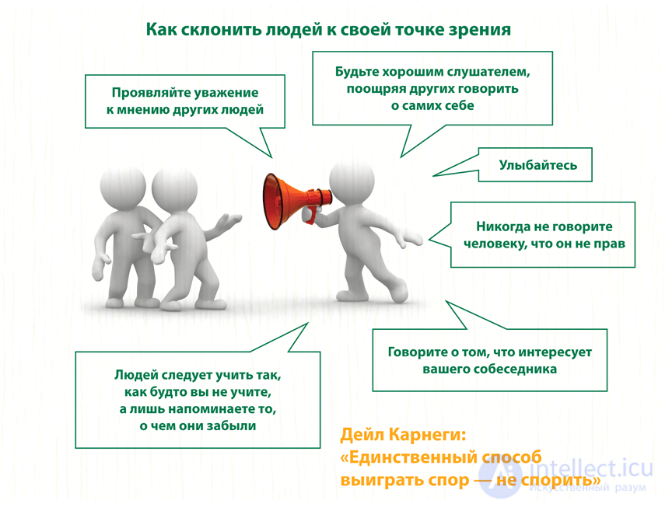
Advice. This technique of persuasion is most effective when
the interlocutor fully trusts the leader. In order to follow
the advice, the form in which it was
given becomes highly significant for the person. It should be remembered that advice is given in a voice that carries notes of sympathy and warmth. Advice, moreover, should be asked for only
sincerely, otherwise the request may backfire on the one asking.
"Placebo." It has long been used in medicine as a technique of suggestion. Its essence lies in the fact that when a doctor prescribes a patient some indifferent medication, they assert that this particular remedy will produce the necessary effect. The patient believes that the prescribed medication will have a beneficial effect, and as a result the positive psychological mindset leads to positive results. It is worth noting that this technique of persuasion is very effective, but it must be used with caution.
Remember that the "placebo" effect is effective only until the first failure. Once a person realizes that the actions they performed so scrupulously and ritually have no real basis, they can no longer be convinced by the
"placebo" technique.
Reproach. The technique has persuasive force only in the case when
the interlocutor compares themselves with another person. Under other conditions, reproach is perceived as moralizing instruction, which one may listen to but need not follow. Since a person quite actively
defends their own "self," for them this technique of persuasion is an encroachment on their
personal independence.
Hint. This is a psychological technique of indirect persuasion through analogy, irony, or joke. At times, advice itself can take the form of a hint. The essence
of a hint lies in the fact that it is directed not at logical reasoning, not at the consciousness, but at the emotions. Since a hint can offend the interlocutor's personality,
it is better to use it under conditions of a "concert mood."
Compliment. This effective technique of persuasion is often confused with
flattery. But not every person finds this pleasant, and although the interlocutor may not
brush flattery aside, it nevertheless offends many people. A compliment, on the other hand, cannot offend anyone — quite the opposite, a compliment elevates any person. The basic techniques of persuasion are useful in life today; the main thing is to know where and which one to apply so as not to offend the interlocutor.
It is important to remember that influence can be both positive and negative, and the use of these methods depends on a person's goals and moral convictions. In interpersonal relationships and social interactions, constructive influence based on mutual respect and trust is often considered the most effective and lasting.

Comments