
Lecture
Psychological influence encompasses a variety of methods and mechanisms used to affect the thoughts, feelings, and behavior of other people. Two of the types of such influence just mentioned are psychic contagion and imitation.
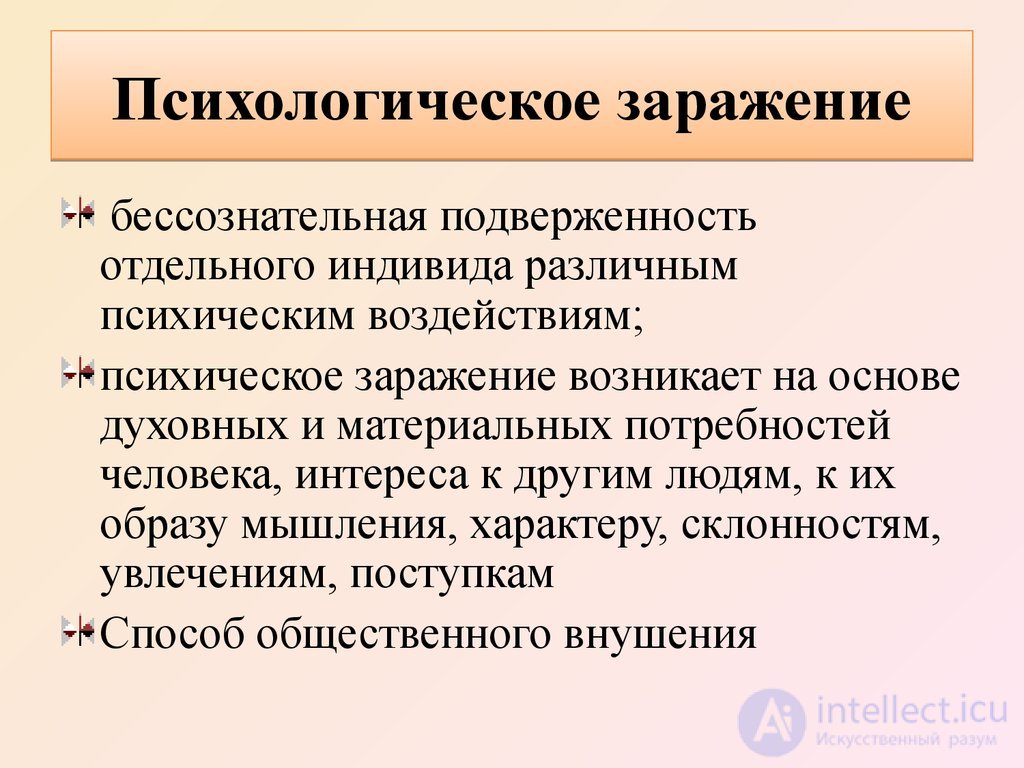
Psychic contagion:
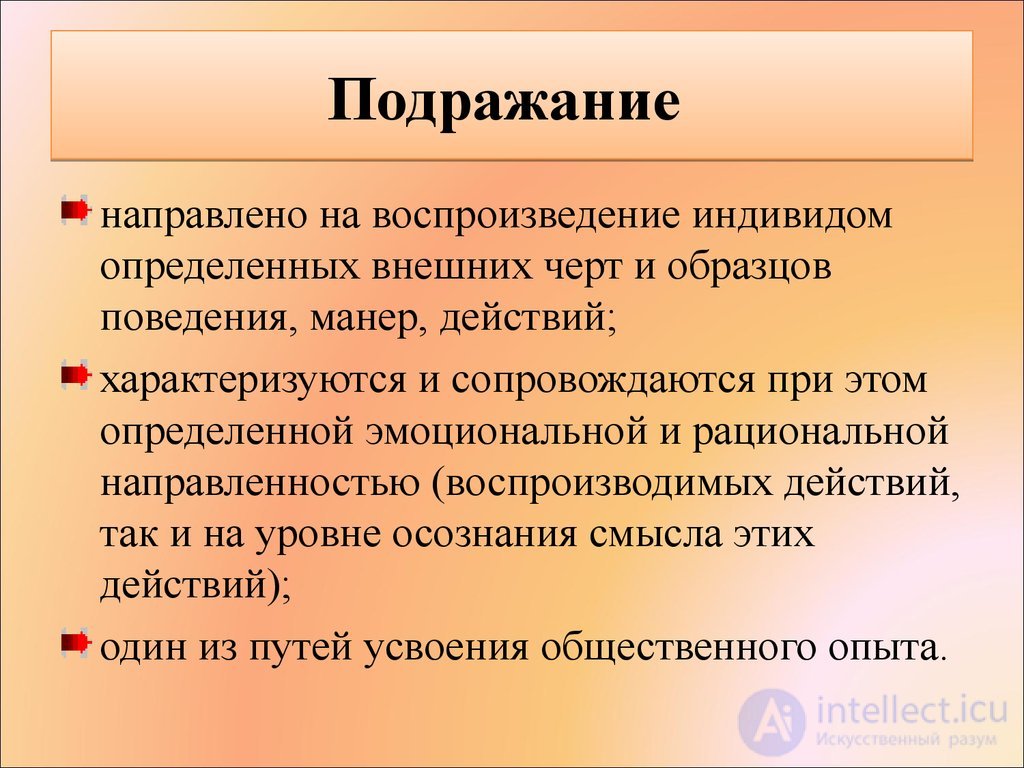
Imitation:
Psychological influence is an effect on the state, thoughts, feelings,
and actions of another person by means exclusively psychological,
while granting that person the right and the time to respond to this influence.
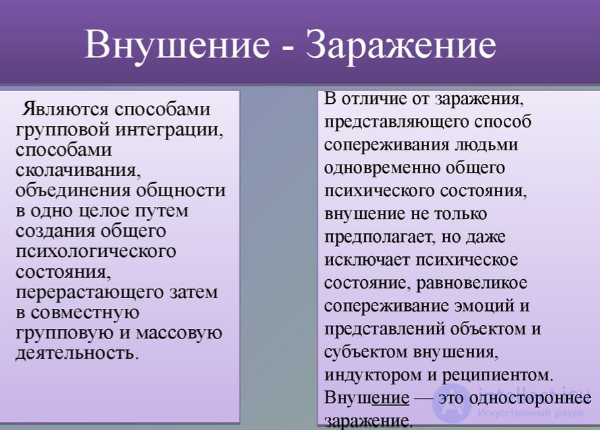
Contagion is a method of emotional influence under conditions of direct contact among large groups of people; an unconscious, spontaneous form
of influence that draws the personality into particular psychic states;
the experience of a common psychological state simultaneously by a large number of people. Contagion is an unconscious, involuntary susceptibility of the individual to particular psychic states. Here, what occurs is not a conscious transmission (acceptance) of some information or pattern of behavior, but
the transmission of a particular emotional state (a psychic mood).
Since all of this takes place within a mass, there is a repeated mutual
reinforcement of the emotional states of the people communicating.
The individual's susceptibility to particular psychic states manifests not through the more or less conscious acceptance of some information
or patterns of behavior, but through the transmission of a particular emotional state, or a «psychic mood». Since this emotional state
arises within a mass, a mechanism of repeated mutual reinforcement
of the emotional influences of the communicating people comes into play. Here the individual does not experience organized, deliberate pressure, but simply unconsciously absorbs patterns of someone else's behavior, merely submitting to it. Many researchers note the existence of a special «contagion reaction», arising especially
in large open audiences, when the emotional state is intensified
through repeated reflection according to the pattern of an ordinary chain reaction. The effect
occurs above all in an unorganized community, most often in a crowd,
which acts as a kind of accelerator that «drives up» a particular
emotional state.
In contagion, mainly nonverbal means are used: exclamations, intonations, rhythmic movements and music, bright patches of color.
This type of psychological influence is especially vividly manifested during
holidays, carnivals, festivals, as well as in situations of panic, religious
ecstasy, and the like. In an organization, contagion can be used in group rituals and training sessions to strengthen team cohesion.
A special situation in which the influence through contagion is intensified is a situation of panic. Panic arises in a mass of people as a particular emotional state that results either from a lack of information about some frightening or unclear piece of news, or from an excess of that information.
The term itself derives from the name of the Greek god Pan, the patron of shepherds,
pastures and flocks, who in his wrath would drive a flock into
madness, causing it to rush into fire or over a precipice for some trivial reason. The immediate occasion for
panic is the appearance of some piece of news capable of causing a peculiar shock. Panic belongs to those phenomena that are extremely difficult
to study. It cannot be directly observed, firstly,
because the timing of its onset is never known in advance, and secondly,
because in a situation of panic it is very difficult to remain an observer: this is precisely
where its power lies, that any person, upon finding themselves «inside» a system of panic, succumbs to it to one degree or another.
Studies of panic remain at the level of descriptions made after its
peak. These descriptions have made it possible to identify the main cycles characteristic
of the process as a whole. Knowledge of these cycles is very important for ending
panic.
Imitation is a person's reproduction of certain patterns of behavior that carry a certain emotional coloring. According to the psychological interpretation, imitation is the individual's reproduction of the traits and patterns of demonstrated behavior.
Imitation also belongs to the mechanisms and means by which people influence
one another, including under conditions of mass behavior, although its role in
other groups, especially in special types of activity, is also considerable
enough. Imitation shares a number of common features with the phenomenon of contagion, but its
specific nature lies in the fact that here what takes place is not the simple adoption of the external features of another person's behavior or of mass psychic states, but
the reproduction by the individual of the traits and patterns of demonstrated behavior.
The following types of imitation are distinguished:
– logical imitation – imitation of a consciously chosen example;
– illogical imitation – imitation of an emotionally colored
example;
– inner imitation – imitation of motives, interests, and ways
of thinking, and the like;
– outer imitation – imitation of external forms of behavior;
– imitation-as-fashion – imitation of patterns currently popular in society or in a reference group (for example, imitating well-known
musicians, actors, athletes, etc.);
– imitation-as-custom – imitation of patterns traditional for a given
culture (classical literary heroes, historical and religious
figures, fathers, and the like).
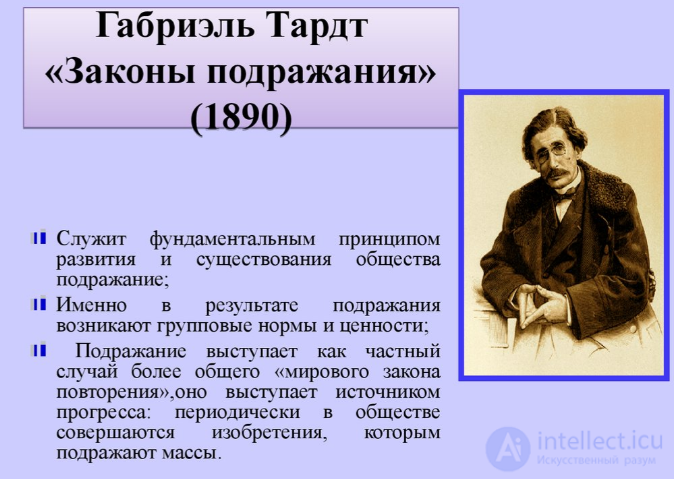
It is precisely as a result of imitation that group norms and values arise. Imitation acts as a particular case of the more general «world law of
repetition». If in the animal world this law is realized through heredity, then in human society it is realized through imitation. It serves as a source of progress: from time to time inventions are made in society that
the masses imitate. These discoveries and inventions subsequently become part of the structure of society and are once again assimilated through imitation.
Considering various aspects of psychological imitation, one may also mention «consumer» imitation. Many advertisers note that in advertising the method of creating conditions for imitation
works most effectively in cases where what is being advertised is something
prestigious for a person, something purchased in order to resemble a well-known, popular, authoritative figure.
The mechanism of psychic contagion
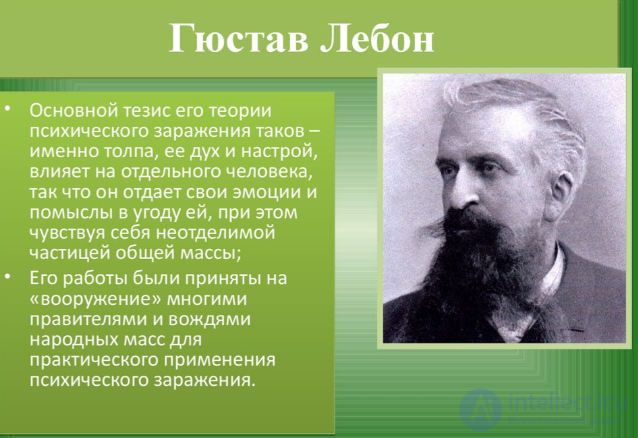
One of the most ancient means of integrating group activity is the mechanism of socio-psychological contagion. Its roots go back into
the depths of human history, and the manifestations of contagion are endlessly varied: these include contagious ritual dances and the dances of members of primitive
communities, and mass psychoses that, at various points in history, have gripped large social groups of people.
Sometimes entire nations can be subject to mass psychoses, which can manifest themselves in a variety of outbursts of mental states: from
mass sporting fervor or religious ecstasy to a mass, politically colored psychosis (nationalism or fascism).
The problem of psychic contagion has been addressed at various times in
domestic scholarly and journalistic literature. However, to this
day the mechanism itself and the functions of socio-psychological contagion remain largely unclear.
There is reason to speak of several features that distinguish contagion from other, related methods of socio-psychological communication.
Unlike imitation, conformity, and other forms of an individual's adaptation to norms, patterns, and standards of behavior imposed on them
from without, contagion appears as a form of a spontaneously arising
internal mechanism of human behavior.
Contagion is characterized by a largely unconscious, involuntary susceptibility of the individual to particular psychic states. It is realized not through passive contemplation and the more or less conscious acceptance
of externally obvious patterns of behavior (as in imitation), but through the transmission
of a psychic mood possessing a strong emotional charge, through
the intensity of feelings and passions.
Pointing precisely to this important feature of contagion, N. K. Mikhailovsky rightly noted at the time that the effect of the contagiousness of an external influence is determined not only by the strength of its emotional charge, but also by the very fact of direct psychic contact
between the people communicating.
«The task of fine art,» he wrote, «consists, among other things, in
the effect on the imagination of the viewer, reader, or listener, such that they personally experience, to a certain degree, the depicted situation or psychic moment.
A great artist will succeed at this, and a great orator or preacher from
among those who act mainly on feeling rather than on reason achieves something even greater. He manages to see with his own eyes that hundreds, thousands of listeners become infected with his personal mood, or relate to his images and pictures
as to something alive, present here, this very moment, in flesh and blood».
The secret of emotional influence under conditions of direct contact lies in the very mechanism of socio-psychological contagion.
The latter essentially comes down to the effect of the repeated mutual reinforcement
of the emotional influences of the people communicating with one another.
Here the intensity of the mounting passions, which creates the psychic backdrop
of the contagion, stands in direct proportion to the size
of the audience and the degree of the emotional intensity of the inductor.
N. K. Mikhailovsky managed to characterize this mechanism very well in one of his works, in which he analyzes a speaker's performance before
an audience numbering several hundred people. Here the excitement felt by the speaker can be conventionally expressed by the figure 10. During the first bursts of his eloquence, the speaker conveys half of this excitement to each of the listeners. Each of the listeners will express this through applause or
heightened attention. And, consequently, he will see not only the excited speaker, but also a multitude of his intensely attentive or excited fellow members of the audience.
Functions of contagion:
1) strengthening group cohesion, if such cohesion already exists;
2) compensating for insufficient cohesion.
Suggestion is a socio-psychological mechanism of purposeful, unargued influence, aimed at forming
a common psychic state and impulses toward individual or mass actions.
Suggestion is characterized by an uncritical perception of information and
is carried out by verbal means on the basis of a person's emotional readiness
to receive a disposition to act. Children are susceptible to suggestion, as are people with
a predominance of a situational psychic mood, those who are insecure,
fatigued, or weakened.
Imitation is a socio-psychological process of an individual or group following some standard or pattern, manifested in the acceptance,
borrowing, and reproduction of the external (behavioral) or internal
(psychological) features of other people. In social psychology it
is usually considered on two levels:
1) as imitation of some specific person;
2) as imitation of norms developed by a group;
and in three forms:
a) copying – carrying out the same action as another person;
b) congruence – carrying out coordinated actions of people and groups;
c) referentiality – when a person copies or is congruent with people
(a group) not present during the given contact.
Both of these mechanisms, psychic contagion and imitation, are natural ways of interacting and learning in society. They can exert an important influence on the formation of culture, social norms, and interpersonal relationships.

Comments