
Lecture
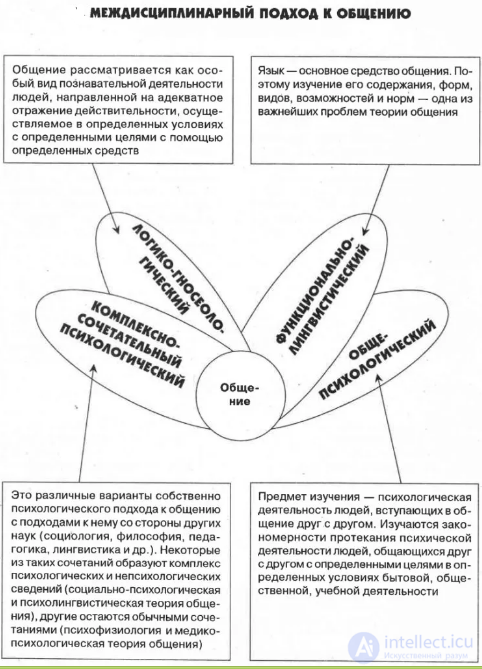
The study of communication as an activity in modern sciences includes various approaches, including sociological, psychological, and socio-psychological ones. Each of these approaches provides a unique perspective on the analysis and understanding of the processes of communication and interaction between people.
Sociological approach:
Psychological approach:
Socio-psychological approach:
The existence of many different definitions of the concept of «communication» is connected with the various views scholars hold on this problem.
A. A. Leontyev understands communication not as an interindividual but as
a social phenomenon, the subject of which «should not be considered in isolation». A. A. Leontyev's view of «communication as a type of activity» is also supported by other authors, for example V. N. Panferov.
Given this abundance of views on the problem of communication, it should be examined from both the sociological and psychological sides.
Within the psychological approach, communication is defined as a specific
form of activity and as an independent process of interaction necessary for carrying out other kinds of personal activity. Psychologists note that a person has a fundamental need – for communication as an important factor in self-formation of the personality.
Communication is characterized by content, functions, and means.
The content of communication can vary:
The functions of communication are identified in accordance with the content of communication.
There are several classifications of the functions of communication. V. N. Panferov
identifies six types:
Communication suffers if even one of the listed functions is disrupted or absent, so when analyzing real communication processes it is useful first to diagnose how well these functions are represented, and then
to take measures to correct them.
Much for understanding the psychology of personality and interpersonal communication
is provided by the works of S. L. Rubinstein (1889–1960), who studied the role of activity
and communication of people in the functioning of their psyche. In his works, the thinking
of a social human being appears as the process of their mental activity
aimed at the spiritual assimilation of reality, the translation of external objective activity into an internal, ideal plane (interiorization). All of this reflects a person's creative understanding of the external world and their attitude
toward it. The works of S. L. Rubinstein contribute to a scientific understanding of the influence
of the external natural and social environment on the development of consciousness, the combination within it
of elements of reflection and creativity, and its role in the practical activity of people.
A scientific understanding of people's behavior and their interpersonal communication
is furthered by D. N. Uznadze's (1886/87–1950) theory of set (installation), whose research
was carried out for many years within the framework of Soviet psychological
science. Uznadze characterizes a set (installation) as the orientation of the subject's consciousness
in a particular direction and toward a particular activity. «Sets, – he pointed out, – are inherent in both conscious and unconscious actions of the subject, and characterize their activity as a whole». For a set to arise,
«two elementary conditions are sufficient»: some actual need on the part of the subject and a situation for its satisfaction. When both of these conditions are present,
a set toward a particular activity arises in the subject. «This or that state of consciousness, this or that content of it, grows only on the basis of
this set».
Considering the formation of sets in a person as their «readiness for
a particular activity», D. N. Uznadze notes that they arise under
the influence not only of reality, but also of words, speech, and verbal
means of communication between people. All of this determines the emergence of corresponding sets, which are objectified in people's activity, in the cultural objects they create, and in their communication with one another.
A profound development of the problems of the interconnection between people's social relations and their interpersonal relations, the place of communication within the system of these relations, and an analysis of the structure of communication, its communicative, interactive, and
perceptual sides is contained in the work of L. I. Antsyferova.
These approaches to studying communication as an activity do not conflict with one another but complement each other, providing a fuller understanding of the multifaceted processes associated with communication and interaction in society. They allow researchers to analyze communication from different angles, taking into account the social, psychological, and combined aspects of this complex activity.

Comments