
Lecture
Social perception is the study of how people form impressions and draw conclusions about other people as sovereign individuals. Social perception refers to identifying and using social cues to make judgments about the social roles, rules, relationships, context, or characteristics of others.
The mechanisms of mutual understanding in communication are the processes and methods by which people exchange information, understand one another, and construct a meaningful perception of messages. Mutual understanding is a key aspect of successful communication. Here are some of the main mechanisms of mutual understanding:
Active listening: Effective mutual understanding begins with active listening. This involves the ability to listen attentively to the interlocutor, ask clarifying questions, show interest, and provide feedback.
Empathy: Empathy means the ability to put oneself in another person's place and understand their feelings, needs, and point of view. Empathy helps create deeper mutual understanding and maintain emotional bonds.
Paraphrasing: Paraphrasing consists in repeating the interlocutor's own words or expressing their ideas in one's own words. This helps ensure that the information has been correctly understood.
Clarification: If something is unclear or raises doubt, it is important to check with the interlocutor. Asking clarifying questions helps resolve misunderstandings and prevent confusion.
Use of verbal and nonverbal cues: Both verbal (words) and nonverbal (facial expressions, gestures, intonation) cues play a role in communication. They can emphasize or change the meaning of statements and help interlocutors understand each other better.
Synchronization: Synchronization in communication means tuning in to the same rhythm and pace of communication as your interlocutor. This can create a sense of agreement and closeness.
Use of language and structure understandable to the interlocutor: It is important to choose a language and structure of communication that are understandable to your interlocutor. Using complex terms or unclear phrases can lead to misunderstanding.
Feedback: Giving and receiving feedback helps ensure that information has been correctly received and understood. This is important in both oral and written communication.
Control of nonverbal cues: Your body, facial expressions, and intonation can express emotions and intentions. Controlling nonverbal cues helps express yourself more clearly and avoid misunderstandings.
Attention to context: Understanding the context in which communication occurs helps interpret information correctly. Context can include physical location, sociocultural norms, and circumstances.
Respect for cultural characteristics: If you are communicating with people from different cultures, it is important to take into account their cultural characteristics and communication norms in order to avoid misunderstandings.
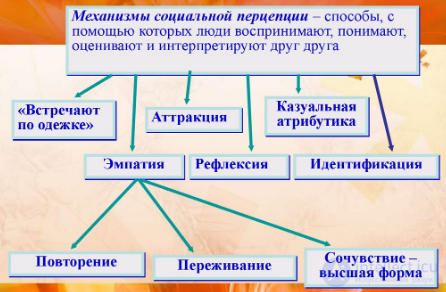
The idea of another person is closely connected with the level of one's own self-awareness. The analysis of self-awareness through another person is carried out with
the help of two concepts: identification and reflection.
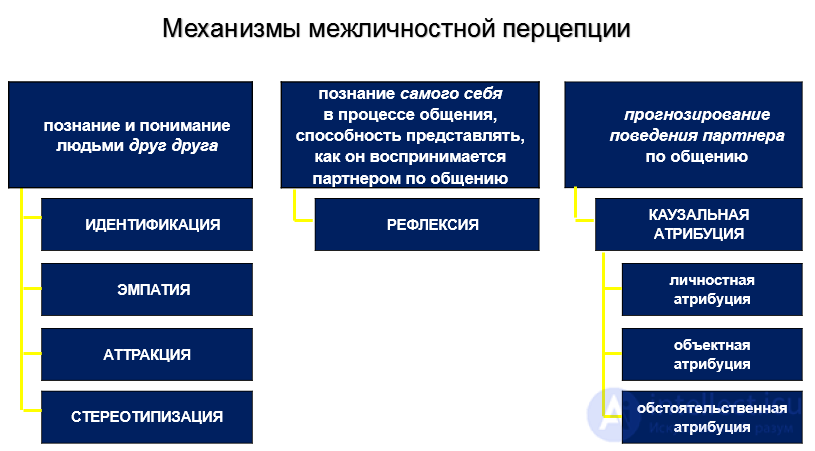
Fig. mechanisms of interpersonal perception
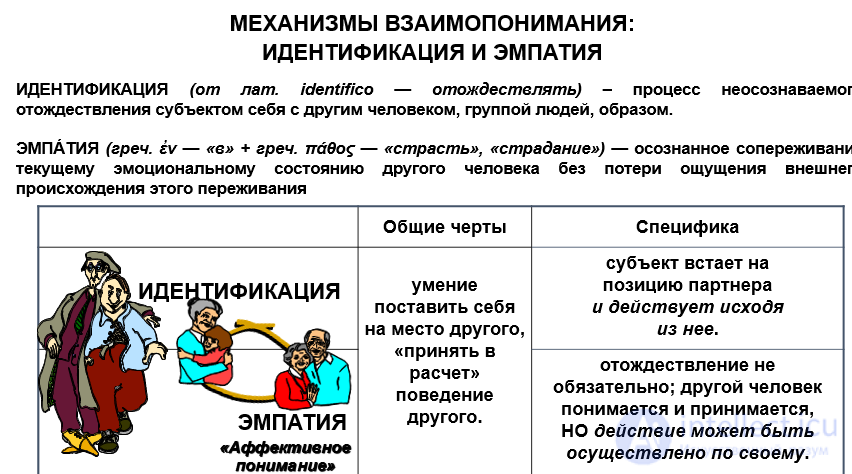
Identification – is one of the mechanisms of cognizing and understanding another person, most often consisting in an unconscious likening of oneself
to a significant other. Here, a significant other is a person who is an authority for the given subject of communication and activity. This usually happens
when, in real situations of interaction, an individual makes attempts
to put themselves in the place of their communication partner. In identification, a certain emotional bond is established with the object.
The concepts of «identification» and «referentiality» should be distinguished. If
for the first concept the basis is the process of the subject likening themselves to a communication partner,
that is, likening oneself to a significant other, then for the second concept
(«referentiality») the main thing is the subject's dependence on other people,
acting as a selective attitude toward them. The object of referent relations may be either a group of which the subject is a member, or
another group to which they relate themselves without actually being a member of it. The function of a referent object can also be performed by an individual person, including
one who does not actually exist (a literary character, a fictional ideal to emulate, etc.). In both cases the subject borrows for
themselves the goals, values, ideas, norms, and rules of behavior of the referent object
(a group, an individual person).
The concept of «identification» is close in content to the concept of «empathy».
Empathy – is the comprehension of another person's emotional states in
the form of compassion. The mechanism of empathy is to a certain extent similar to the mechanism of identification. This similarity lies in the ability to put oneself in another's place, to look at things from their point of view. However, this does not necessarily
mean identifying with that other person (as happens with
identification). Simply, with empathy the partner's line of behavior is taken into account, the subject treats them with sympathy, but interpersonal relations with them are built on the basis of the strategy of one's own line of behavior.
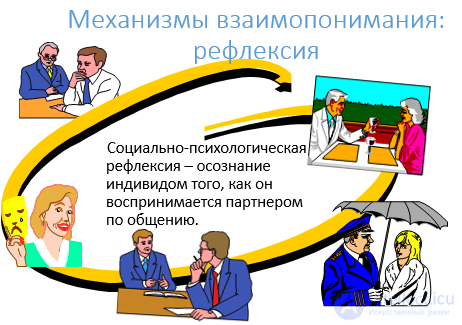
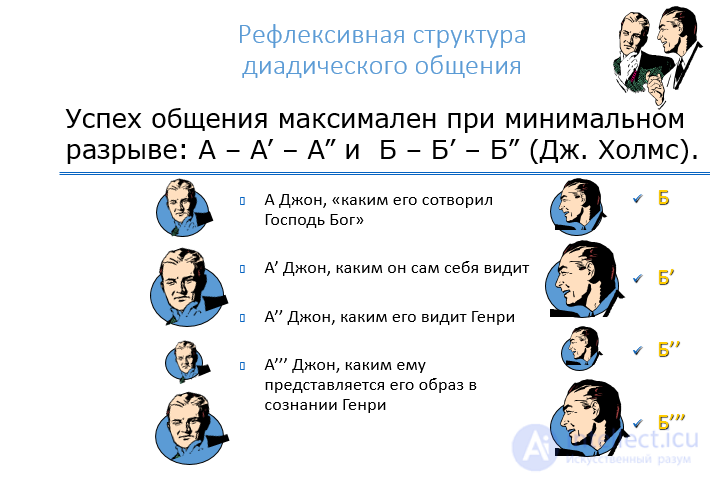
Reflection – is an individual's awareness of how they are perceived
by their communication partner, that is, how the communication partner will understand me.
During interaction, certain characteristics of each other are mutually assessed and changed.
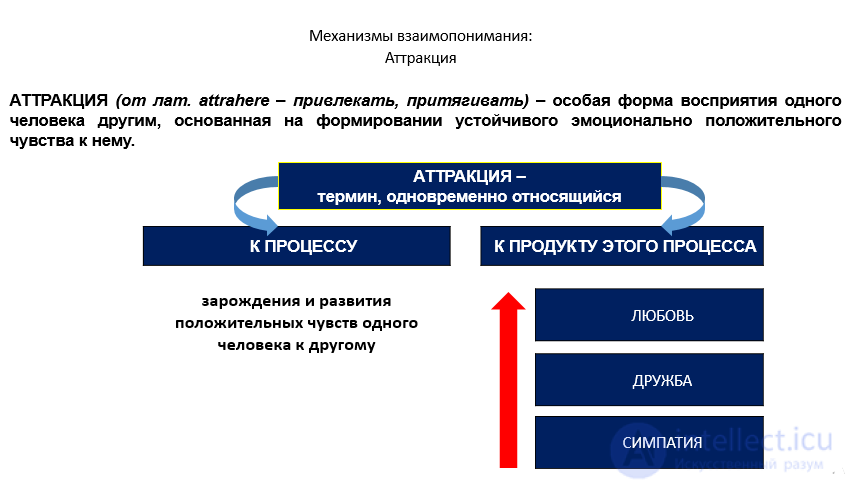
Attraction. When people perceive one another, certain relationships form with the inclusion of emotional regulators – ranging from rejection
of one or another person to sympathy, friendship, love.
Social attraction – is a special kind of social attitude toward another person, in which positive emotional components predominate. Three main levels of attraction are distinguished: sympathy, friendship, love.
Attraction manifests itself in emotional attractiveness, the draw of one
person toward another.
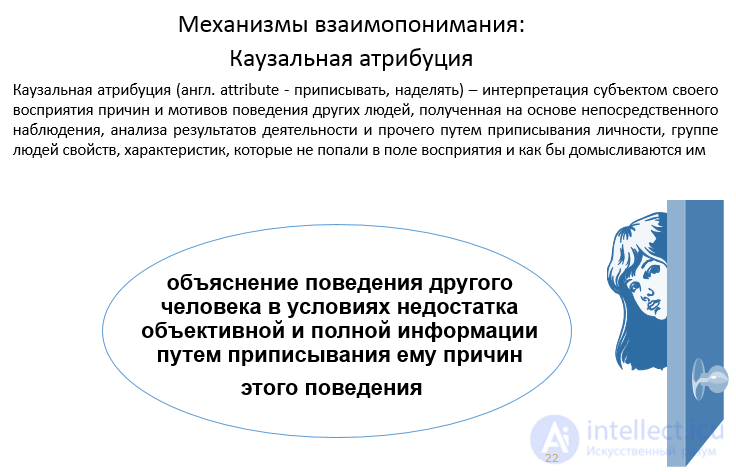
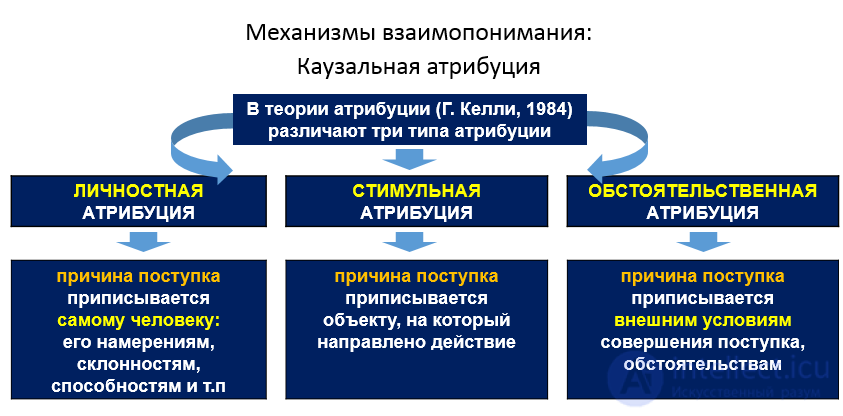
CAUSAL ATTRIBUTION (from the English attribute – to ascribe, to endow) – the subject's interpretation of their perception of the causes and motives of other people's behavior,
obtained on the basis of direct observation, analysis of the results of activity, and so on, by ascribing to a person or group of people properties
and characteristics that did not fall within the field of perception and are, as it were, inferred by them – an explanation of another person's behavior under conditions of a lack of
objective and complete information by ascribing to them the causes of this behavior.
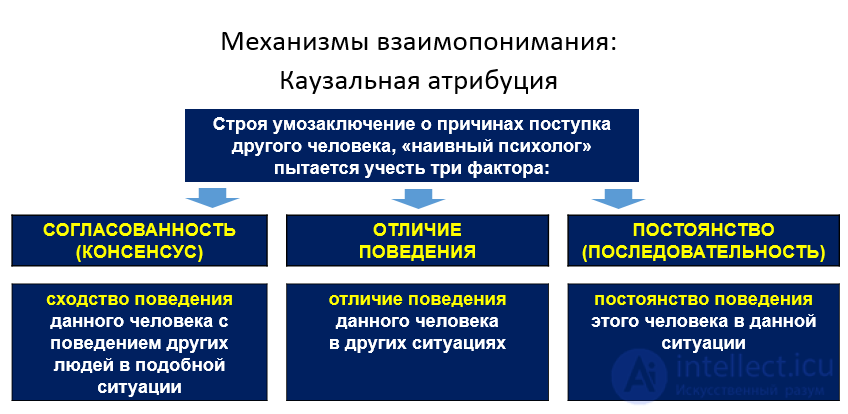
Mutual understanding between communication partners presupposes that each
of them knows the other person's psychology: their value orientations, motives, and
goals of activity, level of aspirations and attitudes, character traits, and so on. People have varying degrees of ability to communicate, to develop interpersonal sensitivity. These abilities can be developed and improved in the course of socio-psychological trainings on
interpersonal sensitivity. Currently, in the practice of foreign
psychology, so-called T-groups are organized (T – the first letter of the word
«training»), in which interpersonal sensitivity training is conducted. Similar trainings have begun to be conducted in our country as well: socio-psychological trainings are organized
using sensitivity techniques.
The sensitivity method belongs to the category of interpersonal sensitivity methods. The main goal of sensitivity training is to develop and improve individuals' ability to understand one another.
Representational system. What is a representational system? Every person has a certain representational system. What does
this hard-to-pronounce phrase mean? By nature, a person has five sources of obtaining information from outside. These are the ears (auditory source), the eyes
(visual source), the skin (tactile sensations, or kinesthetic), the
taste receptors located in the mouth, and the olfactory channel of perception – the nose. From the moment of birth, a person receives information about the surrounding environment
through these channels of perception. Gradually, under the influence of upbringing and environment,
each person comes to rely on one or two leading channels. Most often the main ones
become the auditory, visual, and kinesthetic channels. Of course, this does not
mean that a person does not perceive other types of information, it is simply that
the information received from the leading source is processed first and foremost.
In the psychology of each person, depending on their main (representational) system of perception, they are accordingly called: auditory, visual, kinesthetic (or kinesthete) type. Of course, in their pure form, auditory, visual, and kinesthetic types do not exist; the main source is always mixed with a secondary one. Auditory-kinesthetic, auditory-gustatory, auditory-olfactory systems occur, and the same is true
for the visual system. An auditory-visual system is extremely rare.
Let us characterize each type.
The auditory type – primarily hears, and then sees and feels; such a person may not look at the interlocutor at all, but perceives what is being said to them very well. Sometimes they may deliberately turn away from the speaker, as it were, in order to hear better. Not having a very good memory for
faces, they unerringly identify people by voice. If a person who
is talking to you looks around or even stands with their back to you, this does not
mean that they are ignoring you; most likely, this is a clear auditory type. How to recognize: in speech, the auditory type uses the words «do you hear», «listen». They turn
their ear rather than their face toward the interlocutor. They will easily say: «Listen, what a picture».
The visual type – a person who sees. They will notice every speck of dust, crumb,
insignificant shade of color; in conversation they always try to look the interlocutor in the eye. They have an excellent memory for faces, but may
confuse the voice. How to recognize: the visual type most often says «look», «do you see»,
«let's see». They can easily say: «Look, what music».
The kinesthetic type – they hear and see only when they feel. In conversation
they may touch the interlocutor, and if that is not possible, they will fidget with something in
their hands. If they are at a considerable distance from you, then it is quite likely that the conversation will not happen at all until they «feel you with their skin».
Kinesthetic types choose clothing that is soft, pleasant to the skin; scratchy woolen
sweaters are out of the question. How to recognize: the words «I feel», «soft», «pleasant».
They will easily say: «Do you feel what soft music». They always try to shorten the distance in conversation, to touch either you or your handbag, zipper, button, and so on.
Of course, there are also people with a leading olfactory and gustatory system.
But this is a great rarity; most often such a system is secondary. I have
an acquaintance with a kinesthetic-olfactory system. When we were choosing her
a mobile phone, not only did she feel every single one, she also sniffed them.
The salesperson's eyes showed clear bewilderment and surprise. This is what a lack of knowledge about such elementary things as the representational system leads to.
In family life, it is likewise important to be able to recognize who has which
leading system. If your husband is an auditory type, do not be surprised or offended if he talks to you while staring at the television; he perceives sound better than
image. And if one of your loved ones is a kinesthetic type, hug them more often,
maintain tactile contact.
A person's sensory systems are part of their nervous system, capable of perceiving information external to the brain, transmitting it to the brain, and
analyzing it. Receiving information from the environment and one's own
body is a mandatory and necessary condition for human existence.
The term «sensory systems» (Lat. sensus – feeling) replaced the name «organs
of sense», which has been retained only to designate the anatomically distinct
peripheral parts of certain sensory systems (such as, for example, the eye or the ear). In Russian-language literature, the concept of «analyzer», proposed
by I. P. Pavlov, is used as a synonym for sensory system, pointing to the function of the sensory system.
All sensory systems consist of peripheral receptors, conducting pathways and relay nuclei, primary projection areas of the cortex, and secondary sensory cortex. Sensory systems are organized hierarchically, i.e., they include several levels of sequential processing of information. The lowest level of such processing is provided by primary sensory neurons, which are located in specialized sense organs or
in sensory ganglia and are intended to conduct excitation from
peripheral receptors to the central nervous system.
A person's sensory systems provide:
1) the formation of sensations and the perception of acting stimuli,
2) control of voluntary movements,
3) control of the activity of internal organs,
4) the level of brain activity necessary for human wakefulness.
The human sensory system consists of the following subsystems:
The mechanisms of mutual understanding in communication may vary depending on the situation, cultural characteristics, and personal preferences. Understanding and using these mechanisms helps improve the quality of communication and create deeper and more trusting relationships.

Comments