
Lecture
Analyzing a conflict involves examining its structure and functions. Without knowing both, it is difficult to manage conflict relations and, in general, to
approach this phenomenon meaningfully. In any conflict, the functions depend on the structure, while the structure itself, especially its subjects, may change under the influence of the dominant function.
What, above all, characterizes any conflict? Of course, the conflicting parties, as well as the object of the confrontation. These two defining elements of a conflict do not exhaust its structure. The latter also includes the conflict action in one form or another, the consciousness that directs it, the means and methods of action, and the field of the conflict. Moreover, no conflict is possible without a conflict situation that has taken shape before its emergence.
Depending on the level of the conflict, its subjects are individuals, groups, classes, national-ethnic communities, organizations, social institutions, and so on.
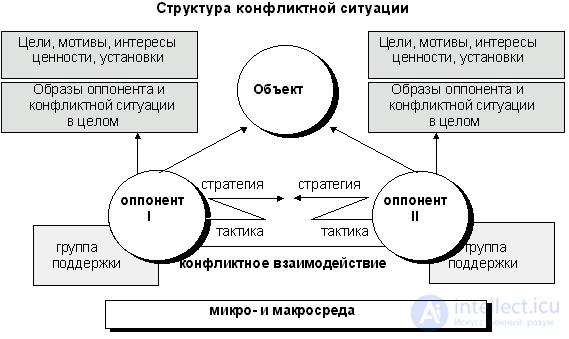
For analyzing a conflict and its dynamics, it is important to distinguish between the subject that initiates the conflict action and the one that dominates it. Moreover,
this is not always the same subject. The agent who provoked the confrontation
often turns out to be not the leading, not the determining, but the led, the determined
party.
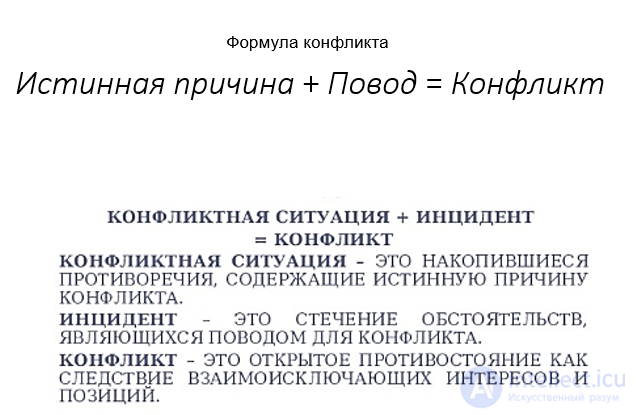
fig. formula of conflict
The behavior and actions of the subjects are directed by conflict consciousness.
It is formed by a particular state of consciousness, the specificity of which lies in the opposing parties' awareness of the opposition of their interests, values, and goals, and in the transformation of these into a motivation for activity.
For a better understanding of conflict, it should be noted that there are various kinds of conflict behavior, which can be generalized into the following types:
1) one subject achieving its goals at the expense of another;
2) partial or complete concession of one subject's position to another;
3) mutual satisfaction of the interests of both conflicting subjects and
the attainment of some common goal;
4) mutual dissatisfaction of the interests of the opposing parties and
the striving to move the conflict to a new level and a new form.
Any conflict arises, proceeds, and is resolved against the background of a conflict situation – an inseparable aspect of the conflict, an essential element of its
structure.
A conflict situation includes, first of all, an acute form of the contradiction that forms the basis of the conflict; specifically, one in which both opposites, or one of them, can no longer exist within the framework of their former
interrelation, their unity. The presence of a conflict situation indicates
that conflict-generating factors have formed and points to the emergence of an initiator of the conflict.
Conflict, like any vital phenomenon that has been analyzed and studied, has a number of essential features. In terms of their content, conflicts
can be characterized as everyday, administrative, professional, ideological, psychological, ambition-driven, and ethical.
An interpersonal conflict is a clash of interests between two autonomous
individuals who have asserted a claim to the object of the clash. This is the most widespread type, in which two people conduct the conflict and are responsible for its outcome.
An intergroup conflict is a clash of interests between two groups as collective subjects.
These may be two classes that have entered into a defense of
their group interests. The bearers and expressers of the group's interest become individual persons acting as representatives of the group; they express the will of the group as such.
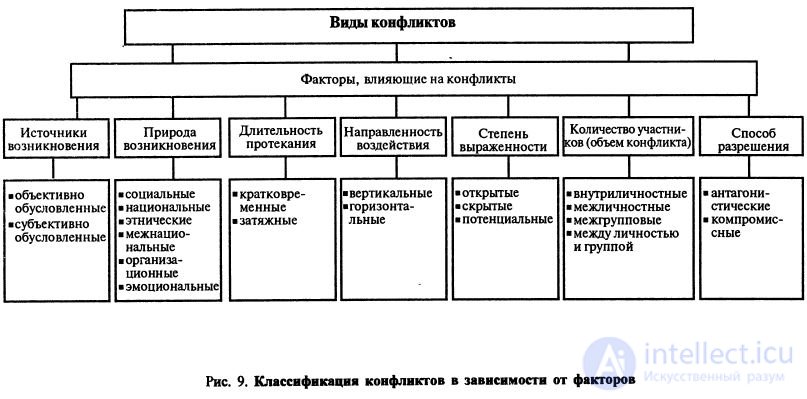
An intrapersonal conflict is a conflict in which a contradiction
arises between two internal motives of one person. The manifestation
of an intrapersonal conflict is as follows: "I want to, but cannot, for a number of reasons,"
or "it's bad either way."
Interpersonal, intrapersonal, and intergroup conflicts can, in
terms of content, be administrative, professional, everyday, psychological, ethical, or ambition-driven. The variety of one characteristic, multiplied by the diversity of another characteristic of the conflict, gives
an idea of the wide palette of conflict.
The ability to identify the characteristics of a conflict makes it possible to clearly classify the conflict and choose the most adequate way of resolving it, and consequently, to work out the necessary strategy and tactics of behavior.
Analyzing the process by which a conflict arises involves studying the development
of the contradiction or contradictions that lie at its foundation. L. Coser notes that conflict arises when the possibility of resolving a contradiction is exhausted. We would add: of an aggravated contradiction.
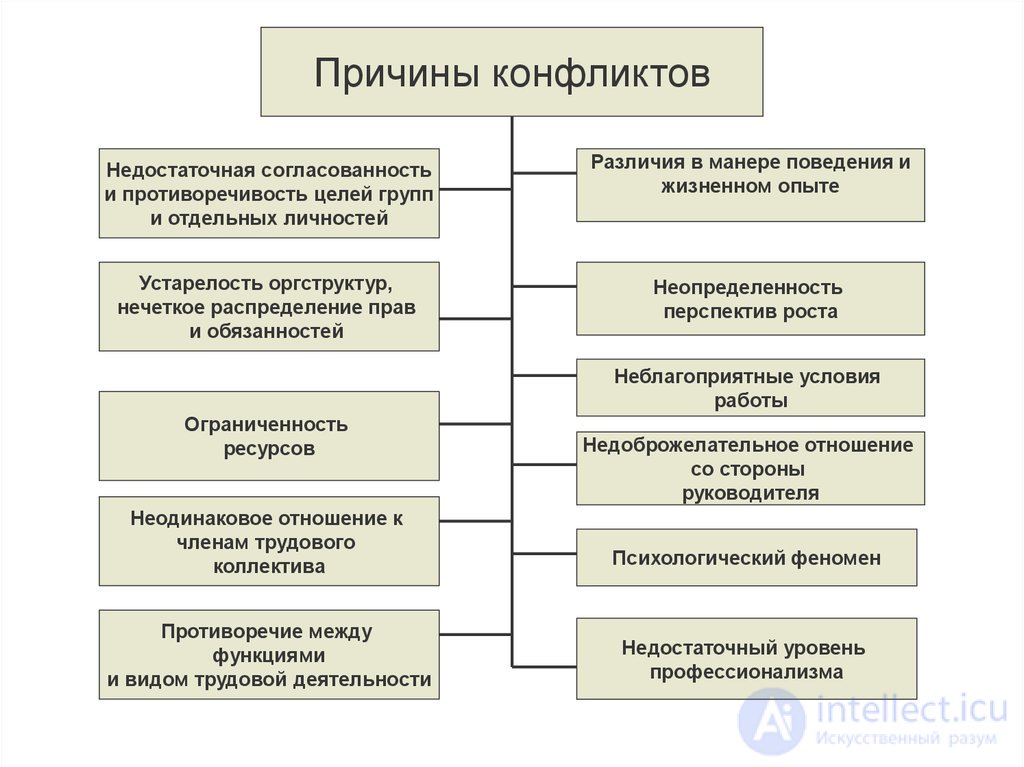
An analysis of a large number of conflicts has shown that those in conflict, as a
rule, cannot formulate the true causes of the conflict, "fixating" on the most irritating moments on the surface, which are in fact a consequence of deeper causes.
Every interpersonal conflict eventually has its resolution.
The forms of its resolution depend on the style of behavior of the subjects in the course of the conflict's development. This part of the conflict is called the emotional side and is considered the most important.
Styles of Behavior in Interpersonal Conflict
Researchers identify the following styles of behavior in interpersonal
conflict: rivalry, avoidance, accommodation, compromise, cooperation, and assertiveness.
1. Rivalry – characterized by a persistent, uncompromising defense of one's interests that rejects cooperation, for which
all available means are used.
2. Avoidance – involves an attempt to escape the conflict, not to attach
much importance to it, possibly because of a lack of conditions for its resolution.
3. Accommodation – presupposes the subject's readiness to sacrifice their own interests for the sake of preserving relationships, which are placed above
the subject matter and object of the disagreement.
4. Compromise – requires concessions from both sides to the extent that,
through mutual concessions, an acceptable solution is found for the opposing
parties.
5. Cooperation – presupposes the joint action of the parties to
resolve the problem. With this kind of behavior, different
viewpoints on the problem are considered legitimate. This position makes it possible to understand the causes of disagreement and find a way out of the crisis that is acceptable to the opposing parties without
infringing on the interests of either.
6. Assertive behavior (from the English assert – to affirm, to insist upon). Such
behavior presupposes a person's ability to stand up for their own interests and to
achieve their goals without infringing on the interests of other people. It is directed at
ensuring that the realization of one's own interests becomes a condition for the realization
of the interests of the interacting subjects. Assertiveness is an attentive
attitude toward both oneself and one's partner. Assertive behavior prevents
the emergence of conflicts, and in a conflict situation helps find the right way out of it. At the same time, the greatest effectiveness is achieved when one assertive person interacts with another equally assertive person.
All of the named styles of behavior can be either spontaneous or consciously used to achieve the desired results in resolving interpersonal conflicts.
Many conflicts arise because of the complexity of certain people's character. Among conflict-prone personalities, six characteristic types can be identified.
We will designate each of them with one word (for brevity).
"Demonstrative." Characterized by a desire to always be the center of attention and to enjoy success. Even in the absence of any grounds, they may enter into conflict just to be in the spotlight in this way.
"Rigid." The word "rigid" means inflexible, unyielding. People belonging to this type are distinguished by ambition, an inflated self-esteem, and an unwillingness and inability to take other people's opinions into account.
An opinion once formed by a rigid personality inevitably comes into contradiction with changing conditions and causes conflict with
those around them. "If the facts don't suit us – so much the worse for the facts."
"Uncontrollable." People belonging to this category are distinguished by impulsiveness, thoughtlessness, unpredictability of behavior, and a lack of self-control. Their behavior is aggressive and provocative.
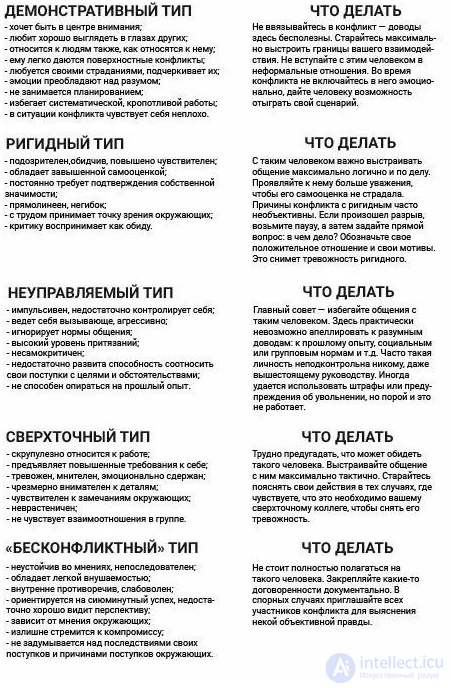
"Overly precise." These are conscientious workers, especially meticulous,
who approach everyone (starting with themselves) from a standpoint of inflated demands. Anyone who does not meet these demands (and that is most people) is subjected to sharp criticism.
They are characterized by heightened anxiety, which shows itself, in particular, as suspiciousness. They are distinguished by heightened sensitivity to the assessments of those around them, especially of supervisors. All of these features
often lead to an unsettled personal life.
"Rationalists." Calculating people, ready for conflict at any moment when there is a real opportunity to achieve personal (career-driven or mercenary) goals through conflict.
"Weak-willed." A lack of one's own convictions and principles can
turn a weak-willed person into a tool in the hands of the person under whose influence they
have fallen. The danger of this type stems from the fact that weak-willed people most often
have a reputation as kind people, from whom no trick is expected. Therefore,
when such a person acts as the initiator of a conflict, it is perceived by the group in such a way that "the truth speaks through their mouth."
This type (like the previous one) is "situational," i.e., it manifests itself
only when a certain situation arises. In this case, it is the presence of
a negative influence on the weak-willed person. Representatives of all the other types initiate conflict on their own.
The psychology of conflict is a field of psychology that studies the nature, origin, resolution, and consequences of conflict situations between people. Conflicts can arise in various spheres of life, from interpersonal relationships to large-scale social contradictions. Here are the key aspects of the psychology of conflict:
The concept of conflict: A conflict is a situation in which there is disagreement, contradiction, or a struggle between two or more parties. It can be caused by differences in interests, values, needs, or goals.
Types of conflict: Conflicts can be individual, interpersonal, group, or intergroup. They can also be functional (contributing to growth and development) or dysfunctional (destructive).
Causes of conflict: Conflicts can arise for various reasons, including limited resources, differences in interests, misunderstanding, stereotypes and bias, and differences in values, etc.
Psychological aspects of conflict: Emotions, motivation, thinking stereotypes, communication, and ways of managing stress play an important role in conflict.
The scheme of conflict: A conflict usually passes through several stages, including escalation (intensification), the peak (the highest point of tension), declaration (a public announcement of the conflict), negotiation, and resolution (or deterioration).
The role of communication: The quality of communication is of enormous importance in resolving conflicts. Insufficient or non-constructive communication can aggravate a conflict, whereas open, empathetic, and constructive communication can contribute to its resolution.
Ways of resolving conflicts: There are several methods of resolving conflicts, including compromise, cooperation (searching for a shared solution), withdrawal (avoiding the conflict), and resistance (attacking or defending one's own interests).
Consequences of conflicts: Conflicts can have both a positive and a negative effect. They can improve mutual understanding between the parties, lead to changes in relationships, or lead to destructive consequences, such as the breakdown of relationships and even violence.
Mediation and conflictology: Professional conflictologists and mediators specialize in resolving conflicts and can help the parties find a compromise and reach a peaceful solution.
The pre-conflict situation
This is a growth of tension in the relations between the potential subjects of the conflict, caused by certain contradictions. This is the state of affairs
on the eve of the conflict. But contradictions do not always develop into a conflict.
Only those contradictions that are perceived by the potential subjects of the conflict as incompatible lead to a heightening of social tension. But
most often, at this stage, there already exist certain preconditions for a conflict. If tension in relations does not spill over into open conflict clashes and such a state of affairs persists for quite a
long time, it is called a potential, or latent (hidden), conflict.
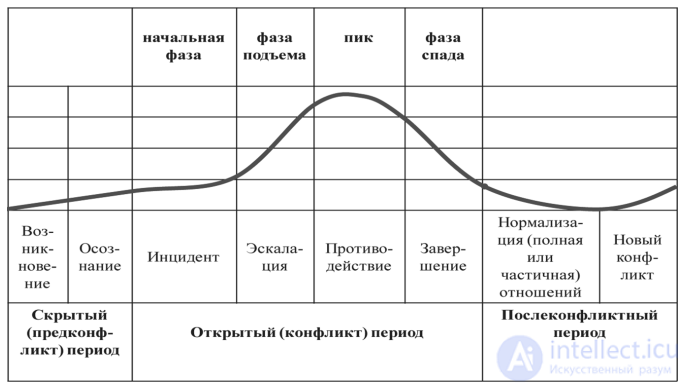
The pre-conflict situation can conditionally be divided into three phases of development, characterized by the following features in the relationship of the
parties:
– the emergence of contradictions concerning a particular disputed object; growing distrust and social tension; the making of one-sided
or mutual claims; a decrease in contacts and an accumulation of grievances;
– an effort to prove the legitimacy of one's own claims and to accuse the opponent of unwillingness to resolve disputed issues by "fair means";
a withdrawal into one's own stereotypes; the emergence of bias and hostility in the emotional sphere;
– the destruction of interaction structures; a shift from mutual accusations to threats; growing aggressiveness; the "formation of an image of the enemy" and a resolve to
fight it. In this way, the conflict situation is gradually transformed into an open conflict. But by itself it can exist for a long time and
not develop into a conflict. For a conflict to become real, an incident is necessary.
The incident
An incident is a formal pretext, an occasion for the beginning of a direct clash between the parties. An incident may occur by chance, or it may be
provoked by the subject (subjects) of the conflict, or arise as the result of the natural course of events. It happens that an incident is prepared and provoked by some
"third" force pursuing its own interests in a supposedly "foreign" conflict. Four types of incident can be distinguished by the nature of their occurrence:
1. Objective purposeful incidents.
2. Objective non-purposeful incidents.
3. Subjective purposeful incidents (a person enters into conflict in order to solve their own problems).
4. Subjective non-purposeful incidents (the interests of two or several parties accidentally collide).
An incident marks the transition of the conflict into a new quality. In the situation that has developed, three variants of behavior of the conflicting parties are possible: the parties (or one party) strive to settle the contradictions that have arisen and find a
compromise; one of the parties pretends that "nothing happened" (withdrawal from the
conflict); the incident becomes a signal for the start of open confrontation. The choice of one variant or another largely depends on the specific orientation (goals, expectations, emotional attitudes) of the parties.
The third stage – the development of the conflict
The onset of open confrontation between the parties is the result of conflict behavior, by which is meant actions directed at the opposing side with the aim of seizing or holding the disputed object, or of forcing the opponent to renounce their goals or to change them. Conflict specialists identify several forms of conflict behavior: actively conflictive behavior (a challenge); passively conflictive behavior (a response to a
challenge); conflict-compromise behavior; compromise behavior.
Depending on the conflict orientation of the parties and the form of behavior of the
parties, the conflict acquires its own logic of development. A developing conflict tends to create additional reasons for its deepening and expansion. And
if nothing hinders it, it begins, as it were, to feed on itself, creating, generating more and more new grounds for its further development.
Therefore, every conflict is, to a certain degree, unique. Three main phases can be distinguished in the development of a conflict:
– the transition of the conflict from a latent state to open confrontation
between the parties. The struggle is still waged with limited resources and is local in character. A first trial of strength takes place. At this stage there still exist real opportunities to stop the open struggle and resolve the conflict by other methods;
– further escalation of the confrontation. To achieve their goals and
block the actions of the opponent, the parties introduce new resources. Almost all
possibilities of finding a compromise have been missed. The conflict becomes increasingly unmanageable and unpredictable;
– the conflict reaches its climax and takes the form of total war
using all possible forces and means. At this stage, the conflicting parties, as it were, forget the true causes and goals of the conflict. The main
aim of the confrontation becomes inflicting maximum damage on the opponent.
This stage is also called the escalation of the conflict (from the Latin scala – a ladder),
i.e., here the conflict "climbs the steps," being realized in a series of separate acts – actions and counteractions of the conflicting parties.
The culmination
This stage occurs when the escalation of the conflict brings one
or both parties to actions that cause serious damage to the cause that
binds them (or to their family ties, or to their friendly relations). The culmination is the highest point of the escalation. It is usually expressed in some
explosive episode or in several consecutive episodes of the conflict
struggle. At the culmination, the conflict reaches such intensity that it becomes clear to both
sides that it should not continue. The culmination directly brings the parties to a recognition of the need to interrupt both the further aggravation of relations and the intensification of hostile actions, and to seek
a way out of the conflict by some other route.
Escalation does not necessarily end in a culmination. Here there is a "limit of tolerance," upon exceeding which the participants in the conflict
grow tired of their confrontation, and a desire arises in them to somehow settle their differences.

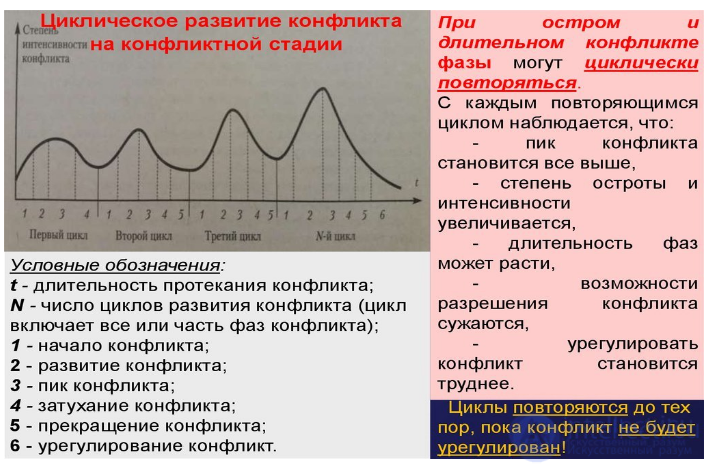
In a protracted conflict, the moment of culmination is long in coming. In some
cases the conflict gradually dies down in the meantime. But in other cases, the delay of the
culmination comes at a very high price: in the process of a prolonged escalation
a high "energy potential" of negative emotions accumulates, not
finding release in a culmination; and when, finally, the moment of culmination
arrives, the release of all this energy is capable of producing the most horrifying
destruction. A culmination of this kind is yet another variant of an acute conflict.
Resolution of the conflict
The duration and intensity of a conflict depend on the goals and attitudes of
the parties, on the resources, means, and methods used in waging the struggle, on the reaction of the
surrounding environment to the conflict, on the symbols of victory and defeat, and on the available (and possible)
ways (mechanisms) of reaching consensus, and so on.
At a certain stage in the development of a conflict, the opposing
parties may substantially change their conceptions of their own possibilities and
those of the opponent. A moment of reassessment of values arrives, brought about by new
relationships, a new alignment of forces, and an awareness of the real situation – the impossibility of achieving one's goals or the excessive cost of success. All of this stimulates a change in the tactics and strategy of conflict behavior. In this case, the conflicting parties begin to seek ways of reconciliation, and the intensity of the struggle, as a
rule, goes into decline. From this moment, the process of ending the conflict effectively begins, which does not rule out new flare-ups.
At the stage of conflict resolution, several variants of the development of events are possible:
– an obvious advantage of one of the parties allows it to impose its own terms for ending the conflict on the weaker opponent;
– the struggle continues until the complete defeat of one of the parties;
– the struggle takes on a protracted, sluggish character due to a lack of resources;
– the parties make mutual concessions in the conflict, having exhausted their resources without a clear (potential) winner having emerged;
– the conflict may be halted under pressure from a third force.
A social conflict will continue until
real conditions for its termination appear, which may be determined even before
the confrontation begins, or may be worked out and agreed upon in the course of the conflict's development.
There exist such absolute conflicts in which the struggle is waged until
the complete destruction of one or both rivals. The more rigidly the subject of the dispute is defined, the more obvious the signs marking victory and defeat for the parties,
the greater the chances of localizing it.
Ways of ending a conflict are aimed mainly at changing
the conflict situation itself, either by influencing the participants, or by changing the characteristics of the object, or by other means. Let us name some of these ways:
– elimination of the object of the conflict;
– replacement of one object with another;
– removal of one of the parties to the conflict;
– a change in the position of one of the parties; a change in the characteristics of the object and subject of the conflict;
– obtaining new information about the object or creating additional conditions;
– preventing direct or indirect interaction
between the participants;
– the participants in the conflict arriving at a joint decision, or an appeal to arbitration on the condition of submitting to whatever decision it reaches.
Here it is necessary to introduce two more concepts: the price of the conflict and the price of exiting
the conflict. The price of the conflict for each of the conflicting parties consists of the sum of three quantities: the expenditure of energy, time, and effort on conflict activity; the damage caused by the unfriendly actions of the other side; and the loss connected with the deterioration of the overall situation. The lack of rigor in an intuitively estimated price of the conflict does not prevent it from being compared
with another intuitively assessed quantity – the price of exiting the conflict.
The price of exiting the conflict is the difference between the losses associated with this exit from the conflict and the gains that this exit provides.
If the gains are greater than the losses, then the benefit of ending the conflict is obvious. However, the gains usually appear vague and
hypothetical, which significantly lowers their perceived value, whereas the losses are clearly visible and are therefore rated highly. This is why it is not surprising that a different variant is encountered much more often: the losses appear greater than the gains. In this case, it is advisable to compare the price of the conflict with the price of exiting
the conflict. If the price of the conflict is lower, i.e., exiting the conflict comes at
too high a price, then attempts to continue the conflict struggle still
make sense.
Thus, comparing the price of the conflict with the price of exiting it allows one to rationally decide the question of whether it is worth continuing the conflict, given
the further growth of its price, or whether it is better to end it.
Negotiations
The final stage of conflict resolution involves negotiations. Usually, one of the conditions for beginning the negotiation process is a temporary truce. But there are possible variants in which, at the stage of preliminary
agreements, the parties not only fail to stop the hostilities, but move toward
an aggravation of the conflict, seeking to strengthen their positions in the negotiations.
Negotiations involve a mutual search for compromise between the conflicting parties and include a variety of procedures: acknowledging the existence of the conflict; establishing procedures, rules, and norms; identifying the main disputed
issues; exploring possible options for solving the problem; searching for agreement on each disputed issue and settling the conflict as a whole;
fulfilling all the mutual obligations that have been assumed.
The negotiation process may be based on the method of compromise, based on mutual concessions by the parties, or on the method of consensus, oriented toward a joint solution of the existing problems. The methods of conducting
negotiations and their outcome depend not only on the relations between the opposing parties, but also on the internal situation of each of the parties,
on relations with allies, and on other factors outside the conflict.
The post-conflict stage
The end of direct confrontation between the parties does not always mean that the conflict is completely over. The degree of satisfaction or dissatisfaction of the parties with the peace agreements reached will depend on the following considerations:
The post-conflict stage marks a new objective reality: a new alignment of forces, new relations of the opponents to one another and to the surrounding social environment; a new vision of existing problems and a new assessment of one's own strengths and possibilities.
Understanding the psychology of conflict can help people manage conflicts more effectively, improve relationships, and minimize negative consequences. It is important to develop skills of empathy, constructive communication, and stress management in order to resolve conflicts more successfully, both on a personal and on a professional level.

Comments