
Lecture
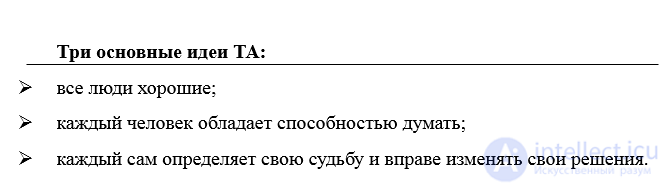
The founder of transactional analysis (TA) – the American psychiatrist Eric
Berne – originally considered his conception a continuation of psychoanalysis,
although this view of his was not shared by many specialists. In developing
his conception, E. Berne drew not only on psychoanalysis, but also on humanistic psychology and mythology, and he also made use of ideas from the cognitive-behavioral approach.
Transaction analysis.. A transaction is the unit of the act of communication during which the interlocutors, each being in one of three ego states, exchange a pair of remarks.
Today TA is a unique theoretical model of personality, of its internal
and external communication, as well as a system of diverse practical technologies for the psychological correction of interaction with an extremely wide range of application – in psychotherapy, in pedagogy, in enterprises, and in organizations. The goal of TA is understanding and action aimed at the development and positive change of human interaction.
As a theory of personality, TA shows how a person is structured and how they
interact with others. For this purpose, a model of ego states is used, which underlies the structural and functional analysis of personality. In addition, as a theory of personality development, TA deals with the analysis of life scripts, uncovering many of the mysteries of behavior that have self-destructive and painful consequences.
Structural Analysis
As a theory of communication, TA reveals the laws of intrapersonal and
interpersonal interaction. Viewing communication as a process
of exchange, TA identifies a special unit of social exchange – the transaction – and
undertakes its analysis. In addition, it deals with the analysis of various ways of structuring time, including the analysis of human games. As
a system of psychotherapy, TA is used in the treatment of all types of psychological disorders. However, the scope of its practical application is not limited to psychiatry and psychology alone. It is successfully used by educators,
sociologists, and social workers in family counseling, in universities and schools, and in enterprises to solve socio-professional
problems in any field where there is a need to understand people and to establish their interaction.
All people are OK. Human relationships are largely conditioned by ideas about oneself, about other people, and about how these other people
relate to us.
In creating TA, E. Berne put forward the idea that already in early childhood a person has certain ideas about themselves and about the people around them.
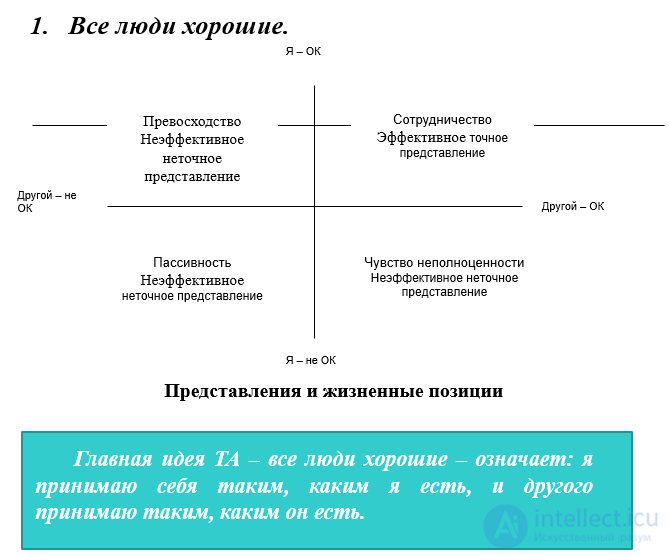
This position evaluates the person themselves: "I am good or bad" – and other people:
"You are good or bad" (in the English-language version, the expressions used to denote the existential position are: "I'm OK, I'm not OK," "You're OK,
you're not OK"). People often switch, within the course of a single day or even a single hour, to
different positions depending on the situation (at work, within the family circle, with
friends):
I'm OK – you're not OK;
I'm OK – you're OK;
I'm not OK – you're OK;
I'm not OK – you're not OK.
These four outlooks on life have been given the name "life positions."
Some authors call them the basic positions, existential positions, or simply positions.
Most people consider themselves good in some respects and not very good in others: failures at work and successful in relating to friends, in the family, or vice versa. Self-assessment and the assessment of others can change over the course of a day, but nevertheless, over certain periods of time, people are most often found in their basic life (existential) position.
The main idea of TA – that all people are OK – means that you and I, both of us, have value, worth, and dignity as human beings. I accept myself as I
am, and I accept you as you are. At times I do not like what you do or how you behave. However, I accept you as a human being, and in this sense you are OK, you are good. E. Berne regards the position "I'm good and so are you" as a person's basic, natural attitude. Deviation from it is a source of numerous problems, of both a social and a psychological nature.
E. Berne's idea about life positions is valuable not only in a theoretical respect. It can be used as a practical tool for improving communication. After all, relationships can objectively be good, but in the eyes of a person with the life position "I'm not OK, you're not OK" they are repugnant. And this individual perception, inevitably affecting the quality of the relationship, can indeed spoil it.
Every person has the ability to think. The person bears responsibility for the decisions made about what they want in life, since
every person, with the exception of those who have suffered severe brain injuries, possesses the ability to think, solve problems, and make decisions. A person's entire life ultimately depends on the decision they make about what it can be and what they want it to be.
Each person determines their own destiny. This idea, that everyone is the master of their own fate and that any decisions, small and large, can be
changed, is closely linked to the first and second ideas. You and I are OK. Sometimes our behavior is not entirely correct because we are following strategies
adopted in childhood. These childhood strategies helped us survive. But even when we were small, no one could force us to develop in any
one particular direction.
So, the life around us is complex and diverse, just like the person themselves. The phenomenon of human communication is significant for us. In recent years
interest in the theory and practice of human communication has been constantly growing. Not a single source on psychology will ever be able to give ready-made recipes for how
to act in one situation or another. At the same time, studying the real many-sidedness of all kinds and types of human communication, and the particularities of certain
situations, works out optimal psychotechnologies of the communicative process and makes it possible to adjust interpersonal relationships. Becoming familiar with new achievements in the field of human communication allows managers to reach a high professional level in managing people and groups.

Comments