
Lecture
Argumentation theory is a field of study concerned with the investigation of argumentation, i.e., the process of constructing and evaluating arguments for the purpose of persuading other people or making well-founded decisions. Argumentation theory studies the structure of arguments, strategies of persuasion, logical and rhetorical devices, and how people analyze and respond to argumentation.
Argumentation theory, or argumentátion (from Lat. arguo «I show, I prove, I clarify») — is interdisciplinary knowledge of how conclusions can be reached through a chain of logical reasoning based on initial theses and premises. It encompasses the art and science of civic discussion, dialogue, conversation, and persuasion. It studies the rules of inference, logic, and procedural rules in both artificial and real-world conditions.
According to the definition given by a group of Dutch logicians of the Amsterdam school, argumentation «is a kind of verbal and social activity whose task is to increase (or decrease) the acceptability of a controversial standpoint for the listener or reader by putting forward a set of interrelated reasons intended to justify (or refute) that standpoint before a rational judge». According to the Belgian philosopher Chaim Perelman, «the goal of argumentation is to create or strengthen the adherence of minds to a thesis presented for their approval». The Australian philosopher Charles Leonard Hamblin defines argumentation as any verbal or nonverbal act «performed by one person to persuade another».
Argumentation includes debate and negotiation, which are concerned with reaching mutually acceptable conclusions. It also covers eristic, a form of public debate in which victory over an opponent is the primary goal. This art and science is often the means by which people defend their beliefs or personal interests in rational dialogue, in everyday speech, and in the process of dispute.
Argumentation is used in law, in research, in preparing arguments to be presented in court, and in testing the validity of certain kinds of evidence. In addition, scholars study post hoc rationalizations, by which organizational actors attempt to justify decisions that they made irrationally.
Important aspects of argumentation theory include:
The structure of argumentation: What elements make up an argument – these are the premises (facts or statements) and the conclusion (the statement or inference itself). A good argument must be logically coherent and supported by evidence.
Logical coherence: An argument must be logically sound, meaning that the conclusion must follow from the premises. Otherwise the argument is invalid.
Rhetorical devices: These are methods of persuasion that can be used to increase the persuasiveness of an argument. They include the use of emotions, analogies, authoritative sources, and other devices that can influence the audience’s response.
Critical thinking: Argumentation theory is also concerned with developing people’s critical thinking. Critical thinking helps in assessing arguments for their strength and validity.
Context and audience: Effective argumentation depends on context and audience. What may persuade one group of people may not work with another.
Logical fallacies: Argumentation theory also studies logical errors that can be used to deceive or to construct invalid arguments.
Logical culture, an important component of a person’s general culture, includes many components. But the most important of them, bringing all the other components together as if in an optical focus, is the ability
to reason argumentatively.
Argumentation – is the adducing of reasons, or arguments, with the intention of evoking or strengthening the support of the other side (the audience) for a proposed position. «Argumentation» is also used to refer to the totality of such reasons.
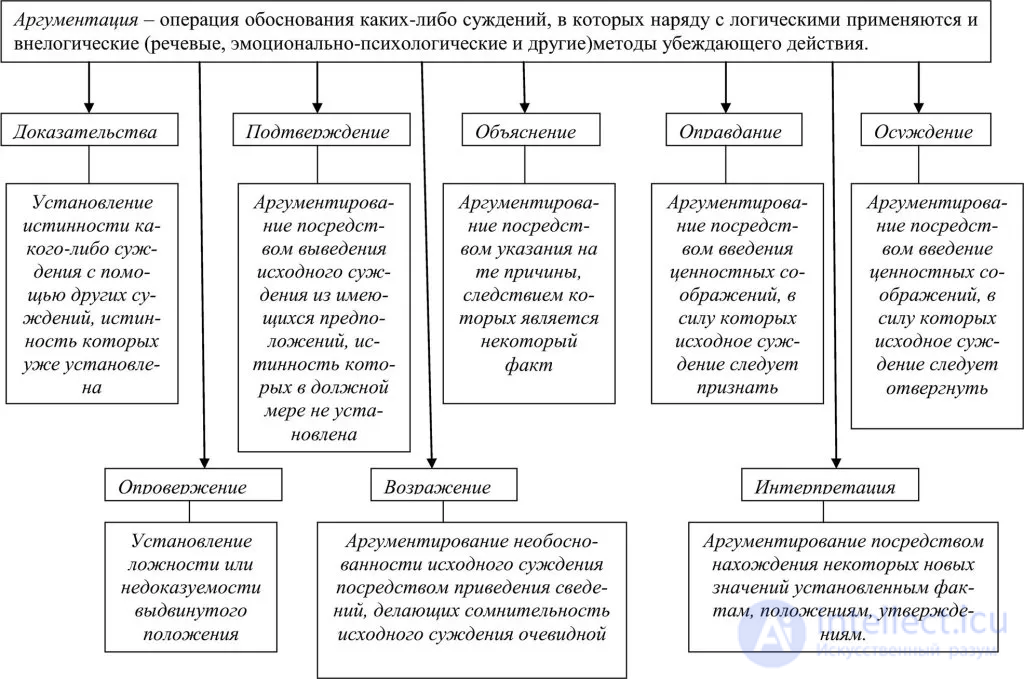
The purpose of argumentation is the audience’s acceptance of the positions put forward.
The intermediate goals of argumentation may be truth and good, but its ultimate goal is always to convince the audience of the soundness of the position offered for its attention and, possibly, of the action that position implies.
This means that the oppositions «truth – falsehood» and «good – evil» are not central either to argumentation or, accordingly, to its theory. Arguments may be adduced not only in support of theses that appear to be true, but also in support of theses that are knowingly false or indeterminate. Argumentation can be used to uphold not only good and justice, but also what
seems, or later turns out to be, evil. A theory of argumentation that proceeds not
from abstract philosophical ideas, but from real practice and conceptions of a
real audience, must, without discarding the notions of truth and good, place at
the center of its attention the notions of «persuasion» and «acceptance».
In argumentation a distinction is drawn between the thesis – a statement (or system of statements) that the arguing side considers it necessary to instill in the audience,
and the argument, or reason – one or several interrelated statements intended to support the thesis.
Argumentation theory investigates the diverse ways of persuading
an audience by means of speech. Beliefs of listeners
or viewers can be influenced not only through speech and verbally expressed reasons, but also through many other means: gesture, facial expression, visual imagery, and so on. Even silence, in certain cases, turns out to be a sufficiently weighty argument. These means of influence are studied by psychology and the theory of art, but are not addressed by argumentation theory. Beliefs can further be influenced by violence, hypnosis, suggestion, subliminal stimulation, medicinal agents, narcotics, and so on. These methods of influence fall within the province of psychology, but they clearly lie outside the bounds even of a broadly
construed theory of argumentation.
Argumentation is a speech act comprising a system of statements intended to justify or refute some opinion. It is addressed first and foremost to a person’s reason, which is capable, after deliberation, of accepting or rejecting that opinion. Argumentation is accordingly characterized by the following features: it is always expressed in language,
takes the form of spoken or written statements; argumentation theory investigates the interconnections of these statements, not the thoughts, ideas, and motives
that lie behind them; it is a purposeful activity whose task
is to strengthen or weaken someone’s beliefs; it is a social activity, since it is directed at another person or other people,
presupposes dialogue and an active response from the other side to the reasons adduced; argumentation presupposes the rationality of those who receive it, their capacity to weigh arguments rationally, to accept or contest them.
Argumentation theory, which began to take shape as far back as antiquity, has gone
through a long history rich in rises and falls. Today one can speak of
the formation of a new theory of argumentation, taking shape at the intersection of logic,
linguistics, psychology, philosophy, hermeneutics, rhetoric, eristic, and others.
A pressing task is the construction of a general theory of argumentation that answers such questions as the nature of argumentation and its boundaries; the methods of argumentation; the distinctive character of argumentation in different fields of knowledge and activity, from the natural and human sciences to philosophy, ideology, and propaganda; the change in the style of argumentation from one era to another
in connection with changes in the culture of the era and its characteristic style of thinking, and so on.
The central concepts of the general theory of argumentation are: persuasion, acceptance (of a statement or a conception), audience, method of argumentation, the position of a participant in argumentation, dissonance and consonance of positions, truth
and value in argumentation, argumentation and proof, and so on.
The general contours of the new theory of argumentation took shape over the last two or three decades. It restores what was positive in ancient
rhetoric and is sometimes called, on this basis, the «new rhetoric». It has become
evident that argumentation theory cannot be reduced to the logical theory of proof, which rests on the notion of truth and for which the notions of persuasion and audience are entirely alien. Nor can argumentation theory be reduced to the methodology of science or the theory of knowledge. Argumentation – is a specific human activity, taking place in a concrete social context, whose ultimate goal is not knowledge in itself, but persuasion as to the
acceptability of certain positions. Among the latter may be not only
descriptions of reality, but also evaluations, norms, advice, declarations, oaths, promises, and so on. Nor is argumentation theory reducible to eristic – the theory of dispute, for
a dispute – is only one of many possible situations of argumentation.
Important contributions to the formation of the main ideas of the new theory of argumentation
were made by the works of Ch. Perelman, H. Johnstone, F. van Eemeren, R. Grootendorst, and others. However, even today argumentation theory lacks a single paradigm, or a few competing
paradigms, and represents a field of scarcely surveyable diversity of opinion on the subject of this theory, its
main problems and prospects for development.
In argumentation theory, argumentation is examined from three different, mutually complementary standpoints: from the standpoint of thinking, from the standpoint of the individual and society, and, finally, from the standpoint of history. Each of these aspects of examination has its own specific features and breaks down into
a number of subdivisions.
Analysis of argumentation as a human activity of a social character presupposes investigation of the audiences within which it unfolds. The narrowest audience includes only the one who puts forward a given position or opinion, and the one whose convictions he seeks to strengthen or
change. A narrow audience may be, for example, two people in a dispute, or
a scholar putting forward a new concept, and the scientific community called upon
to assess it. A broader audience in these cases will be everyone present at the dispute, or everyone involved in the discussion of a new scientific concept, including non-specialists recruited to one side or another through propaganda. Studying the social dimension of argumentation presupposes
also an analysis of how the manner of argumentation depends on the general characteristics of the
particular integral society or community within which it takes place. A characteristic example is provided by the features of argumentation in so-
called collectivist (closed) societies (a totalitarian society, a medieval feudal society, etc.) or collectivist communities («normal science», the army, the church, a totalitarian political
party, etc.). Studying the historical dimension of argumentation includes three
temporal cross-sections:
1. Taking into account the historically concrete time in which
the argumentation takes place and which leaves its fleeting trace on it.
2. Studying the style of thinking of a historical epoch and those features
of its culture which leave their indelible imprint on any argumentation belonging to that epoch. Such a study makes it possible to distinguish five fundamentally different, successive types, or styles, of argumentation: archaic (or primitive) argumentation, ancient argumentation, medieval (or scholastic) argumentation, the «classical» argumentation of the Modern era, and contemporary argumentation.
3. Analysis of the changes that argumentation undergoes over the course of all human history. It is precisely in this context that a comparison of the styles of argumentation of different historical epochs becomes possible, and the raising of questions about the comparability (or incomparability) of these styles, the possible
superiority of some of them over others and, finally, the reality of historical progress in the sphere of argumentation.
Argumentation theory treats argumentation not only as a special technique of persuasion and justification of the positions advanced, but also as a practical art, presupposing the ability to select from a multitude of possible
devices of argumentation that combination and that configuration of them which are effective for a given audience and determined by the specifics of the
problem discussed.
Compliance with special rules helps prevent errors in argumentation. According to the elements of argumentation, these rules are divided into three groups:
1) with respect to the thesis,
2) with respect to the arguments,
3) with respect to the demonstration.
Rules with respect to the thesis:
1. Explicit formulation of the thesis (in the form of a statement, a system of statements). To implement this rule it is necessary to:
1) examine the contested statement and identify the points of agreement and disagreement;
2) agree on the theses of the opponents’ argumentation.
2. A clear and precise formulation of the thesis.
A common field of argumentation should be worked out – agreement should be reached on how
to understand the basic terms, the disputed and other statements, which theory
the parties should adhere to, etc. In polemics and business discussions a common
field of argumentation is not always worked out, because the goal of achieving truth is not set.
3. The thesis may not be changed in the course of argumentation without special reservations.
Violation of this rule is associated with the error of substitution of the thesis, committed when a certain statement is put forward as the thesis, while a different, similar statement is argued, and at the end a conclusion is drawn that the original statement has been substantiated.
Rules with respect to the arguments:
1. Explicit and clear formulation of the arguments.
To fulfill this rule it is necessary to:
1) list all the arguments; if in the course of argumentation some
arguments are dropped, changed, or new ones are introduced, this must be noted;
2) identify the logical content of the arguments; clarify the quantifier
words, logical connectives, modal terms; clarify the evaluative characteristics of the arguments (whether they are true or merely plausible statements).
2. The arguments must be wholly or partly substantiated.
In proofs, refutations, and confirmations the arguments must
be true statements. In explanation and justification, hypothetical propositions may serve as arguments.
Failure to observe this rule leads to the error known as the false
argument, when a false statement is used as a true argument. This error is also committed when substantiating a claim about
facts whose final assessment is possible only in the future. For example,
in substantiating the correctness of economic reforms being carried out, arguments are used such as: «In six months the reforms will produce a significant effect»,
«There will be no decline in the population’s standard of living», and so on.
3. Argumentation must not contain a circle, where the thesis is substantiated by certain arguments, and the arguments, in turn, are substantiated by that same thesis.
For example, a pupil asserts that the number 166 is a natural number (the thesis), and adduces the argument: «It is a member of the sequence of natural numbers, and every
member of the sequence of natural numbers is a natural number». To the question of how it is evident that it is a member of the sequence of natural numbers, the answer follows: «This is clear from the fact that this number is natural!»
The study of the nature of conversation arose from the field of sociolinguistics. It is usually called conversation analysis. Inspired by ethnomethodology, it was developed in the late 1960s and early 1970s, chiefly by the sociologist Harvey Sacks and, in particular, his close associates Emanuel Schegloff and Gail Jefferson. Sacks died early in his career, but his work was continued, and conversational argumentation gained recognition in sociology, anthropology, linguistics, and psychology. It is especially influential in integrational sociolinguistics, in discourse analysis and discursive psychology, and is also a coherent discipline in its own right. Recently, methods of sequential analysis of conversational argumentation have been used to investigate the fine details of phonetic speech.
Empirical studies and theoretical formulations by Sally Jackson and Scott Jacobs, and several generations of their students, have described argumentation as a form of managing conversational disagreement within contexts and communication systems that naturally favor agreement.
The foundation of mathematical truth has been the subject of long debates. Frege, in particular, sought to demonstrate (see Frege, Foundations of Arithmetic, 1884, and logicism in the philosophy of mathematics) that arithmetical truths can be derived from purely logical axioms and are therefore, ultimately, logical truths. The project was developed by Russell and Whitehead in their Principia Mathematica. If an argument can be cast in the form of sentences in symbolic logic, it can then be checked by applying recognized proof procedures. This work was carried out for arithmetic using the Peano axioms. Be that as it may, an argument in mathematics, as in any other discipline, can be regarded as valid only if it can be proven that it cannot have true premises and a false conclusion.
Perhaps the most radical statement of the social foundations of scientific knowledge appears in Alan G. Gross’s The Rhetoric of Science (Cambridge: Harvard University Press, 1990). Gross holds that science is rhetorical «without remainder», which means that scientific knowledge in itself cannot be regarded as an idealized foundation of knowledge. Scientific knowledge is produced rhetorically, which means that it possesses special epistemic authority only insofar as its communal methods of verification can be trusted. This line of thinking represents an almost complete rejection of the foundationalism on which argumentation was originally based.
Explicative argumentation is a dialogical process in which participants examine and/or resolve interpretations, often within a text of any medium, that contains significant differences in interpretation.
Explicative argumentation is relevant to the humanities, hermeneutics, literary theory, linguistics, semantics, pragmatics, semiotics, analytic philosophy, and aesthetics. Topics in conceptual interpretation include aesthetic, judicial, logical, and religious interpretations. Topics in scientific interpretation include scientific modeling.
Legal arguments are heard in a lawyer’s speech in court or in an appellate court presentation, or in the presentation of parties representing themselves and arguing legally why they should prevail. Oral argument at the appellate level is accompanied by a brief, which is likewise prepared in advance by each side in the legal dispute. The closing argument is the final statement by each side’s lawyer, repeating the important arguments in the case. The closing speech is delivered after the evidence has been presented.
Political arguments are used by scholars, media professionals, candidates for political office, and government officials. Political arguments are also used by citizens in everyday relations to comment on and understand political events. The rationality of the public is one of the central questions in this line of research. The political scientist Samuel L. Popkin coined the expression "low-information voter" to describe the majority of voters who know very little about politics or the world in general.
Psychology has long studied the non-logical aspects of argumentation. For example, research has shown that mere repetition of an idea is often a more effective means of argumentation than appeals to reason. Propaganda frequently makes use of repetition.
Empirical studies of communicator credibility and attractiveness, sometimes called charisma, have also been closely linked to empirically encountered arguments. Such studies bring argumentation into the sphere of the theory and practice of persuasion.
Some psychologists, such as William J. McGuire, hold that the syllogism is the basic unit of human thought. They produced numerous empirical works around McGuire’s famous book «A Syllogistic Analysis of Cognitive Relationships.» The central thread of this way of thinking is that logic is contaminated by psychological variables such as «wishful thinking». People hear what they want to hear and see what they expected to see. If people assume that something will happen, they will see that it is more likely to happen. If they hope that something will not happen, they will see that it is unlikely to happen. Thus, every smoker thinks that he personally will avoid getting cancer. Promiscuous people practice unsafe sex. Teenagers drive carelessly.
Stephen E. Toulmin and Charles Arthur Willard advocated the idea of a field of argument, drawing mainly on Ludwig Wittgenstein’s notion of the language game (Sprachspiel) in its latest deployment in communication and argumentation theory, sociology, political science, and social epistemology. For Toulmin, the term «field» denotes the reasoning within which arguments and factual claims are grounded. For Willard, the term «field» is interchangeable with the terms «community», «audience», and «reader». Alongside similar projects, G. Thomas Goodnight studied the «spheres» of the field of argumentation and set off a stream of literature produced by young scholar-respondents or by writers using his idea. The common thread of these field theories is that the meaning of an argument is accepted by the community of those attending to it, and is argumentative only insofar as it is recognized as such by them.
Undoubtedly, the most influential theorist was Stephen Toulmin, who trained as a philosopher at Cambridge as a student of Wittgenstein. What follows is a sketch of his ideas.
Toulmin argued that absolutism (embodied in theoretical or analytic arguments) has limited practical value. Absolutism derives from Plato’s idealized formal logic, which advocates a universal truth. Accordingly, it is held that moral questions of absolutism can be resolved by adhering to standard sets of moral principles, regardless of context. In contrast, Toulmin argues that many of these so-called standard principles have no bearing on the real situation a person faces in everyday life.
To describe his vision of everyday life, Toulmin introduced the notion of a field of argument. In «The Uses of Argument» (1958), Toulmin argues that some aspects of argumentation differ from field to field, and are hence called «field-dependent», while other aspects of argumentation are the same across all fields and are called «field-invariant». In Toulmin’s view, the shortcoming of absolutism lies in its unawareness of the «invariant» aspect of argumentation; absolutism assumes that all aspects of argumentation are «field-dependent».
Recognizing the shortcomings inherent in absolutism, Toulmin in his theory avoids the flaws of absolutism without turning to relativism, which, in his view, provides no grounds for distinguishing moral from immoral arguments. In «Human Understanding» (1972), Toulmin argues that anthropologists were drawn to the relativist side because it was they who drew attention to the influence of cultural change on rational argumentation; in other words, anthropologists and relativists attach too much importance to the «field-dependent» aspect of argumentation, and are unaware of the existence of the «invariant» aspect. In an attempt to resolve the problems of the absolutists and the relativists, Toulmin in his work develops standards that are neither absolutist nor relativist, and that will serve to assess the value of ideas.
Toulmin holds that a good argument can succeed in verification and will be resistant to criticism.
In «The Uses of Argument» (1958), Toulmin proposed a layout containing six interrelated components for analyzing arguments:
The first three elements – «claim», «data», and «warrant» – are regarded as the essential components of practical argumentation, whereas the last three – «qualifier», «backing», and «rebuttal» – are not always necessary.
Toulmin did not anticipate that this scheme would be applied in the field of rhetoric and communication, since this scheme of argumentation was originally meant to be used for analyzing the rationality of arguments, typically in a courtroom; in fact, Toulmin had no idea that this scheme would be applied in the field of rhetoric and communication until his work was introduced by Wayne Brockriede and Douglas Ehninger. Only after the publication of Decision by Debate (1979) did this scheme gain recognition.
In «Human Understanding» (1972), Toulmin argues that the development of science is an evolutionary process. This book criticizes Thomas Kuhn’s view regarding conceptual change in the structure of scientific revolutions. Kuhn held that conceptual change is a revolutionary (as opposed to evolutionary) process in which mutually exclusive paradigms compete with one another. Toulmin was critical of Kuhn’s relativist ideas and held the view that mutually exclusive paradigms provide no basis for comparison; in other words, Kuhn’s claim is the error of the relativists, and it consists in excessive attention to the «field — dependent» aspects of argumentation, while simultaneously ignoring the «field — invariant» aspects, or the commonality shared by all argumentations (scientific paradigms).
Toulmin proposes an evolutionary model of conceptual development, comparable to Darwin’s model of biological evolution. On the basis of this argumentation, conceptual development includes innovation and selection. Innovation means the emergence of a multitude of variant theories, while selection means the survival of the most stable of these theories. Innovation arises when professionals in a particular field begin to perceive familiar things in a new way, unlike their predecessors; selection subjects innovative theories to the process of discussion and investigation. The strongest theories, having passed through discussion and investigation, will take the place of traditional theories, or else additions will be made to the traditional theories.
From the absolutist point of view, theories can be either reliable or unreliable, regardless of context. From the relativist point of view, one theory cannot be either better or worse than another theory from a different cultural context. Toulmin holds the view that evolution depends on a process of comparison that determines whether a theory will be able to provide an improvement in standards better than another theory can.
Scholars from the University of Amsterdam in the Netherlands introduced a rigorous modern variant of dialectics called pragma-dialectics. The intuitive idea is to formulate clear rules which, if followed, will yield rational discussion and well-founded conclusions. Frans H. van Eemeren, the late Rob Grootendorst, and their many, many students have produced a large body of work setting out this idea.
The dialectical conception of reasonableness gives ten rules for critical discussion, all of which play an important role in achieving the resolution of a disagreement (from Van Eemeren, Grootendorst, & Snoeck Henkemans, 2002, pp. 182—183). The tenets of this theory function as an ideal model. The model, however, can serve as an important heuristic and critical tool for testing how closely reality approaches the ideal, and the point at which the discourse goes wrong, that is, when the rules are violated. Any such violation constitutes a fallacy. Although not primarily oriented toward fallacies, pragma-dialectics provides a systematic approach to addressing them in a coherent manner.
Douglas Walton developed a distinctive philosophical theory of logical argumentation, built around a set of methods to help the user recognize, analyze, and evaluate arguments both in everyday conversations and in more structured settings, such as discussions in legal and scientific fields. There are four main components: argumentation schemes, dialogue structures, tools for displaying arguments, and formal systems of argumentation. The method uses the notion of commitment in dialogue as the primary tool for analyzing and evaluating argumentation, rather than the notion of belief. A commitment — is a statement that an agent has expressed or formulated and has undertaken to fulfill or to make as a public statement. Under the commitment model, agents interact with one another in a dialogue in which each takes a side in order to contribute to the development of the conversation. Within the dialogue, critical questioning is used as a way of testing the truthfulness of explanations and finding weak points in an argument that raise doubts about its acceptability.
Unlike the approach accepted in the dominant epistemology of analytic philosophy, based on true belief, Walton’s logical model of argumentation holds a different view of proving and justification. Argumentation, based on the logical approach, treats knowledge as a form of belief-commitment to a firmly fixed argumentation procedure that tests the evidence of both sides and uses standards of proof to determine whether a proposition qualifies as knowledge. On this basis of factual data, scientific knowledge must be regarded as defeasible.
Efforts have been made in the field of artificial intelligence to carry out and analyze argumentation with computers. Beginning with the influential work of Dung (1995), argumentation has been used to provide a theoretical proof of meaning for non-monotonic logic. Computational argumentation systems have found specific application in areas where formal logic and classical decision theory are unable to capture the full richness of reasoning, such areas as law and medicine. Emphasizing the emerging formalizations for practical argumentation, Philippe Besnard and Anthony Hunter, in Elements of Argumentation, introduced a methodology for formalizing deductive argumentation in the field of artificial intelligence. A detailed review of this field can be found in a recently published book edited by Iyad Rahwan and Guillermo R. Simari.
Regular annual events are held in computer science, attracting participants from every continent: the ArgMAS workshop series, the CMNA workshop series,[ and the COMMA scientific-practical conference. The journal Argument & Computation is devoted to studying the relationship between argumentation and computer science.
Argumentation theory is applied in various fields, including philosophy, rhetoric, law, medicine, politics, and much more. Its purpose is to help people develop skills of persuasion and critical analysis of information, which helps them make more well-founded decisions and better understand and influence the world around them.

Comments