
Lecture
Pedagogical communication, like any other type of communication, can encounter various barriers that can hinder effective interaction between teachers and students. Here are some of the most common barriers in pedagogical communication:
Language barrier: This barrier arises when the teacher and the student speak different languages or dialects. Insufficient knowledge of the language can hinder the transmission of information and the understanding of course material.
Cultural barrier: Differences in cultural norms, values, and customs can cause misunderstanding or conflict in pedagogical communication. It is important for teachers to take cultural differences into account and strive to create an inclusive educational environment.
Emotional barriers: The emotional states of teachers and students can affect communication. For example, a teacher who is under stress or irritated may have difficulty effectively conveying material, as well as establishing positive relationships with students.
Stereotypes and bias: Bias or stereotypes based on gender, race, religion, disability, etc., can create barriers to communication and hinder the establishment of trusting relationships.
Insufficient clarity and structuring of information: If a teacher does not provide clear and structured information, students may have difficulty understanding the course material.
Incorrect use of terms and specialized vocabulary: Teachers may inadvertently use terms or specialized vocabulary that students do not understand, which leads to misunderstanding.
Lack of motivation in students: Low motivation or lack of interest in learning can become a barrier to effective instruction. Teachers have to look for ways to motivate students.
Perception problems: Students may have different learning styles and ways of perceiving information. Some may be visual learners, while others prefer auditory learning. Teachers must take these features into account.
Conflicts and negative relationships: Conflicts between students, or between the teacher and students, can create barriers to effective learning and communication.
Insufficient communicative competence: Teachers may encounter barriers in communication due to a lack of communication skills and effective classroom management.
A complex problem of significant pedagogical relevance for pedagogical psychology and the psychology of communication is the problem of impediments, or "barriers," to communication, which a person encounters in activity, in communication.
In pedagogical activity, impediments in the process of interaction
between the teacher (instructor) and the students (learners), and among the students (learners) within a class (group), have been studied fairly intensively with
the aim of determining the factors that influence them and the causes that give rise to them. The significance of these impediments for learning activity has also been studied (N. V. Kuzmina, A. A. Leontiev, A. K. Markova, V. A. Kak-Kalik, E. V. Tsukanova,
V. V. Ryzhov, L. A. Povarnitsyna, and others). Let us note that an "impediment" or "barrier"
to communication is a subjective formation, the subject's experience of a certain
difficulty, unusualness, non-standardness, or contradictoriness of the situation. Therefore, what causes difficulty for one person may not even be noticed by another.
The positive function of impediment (according to A. K. Makarova) "... has two
meanings: a) indicative (drawing the teacher's attention; for example, an attentive teacher will be alerted to his difficulties by his students' mistakes); b) stimulating, mobilizing (activating the teacher's activity in analyzing and overcoming impediments, gaining experience)." Indicative in this respect is
the duality of teachers' positions regarding error as a consequence of an inadequate solution to a complex pedagogical or communicative task. Some
consider errors in this activity unacceptable, while others regard
them as a necessary and inevitable element.
At the same time, A. K. Markova also identifies the negative function of impediment, which likewise has two meanings: "a) restraining (in the absence of
conditions for overcoming impediments, or the presence of dissatisfaction with oneself, for example, low self-esteem), and b) destructive, disruptive
(impediments lead to a halt, to the breakdown of activity, to a desire to leave
school or the profession)"
.
At the same time, a person's impediments in communication can be related not only to the nature of the activity or to emotional, cognitive
(for example, cognitive style) and other spheres of personality, but can also be a consequence of deeper and, at the same time, broader influences. One can distinguish
the following main areas of a person's impediments in communication: ethno-sociocultural, status-positional-role, age-related, individual-psychological, activity-related, and the area of interpersonal relations.
Impediments in this area are related to features of ethnic consciousness, values, stereotypes, and attitudes of a person's consciousness manifested
in communication under the specific conditions of his or her social and cultural development.
Features of the ethno-sociocultural sphere give rise to a whole range of impediments in observing the etiquette of communication. For example, in Russian culture
a student, when answering, typically looks at the teacher, whereas among a number of Turkic peoples, the Yakuts for instance, it is not customary to look an elder, a Teacher, directly in the eye – this is seen as a challenge. Such behavior can disrupt, and not merely hinder, communication. Nonverbal means – facial expressions, gestures, postures – play a major role in this ethno-sociocultural conditioning of communication, and their correct "reading" is the key to adequate mutual understanding and interaction among learners.
The status-positional-role sphere of impediments in communication is conditioned by a whole series of deep-seated causes: upbringing in the family, one's position in
the community, the attributes of one's role, the status of the institution, the educational system,
the region, the city, and so on.
The age-related characteristics of communication partners can also give rise to impediments. It is known that before school a child prefers to communicate with adults; up to middle adolescence, almost half of children prefer to communicate with peers. This preference dominates among senior high-school students
until they finish school, when again about a third of young men and women show interest in communicating with adults. Impediments in communicating with an adult, a teacher, most often arise because the learner, especially an adolescent, believes that his or her inner world is not understood by adults, who continue
to address him or her as if still a child (which is why a teacher's addressing the class as "children" or "boys and girls" can provoke a negative or skeptically
reserved reaction).
Individual-psychological characteristics of communication partners, both
the teacher (instructor) and the students, most often serve as the cause of communicative impediments. This is explained, first, by the fact that
these impediments are the result of the interrelation of at least three factors: the individual-psychological characteristics of the teacher (instructor), of the student, and their mutual acceptance of one another. As E. A. Klimov notes, the coincidence of individual activity styles, reflecting people's individual-psychological characteristics, is one of the main conditions for their unimpeded communication.
Second, this impediment in pedagogical communication can be explained by the teacher's conscious lack of regulation and restraint
of his or her own individual-psychological characteristics that negatively affect communication, such as, for example, irritability, excessive emotionality, criticality, skepticism, and others. The situation is aggravated by the fact that it may be an expression of the teacher's position, according to which he or she should be
"natural" in his or her individual, and in particular emotional, manifestations.
Among the individual-psychological characteristics of the partner that have the greatest influence on communication (and give rise to impediments when
these characteristics of communication are absent or mismatched), the following are noted: communicativeness (sociability), contactability, emotional stability,
impulsivity (reactivity), extra- and introversion, locus of control (extra-/intra-punitiveness), internally and externally attributed reactions,
features of cognitive style, insufficient social perception, and others
(I. A. Zimnyaya).
The most thoroughly studied among the individual-psychological factors
influencing communication is extraversion-introversion. This is explained,
first, by the direct and evident conditioning of communication by these
characteristics. Second, they have been comprehensively studied thanks to the portability and refinement of the method for determining them via the Eysenck questionnaire. Third, these factors attract interest thanks to the authority of C. Jung.
Among the individual-psychological factors that give rise to certain impediments in communication for both the speaker and the listener is
cognitive style of activity. This is an entire system of features of cognitive, above all analytic-synthetic (S. L. Rubinstein), activity, features of the organization of semantic memory, the structure of the thesaurus,
strategies for selecting means and methods of action and decision-making. Cognitive style, like any other individual style, is a feature of cognitive activity that is stably manifested across changing situations, and in particular in communicative situations,
a feature of cognitive activity.
A fairly great degree of impediment is caused by a low level of emotional regulation (or its absence in communication), manifested in the uncontrolled reaction of communication partners to one another, to the text, to the entire communicative situation. The source of stress can be the activity, the partner, or the speaker himself (N. V. Vitt). Depending on this, the overall tone of communication changes, as do the intonational and lexico-grammatical characteristics of the text and the nonverbal means used. Accordingly, one can say that individual-psychological characteristics, including intellectual, affective
(emotional), volitional, behavioral, and personal manifestations, can either
facilitate or impede communication. Everything that causes impediment in pedagogical communication must be an object of awareness and correction, as a professionally necessary condition for a person's suitability for this activity
(I. A. Zimnyaya).
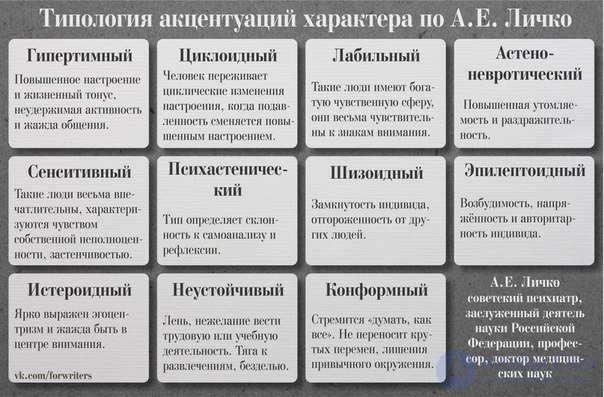
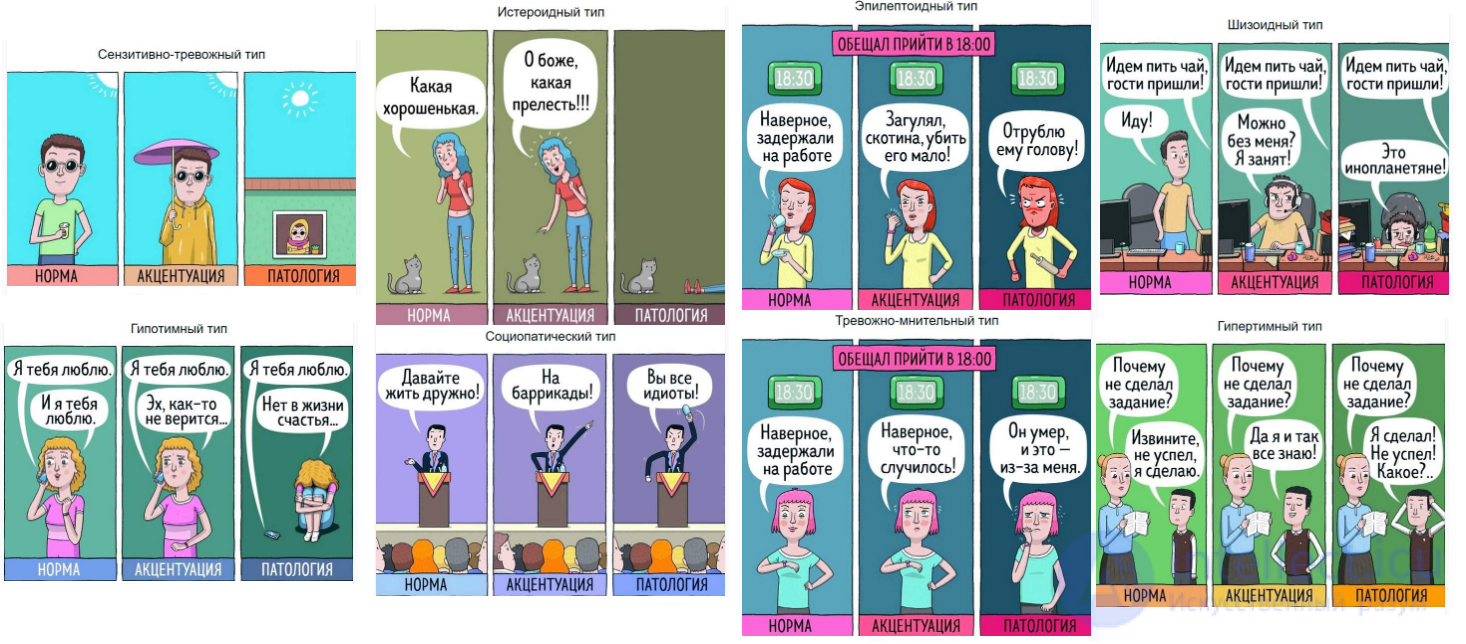
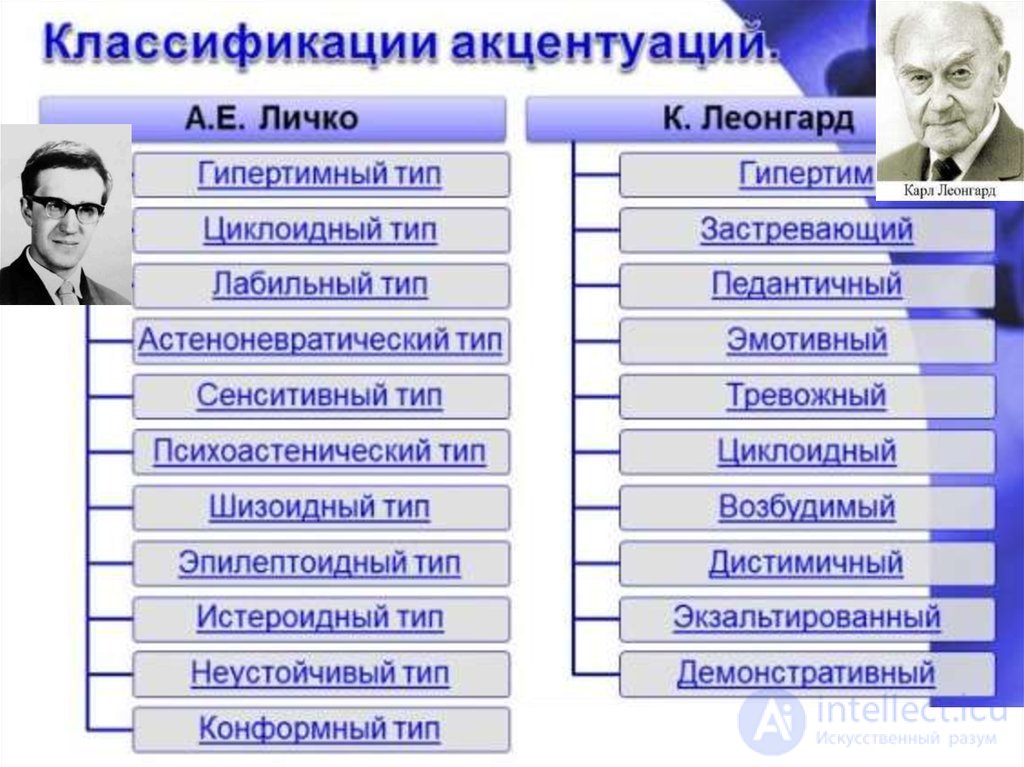
In noting the influence of communication partners' individual-psychological characteristics on this process, researchers have in mind non-accentuated people. Character or personality accentuation (K. Leonhard, A. E. Lichko) –
is an excessive expression of individual traits, personal and characterological manifestations (intellectual, emotional, volitional, behavioral). At present, 13 types of character (personality) accentuation have been identified, each of which has a general behavioral specificity of communicative manifestation:
Impediments in communication associated with 1) the teacher's own pedagogical activity and 2) the learner's educational activity are related to the content and nature of these activities. In pedagogical activity, impediments can be caused both by the subject content itself, i.e., the level
and manner of the teacher's command of the knowledge whose assimilation his or her activity is meant to organize, and by professional-pedagogical skills and didactic competence, i.e., the means and methods of pedagogical influence on learners (I. A. Zimnyaya).
Pedagogical impediments of the first kind lie within the activity itself. According to A. K. Markova, these are difficulties in setting and solving
pedagogical tasks, expressed in insufficiently complete and precise planning of the outcome of one's actions, failure to take past erroneous actions into account, insufficient flexibility in changing and restructuring tasks in the course of a lesson, and a narrowing
of their content through the exclusion of the educative and developmental function.
V. A. Kan-Kalik and A. K. Markova noted that impediments in teaching
activity can be caused, first, by the fact that one method being used is in no way connected with others; second, the teacher uses several methods that are not interconnected; third, the teaching method applied does not
correspond to the learners' capabilities; fourth, it does not correspond
to the teacher's individual-psychological characteristics (for example, if an active, impulsive, sociable extravert teacher uses a method of algorithmized, step-by-step control, or if a deeply introverted teacher conducts a business game in the form of a rapid-fire solution).
Moreover, if we combine the eight most typical barriers to pedagogical communication identified by V. A. Kan-Kalik (Kan-Kalik V. A. To the Teacher About Pedagogical Communication. Moscow, 1987.)
we obtain three groups:
– fear of the class and of a pedagogical mistake;
– a mindset formed as a result of past negative work experience in general and of working with a given class in particular; a mismatch between the teacher's own attitudes toward working with the class and the attitudes of the learners;
– inadequacy of one's own activity to the communicative situation taking shape in the lesson
communicative situation. This can occur either as a result of the mechanical copying of the communication style (manner) of a person who is a reference figure for the teacher,
or as a result of limiting communication to only its informational side.
Barriers of the first group are overcome through the teacher's work experience and increased professionalism. Barriers of the second group, caused by the phenomenon
of social apperception as the conditioning of perception and understanding of the social environment by past experience, require their objectification, i.e., awareness of the object of the impediment and purposeful, deliberate correction. An example of such social apperception could be an examiner's inadequate assessment of a learner's answer after having previously looked through the learner's grade book,
or being under the influence of a group instructor's negative opinion of
the student's work over the course of the semester. Barriers of the third group are related to a misunderstanding (lack of knowledge) of the functional content of pedagogical
communication and activity (as a result of which only the informing
function remains, apart from the developmental and educative functions, which presuppose developed social perception, empathy, understanding of the other, and facilitation
of communication, etc.), as well as to an uncritical adherence to a model incompatible with the teacher's specific individual-psychological makeup.
Communication impediments arising in the "teacher–student" and
"student–student" relationships are assessed differently by the communication participants themselves and by other
people (E. V. Tsukanova). Thus, teachers' and students' assessments of communication impediments do not coincide (either in nomenclature or in rank). Whereas
teachers believe that the individual characteristics of communication partners cause the greatest impediments in the "teacher–student" scheme, students place features of participation in the activity first among the causes of impediment in such communication. At the same time, in characterizing the overall conditions of joint learning activity, researchers note that the main impediments are related
above all to interpersonal relations, then to the individual-psychological characteristics of those communicating, and only after that to the nature of their participation in the activity.
More than 90% of students' and teachers' assessments of each other's contactability do not
coincide. Students rate teachers as difficult to engage with three times
more often (than teachers rate students), considering them rigid, "barrier-forming" (Z. A. Noliu, L. B. Filonov).
L. A. Povarnitsyna identified six groups of communication difficulties
among students. The first included difficulties associated with students' inability to conduct
themselves, not knowing what and how to say. Difficulties of the second group are caused by a failure to understand the communication partner, i.e., insufficient development of the perceptual side of communication as such. The third group consists of difficulties
caused by the fact that the communication partner does not understand or accept the speaker.
Communication difficulties of the fourth group are due to the feeling of embarrassment, awkwardness, and uncertainty experienced by the speaker. Difficulties of the fifth group
are related to experiencing displeasure, even irritation, toward the
partner. The sixth group includes difficulties caused by a person's general dissatisfaction with communication. On this basis, the author analyzes features
of student communication in various social spheres, depending on the year of study (from
the first to the third) and on other factors. It was shown that in communication with
adults, students less often experience difficulties in understanding their communication partner (14.2%) and very often (29.6%) experience difficulties associated with not knowing how to conduct themselves and not knowing the subject of communication.
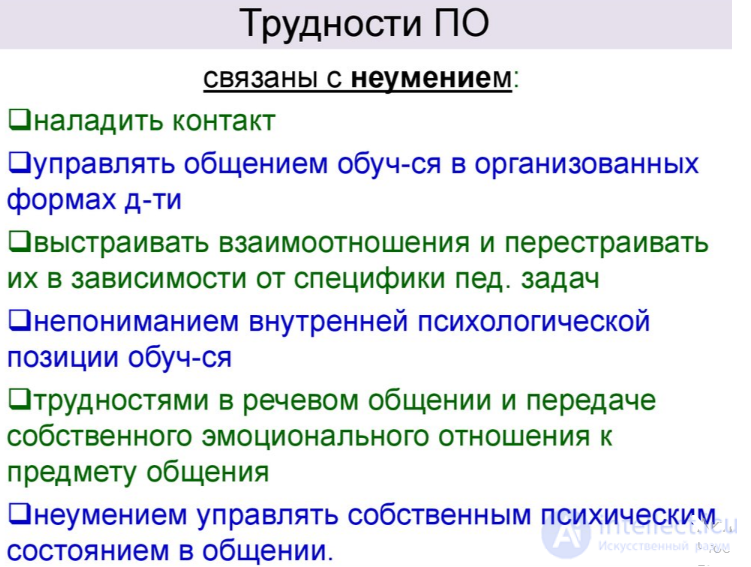
fig. difficulties in pedagogical communication
10.3.4. Interpersonal Relations as a Sphere of Impediments
Interpersonal relations significantly influence the nature
of learners' joint learning activity and of the teacher's (instructor's) pedagogical activity (A. K. Markova, Ya. L. Kolominsky, N. V. Kuzmina, A. A. Rean, and others). Underlying these relations are sympathy (antipathy),
acceptance (non-acceptance), the coincidence of value orientations or their divergence, and the correspondence or difference of cognitive and, in general, individual styles
of activity (communication), and much else, which can either facilitate or substantially impede people's interaction, up to and including its cessation.
An important interpersonal feature of partners that gives rise to impediments in communication is the dominance of one or another personal state in each of them. According to E. Berne, in the structure of a person's consciousness
three states coexist in every individual: "Parent," "Adult," "Child." Here, the first – "Parent" – can manifest in two ways: either in a controlling-authoritarian function or in a helping-nurturing one. E. Berne
provides verbal and nonverbal characteristics of each of the three states, as well as examples of the interaction of people who are in the same state or in
different states.
A large number of conflicts are observed in the professional sphere of
"person-to-person" activity. Among these, one of the most conflict-prone
is pedagogical activity. The problem of pedagogical conflict
belongs to the category of so-called universal psychological problems.
Pedagogical conflicts are caused by a whole series of circumstances. First, the teacher's activity itself is one of the most stress-inducing.
When, in the mid-1950s, nationwide research on the psychology of labor was carried out in our country, the psychophysiological strain of a teacher's work was found to be comparable to that of test pilots and mountain climbers. Modern conditions have not made the teacher's work
any less strenuous. On the contrary, they increasingly contribute to distress
conditions, nervous overload, and, accordingly, conflicts. Second, in
the process of instruction the teacher must constantly monitor the students' work,
which, in turn, develops an evaluative approach to other people. This predominance of an evaluative approach in interaction fairly often serves as a source of contradictions. Many teachers, in the process of communication, do not so much
participate in the interaction as monitor it. Of course, control-and-evaluation activity should be generalized, i.e., extended to interpersonal interaction as well (I. A. Zimnyaya).
Avoidance of conflict is largely related to adults' inability to make demands on their charges correctly. Usually the measure of the demand is violated. Either there are too many demands and they are too high, i.e., unattainable,
or they are too simple. In the first case, the child is unable to cope with
the task, which leads to psychophysical strain and nervous breakdowns. In
the second case, the child needs no effort at all to complete the task.
The success of a strategy used by teachers or parents in conflict situations depends on many causes. It cannot be claimed that avoidance and accommodation are always effective. There are situations in which these
strategies are indeed appropriate. However, it should be kept in mind that
excessive reliance on such strategies can have a detrimental effect both on the substance of the matter
and on the interpersonal relations between the educator and the person being educated.
N. P. Anikeyeva identified particular positions held by a teacher within the pedagogical staff that hinder the establishment of a normal psychological climate and contribute to the development of conflict situations (Anikeyeva N. P. Psychological Climate in a Group. Moscow, 1989.)
. Such positions can
be viewed as distinctive social roles within the pedagogical staff: "the prima donna," "the public figure," "the self-promoter," "the patriarch," "the imitator." "The prima donna" is a pattern of behavior of a teacher who has attained a high level of professional performance and is one of the best
teachers in the school. However, professional and personal ambitions do not allow such a teacher to acknowledge the merits of other, no less successful colleagues. And
although the "prima donna's" outward behavior is quite amiable, such a person causes tension within the group. At the level of contextual informativeness of the position
(hints, tactless acts, etc.), the "prima donna" puts out information that discredits other teachers, above all successful teachers, since only they are the "prima donna's" real rivals. In this case, the leading
behavioral strategy is rivalry (I. A. Zimnyaya).
The positions of "the public figure," "the self-promoter," and "the imitator" give rise to conflicts, since they are determined by the teacher's striving to create a positive image of himself or herself, not through productive activity, but through self-presentation. As for the position of "the patriarch," its negative
reception by young teachers is due to their constant discontent. Teachers who are able to work with pedagogical conflict are the most successful in their professional activity, since the very
fact of having such a reflective approach makes the party to the conflict an
expert in it. In this case, teachers become aware of the necessity and the possibility of resolving problems themselves fairly effectively, since the most optimal
methods of resolving a conflict are always related to the individual characteristics of its participants. Moreover, by reflecting on a conflict, the teacher also learns to help students in their not always simple relationships with one another.
Very important data were obtained by N. A. Berezovin and Ya. L. Kolominsky1
They identified five styles of a teacher's attitude toward schoolchildren:
The difference between these styles is best shown using the schoolchildren's comments about their teachers cited in the book mentioned above. The actively positive
style needs no illustration. Situational: "The teacher is always putting them in
the corner and scolding them"; "She says that they behave badly and don't listen to her."
Passively positive: "Yesterday she was reprimanded for writing
directly in the fair copy and solving it incorrectly"; "He's always lazy in class" (this is the first grade, where the teacher's assessment is perceived as objective
truth!). Actively negative: "The teacher puts them in the corner and says
that they're only capable of getting ones and twos"; "The teacher says
he can't do anything, not even read." Passively negative: "The teacher says that mom and dad do everything for him, because he writes untidily in class but writes well at home," and so on.
And here are excerpts from evaluations given to teachers by principals and deputy principals:
1. "She is in love with the school and the children. She can teach any child. She doesn't like
extreme measures. At the same time, she is very principled and demanding."
And here is another style:
1 Berezovin N. A., Kolominsky Ya. L. The Teacher and the Children's Collective. Minsk, 1975 // Leontyeva A. A. Pedagogical Communication. Moscow, 1979.
2. "Conscientious, knowledgeable, works a great deal, loves her profession and
the children, but if the students get confused, she loses her composure."
3. "The teacher is wonderful, but there's a certain coldness — she never says a kind, gentle word to the children."
4. "She makes remarks harshly, forgets about praise as a method of upbringing. At any failure of a student, she is indignant at the top of her voice. She doesn't like lazy and poorly prepared students and doesn't want to work with them."
5. "She perceives everything warily. Her indignation at the students' behavior
doesn't show outwardly. She just shrinks into herself. She doesn't like staying late at school."
Is it necessary to explain which style of teacher each of these
characteristics belongs to?! These authors showed how the difference in styles affects
the teacher's assessment of the socio-psychological situation in the children's group and
this situation itself, students' assessment of the teacher and of their relationships with him, and so on.
It is interesting to cite data from one of the tables. To the question: "Whom, in your
opinion, does the teacher like less than others in your class?" — on average
(in %), the following number of answers "Likes everyone" and, correspondingly, "Doesn't like everyone" was obtained (it doesn't matter to us exactly whom!). Actively positive style — 46
and 36; passively positive — 17.5 and 66.5; situational — 7 and 76; actively negative — 0 (!) and 91.5 (!); passively negative — 4 and 73. The remaining
children answered "don't know." Such "don't-knows" were fewest among the actively negative-style teacher (8.5%) and most numerous among the passively negative one (23%).
When the question was asked: "Imagine that you are being transferred to a neighboring
class. Who would you go with? With the teacher? With friends? Alone?", then for the
actively positive-style teacher, 74% of students wanted to go along with him.
Only 47% of students would "take along" the situational teacher. For the negative-style teachers — 35–39%. (Let us not forget that the experiment was conducted in the first through third grades, where the teacher's authority is unquestioned, especially for first-graders.) Those wanting to leave alone amounted to 14% among the "situational" teacher's students, 19% among the "actively negative" teacher's students, and 22% among the "passively negative" teacher's students.
"Would you like to go back to kindergarten?" Actively positive —
100% "no" (!). Passively positive — 29% "yes." Situational — 33%
"yes." Actively negative — 33% "yes." Passively negative — 58%
"yes." The authors comment on this data, and one cannot help but agree with them:
"These results are especially striking against the backdrop of… the ardent eagerness of seven-year-old preschoolers to go to school. Only deep, emotionally negative impressions could have caused such profound disappointment…".
Overcoming these barriers requires flexibility, empathy, and professionalism on the part of teachers. It is important to strive to adapt one's teaching and communication style according to the individual needs and characteristics of students, as well as to take into account the context of the educational environment.

Comments