
Lecture
Teachers and instructors can have different characteristics that determine their style of teaching and interaction with students. The effective interaction of communicators can be hindered by a wide variety of factors known as communication barriers. Objective factors such as distance and lack of visibility or audibility are a subject for analysis
by physicists and engineers. We are interested in the subjective factors connected with
the personality of the communicators and the circumstances accompanying communication.
Three such types were identified in the studies referred to: the "proactive," the "reactive," and the "hyperreactive" teacher.
The "proactive" teacher takes the initiative in organizing communication and interaction in the classroom, both as a group and in pairs (teacher–student). He clearly individualizes his contacts with students. But his attitudes change
in line with experience – such a teacher does not seek mandatory confirmation of an established attitude. He knows what he wants and understands what, in his own behavior or in the students' behavior, contributes to achieving this
goal.
The "reactive" teacher is also flexible in his attitudes, but internally
weak, subject to the "elements of communication." The differences in his attitudes toward individual
students do not reflect differences in his strategy but differences in the behavior of the students themselves. In other words, it is not he himself but the students who dictate the character of his communication with
the class. He has vague goals; he does not want and achieve, but adapts.
The "hyperreactive" teacher, noticing individual differences, immediately
constructs a completely unrealistic model that exaggerates these differences
many times over, and considers this model to be reality itself. If a student is a bit
more active than others, in his eyes that student is a rebel and a troublemaker; if slightly more passive, a slacker, and so on. Such a teacher deals not with real students but with the students he has
invented, and behaves accordingly. And what he actually
invents are stereotypes, forcing real, thoroughly non-stereotypical
students to fit them. His students thereby become his personal enemies, and his behavior a kind of psychological defense mechanism.
The character of his attitudes changes correspondingly. A teacher of the first type
tends toward positive attitudes, while a teacher of the third type tends toward negative ones. And
very often such a teacher reacts aggressively and disapprovingly even to such
behavior on the part of a "bad" student that, one would think, should elicit a
positive assessment.
Let us give a list of signs by which, according to these studies, one can "recognize" the presence of a teacher's negative attitude, i.e., an unconsciously poor attitude toward a student (A. A. Leontiev):
1. He gives a "poor" student less time to answer than a "good" one, i.e., he does not let him think.
2. If a wrong answer is given, he does not repeat the question or offer a hint, but immediately asks someone else or gives the correct answer himself.
3. He is "lenient," rating a wrong answer positively.
4. At the same time, he more often scolds the "poor" student for a wrong answer.
5. Correspondingly, he less often praises a correct answer.
6. He tries not to react to the "poor" student's answer, calling on someone else, not
noticing a raised hand.
7. He smiles less often and looks the "poor" student in the eye less than the "good" one.
8. He calls on him less often, sometimes not working with him in class at all.
Below are the general characteristics of other types of teachers:
Strict teacher:
Friendly teacher:
Innovative teacher:
Structured teacher:
Creative teacher:
Adaptive teacher:
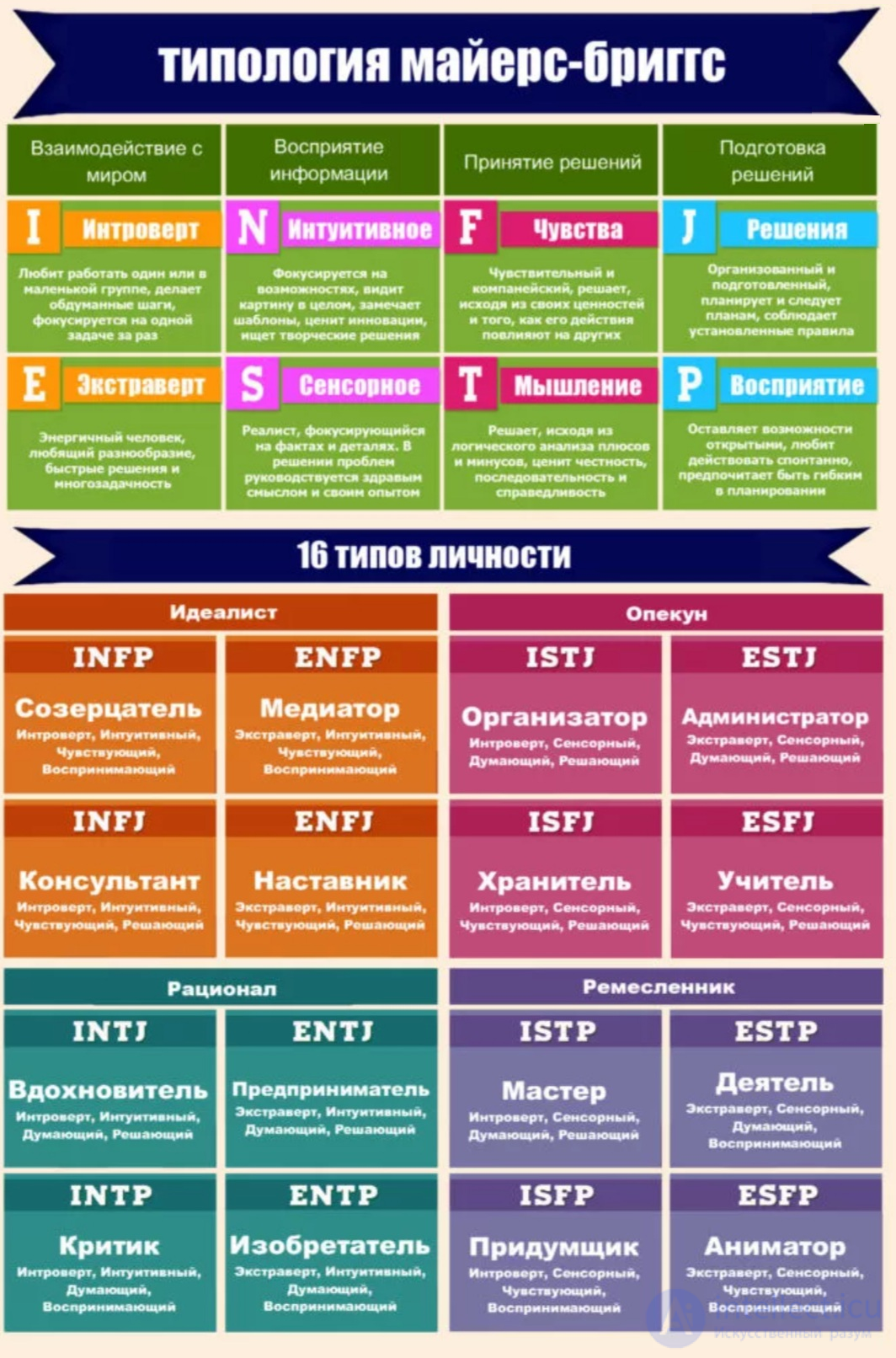
Fig. MBTI personality types
MBTI (Myers-Briggs Type Indicator) is a popular tool for assessing personality types, developed on the basis of Carl Jung's theory of psychological types. MBTI divides personalities into 16 types, each of which is characterized by four letters representing four aspects of personality:
Extraversion (E) or Introversion (I): Reflects the source of a person's energy. Extraverts are usually energetic and gain energy from interacting with others, while introverts prefer solitude and lose energy in social situations.
Sensing (S) or Intuition (N): Reflects the way information is gathered. Sensing types are oriented toward concrete details and facts, while intuitive types focus on general ideas and possibilities.
Thinking (T) or Feeling (F): Reflects the way decisions are made. Thinking types make decisions based on logic and objectivity, while feeling types are oriented toward emotions and social considerations.
Judging (J) or Perceiving (P): Reflects the way life is managed. Judging types prefer structure, planning, and organization, while perceiving types tend toward flexibility and adaptability.
A teacher's MBTI personality type can influence their teaching style and interaction with students, although it is not the only factor determining their approach. Below are examples of links between certain MBTI personality types and teaching style:
INTJ (Introvert, Intuitive, Thinking, Judging): INTJ teachers may be analytical and structured in their lessons. They may prefer lectures and a logical approach to teaching.
ENFJ (Extravert, Intuitive, Feeling, Judging): ENFJ teachers are often focused on supporting and motivating students. They actively interact with students and create a warm atmosphere in the classroom.
ISTP (Introvert, Sensing, Thinking, Perceiving): ISTP teachers may be practical and focused on problem-solving. They may provide students with concrete skills and tasks.
ESFP (Extravert, Sensing, Feeling, Perceiving): ESFP teachers may make lessons interesting and engaging. They actively involve students and use practical examples.
It is important to note that MBTI personality type is only one aspect of a teacher's personality, and other factors, such as education, experience, and individual preferences, also play an important role in determining teaching style. Every teacher is unique, and their teaching style may combine different aspects depending on the situation and context.
Teachers' characteristics can vary greatly, and teachers often combine different elements of different types depending on the specific situation and the needs of their students. An effective teacher usually strives to find a balance between different styles and types of teaching in order to ensure quality education and maintain a positive educational environment.
What follows from all this? It is bad when there are no differentiated attitudes at all, and the teacher's behavior and communication with students are not individualized. Unwarranted negative attitudes are dangerous.

Comments