
Lecture
Ontopsychology is a multifaceted study of human being as an individual and a personality, as a subject and as an individuality, in ontogenesis.
In formulating the theoretical, research, and applied tasks that are resolved in the course of constructing ontopsychology as a science, B. G. Ananyev grouped them into four blocks of problems:
1) establishing the essence of the development of individual and personal characteristics from the standpoint of biosocial relations at different periods of ontogenesis and of a person's life course;
2) tracing the interrelations between individual and personal properties
at different stages of a person's individual development;
3) identifying the connections of both individual and personal
phenomena of a person with his subject-activity characteristics;
4) studying the formation of individuality as a process of integrating
the principal characteristics of a person as an individual, a personality, and a subject of activity, one distinguished in many of its parameters by unrepeatable originality.
In the studies that B. G. Ananyev conducted to reveal the organization of the individual and its ontogenesis, it was shown that the comparative age-related study of individual characteristics represents one of the most important aspects of understanding the natural forms of the psyche, which do not
lose their relative independence as mental activity grows more complex, continuing to
perform the function of its potential throughout a person's entire
life.
Another important direction in this cycle of research is tracing the relationships and the degree of interconnection among individual properties at different periods of a person's life.
In the complex structure of individual organization, which includes elements of various kinds, both single-level and multilevel connections were studied under B. G. Ananyev's guidance.
It was shown that the presence of a multilevel structure of the individual, arising from the stratification of its elements, entails the study of processes of differentiation and integration within this human system.
A further stratification of secondary individual properties is also a consequence of socialization.
A socialized level of psychophysiological functions is formed on the basis of the natural forms of the psyche. Alongside the natural structures, intercorrelations arise as a result of socialization.
The role of acquired connections at the level of the individual increases more and more in the course of a person's individual development.
Both natural and acquired correlational connections are characterized by ever-increasing specialization, dynamism, and extraordinary plasticity under the influence of social factors, which substantially affect the processes of restructuring correlational relations.
The problematics of personality in human existence, and in twentieth-century Russian psychological science, were profoundly hypertrophied.
Among the circumstances that determined the interruption and the lag in the development of Marxist social psychology in our country, a significant factor was the atmosphere of administrative fiat and decree-making
that prevailed in the social sciences,
which constrained creative initiative,
bred dogmatism, and instilled a fear of engaging with complex, sensitive questions,
among which were also the problems of social psychology.
The main reason was the underestimation of the role of the subjective (human) factor.
The dominant viewpoint was that of the social determination of human processes,
properties, and states of the person.
For this reason it was not considered necessary to study social-psychological phenomena specifically, including personality.
The absence of social psychology as a special scientific discipline also held back the development of the problematics of personality.
But in pedagogical science these problems were becoming increasingly significant.
However, the development of the methodology and theory of general psychology was gradually preparing the theoretical foundation for the development of social psychology.
Of particular importance were ideas about the socio-historical determination of mental phenomena,
and the elaboration of the principles of the unity of consciousness and activity, of determinism, and of the principle of development.
Ideologization manifested itself especially vividly, even demonstratively, in the study of needs.
It turned out that an individual could be called a personality only if he expressed the needs of the progressive class and of humanity as a whole.
The sphere of needs was rigidly hierarchized
and increasingly "alienated" from the living, concrete person, in the direction of a generalized, abstract social humanity.
The distance gradually erected between the real person and the ideologically composed model
of the Soviet personality was insurmountable.
An unambiguous sense arose that to be a personality meant, under no circumstances, to belong to oneself,
not to express one's own interests, needs, one's "I," that is, one's own subjectness.
Priority was proclaimed for socially significant moral values and for moral needs of the highest
order: ethical, aesthetic, moral.
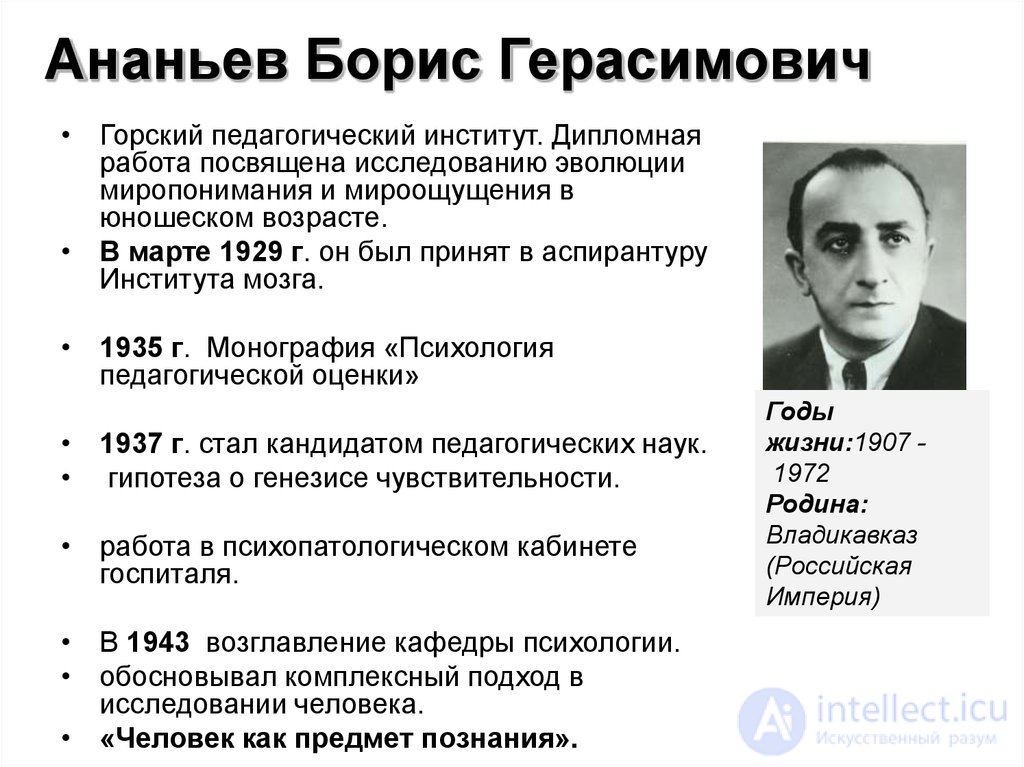
B. G. Ananyev, speaking in this discussion, said that the field of the psychology of personality, in its current state, represented a rather nebulous formation within the structure of our science.
His address sounded like the statement of a programmatic agenda concerning the psychology of personality.
He pointed out that such a state of affairs in the development of a theory of personality could no longer be tolerated,
since it was, above all, the theory and practice of education that suffered from it,
unable to rely on a serious and rigorous psychological theory of personality.
For this reason B. G. Ananyev proposed to acknowledge that the discussion on questions of set was only the beginning of the discussion on the problem of personality.
In this connection he considered it necessary to draw the conclusion that the situation that had arisen needed to change,
in which one concept or another universalized a particular phenomenon, instead of contributing to the creation of new systems of knowledge in the psychology of personality.
And then he put forward a proposal to open up a broader scholarly discussion, no longer on the problem of the psychology of set,
but on the psychology of personality as a whole,
excluding none of the concepts of contemporary psychological theory.
It follows from the materials of the discussion that the concept of set was advanced and defended, above all, as a general
principle for explaining the structure of personality and of human activity. This was attested by the numerous
definitions of set as a "dynamic state of readiness for activity," which determines "the orientation
of personality and the orientation of activity," "the subject's preparedness for a given activity." In this
way, in the psychology of the mid-1960s the idea of set was advanced as a universal
general-psychological principle, one meant to be placed at the basis of explanations of all the mental phenomena
observed in man, including personality. However, this position was not fully accepted, and the concept
of set did not attain the rank of a central, foundational concept of psychology.
Paradoxically, in analyzing the works on the psychology of personality from this period, one has to note that
the research positions of such authors as V. M. Bekhterev, P. P. Blonsky, A. I. Nechaev, and A. F. Lazursky, who had successfully
developed the theory of personality and applied experiment and observation in studying it in the early 1920s, were
not only not continued by subsequent generations of scholars but were altogether forgotten. A sense arose of the absence
of traditions and experience in studying man as a personality, even though the personality problematics itself was gradually
advancing to the forefront, crowding out cognitive processes, the physiology of higher nervous activity, and
the problems of the development of the psyche.
The materials of the research of B. G. Ananyev, L. I.
Bozhovich, K. K. Platonov, D. B. Elkonin, and T. V. Dragunova stand out somewhat and compare favorably with the above-named works.
Thus, for example, in the works of B. G. Ananyev the question was raised of the dynamic character of the relations of personality,
and a position was developed on the dynamism of the structure and of its components. It was he who unfolded the static model
of personality into the dynamics of the life course. He carried out a radical transition from the question of the structuring
of the mental elements within personality to the question of how personality organizes its systemic relations with the world. However,
the attempt to realize a systemic approach in the study of personality came into conflict with the static, structural
method of analyzing fragments of life used in the social psychology of those years.
The laws of societal, historically class-based development were regarded as the driving force
behind the formation and development of personality precisely in the works of B. G. Ananyev. "It is from these laws," writes B. G. Ananyev, "and not from
the inner life of personality itself, that the sources of the formation of personal properties, its
distinctiveness, must be derived." And further we read that "the activity of personality, the whole process of its life, including the spiritual, bears a
societal, historical, class character. A person's consciousness reflects this concrete, societal,
historically class-based being of people. Thus, under the typical circumstances of a specific class-historical environment,
the typical characters of an epoch are formed." He asserted that man is formed under the directed influence of
society, that "this is a social individual and, consequently, a subject of labor, communication, and cognition."
The mental development of man was considered by him in the context of his development as an individual, as a personality, and as a
subject of activity. His central idea was a comprehensive, generalized study of man, synthesizing knowledge
obtained in psychology, physiology, pedagogy, biophysics, and cybernetics, that is, in the psycho-pedagogical,
natural, and technical sciences. The idea of the integration of knowledge about man pervades his principal works: "Man
as an Object of Cognition" (1968), "On the Problems of Contemporary Human Science" (1977), "On Man as Object and
Subject of Education" (1965). B. G. Ananyev represented himself in psychology precisely as the author of wide-ranging
ideas of human science, of their comprehensive resolution, integration, and synthesis.
He saw the task of pedagogical anthropology as solving the problems of the formation of man as an individual,
a personality, and an individuality. He believed that the wholeness or fragmentation of the human personality is determined
by class ideology, by its significance for the historical process. Following V. N. Myasishchev, B. G. Ananyev
asserts that every character trait represents definite relations of the personality to the surrounding
reality, to the living conditions of its development. He believed that not every
relation becomes a character trait, but only an essential, deep-rooted one. He was inclined to assert that "in the process of personality development
a person's real relations to reality are always interconnected and mutually conditioned. This interconnection
of the actual, practical relations of a person to society, to labor, to other people, and to himself finds its
reflection in the correlation of character traits with one another."
The directions of research into the problems of character in B. G. Ananyev and V. N. Myasishchev coincide. Both singled out, from
the totality of personality relations, those forms of relations that are character-forming. These were
taken to include: relations to society, to ideology, to labor, to other people, and to oneself. In all likelihood, both
identified character traits with properties of personality. As with V. N. Myasishchev, in B. G.
Ananyev's conception of personality there is no clear distinction between personality and character.
In B. G. Ananyev's conception, the role of one of the main factors was assigned to a person's activity. Holding that
the individual-psychic development of a person is socially determined, he at the same time
emphasized that a person becomes a subject through his own activity. And that is why he regarded these two concepts,
"subject" and "activity," as inseparable from one another.
Hence it is clear why such fundamental importance was attached to those kinds of activity in which
the properties of a person as a subject are formed. A classification of the principal kinds of activity was developed. Play,
learning, and labor were given the status of leading activities, and they came to be regarded as the fundamental conditions
for a person's mental development. B. G. Ananyev regarded the individual consciousness of a person as the result
of cognition, communication, and labor, and of their various convergences.
The analysis of the historical paths and regularities in the formation of the systems of the sciences of man enabled B. G. Ananyev to determine the place of psychology within this system.
In assessing the significance of B. G. Ananyev's theoretical quests, A. A.
Bodalev, B. F. Lomov, and others noted that he had "created a general picture of man in all his manifestations."
The historical mission of psychology, as the integrator of all spheres of human science and as the principal means
of constructing a general theory, is reflected in B. G. Ananyev's summary works "Man as an Object of Cognition" and
"On the Problems of Contemporary Human Science," which proposed a classification of the problems associated with the study of man. These are
the problems of anthropogenesis, race formation, race studies, historical phylogeny, and the somatic
organization of man.
In the works of B. G. Ananyev an extensive characterization is given of the concepts "individual," "personality," and "subject of activity." To
the individual properties of man he assigned the age-sex properties (the stages of ontogenetic evolution and sexual
dimorphism) and the individual-typical properties (constitutional features, the neurodynamic
properties of the brain, features of the functional geometry of the cerebral hemispheres). The highest integration of these properties
is represented in temperament and character.
B. G. Ananyev noted that in a whole series of studies conducted "it was established that in any of the factors
that determine the structure of personality, correlational pleiades are found — intricately branching chains of connections
between the relations and properties of the personality, the intellectual and other mental functions,
and the somatic and neurodynamic features of the person... The determining and leading element in this
structure, the dominant structural units of personality, are the social qualities formed on
the basis of status, social functions, and the experience of the person's actual activity."
Status, roles, and value orientations were included by him in the characterization of personality. According to B. G. Ananyev, these
personal characteristics determine the features of behavioral motivation. In his classification they
are characterized as secondary personal properties. Character integrates the personal properties. B. G.
Ananyev's conclusion: the properties of personality develop throughout the whole of a person's life course in society, creating his
biography.
Beginning with the works of B. G. Ananyev, the characterization of man as a subject of activity becomes foundational.
The integrity of individual development is ensured by the formation of individuality — the highest synthesis
of various properties. This problem runs through all the stages of his scientific work, constituting the specific feature of that
scientific direction which has been called the "school" of B. G. Ananyev.
He demonstrated the structure, the polyfactorial nature of development, and the heterochrony (unevenness) of the phases of development,
and examined the manifestations and internal contradictions of ontogenetic evolution. What was most valuable was that
B. G. Ananyev revealed heterochrony not only in the example of individual properties, but extended this principle to
the study of the formation of personality. He emphasized that the internal contradictoriness of personality development,
manifested in the heterochrony of the change of its social functions, roles, and states, is a factor
that intensifies the contradictoriness of ontogenetic evolution.
B. G. Ananyev believed that the individual variability of a person's properties as a personality is determined by the interaction
of the main components of status (economic, legal, family, school-related, and so on), the changing of roles and of systems
of relations in collectives (macro- and microgroups), and by the general social formation of the person. In accordance
with the character of this interaction, the development of individual properties of personality occurs unevenly and, at each
particular moment, heterochronously. The fundamental foundations of contemporary human science were synthesized
by B. G. Ananyev from two gigantic constellations of scientific disciplines: the science of Homo sapiens and the sciences of humanity.
Ananyev's school also encountered another difficulty. The analysis of the life course of personality was based on
understanding it as an individual history. However, the periodization of life and the typology of life structures and forms
of activity (communication, cognition, activity), undertaken in actual research, led in fact to
a notion of a typical history, a typical life course, and a periodization of life applicable to any and every personality. B. G.
Ananyev did not manage to realize his idea of individualization in the theory of the life course, because personality was not
considered by him as the subject of life activity, that is, the periodization of life was not linked to the activity
of the personality itself, which creates its own life syntheses and forms its own life line. At the same time it was
acknowledged that B. G. Ananyev's concept was a necessary prerequisite for the subsequent resolution of the question of
the typical and the individual.
Later the question of the typical and the individual in personality acquired even greater urgency, expressed in the posing
of the task of understanding the connection between personality and the objective characteristics of life activity. Establishing the factorial
correspondence of this or that stage, event, or circumstance of life with this or that feature or trait
of personality no longer satisfied researchers of personality. The need to uncover the causal
connection became obvious. Personality began to be regarded not only as dependent on the totality of external circumstances, but also as
actively transforming them, as forming, within certain limits, the position and line of its own life.
Gradually the activity of personality came to be defined by the capacity to transform the totality of circumstances,
to direct the course of life, to form a life position. From the character of activity, conclusions began to be drawn about the
capacity of personality to transform events in the needed direction. This was already a dynamic approach to
personality. According to such an approach, the system of personal relations conditions a system of internal tendencies
directed at transforming or changing the action of external conditions of life, which must
be regarded not statically, but as objectively affecting or hindering the activity of personality.
The introduction of the category of subject of activity proved very productive: it helped to reveal the way in which
personality organizes life. This meant that, together with the structuring of life and its periodization,
typical for all people (way of life, and so on), the way in which the personality itself organizes (manages, directs,
forecasts, and so on) its life also began to be taken into account. It is true that it was noted and stipulated that the organization of life
by personality occurs simultaneously under regulation both by society and on the basis of self-regulation.
Consequently, taken into account were: the regulation of personality by society, the self-regulation by personality of its own life,
and the regulation of society by personality.
Further, the task of constructing a general-psychological typology of
personality was unambiguously and definitely formulated. It became evident that the category of subjectness reveals personality not only individually but also
typologically. The levels of personality's activity, that is, the measure of its subjectness, were chosen as typological
criteria. Activity was given the status of a typologizing factor.
The typology of personalities proved to be derivative of those models of the organization of life which they chose.
Constructing a typology through the category of the subject of life activity uncovered an area of research in which
the interests of general and social psychology directly intersected. The social and general psychology
of personality set the task of jointly explaining how personality reflects, expresses, and realizes, in
personal and social life, societal tendencies. The character of the coincidence of external and internal tendencies
(harmonious, contradictory, disrupted, disjointed) revealed the real driving forces of the life
of personality.
The personality concepts of B. G. Ananyev, V. N. Myasishchev, and V. S. Merlin were for a long time recognized as
leading. The same can be said of the significance of the research conducted in the schools of B. M. Teplov, V. D.
Nebylitsyn, and V. S. Merlin, who gathered a large body of experimental material that formed the basis for
understanding the individual-typological features of personality.
By now the number of definitions of personality has noticeably grown, each carrying its own specific
nuances introduced by every new researcher. As a result it became clear that personality had been examined
by different authors from standpoints that often contradicted one another, that is, personality as a psychological phenomenon
was studied on the basis of various premises that offered unequal possibilities for predicting,
understanding, and developing it.
A comparison of the theoretical and empirical materials examined in this chapter makes it possible
to conclude that not one of the definitions and not one of the concepts of this period gave an exhaustive
account of personality and its essential characteristics, since each author illuminated only its particular
features. However, the diversity of definitions and approaches to personality that emerged nevertheless made it possible to broaden
and deepen its understanding, and clearly to delineate the philosophical-sociological, natural-scientific,
experimental, socio-psychological, and general-psychological approaches to the study of personality.
In studies conducted under the guidance of B. G. Ananyev, it was
shown that a whole range of psychological features of a person turns out to be
connected with the features of the course of processes at the vegetative and biochemical levels. And this is no accident, since mental activity is ensured by the work of all the systems of the human organism, beginning with biochemical processes and ending with processes occurring at the highest cortical level. Moreover, under conditions of heightened intellectual and emotional load, connections and
dependencies emerge between a person's psychological characteristics and the features of the vegetative and biochemical levels that are not detected in background studies.
Another essential direction connected with the study of individual
organization in ontopsychology consists in revealing its role as the foundation
for the formation of personality, the subject of activity, and individuality. The complex of problems concerning the interrelations of the individual and other substructures of a person includes the consideration not only of genetic but also of structural relations at various stages of the life course, which makes it possible to come closer
to understanding mental development as a holistic phenomenon.
The next cycle of research in ontopsychology includes the study of personality and its life course. Unlike individual organization,
personal features represent the psychological effects of a person's social development. The psychological result of a person's active involvement in various systems of social relations and types of communities
is the development of the person as a personality with its multidimensional and multilevel substructures and diverse properties.
The significance of the socio-psychological characteristics of personality, Ananyev emphasized, is determined by their regulating function. A person makes one decision or another precisely on the basis of taking into account his subjective relations to various aspects of the surrounding reality. Also included in their sphere is the relation to oneself as a subject of social relations and as a personality as a whole. The degree of maturity of personality, according to Ananyev, is expressed in the ability to make one's own decisions and consciously exercise choice in
complex situations.
In the context of ontopsychological science, one of the fundamental questions is
the study of the process by which the integrity of personality is formed as a multilevel system, the process of its transformation from an object of social influences into a subject
of individual and social development throughout the entire life
course of a person.
The next section of ontopsychology is devoted to the interrelations of the individual and
the personality that take shape over the course of life. The complex of problems concerning the relations of these two main substructures of a person includes consideration not only of genetic but also of structural connections and factors determining their characteristics at various periods of the life cycle. This makes it possible to come closer to understanding mental development as a holistic
phenomenon possessing a multilevel, hierarchical structure.
The problem of the relationship between the individual and the personality is complicated by the fact that these two structures of a person interact in different ways with the subject of activity, communication, and cognition. The components and properties
of individual organization serve as prerequisites for the development of the general and special abilities that make up the structure of the subject. And, moreover, labor
activity, the process of communication, and cognition are powerful factors of socialization and of individual organization, which is expressed in quantitative
(level-related) and qualitative (structural) changes in its various aspects, as
well as in the form of various kinds of new formations.
Personality is also closely connected with the subject of cognition, communication, and labor activity. Personal influences on the subject of activity are exerted
above all through the motivational sphere and its social component, and also
through attitudes, values, and character features that facilitate or,
conversely, hinder the performance of one activity or another.
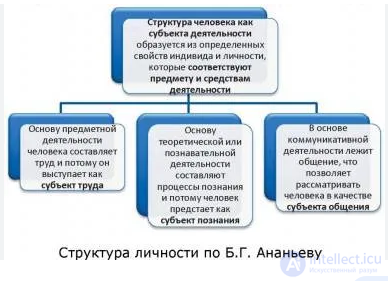
Disclosing the content of the concept of the subject, Ananyev links it to activity, to its object, its tools, its operations, and its planned result.
The subject, he emphasizes, is not reducible solely to exclusively specific
subject-related phenomena. The structure of the subject integrates the properties of the individual and
of the personality that determine the readiness and ability to perform activity and to achieve within it a certain level of productivity. Therefore
the structure of the subject is the structure of a person's potentials, beginning with his viability and capacity for work and ending with talent.
Drawing on the results of numerous experiments, B. G. Ananyev shows that one of the central places among the potentials of the subject
is occupied by intelligence — a multilevel and multicomponent organization of cognitive powers, which includes psychophysiological functions, mental processes, states, and properties. Intelligence, as these same carefully conducted experiments showed, is grounded in life activity, and its productivity depends not only on the degree of mastery of operations and on the nature
of motivation, but, as was emphasized in another connection, also on the energy
supplied by the organism to the processes of information processing and decision-making, which is expressed in what is known as the cost of intellectual strain.
So then, Ananyev constantly and consistently related both the characteristics of the individual, and the features of personality,
and the properties of the subject, and the complex character of the interconnection among them
to the essential traits of human activity.
The role of communication, cognition, play, learning, labor, sport, and so on, in his view, lies in the fact that it is precisely in them that those qualities of personality and those properties of the subject are formed which
are necessary for their successful performance. Thus, in considering the problem of the relationship between the individual and the personality in individual development, one must take into account which
kinds of activity a person becomes involved in, and which connections with the subject mediate this relationship at
different stages of life.
In becoming involved in various kinds of activity, both primary (communication, cognition) and derivative (play, learning, labor), a person realizes the natural potential accumulated in the course of life. This leads to the formation of individuality, which may be regarded as the highest type of new formation. Within individuality there occurs not only the unification and establishment of close connections among the main structures of a person as an individual, a subject
of activity, and a personality, but also their unidirectional development, in which the social
tasks and attitudes of the personality are realized through active, creative
activity drawing on all the resources of individual organization. Therefore the most active influence of personal features on their natural
basis is exerted only within the structure of individuality, which is
the outcome of a person's life course

Comments