
Lecture
Psychological barriers in the process of communication are obstacles or hindrances that can arise due to psychological factors and interfere with the effective exchange of information and ideas between people. They can arise on the part of the speaker as well as on the part of the listener, and can affect the quality and understanding of communication. Here are some of the most common psychological barriers:
Insufficient attention: The listener may be insufficiently attentive to the speaker due to distractions, fatigue, or lack of interest in the topic of communication.
Bias and stereotypes: Bias and stereotypes can hinder the objective perception of information and create a distorted impression of the speaker or their message.
The ability to listen and hear: Some people may have difficulty with active listening, which means the ability to listen and simultaneously understand the message. This may include listening to only part of the message or failing to pay attention to the nonverbal means of communication.
Information overload: In a world saturated with information, information overload can make it harder to perceive and process messages. An excessive amount of information can create confusion and cause fatigue.
Emotions and emotional barriers: Strong emotions, such as anger, fear, or disappointment, can hinder understanding and constructive communication. Emotional barriers can lead to conflicts and misunderstandings.
Introversion and extraversion: Introverts and extraverts may have different communication styles, which can cause misunderstanding and confusion in communication.
Fear of criticism: Fear of criticism can prevent the speaker from honestly expressing their opinion and ideas, especially if they are afraid of a negative reaction from listeners.
Uncertainty and doubt: Some people may doubt their ability to understand or express information, which can lead to indecisiveness and low self-confidence in communication.
Language barriers: Not knowing a language or having insufficient command of it can create language barriers that impede effective communication.
A special group of communication difficulties consists of violations of strategies,
planned in advance by the participants. For example, an unexpected form of contact,
or a discrepancy between the expected behavior and the partner's actual actions in communication can lead to complete confusion. Insufficient orientation in
the conditions and content of communication leads to confusion or mental strain, as a result of which the interaction between the parties risks ending in
conflict.
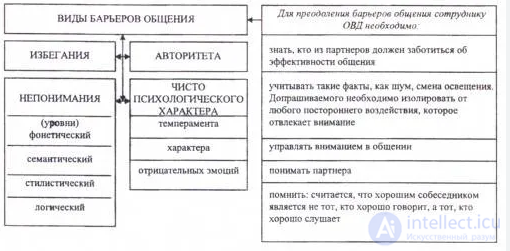
Fig. types of communication barriers and how to overcome them
This same group of difficulties includes the problems of social perception.
Stereotypes of perception, bias and prejudice, negative attitudes of partners toward one another, a mismatch of value orientations at the level of basic social attitudes and layers of meaning in consciousness, and the formal classification of another person's image into categories such as "bad – good,"
"reliable – unreliable," and so on, significantly distort people's perceptions of one another and provoke negative reactions during meetings, conversations, and negotiations, arousing distrust and reducing the effectiveness of establishing relationships.
The importance of being able not only to speak but also to listen is also evident. Because of the habit of constantly talking and giving instructions to others, as is often the case with
some people, the skills of attentive listening based on interpersonal understanding may weaken. Other people, in contrast, have difficulty developing speaking skills and often find it hard to "get a word out." These individual differences are one of the factors behind impeded communication.
Learning communication tactics requires knowledge of and attention to the distances,
determined by the relationships between people.
A violation of these distances leads to psychological discomfort for those communicating. These distances are divided into spatial zones: intimate, personal, role-based, and social. In different cultures these zones differ somewhat, depending on factors such as age, individual psychological characteristics, and belonging to a particular culture, but on average they range from 0–15 cm to 15–46 cm in intimate relationships, from 35–60 to 80–120 cm in interpersonal relationships, from 120 to 210 cm in role-based interactions, and in the most extreme cases can reach 3.6 m.
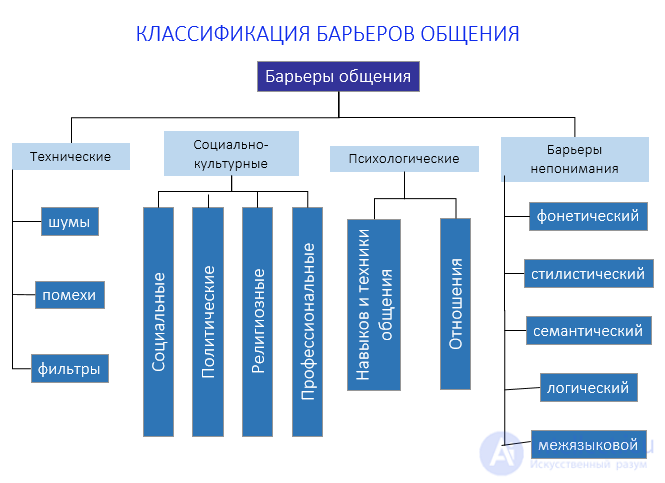
fig. classification of communication barriers
Social spaces are the spaces of interaction between groups of people, of mass communication with audiences. They begin at a distance of 3.6 m and
constitute an individual's publicly accessible zone. Entering another
person's zone in a way inconsistent with the relationship already established with them causes
the release of large amounts of adrenaline, reddening of the skin, an increase in
heart rate, and other physiological reactions characteristic of stress.
Psychological barriers, i.e., obstacles and impediments, in communication can
arise both in connection with the emotional state of the people communicating and in
connection with a mismatch in the meaning of statements, requests, orders, etc. In the subject's state when barriers arise, heightened negative experiences are observed (for example, feelings of shame, guilt, fear, anxiety,
and lowered self-esteem, etc.).
A communication barrier (psychological) is a psychological state experienced as inadequate passivity that impedes communication. Overall,
communication barriers can be divided into aesthetic, moral,
and emotional barriers. For example, a person detained while wearing dirty clothing is, because of this aesthetic barrier, perceived in advance as a potential offender, although, of course, they may not have committed any unlawful acts at all. Barriers in communication are linked to the bias and groundlessness of negative attitudes that in a number of cases arise from a first impression. Negative attitudes can be introduced into a person's experience by someone
else.
To overcome psychological barriers in communication, it is important to recognize their existence and work on improving communication skills and emotional intelligence. This may include active listening, managing emotions, openness to diverse points of view, and respect for the interlocutor

Comments