
Lecture
Pedagogical styles of communication represent the various ways a teacher interacts with students in the educational environment. Depending on the style adopted, a teacher can create a particular classroom atmosphere and influence the students.
Pedagogical communication is a holistic system (techniques and skills) of the socio-psychological interaction between the teacher and those being educated, encompassing
the exchange of information, educational influences, and the organization of relationships by means of communicative tools (A. A. Leontiev). In the course of ontogenesis and socialization, every person spontaneously develops a
style, and deliberately shapes several models of communication.
It should be noted that the individual-typological features of a teacher's interaction with learners determine the style of pedagogical communication. The most widespread of these are well known
.
The «joint creativity» style is the most productive, not only in terms of its final result but also its educational side. It is based on
the unity of the teacher's high professionalism and ethical attitudes. The activity-dialogue scheme of this type of communication places the teacher and the learner in
an equal position, where common goals are set and solutions are found through joint effort. In this style, as on a photographic film, all the personal qualities of both sides are revealed.
The «friendly disposition» style is closely related in its features to the previous one. It is based on genuine interest in the personality
of one's communication partner, in the audience as a whole, respectful treatment of everyone, and openness to contact. This style is a prerequisite for successful joint
educational activity. The extreme form of «friendly disposition», carrying a negative charge in relationships, may be regarded as the style of «flirtation». It is based on the desire to win a false, cheap authority with one's communication partner. This style emerges from the wish to be liked, to be pleasant to the audience, in the absence of even a minimal personal communicative culture and
solid general pedagogical training. A novice teacher can easily slide into this style of communication.
In contrast to «flirtation», there is also the «intimidation» style, which arises as a consequence of one's own insecurity combined with a higher status,
than that of the partner, or due to an inability to organize communication on the basis of productive joint activity. This style artificially places the partner
in a position of dependence, evoking a negative attitude toward the opposite side. The process of communication turns out to be rigidly regulated,
confined within formal, official limits. An invisible barrier of alienation arises between those communicating. For productive creative activity, this
style is entirely unacceptable.
In business circles, as well as in school and university pedagogy, the «distance» style is widespread. It has various shades, but in every case it comes down
to a subjective emphasis on differences between partners: age-related, social, occupational, professional. Without maintaining distance, pedagogical communication can slide into overly familiar, condescending relations. Distance serves as an indicator of the teacher's leading role. On the other hand, however, absolutizing distance as a style sharply limits the creative potential of joint activity and provokes authoritarianism
in managing the pedagogical process. With this style of communication, one should choose a reasonable range for its application, which depends not so much on practical experience as on the teacher's empathic tendencies, i.e., on the tendency to «empathize» with the partner's situational state. It should be noted that inflexible use of this style, despite its very high popularity, is bound to lead to failures in professional and pedagogical communication.
One of the extreme varieties of the «distance» style can be considered the «mentoring» style, when one of the partners (most often a person
who considers himself an «experienced» person) voluntarily or unintentionally takes on the role of mentor. The instructive, patronizing tone on his part, present not only in dialogue but in his entire outward manner, not only increases the gap between those communicating but may become an object of mockery and caricature. In the worst case, this style will lead to a complete loss of contacts, and communication will take on a one-sided, purely informational character.
«Intimidation», «flirtation», and extreme forms of the «distance» communication style carry a hidden danger due to their high capacity to penetrate a person's individuality, since they represent a mechanism of psychological defense against outside influence. They can easily turn into
stable behavioral stereotypes that fence a person off from the environment in which he finds himself. The risk increases of becoming rejected by one's social
environment and ending up an outcast.
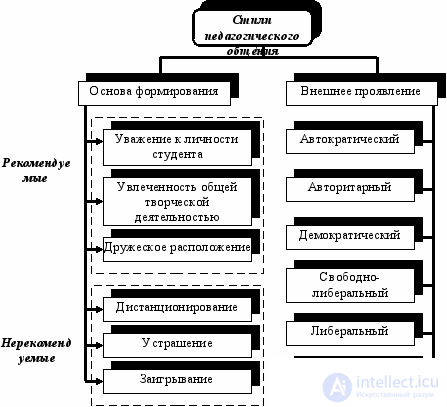
Fig. Styles of pedagogical communication as a means of managing educational and cognitive activity.
The listed options do not exhaust the full richness of communication styles spontaneously developed through long practice. Within its spectrum, the most varied nuances are possible, producing unexpected effects that establish or disrupt partners' interaction. As a rule, they are found empirically. At the same time, a style of communication found and acceptable for one teacher may prove completely unsuitable for another. The individuality of a person is vividly revealed in their style of communication.
Below are other styles of teachers' communication:
Authoritarian style:
Democratic style:
Mixed style:
Coaching style:
Communicative style:
The choice of communication style depends on the goals of the educational process, the characteristics of the group of students, and the teacher's personal preferences. Moreover, a successful pedagogical style often combines elements of different styles, adapted to specific educational tasks and context.
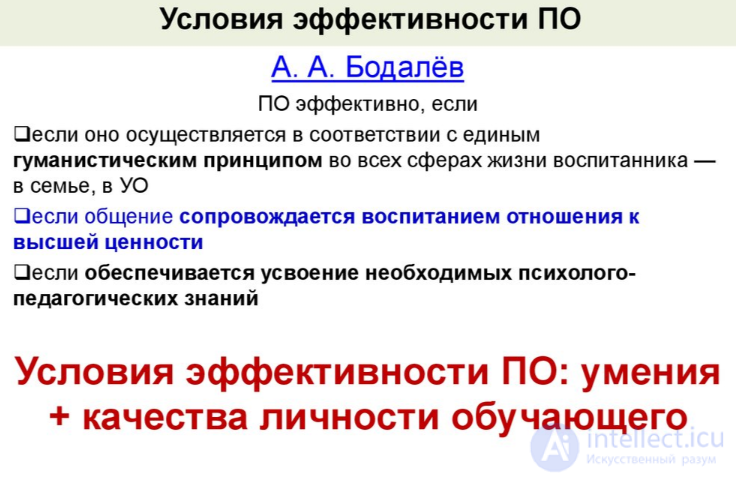
Fig. Conditions for the effectiveness of pedagogical communication
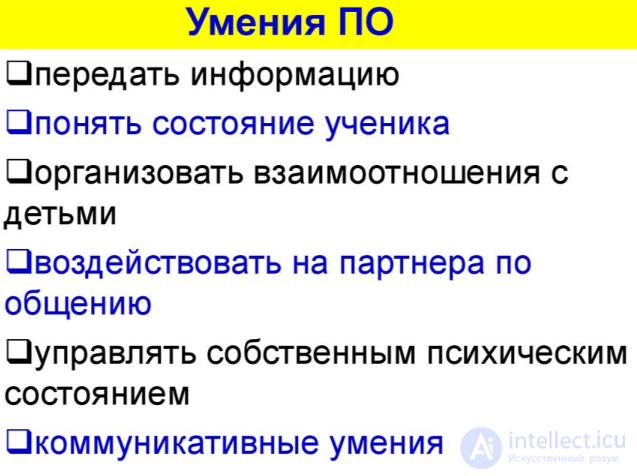
Fig. Skills of pedagogical communication
Models of a teacher's communication are theoretical frameworks that describe and explain how a teacher interacts with students and which strategies and approaches he applies in the educational process. Different styles of communicative interaction give rise to several models of teacher behavior in communicating with learners during classes.
They can conventionally be designated as follows.
The lecturer model («Mont Blanc»). The teacher is, as it were, detached from the learners, soaring above them, dwelling in the realm of knowledge. The learners are
merely a faceless mass of listeners. There is no personal interaction at all. Pedagogical functions are reduced to the transmission of information.
Consequence: absence of psychological contact, and hence a lack of initiative and passivity among the learners.
The non-contact model («the Great Wall of China») is very close in its
psychological content to the first one. The difference is that between the teacher and
the learner there is weak feedback due to a barrier to communication, erected arbitrarily or unintentionally. The role of such a barrier may be played by a lack of desire to cooperate on either side, an informational rather than dialogical nature of the class, an involuntary emphasis by the teacher on his status, or a condescending attitude toward the learners.
Consequence: weak interaction with the learners, and, on their part, an indifferent attitude toward the teacher.
The model of differentiated attention («Locator») is based on selective relationships with learners. The teacher is oriented not toward the whole audience but only toward a part of it — say, toward the talented, or, conversely,
the weak, the leaders, or the outsiders. In communication, he places them, as it were, in the position of
figurative navigational marks, by which he gauges the mood of the group, concentrating his attention on them. One of the reasons for this model of communication in classes may be an inability to combine individualization of instruction
with a frontal approach.
Consequence: the integrity of the act of interaction within the «teacher–collective» system is disrupted; it is replaced by fragmentary situational contacts.
The hyporeflexive model («Black Grouse») consists in the fact that the teacher, in
communication, is, as it were, closed in on himself: his speech is for the most part monological.
At the same time, while speaking, he hears only himself and does not react to the listeners in any way. In dialogue, it is useless for the opponent to try to interject a remark — it simply will not be perceived. Even in joint work activity, such a teacher is absorbed in his ideas and displays emotional deafness toward those around him.
Consequence: there is practically no interaction between the learner and the
teacher, and a field of psychological vacuum forms around the latter.
The parties to the communication process exist in isolation from one another, and educational influence is exerted only formally.
The hyperreflexive model («Hamlet») is the opposite, in its psychological pattern, of the previous one. The teacher is concerned not so much with the substantive side of the interaction as with how he is perceived by those around him. Interpersonal relations are elevated by him to an absolute, acquiring a dominant
significance for him. He constantly doubts the effectiveness of his arguments, the correctness of his actions, and reacts sharply to nuances in the psychological
atmosphere of the learners, taking them personally. Such a teacher is like an exposed nerve.
Consequence: heightened socio-psychological sensitivity
of the teacher, leading to inadequate reactions to the remarks and actions of the
audience. In this model of behavior, it is not out of the question that the reins of control
will end up in the hands of the learners, while the teacher will take on a deliberately submissive position in relations with them.
The model of inflexible response («Robot»). The teacher's relationships with the
learners are built according to a rigid program, in which the goals and
objectives of the class are strictly maintained, the methodological techniques are didactically justified, there is
impeccable logic of presentation and argumentation of facts, and facial expressions and gestures are polished, but the teacher lacks a sense of the constantly changing situations of communication. He fails to take into account pedagogical reality, the composition and psychological state of the learners, and their age and ethnic characteristics. An ideally
planned and methodically polished class is wrecked on the reefs of socio-psychological reality, failing to achieve its goal.
Consequence: low effectiveness of pedagogical interaction.
The authoritarian model («I — myself»). The educational process is entirely focused on the teacher. He is the main and only acting figure. From him
come the questions and the answers, the judgments and the arguments. There is practically no
creative interaction between him and the audience. The teacher's one-sided activity suppresses any personal initiative on the part of the learners, and
they see themselves merely as performers, waiting for instructions to act.
Their cognitive and social activity is reduced to a minimum.
Consequence: it fosters a lack of initiative in the learners, the creative character of learning is lost, and the motivational sphere of cognitive
activity is distorted.
The model of active interaction («Alliance»). The teacher is constantly in dialogue with the learners, keeps them in a positive mood, encourages
initiative, easily grasps changes in the group's psychological climate, and responds to them flexibly. A style of friendly interaction predominates
while maintaining role distance. Emerging educational, organizational, and
ethical problems are creatively resolved through joint effort. This model is the most productive.
To quantitatively assess a teacher's communication style, we recommend filling out the test map of communicative activity developed
by I. M. Yusupov on the basis of A. A. Leontiev's questionnaire. To do this, four or five people with experience of communicating with an
audience should act as experts. Each expert works independently, after which
an averaged score is found. The assessment should be carried out on the proposed scale, and in the discussion an attempt should be made to explain which actions of the teacher elicited one score or
another.
Table 2
| 1 | Goodwill | 7 6 5 4 3 2 1 | Ill will |
| 2 | Interest | 7 6 5 4 3 2 1 | Indifference |
| 3 | Encouragement of learners' initiative |
7 6 5 4 3 2 1 | Suppression of initiative |
| 4 | Openness (free expression of feelings, absence of a «mask») | 7 6 5 4 3 2 1 | Closedness (a tendency to cling to a social role, fear of one's own shortcomings, anxiety over prestige) |
| 5 | Activity (always engaged in communication, keeps learners «on their toes») | 7 6 5 4 3 2 1 | Passivity (does not manage the communication process, lets it take its own course) |
| 6 | Flexibility (readily grasps and resolves emerging problems and conflicts) | 7 6 5 4 3 2 1 | Rigidity (does not notice changes in the mood of the audience, is focused as it were on himself) |
| 7 | Differentiation (individual approach in communication) |
7 6 5 4 3 2 1 | Absence of differentiation in communication (no individual approach to the learners) |
If the experts' averaged score ranges between 45–49 points, then the communicative activity is very intense and close to the model of active interaction. The teacher has reached the peak of his mastery and commands the audience with ease. Like a conductor, he masterfully distributes his attention, and all
the means of communication are organically woven into the interaction with the learners. To the uninitiated it may seem that a company of people who have long known each
other has gathered to discuss recent events. However, at the same time everyone is engaged in a common task, and the class achieves its stated goal.
35–44 points – a high score. A friendly, relaxed atmosphere reigns in the audience. All participants in the class watch the teacher with interest or discuss the question at hand. Opinions are actively voiced, and options for solving the problem are proposed. There is no spontaneity. The teacher correctly guides the course of the class, without forgetting to give due credit to the humor and wit of those present. Every successful suggestion is immediately picked up and
encouraged with moderate praise. The class proceeds productively in an active interaction of the parties.
20–34 points characterize the teacher as having quite satisfactorily mastered the techniques of communication. His communicative activity is fairly free in form, he easily makes contact with the learners, but not everything falls within his field of attention. In improvised discussions he relies on
the most active part of those present, while the rest for the most part act as observers. The class proceeds animatedly, but does not always achieve its stated goal. The content of the class may involuntarily be sacrificed to the form of communication. Here, elements of the models of
differentiated attention and inflexible response may manifest themselves.
11–19 points – a low score for communicative activity. There is a one-sided direction of the educational influence on the
part of the teacher. Invisible barriers to communication hinder live contacts
between the parties. The audience is passive, and initiative is suppressed by the teacher's dominant position. His style resembles the authoritarian or non-contact models of communication.
Table – Models of teacher behavior:
|
Name of the model |
Characteristics |
Consequence |
|
1. The lecturer model ("Mont Blanc"). |
Pedagogical functions are reduced to informational communication in the absence of personal interaction. |
absence of psychological contact, lack of initiative and passivity of the learners. |
|
2. The non-contact model ("The Great Wall of China"). |
Between the teacher and the learner there is weak feedback due to barriers to communication: lack of desire to cooperate, an informational rather than dialogical nature of the class. |
weak interaction with the learners, and, on their part, an indifferent attitude toward the teacher. |
|
3. The model of differentiated attention ("Locator") |
Based on selective relationships with learners. Teachers are oriented not toward the whole audience, but only toward part of it, say, toward the talented, the weak, the leaders. |
the integrity of interaction within the "teacher-collective" system is disrupted, it is replaced by fragmentary situational contacts.
|
|
4. The hyporeflexive model ("Black Grouse"). |
The teacher, in communication, is, as it were, closed in on himself: his speech is for the most part monological. Such a teacher displays emotional deafness toward those around him. |
there is practically no interaction between the learner and the teacher (a field of psychological vacuum). |
|
5. The hyperreflexive model ("Hamlet"). |
The teacher is concerned not so much with the substantive side of the interaction as with how he is perceived by those around him. Interpersonal relations take on a dominant significance for him. |
heightened socio-psychological sensitivity of the teacher, leading to inadequate reactions to the remarks and actions of the audience; the reins of control may end up in the hands of the learners. |
|
6. The model of inflexible response ("Robot"). |
The teacher's relationships with the learners are built according to a rigid program, but the teacher lacks a sense of the constantly changing situation of communication. The composition and psychological state of the learners, their age and ethnic characteristics, are not taken into account. |
low effectiveness of social interaction. |
|
7. The authoritarian model ("I – myself"). |
The educational process is entirely focused on the teacher. He is the main and only acting figure. From him come the questions and the answers, the judgments and the arguments. |
it fosters a lack of initiative, the creative character of learning is lost, and the motivational sphere of cognitive activity is distorted. |
|
8. The model of active interaction ("Alliance"). |
The teacher is constantly in dialogue with the learners, keeps them in a positive mood, encourages initiative, easily grasps changes in the group's psychological climate, and responds to them flexibly. A style of friendly interaction predominates while maintaining role distance.
|
Consequence: emerging educational, organizational, ethical, and other problems are creatively resolved through joint effort. This model is the most productive. |
At very low scores of 7–10 points, any interaction with the learners is absent. Communication develops according to the dictatorial or hyporeflexive style models. It is impersonal, anonymous in its psychological content, and practically indistinguishable from a mass public lecture or
a radio broadcast. Pedagogical functions are limited solely to the informational side.
Below are additional models of a teacher's communication:
Direct Instruction Model:
Sociocultural Interaction Model:
Differentiation and Individualization Model:
Instructional Coaching Model:
Active Participation Model:


These models are not rigid frameworks, and teachers often combine various elements from different models depending on specific educational goals and context. It is important to choose the communication model that best suits the specific situation and the group of learners.

Comments