
Lecture
Communication as a communicative process is a complex and multifaceted process of interaction between individuals or groups of people, in the course of which information, ideas, feelings and thoughts are conveyed. Communication is not merely the transmission of words or signals, but also an act of mutual understanding and the exchange of meaningful information. To better understand this concept, let us examine its key aspects:
Elements of communication: The communicative process includes various elements, such as the sender (the one who conveys the message), the message (the information the sender conveys), the channel (the means of transmitting the message, for example oral communication, a letter, or email), the receiver (the one who receives the message), and feedback (the receiver's reaction to the message).
Goals and motives: People communicate with specific goals and motives, which can range from conveying information to establishing relationships, expressing emotions, or resolving conflicts.
Nonverbal communication: Communication includes not only verbal communication (words) but also nonverbal elements, such as gestures, facial expressions, intonation, and body language. Nonverbal signals can convey strong emotional and sociocultural contexts.
Interpersonal relationships: Communication plays an important role in forming and maintaining interpersonal relationships. It fosters the establishment of connections, trust, and understanding between people.
Cultural context: Effective communication also depends on cultural context. Different cultures have their own characteristics and norms of communication, which can influence the ways and structure of communication.
Problems and barriers: In the course of communication various problems and barriers can arise, such as misunderstanding, conflicts, incorrect perception, or failure to understand nonverbal signals.
Feedback: Feedback is an important part of communication, as it allows the sender to assess whether the message was correctly understood and what corrections may be necessary.
The concept of communication (from the Latin communicatio
– message, connection, path of a message) is considered on two levels – the everyday and the scientific understanding of this phenomenon. At the everyday level, communication is understood as the ability to establish contacts of any kind (for example, a person who easily makes contact with people
and finds mutual understanding with them is called «sociable»). In some scientific definitions communication is not separated from social interaction and is treated as the interaction of individuals or social groups, consisting in the direct exchange of skills,
abilities, experience, information, and also the results of activity.
Sociologists and psychologists view communication as the process of transmitting information, ideas, or emotions from one person to another, mainly by means of symbols (the Russian scholar Yu. Lotman, in particular, speaks of communication as the translation of a text from my «I» into the language of your «you»). In cybernetics communication is understood as the exchange of information
between complex dynamic systems and their parts, which are able to receive information, accumulate it, and transform it.
The communication process is the process of exchanging information between
two or more people. The purpose of the communication process is to ensure understanding of the information, which may be called the message. Knowing the role and
content of each of the stages makes it possible to manage the process as a whole more effectively. Let us consider the individual components and stages of this process.
The forms of representing information in the modern world are diverse.
Let us consider how the exchange of information among people takes place.
Information obtained through visual observation or reading
is visual information. Visual information can not only
be received but also transmitted through facial expressions and gestures, as well as through
books, newspapers, paintings, drawings, and other images.
In human communication there is also auditory information (spoken speech,
music, etc.).
Special attention should be paid to writing. Writing is
a symbolic (alphabetic) representation of spoken speech, in which letters correspond to sounds. On the one hand, reading books, journals, and other sources in
which information is presented in written form belongs to visual
information. On the other hand, writing is a representation of spoken speech, which
belongs to auditory information.
Thus, the same information can be read, seen, and
heard.
The concepts of «communication» and «social interaction» are often used in everyday life as
synonyms, but this is not entirely accurate – there is a substantial difference between them. Everyday exchange is more often social interaction, professional exchange is more often communication. Aimless exchange without rules is more often social interaction, while exchange with a conscious purpose and following scripts (pre-
prepared texts) is more often communication. Unlike social interaction, communication presupposes the presence of a goal in at least one of the
participants.
During social interaction one must bear in mind the following point: speech skills are
by their nature mechanical and stereotyped. Communicative
skills are creative in nature: the conditions of interaction are never repeated
in full. Recall the ancient Greek philosopher Heraclitus: «No one
can step into the same river twice; a moment later he is not the same, and the river is different». Thus,
each time, in accordance with the situation of interaction, a person selects the necessary linguistic means and speech skills. Therefore the methods and forms of teaching
communicative skills should differ from the methods of teaching linguistic
skills.
Mass communication is the process of disseminating information (knowledge, spiritual values, moral and legal norms, etc.) by means of technical media (the press, radio, television, computer technology, etc.) to
numerically large, dispersed audiences.
The main parameters distinguishing mass communication from group communication are quantitative. At the same time, as a result of a significant quantitative superiority (an increase in individual communicative acts, channels,
participants, etc.), a new qualitative entity is created; communication
acquires new possibilities, and a need arises for special means
(transmitting information over a distance, speed, reproducibility, etc.).
The conditions for the functioning of mass communication (according to V. P. Konetskaya):
a mass audience (it is anonymous, spatially dispersed,
but divided into groups by interest, etc.);
the social significance of the information;
the presence of technical means ensuring the regularity, speed, and reproducibility of information, its transmission over a distance, storage, and
multichannel character (in the modern era, everyone notes the predominance of the visual channel).
Mass communication is characterized by the following features:
In the process of exchanging information, 4 basic elements can be identified:
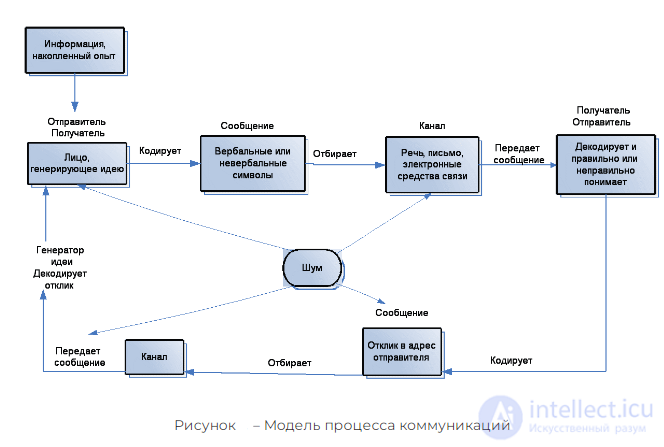
Fig. model of the communication process
The sender and the receiver, in exchanging information, pass through several
interconnected stages. Their task consists in composing a message that
must be conveyed through communication channels in such a way that both parties understand and share the original idea. This process is far from easy, since each
stage is simultaneously a point at which the meaning may be distorted or
lost entirely.
The sender and the receiver of information within the communication system perform a shared basic function and must meet common requirements:
they must have at least a minimal level of humanitarian knowledge; understand a common
symbolic language (code); possess the keys for encoding and decoding encoded information; and have a mutual desire to establish and maintain communication.
In addition, they must possess what are called the background knowledge of the communicants – knowledge of the surrounding reality, the social values of society, culture, and so on. A communicative goal is the strategic result toward which a communicative act is directed.
For example, announcing an impeachment, filing for divorce, or taking on after-sales
service obligations are key speech components of communicative behavior that realize one or another communicative intention, i.e., the intention of the individual communicant (or a corporate communicant presenting itself as an individual) to carry out one or another action
through a communicative act or with its help. A communicative role is the way of behaving within a communicative act that is considered appropriate for a particular situation (group of situations). It is known that
an individual performs a great many different social roles in life. Norms
or rules of behavior in society set the patterns of behavior accepted in a given environment. We observe the highest degree of regulation of the communicative conventions of speech behavior in the legislative assemblies of a number of
countries (the stages by which bills pass). Judicial or scholarly speech is yet
another example of conventions that differ within national communicative structures. A communicator aiming to win over a particular audience must determine its social orientation, knowledge, and interests. Depending on this, the form of the information, its volume and structure, as well as
the means of conveying it, are chosen.
Communicative barriers in communication arise because of internal psychological obstacles and external phenomena that stand in the way of receiving or
transmitting information between interlocutors.
Since there is no single classification of communicative barriers, we will consider two main types of this barrier:
External communicative barriers – the appearance of these barriers is caused not only by people, but also by certain circumstances or physical conditions not
dependent on people's will and not subject to the people conducting the conversation. The cause
of a language barrier may be not only strong noise or unfavorable weather conditions, but also a lack of understanding because the interlocutors speak different languages.
Internal communicative barriers are a far more complex
problem, one that must be fought long and diligently.
An internal barrier can arise because of reasons that prevent an objective assessment of the information
received from the interlocutor.
It may be caused by something as trivial as irritation at a partner's appearance, or by personal dislike of the person as an individual.
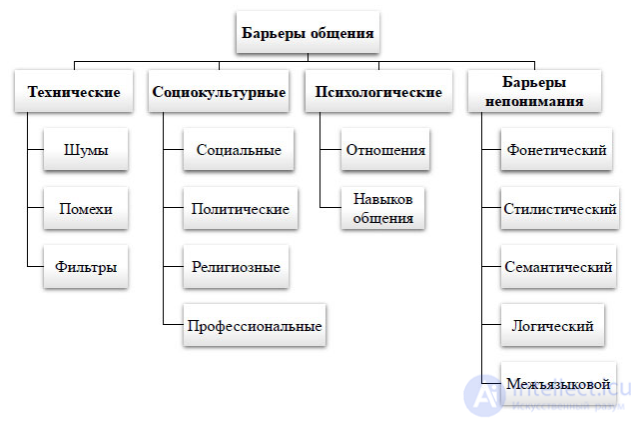
Fig. types of communication barriers
Communicative barriers in business communication can harm
your career, so they must be overcome. In fact, they
persist only until you decide to get rid of them and
think it through. Practice overcoming barriers in communication, pay more attention to your interlocutor, and show genuine interest – then communicative barriers will remain a thing of the past for you forever.
It is practically impossible to do without barriers to interpersonal communication in our lives, unless one communicates only with people who are pleasant to us, and that,
as you understand, does not always work out. The task facing every member of society is
to determine the type of their barrier to understanding in the process of communication and
to apply the most effective way of removing it. To eliminate barriers in communication, always try to be confident, calm, and tolerant
of other people's weaknesses, and do not allow conflicts to build up!
In the process of human communication, the difference between two seemingly
close concepts becomes fully apparent: «to listen» and «to hear». Unfortunately, quite often people, while listening, do not hear one another. Scientifically speaking,
we can talk about effective and ineffective listening.
Listening is ineffective in cases where it does not ensure correct understanding of the interlocutor's words and feelings, creates in the speaker the feeling of not being heard, substitutes their problem with another one more convenient for
the listener, or treats their experiences as ridiculous or insignificant. Listening is also ineffective in cases where it does not advance the communication partners' understanding of the problem being discussed, does not lead to its resolution or correct formulation, and does not foster the establishment of trusting relations between communication partners.
Effective listening, which ensures the correct course
of the processes named above, is a complex volitional act requiring constant attention, interest, and readiness on the part of the listener to break away from
their own concerns and delve into the problems of the other person. Two types of effective listening are distinguished, differing according to the situation of their use:
1. Nonreflective listening – the ability to remain attentively silent without interrupting the interlocutor's speech with one's own remarks (used at the stages of formulating a problem, when it is still being framed by the speaker, as well as in situations where the speaker's goal in the conversation is «pouring out one's soul», emotional release). Attentive silence is listening that actively employs nonverbal means – nods, facial reactions, eye contact and
posture, attentive interest. Verbal techniques are also used, such as repeating the speaker's last words (the «mirror»), interjections («uh-huh
backchanneling»).
2. Reflective listening – this is objective feedback to the speaker, used as a means of monitoring the accuracy of what has been perceived
(used in situations where the speaker needs not so much emotional support as help in solving certain problems).
In this case feedback is given by the listener in verbal form through the following techniques: asking open and closed questions on the topic of the conversation
(clarification), paraphrasing the interlocutor's words, which allows the same thought to be expressed in different words (paraphrase), reflecting feelings, and summarizing –
stating the intermediate and final conclusions of the conversation (usually used in lengthy conversations).
Communication as a communicative process plays a key role in the life of a person and of society. It not only facilitates the exchange of information, but also shapes relationships and influences psychology and culture. Understanding the principles and features of communication can help improve the quality of communication and increase the effectiveness of interaction with others.

Comments