
Lecture
Pedagogical communication is a form of educational interaction, cooperation between the teacher and the students. It is – axial-retial, personality- and socially-oriented interaction (I. A. Zimnyaya). Pedagogical communication simultaneously realizes the communicative, perceptual, and interactive functions, using in the process the entire set of verbal, pictorial, symbolic, and kinetic means.
Pedagogical communication - is a specific type of communication that takes place between a pedagogue (teacher, coach, instructor, etc.) and pupils, students, or trainees in an educational or upbringing environment. It is aimed at achieving educational goals, teaching, and the formation of personality. Here are some characteristics of pedagogical communication:
Educational orientation: Pedagogical communication is based on educational goals and objectives. The teacher sets himself the task of conveying knowledge, skills, and values, and of forming competencies in the students.
Two-way communication: In pedagogical communication, two-way communication is important, in which the teacher and the student interact with one another. The teacher not only conveys information but also listens to and interacts with the students in order to understand their needs and abilities.
Individual approach: Pedagogical communication often requires an individual approach to each student. Teachers and educators take into account the individual characteristics, learning styles, and level of knowledge of each student.
Motivation and inspiration: Pedagogical communication is aimed at motivating and inspiring students to learn and to engage in self-development. The teacher tries to create interest in the subject or task and to help the students see meaning in what they are studying.
Assessment and feedback: Pedagogical communication includes the process of assessing academic achievement and providing feedback. Teachers give students information about how they are doing and offer recommendations for improvement.
Development of communication skills: Teachers and educators play an important role in developing students' communication skills. They model correct ways of communicating and help students develop the skills of listening, expressing their thoughts, and respecting others.
Emotional communication: Pedagogical communication also takes the emotional component into account. Teachers try to create a supportive and emotionally safe environment for students, in which they can freely express their feelings and emotions.
Sociocultural context: Pedagogical communication depends on the sociocultural context and may include a variety of cultural, linguistic, and social aspects.
Cooperation with parents: In some cases, especially in the primary grades, pedagogical communication also includes cooperation with the students' parents, in order to ensure more effective education and upbringing.
As N. V. Kuzmina notes, a pedagogical system – is a socio-historical concept, and every historical type of pedagogical system
is aimed at achieving particular state, pedagogical, and historical goals. This system carries out the instruction and upbringing of the learner's personality, organized by the pedagogical
staff (as its most important element), in a process of purposeful, systematic, and prolonged influence upon him. The pedagogical system has its own goals, objectives, content, and structure, and, what is especially important for the further analysis of communication,
different units: structural, functional, and substantive (Kuzmina N. V. Professionalism in the Activity of the Teacher and Master of Industrial Training at Vocational Schools. M., 1989.)
.
In this broad context, pedagogical communication is defined as «…such communication of the teacher (and, more broadly, of the pedagogical staff) with schoolchildren in the process of instruction, as creates the best conditions for developing the students' motivation and the creative character of learning activity, for the correct formation of the schoolchild's personality, ensures a favorable emotional climate of instruction (in particular, prevents the emergence of a
«psychological barrier»), ensures the management of socio-psychological processes in the children's collective, and allows the teacher's personal qualities to be used
to the fullest extent in the educational process» (A. A. Leontiev).
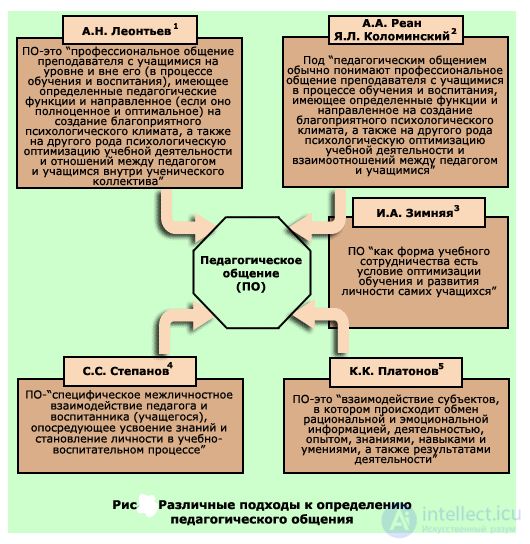
Let us add to this that pedagogical communication, as a form of instructional cooperation, is a condition for optimizing the learning and personality development of the students themselves.
At the same time, pedagogical communication is also determined by the threefold orientation of its subjects: personal, social, and subject-related. The teacher
(instructor), while working with a single student on mastering some piece of educational material, always orients its outcome toward everyone present
in the classroom, and conversely, while working with the class, i.e. frontally, influences every individual student (I. A. Zimnyaya).
The second quality of pedagogical communication is conditioned above all by its teaching function, which includes the upbringing function,
since the educational process, as already noted, has an upbringing and developmental character.
No less significant is the function of facilitation of communication noted by C. Rogers, which is likewise common to these types of interaction. This function is so important that C. Rogers calls the teacher above all a facilitator of communication. This means that the teacher helps the student express himself, express the positive that is in him. The teacher's interest in the student's success, and a benevolent, supportive atmosphere of communication, ease pedagogical interaction and promote the student's self-actualization and further development (Rogers C. On Becoming a Person: A Therapist's View of Psychotherapy. M., 1984.)
.
Thus, speaking of pedagogical communication, let us note in it, alongside the teaching and upbringing component, a facilitative function as well.
The pedagogical task is connected with the students' mastery of certain educational material (for example, the explanation, interpretation, and systematization
of this material, the organization of the development of generalized modes of action, etc.), whereas the communicative task – is the answer to the question of how, by what
means of influencing the students this can be accomplished more effectively.
Here, too, arises the question of the speech acts realizing a particular communicative task under the various conditions of pedagogical communication, among which are the nature of the pedagogical situation and of the communicative act.
The pedagogical situation is considered in the context of a unit of a particular educational process – a lesson, a class session. It is characterized by its purpose, objectives, the stages of the lesson, its content, and the nature of the interaction of the subjects of the joint educational-pedagogical activity, etc.
Depending on the basis used, pedagogical situations can be classified in different ways (I. A. Zimnyaya):
Each situation is carried out by way of particular communicative acts, in the form of communicative tasks, by means of particular speech actions. And here it may be noted that in communication in general, and in pedagogical communication in particular, structural and functional units are distinguished, which take the form of communicative acts and communicative tasks.
Pedagogical communication is of decisive importance for the successful instruction and development of students. The quality of this communication can significantly affect the motivation, academic achievement, and personality development of each student.
The connection between the different aspects (functions) of communication, and their dynamics, are most clearly traced in the level scheme of communication proposed by J. Janoušek
(1981) (Janoušek J. Communication of Three Participants in Joint Activity // The Problem of Communication in Psychology. M., 1981.)
. At the first level of this scheme, communication represents, above all, the transmission and reception of information, its encoding and decoding, which brings about an equalization of the differences existing in the initial awareness of the individuals who have entered into contact.
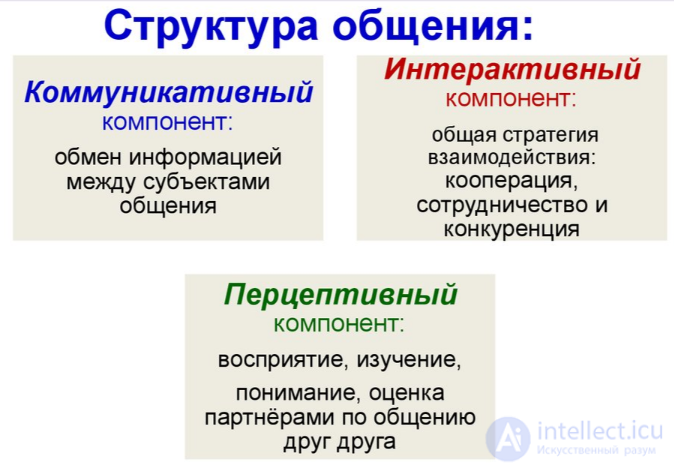
Communication acquires a clearly mutual character at the second level, where it represents the mutual transmission and reception of meanings by the participants. At this level, communication is directly linked to their joint activity in solving a common task, which leads to a certain differentiation.
At the third level, what comes to the fore is what is most essential for communication, namely: the striving to understand one another's attitudes and views,
to listen to the opinions of others, even when one disagrees with them, etc. In this case, communication is directed toward forming a shared assessment
of the results achieved and of the contributions of the individual participants. Striving for a shared assessment may run into an obstacle consisting in the difference of the basic values with which the individual participants enter into communication.
This third level of communication is linked to the collective character of the mutual relations (Janoušek J. Communication of Three Participants in Joint Activity // The Problem of Communication in Psychology. M., 1981.)
.
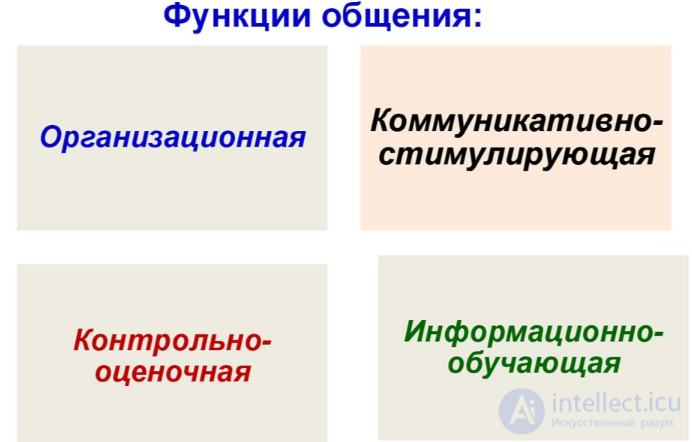
Researchers have identified the speaker's communicative tasks (actions) (for example, informing, persuading, prompting, suggestion, approval,
explanation, refutation, proof, questioning, etc.), which carry the greatest functional load in pedagogical communication. The results
of a survey of teachers from various Moscow schools show that in pedagogical communication the communicative tasks most frequently encountered are
proof, narration, explanation. To the survey question «What is easier for you to do in the classroom?» more than 50 % of teachers answer: «to explain», «to narrate», «to persuade». At the same time, to the question «What do you most often have to do in the classroom?» about 50 % of teachers answer «to prove», which they did not note as
an easy task. 66.7 % of the teachers surveyed solve the communicative task of persuasion more successfully when they are contradicted than when they are agreed with. 80 % of teachers prefer to solve communicative tasks in communication with the class rather than with a single student (L. A. Kharayeva, T. S. Putilovskaya). In other words, socially-oriented communication is preferable for teachers to personally-oriented communication (I. A. Zimnyaya).
At the same time, the ability to solve communicative tasks purposefully is not formed even among students of pedagogical institutes – future teachers.
This is evidenced by the fact that in the very structure of textbooks about 70 % of the exercises are aimed at forming students' informational skills,
with more than half of them ensuring the development of the skills of informing and narrating about something. And only 1.2 % of the exercises are intended for developing regulatory skills, and a little more than 3 % – for developing affective-communicative skills, which determine the style of communication (L. N. Nikipelova,
I. M. Yusupov)

Comments