Psychological manipulation — a type of social influence (or a socio-psychological phenomenon) — is an activity aimed at changing the perception (or behaviour) of other people through hidden, deceptive or coercive tactics, in the interests of the manipulator.
Because such methods advance the manipulator’s interests at other people’s expense, they can be considered exploitative, coercive, dishonest and unethical. Social influence is not always negative — it is usually considered harmless if it is not coercive and respects a person’s right to accept it (or reject it). Depending on the context and the motivation behind it, social influence may amount to either covert or overt manipulation.
Psychological manipulation is a way of influencing a person and their psyche in which the manipulator conceals their true goals and states false ones, gaining an advantage at the victim’s expense.
The manipulator’s victim is a person who is influenced, against their will, in order to shape the needs and motives the manipulator requires of them.
A manipulator is someone who consciously influences other people. There are four types of manipulators:
- the active,
- the passive,
- the competitive,
- the indifferent.
In addition, by type of behaviour manipulators can be divided into:
- dictators,
- doormats,
- bullies,
- judges.
These labels reflect their approach to manipulation.
The opposite of the manipulator is the actualizer. In psychology it is held that both of these opposites are present in every person, and which one manifests itself depends on which one the person develops more. To become a fully realized personality, it is important to learn to be an actualizer.
A comparative characterization of the manipulator and the actualizer is given below (see the table).
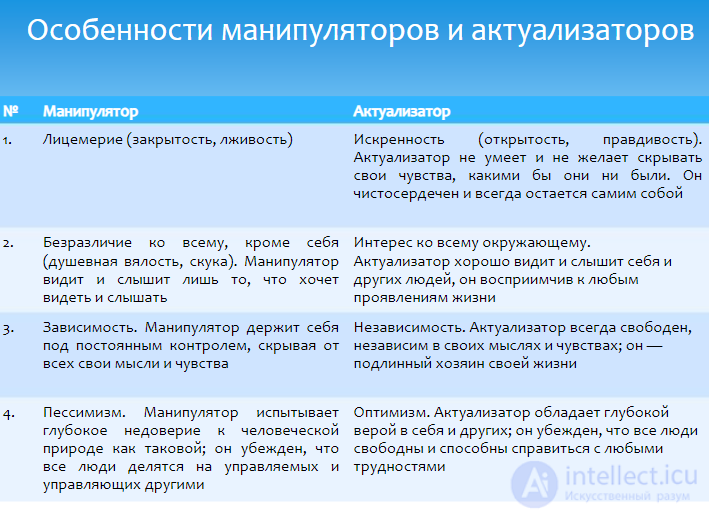
T. V. Barlas notes in her work that manipulation is based on a person’s motives — more precisely, on influencing them. Several motives are usually involved in the process of manipulation. In the workplace, for example, these might be the motives of earnings, prestige, personal growth or interest in the work itself. Usually, however, one of these motives becomes dominant.
It is thought that a person begins to manipulate others when they themselves are experiencing an internal conflict of motives.
Every person takes part in various social spheres — trade, communication, family relations or leisure — as either a consumer or a provider. Manipulation often arises in interpersonal interactions, whether real or virtual. Regardless of the sphere, all manipulation rests on the same general psychological mechanisms, which makes it important to ask how to protect oneself and learn to resist manipulation.
To do this, one needs to understand the essence of manipulation as a social and psychological phenomenon, study its types and techniques, and understand the principles of influence. It is also important to master methods of resistance and to build an effective system of defence against manipulation.
Manipulation is used in every sphere of life and in every kind of relationship — between parent and child, between adults, between employee and boss, or between seller and buyer, commander and private, deputy and assistant.
The mass media often report cases of people taking out loans, buying goods they do not need, joining dubious organizations, or following someone else’s recommendations against their own will. Examples of this include the scandalous activities of A. Chumak in the 1980s, the “MMM” pyramid scheme in the 1990s, and similar schemes today.
The problem of manipulation is especially pressing among young people online, where the risks have grown considerably. This can be seen in examples such as “death groups” and mobile games that act on teenagers’ minds and exploit their unstable psyche. Advertising, fortune-tellers and folk healers are all examples of systems of manipulation and suggestion.
Manipulation is the control of a person’s mind for the manipulator’s benefit, and this phenomenon is found everywhere.
The place of manipulation in the system of human relationships
According to E. L. Dotsenko, all human acts can be arranged along a value axis running from “treating the other as a value” to “treating the other as a means.” The first pole (the subject pole) presupposes recognizing the other person’s intrinsic worth and their right to be as they are. This attitude is expressed in a striving for cooperation, for building relationships of equality, for jointly solving problems as they arise, and in a readiness to understand the other. The second pole (the object pole), by contrast, presupposes treating the other person as a tool for achieving one’s own goals: if they are needed — draw them in; if not — push them aside; if they are in the way — remove them. This attitude is expressed concretely in a desire to possess and control the other person, in a failure to understand them and a lack of any attempt to do so, and in a simplified, one-sided view of them based on stereotypes and commonplace judgements.
However, far from all forms of human interaction can be assigned to one or the other of these two poles. That is why E. L. Dotsenko identified five types of attitudes toward interaction:
- Domination. Characterized by: 1) treating the partner as a thing or a tool for achieving one’s goals, whose interests are not taken into account; 2) a striving to possess, control, and hold an unlimited one-sided advantage; 3) a simplified, one-sided perception of the partner, with stereotyped notions about them; 4) the presence of open, imperative influence (ranging from violence to imposition and suggestion).
- Manipulation. Characterized by: 1) treating the partner as a “thing of a special kind” (a tendency to disregard their interests and intentions is present, but it is not all-encompassing); 2) a striving for one-sided advantage combined with an eye to the impression being made; 3) the presence of covert influence involving indirect rather than direct pressure (provocation, deception, intrigue).
- Rivalry. Characterized by: 1) treating the partner as a dangerous and unpredictable object that must not be underestimated; 2) a striving to outplay them and “wrest away” a one-sided advantage; 3) the use of both covert and overt influence (certain kinds of “subtle” manipulation, tactical agreements).
- Partnership. Characterized by: 1) treating the partner as an equal; 2) a striving to avoid harm to oneself without infringing on the other’s interests; 3) the use of methods of interaction rather than influence (agreement).
- Fellowship. Characterized by: 1) treating the partner as a person of intrinsic worth; 2) a striving for union and joint activity in pursuit of shared or coinciding goals; 3) the use of agreement (consensus) as the principal mode of interaction.
Thus, according to E. L. Dotsenko’s classification, manipulation presupposes unequal relations, close to domination, but distinguished by a lesser intensity of impact on the partner’s psyche.
Classification and types of manipulation
There are various types and techniques of manipulation, which can be divided into direct and indirect.
Direct manipulation
Direct manipulation involves acting on the mind through rational arguments, such as the real characteristics of a product, a matter or an act. This type of manipulation is effective when a person has already decided that they need something but has not yet settled on the specifics (exactly what, and for what purpose).
Indirect manipulation
Indirect influence is used in situations where a person had not originally planned to take some action or buy a product, but the manipulator wants to impose that decision on them. Two techniques are especially common within indirect manipulation: the technique of the missed opportunity and the technique of exclusivity.
-
The technique of the missed opportunity is based on the fear that something missed will become more valuable in the future. In trade this can take the form of promotions, discounts, or offers such as “last hours,” “last days” or “last items in stock.” In relationships it can take the form of threats such as “If we don’t go to the resort, I’ll leave you.”
-
The technique of exclusivity acts on a person’s self-esteem. It produces a feeling of satisfaction and self-worth when buying an exclusive item or, for example, marrying a woman “pursued by a crowd of suitors.”
Techniques and methods of manipulation
1) Influence on the subconscious is one of the most effective and most frequently used methods of manipulation, especially in advertising, the media environment and product presentations, and is often used by fraudulent firms. These techniques act on a person’s subconscious, bypassing their rational filters and beliefs. They are aimed at creating associations that trigger the desired emotions in a person and prompt them toward certain actions, even if the person is not aware of the true motives behind their behaviour. Advertising, for example, may use images, sounds or slogans that evoke positive associations linked to the product, or create a sense that it must be purchased right away.
2) Associations is a manipulation technique based on creating links between a product and certain values or pleasures. This technology is widely used in advertising to build positive associations with a product at the subconscious level.
For example, in an advertisement where chocolate helps people make new acquaintances, an associative link is created between the product and social success. At the subconscious level, the person forms the attitude that buying this chocolate will lead to positive social interactions.
Associations can be linked to various aspects of life:
- Prestige and status: the product is associated with high social standing.
- Love and marriage: it is linked to romantic relationships or family happiness.
- Sexuality and attractiveness: the product makes the person more attractive and desirable.
- Family well-being: it is linked to caring for the family and domestic comfort.
- Luck: the product brings success and good fortune.
- Comfort (moral and material): the product provides convenience and comfort.
- History and culture (national values): it is associated with traditions and cultural values.
- Relief from ailments and pain: the product eases pain or resolves health problems.
These associative links prompt a person to buy, creating the sense that the product satisfies not only functional but also emotional needs.
3) Trance is a manipulation technique aimed at inducing an altered state of consciousness in a person, in which their perception is weakened and their suggestibility increased. This method is widely used in advertising, the media environment and other forms of mass influence. The main elements of this technique include:
-
An abundance of shots and a high rate at which they change: rapid changes of image and information overload mean that the mind does not have time to process the information fully, and the person shifts into a more passive, trance-like state.
-
A visible demonstration of the trance state: including in the footage scenes where the characters are in a trance (frozen in one pose, without speech or movement) helps the viewer unconsciously enter a similar state.
-
Nonsensical phrases and contradictions: the use of meaningless or contradictory statements, which the conscious mind tries but fails to make sense of, causes the subconscious to start absorbing the information directly, bypassing critical thinking.
-
Mounting tension with an unexpected resolution: gradually building emotional tension that is then suddenly released produces a feeling of relief in the person. This can lower critical perception and increase suggestibility at the moment of resolution.
These elements help weaken a person’s rational defences, making it easier for the manipulator to plant the ideas or attitudes they want.
4) Play as manipulation is a form of interpersonal interaction in which manipulation and motives take the form of a game. At the level of intimate-personal communication, according to E. Berne, one of the most common games is the quarrel or scandal. The components of such a "game" include:
-
The hook: starting a discussion of a painful or sensitive topic in an unsuitable situation, which provokes a reaction from the other person.
-
The gimmick (vulnerable spot): identifying an important motive or pressing need of the other participant, which is kept constantly in mind and used for manipulation.
-
The interaction: an exchange of remarks that gradually rise in volume and sharpness, unfolding the conflict.
-
The switch and payoff: at the climax of the game a temporary or final falling-out occurs, leaving one of the participants in a state of shock or disappointment.
-
The payoff: satisfaction is achieved in the form of an existential payoff (confirming one’s beliefs) or a psychological payoff (achieving an unconscious motive).
Example of the game in trade:
-
The hook: the salesperson states, “This model is the best, but it costs more,” nudging the buyer toward a choice.
-
The gimmick: the buyer feels a blow to their vulnerable spot — their financial means (affluence).
-
The switch: the buyer makes the decision and buys the item, even though they may not have originally planned to.
-
The payoff: the buyer may later regret the purchase and not understand how it happened.
The difference between manipulative games and ordinary games in relationships:
-
Ordinary personal games: in such games both participants are active, but their true motives often go unrecognized. Both obtain a certain payoff, but it usually has no practical application, and such games can go on for a long time.
-
Manipulative games: here only one participant is active, their motives are conscious, and they obtain a practical payoff. Such manipulations are usually short-lived and aimed at achieving a specific result.
5) Manipulation through fear is a powerful tool used to control and change a person’s behaviour. This method relies on fear as an emotional lever that makes people act or make decisions under the influence of anxiety and worry. Manipulation through fear is a tool that calls for conscious counteraction. Understanding its mechanisms and methods of influence can help both individuals and society as a whole protect themselves from the negative consequences of this manipulation.
Let us look at the main mechanisms, methods of influence, and possible consequences of this form of manipulation.
1. Mechanisms of manipulation through fear
Creating a sense of threat:
- Spreading panic: the manipulator may spread frightening news or rumours to create a sense of imminent threat. This can relate to safety, health or financial well-being. For example, spreading information about an approaching disaster or economic crisis can cause panic and make people act in the manipulator’s interests.
- Escalating fears: repeatedly emphasizing danger, reinforced through the media or personal messages, helps sustain a high level of anxiety and fear.
Exploiting phobias and fears:
- Exploiting existing phobias: manipulators may use phobias a person already has (for example, fear of death, poverty or social isolation) to control their behaviour. This may include threats or reminders of potential risks, which heightens anxiety.
- Creating new fears: in some cases manipulators deliberately create new fears that did not previously exist in the victim. This may involve using false information or exaggerating minor problems.
Using group fear:
- Social pressure: using the fear of being isolated from the group or society is one of the most powerful tools. For example, the threat of being rejected by the group or society can make a person follow certain norms or ideas, even if these contradict their beliefs.
- The influence of mass panic: manipulators can use fear that has already spread through society to steer people’s actions in the direction they want. In this case the group or society becomes more susceptible to manipulation, since in a state of fear people tend toward herd behaviour.
-
Creating or exaggerating a threat:
- The manipulator creates or exaggerates a threat in order to induce fear. This can be either a real threat or a contrived one. In political propaganda, for example, threats to national security may be inflated.
-
Sustaining the state of fear:
- Having created the threat, the manipulator sustains the state of fear in order to keep the person anxious and dependent. This may include regular reminders of the "dangers" or amplifying fear through the media and advertising.
-
Offering "salvation" or "protection":
- The manipulator offers a solution or protection from the threat they created, thereby strengthening their power over the victim. This can take the form of political decisions, goods or services supposedly meant to protect against the threat.
-
Using social and cultural factors:
- Manipulation through fear can exploit cultural and social norms and prejudices to heighten fear and pressure on a person. In religious contexts, for example, fear of punishment or sin may be used.
2. Methods of influence
The methods used in manipulation through fear are varied and can significantly affect a person’s behaviour and thinking. Here are the main mechanisms:
1. Informational influence
- Using fabricated or distorted information: manipulators often spread false or distorted data in order to impose certain ideas or make people act in a certain way. This can include presenting particular groups of people, events or ideas in an extremely negative light, painting bleak forecasts of the future, or inflating possible threats. Propaganda, for example, may use fear to justify aggressive political action or the restriction of civil liberties.
- Creating threats and terrifying future scenarios: the manipulator may describe hypothetical scenarios that frighten people and instil in them a sense of hopelessness or the inevitability of catastrophe. Under such pressure a person may lose the capacity for critical thinking and begin blindly following the manipulator’s instructions.
2. Emotional influence
- Triggering negative emotional reactions: manipulators use fear to provoke strong negative emotions such as anxiety, panic, depression or anger. These emotions undermine a person’s ability to make rational decisions, making them more susceptible to suggestion. Emotional manipulation, for example, can involve stoking fear of illness, economic crisis or violence, which can force people to make decisions under the influence of fear rather than logic.
- Control through emotion: when a person is in a state of fear, their capacity for independent thought decreases, while the manipulator’s influence grows stronger. This can lead to irrational actions, such as panic buying or support for radical measures that the person would not accept under normal circumstances.
3. Social influence
- Influence from the group or public opinion: social pressure is a powerful tool of manipulation through fear. Manipulators may use the threat of ridicule, ostracism or condemnation by society to make a person conform to accepted norms or demands. Fear of being rejected or mocked can force a person to make decisions that contradict their own beliefs and interests.
- Threat of isolation: manipulators may threaten social isolation — for example, the withdrawal of support from friends, colleagues or family — if the person does not comply with their demands. This is especially effective in cultural or social groups where collective opinion carries great weight.
-
Changes in behaviour:
- People may begin to act against their own interests or values out of fear. This can take the form of making harmful decisions, following the manipulator, or making concessions.
-
Simplification of decision-making:
- Fear can make people decide faster and less deliberately, which makes them more vulnerable to manipulation.
-
Submission and dependence:
- Sustained exposure to fear can lead to psychological dependence on the manipulator and their decisions. People can become more submissive and less inclined to resist.
-
Psychological and emotional consequences:
- Prolonged exposure to fear can lead to anxiety disorders, depression and a decline in overall well-being.
Psychological pressure:
- Threat of punishment: deliberately using fear of punishment — whether physical violence, loss of a job, or loss of reputation — forces people to bend to the manipulator’s will.
- Isolation: the manipulator may threaten social isolation or hold the person up to ridicule, making them feel vulnerable and pliable.
Media influence:
- News and information: manipulators often use the media to spread fear by dramatizing events, emphasizing the negative sides of situations, or spreading false information.
- Social media: in today’s world social media has become a powerful tool of manipulation through fear, where fake news, memes or alarming posts create mass panic or discontent.
These methods of manipulation through fear are used to suppress will, restrict freedom and control a person’s behaviour. Understanding these mechanisms makes it possible to better protect oneself from manipulation and preserve critical thinking even under pressure.
3. Possible consequences
For the individual:
- Anxiety disorders: sustained exposure to fear can lead to chronic anxiety, stress, depression and other psychological disorders.
- Reduced critical thinking: under fear a person tends to act impulsively, without thinking through the consequences, which makes them an easy target for a manipulator.
- Social isolation: fear of being rejected or ridiculed can lead to social isolation, which aggravates feelings of helplessness and vulnerability.
For society:
- Social instability: mass panic and fear can destabilize society, reduce trust in state institutions, fuel protest sentiment and even lead to revolutions.
- Increased control: fear can be used to justify tightening state control, restricting freedoms and rights, and suppressing opposition.
- Division of society: manipulation through fear can deepen social division and conflict, polarizing society amid fear of various "threats."
Consequences of manipulation through fear
-
Social and political consequences:
- Manipulation through fear can be used to achieve political goals, consolidate power or suppress opposition. This can lead to social instability and violations of human rights.
-
Economic consequences:
- Manipulation through fear can be used for commercial purposes, to boost sales or attract customers by creating artificial demand for protective products or services.
-
Personal consequences:
- At the personal level, manipulation through fear can destroy trust, relationships and self-esteem, leading to long-term psychological problems.
1. Psychological consequences
- The development of anxiety disorders: sustained exposure to fear can lead to a chronic state of anxiety, in which a person becomes excessively worried and perceives the surrounding world as a source of danger. This can develop into generalized anxiety disorder, which significantly worsens quality of life.
- Depression: a constant sense of threat and helplessness can lead to depressive states. A person may lose interest in life, feel useless and unable to influence events, which in severe cases can lead to suicidal thoughts.
- Panic attacks: manipulation through fear can trigger panic attacks — sudden episodes of intense fear accompanied by physical symptoms such as a racing heart, shortness of breath and dizziness.
- Post-traumatic stress disorder (PTSD): if manipulation through fear leads to traumatic events or a prolonged sense of threat, a person may develop PTSD, accompanied by recurring memories, nightmares and avoidance of situations that recall the trauma.
2. Social consequences
- Mass hysteria: when fear spreads among a large number of people, it can trigger mass hysteria. Amid panic, people can make irrational decisions, which can lead to unrest, violence or other forms of social breakdown.
- Conflict and division within society: the use of fear can split society into rival groups, deepening conflicts along ideological, religious or ethnic lines. This threatens social cohesion and can lead to violence or civil unrest.
- Suppression of civil liberties: under fear, people may give up their rights and freedoms in exchange for a promise of security. This can lead to the establishment of authoritarian regimes and the restriction of freedom of speech, assembly and other fundamental rights.
3. Decline in quality of life
- Restriction of freedom: the life of a person subjected to manipulation through fear becomes constrained. Fear controls their actions, thoughts and decisions, depriving them of freedom of choice. This can make the person dependent on others and cause them to lose self-confidence.
- Chronic stress: constantly living in a state of fear causes chronic stress, which negatively affects physical and mental health. This can lead to cardiovascular disease, a weakened immune system and other physical ailments.
- Loss of personal and professional growth: when a person is under the control of fear, they lose the ability to develop, to set goals for themselves and to achieve them. This can have a negative effect on their career, relationships and overall well-being.
Counteracting manipulation through fear
-
Awareness and analysis:
- Work out the source of the fear and understand what mechanisms are used to intensify it. Knowing the methods of manipulation helps you defend against them better.
-
Critical thinking:
- Assess information objectively, do not give in to emotional manipulation, and look for factual evidence.
-
Seeking support:
- Talk to close friends or professionals to get an objective assessment of the situation and emotional support.
-
Developing skills to manage fear:
- Learn methods for managing anxiety and stress, such as meditation, breathing exercises and psychotherapy.
Manipulation through fear is a serious and dangerous phenomenon that calls for awareness and active counteraction. Knowing its mechanisms and consequences helps people defend themselves better against manipulators and preserve their mental health.
Manipulative ploys in communication
According to R. V. Kozyakov, manipulative ploys in communication can be divided into three main groups:
1. Organizational and procedural
These manipulations are used to create a particular atmosphere during discussions, negotiations or conversations, especially in business communication:
- Forming an initial mindset: putting the partner in the desired frame of mind.
- Providing materials the day before: preparing information in advance.
- Preventing renewed discussion: blocking a topic from being discussed again.
- Heating up the atmosphere: creating a tense environment.
- Priority order in voting: giving precedence to voting on pre-selected questions.
- Halting discussion on the desired option: freezing discussion once a suitable option comes up.
- Selective loyalty to procedure: applying the rules of procedure selectively.
- Adopting a pseudo-decision: formally adopting a decision without an actual resolution.
- Breaking off discussion: stopping discussion without bringing it to a conclusion.
- Letting off steam on minor issues: discussing trivial matters to avoid the main one.
- An accidental missing document: the absence of a necessary document.
- Information overload: swamping people with information.
- Lost documents: documents that are lost or unavailable.
- Ignoring proposals: disregarding the opponent’s proposals.
- An abrupt change of topic: rapidly switching the subject of discussion.
2. Logical
These manipulations involve the use of logical tricks and fallacies:
- Vagueness of the thesis: an unclear formulation of the main idea.
- Violation of the law of sufficient reason: a lack of evidence.
- Circular reasoning: a logical fallacy in which the conclusion is used as a premise.
- False causal syllogism: falsely linking causes and effects.
- Incomplete refutation: only partially refuting the arguments.
- Improper analogies: incorrect comparisons.
3. Psychological
The broadest group, used in various forms of communication:
- Irritating the opponent: provoking irritation.
- Using obscure words and terms: employing complicated language to create confusion.
- An unexpectedly fast pace of discussion: speeding up the pace of discussion.
- Shifting the argument to speculation: moving the discussion onto assumptions and speculation.
- Mind-reading by suspicion: assuming that someone thinks in a certain way.
- Appealing to higher interests without spelling them out: references to abstract ideas without any specifics.
- Judgements such as “that’s trivial”: diminishing the significance of an idea.
- Conditioning toward a specific thought: instilling a particular thought through repetition.
- Leaving things unsaid while hinting at hidden motives: hinting at concealed motives.
- Appeal to authority: relying on the opinion of authoritative figures.
- Accusing ideas of being utopian: criticizing ideas as unrealistic.
- Flattery or compliments: using praise to manipulate.
- False shame: instilling a sense of guilt.
- Belittling through irony: using irony to diminish.
- Displaying offence: showing offence in order to manipulate.
- Assertiveness or apparent candour of a statement: creating the impression that an opinion is the truth.
- Double standards: different standards for different people.
- Feigned inattention: pretending to overlook important aspects.
- Misunderstanding or feigned incomprehension: creating the appearance of not understanding.
- Practical inapplicability: obstructing the practical application of ideas.
- Relying on a past statement: using earlier remarks as an argument.
- Labelling: sticking labels on people or ideas.
- Substituting information: replacing true information with false.
- Apparent support: creating the appearance of support without any real action.
- Linguistic cosmetics: using manipulative language.
- Reducing a fact to a personal opinion: presenting facts as subjective opinions.
- Selecting arguments: choosing only the arguments that support the desired point of view.
- Ridicule: using mockery to manipulate.
- The Trojan horse: using hidden motives within an argument.
- The boomerang: turning the opponent’s own arguments back on them.
- Concealment: leaving out important information.
- Half-truth: providing incomplete information.
- Lying: distorting facts.
- Carrot and stick: using punishment and reward to manipulate.
- A barrage of questions: overwhelming someone with questions to create confusion.
- “Do you have something against it?”: implying a conflict where none exists.
Conditions for successful manipulation
According to George K. Simon, the success of psychological manipulation depends above all on the extent to which the manipulator:
- conceals aggressive intentions and behaviour;
- knows the victim’s psychological vulnerabilities well enough to determine which tactic will be most effective;
- is ruthless enough not to worry about harming the victim if that becomes necessary.
Consequently, manipulation most often remains covert — taking the form of relational aggression (harm done to a person’s relationships with others, or to their social standing) or passive aggression.
Not every attempt to act on the psyche succeeds. The success of manipulation can depend on many factors. Here are the key conditions that contribute to successful manipulation:
-
The manipulator’s authority: if the manipulator has high status or is well regarded, their influence over the victim increases.
-
The victim’s illness or weakness: in a state of physical or emotional weakness, a person can be more vulnerable to manipulation.
-
A fitting setting: a particular setting or atmosphere — a mystical one for a fortune-teller, for example — can strengthen the manipulator’s influence.
-
Favourable personal traits of the victim: insecurity, timidity, shyness and other personal traits can make a person more susceptible to manipulation.
-
The manipulator’s developed abilities and education: the manipulator’s experience and skill in applying manipulation techniques can increase their effectiveness.
-
Skilful targeting of the victim’s motives and interests: manipulation becomes more successful when it is aimed at the victim’s current needs and interests.
-
The victim’s ignorance of manipulation: a lack of knowledge about manipulation makes the victim more vulnerable to manipulative techniques.
These factors interact and can vary depending on the situation, which affects how successful the manipulation turns out to be.
How manipulators control their victims
According to Braiker
Harriet B. Braiker identified the following main ways in which manipulators control their victims:
- positive reinforcement — praise, superficial charm, superficial sympathy (“crocodile tears”), excessive apologies; money, approval, gifts; attention, facial expressions such as feigned laughter or smiling; public recognition;
- negative reinforcement — removing a troublesome, unpleasant situation as a reward.
- intermittent or partial reinforcement — this can create an effective climate of fear and doubt. Partial or intermittent positive reinforcement can encourage the victim to persist — for example, in most forms of gambling the player may win from time to time, but will still end up losing overall;
- punishment — reproaches, shouting, “the silent treatment”, intimidation, threats, verbal abuse, emotional blackmail, imposing a guilt trip, a sullen look, ostentatious crying, playing the victim;
- a traumatic one-off experience — verbal insult, shouting, an outburst of anger or other frightening behaviour aimed at establishing dominance or superiority; even a single incident of such behaviour can teach the victim to avoid confrontation or contradicting the manipulator.
According to Simon
Simon identified the following methods of control:
- Lying — using a lie that is hard to spot at the moment it is told, when the truth will often only come out later, when it is too late. The only way to minimise the chance of being deceived is to recognise that certain personality types (psychopaths especially) are masters of the art of lying and deception, doing it systematically and, quite often, subtly.
- Deception by omission — a very subtle form of lying by withholding a significant part of the truth. This technique is also used in propaganda.
- Denial — the manipulator refuses to admit that he or she did something wrong.
- Accusing the victim of cowardice — a deep-layer manipulation touching on psychological aspects of personality. Among them: personal attitudes toward one's own behaviour and the situation, public opinion and required clichés, transgenerational attitudes.
- Rationalisation — the manipulator justifies his or her behaviour with reasons and grounds that seem convincing at first glance. Rationalisation is closely tied to “spin” — a form of propaganda or PR, see spin doctor.
- Minimisation — a form of denial combined with rationalisation. The manipulator claims that his or her behaviour is not as harmful or irresponsible as someone else believes, for example, claiming that a taunt or an insult was only a joke.
- Selective inattention or selective attention — the manipulator refuses to pay attention to anything that might upset his or her plans, saying something like “I don't want to hear about it”.
- Diversion — the manipulator does not give a direct answer to a direct question and instead shifts the conversation to another topic.
- Evasion — similar to diversion, but by giving irrelevant, incoherent, vague answers, using indefinite phrasing.
- Covert intimidation — the manipulator makes the victim take on the role of the defending party by using veiled (subtle, indirect or implied) threats.
- False guilt — a special kind of intimidation tactic. The manipulator hints to the conscientious victim that she is not attentive enough, too selfish or too frivolous. This usually leads the victim to start experiencing negative feelings, falling into a state of insecurity, anxiety or submission.
- Shaming — the manipulator uses sarcasm and offensive jabs to increase the victim's fear and self-doubt. Manipulators use this tactic to make others feel insignificant and thus submit to them. Shaming tactics can be very skilful, for example a hard facial expression or look, an unpleasant tone of voice, rhetorical remarks, subtle sarcasm. Manipulators can make a person feel ashamed even for the audacity of challenging their actions. It is an effective way to instil a sense of inadequacy in the victim.
- Playing the victim — compared with any other tactic, this is the most powerful means of forcing the victim into a defensive position, while simultaneously masking the manipulator's aggressive intent.
- Playing the victim (“poor me”) — the manipulator portrays himself as a victim of circumstances or of someone else's behaviour in order to win pity, sympathy or compassion and thereby achieve the desired goal[13]. Caring and conscientious people cannot help but sympathise with another's suffering, and the manipulator can often easily play on that sympathy to secure cooperation.
- Playing the servant — the manipulator conceals self-serving intentions under the guise of serving a nobler cause, for example claiming to act in a certain way out of “obedience” and “service” to God or another authority figure.
- Seduction — the manipulator uses charm, praise, flattery or open support of the victim to lower her resistance and earn trust and loyalty.
- Projecting blame (blaming others) — the manipulator turns the victim into a scapegoat, often in a subtle, hard-to-detect way.
- Feigning innocence — the manipulator tries to suggest that any harm he caused was unintentional, or that he did not do what he is accused of. The manipulator may put on an air of surprise or indignation. This tactic makes the victim question her own judgement and, possibly, her own good sense.
- Feigning confusion — the manipulator tries to play the fool, pretending not to know what is being talked about, or that he confused an important matter that is being brought to his attention.
- Aggressive anger — the manipulator uses anger to shock the victim and force submission. In most cases this display of emotion is put on; it is often used to mask insecurity and anxiety.
- Debasement — debasing the victim, followed by the victim compensating for her supposed insignificance, to the manipulator's benefit.
According to Dotsenko
In the view of E. L. Dotsenko, the outcome of a manipulator's activity largely depends on the “arrangement” of his statements. Analysing the work of his predecessors, the researcher identified the following means of informational framing used for the purpose of psychological influence (in the examples below, the words carrying the main semantic load are italicised)
- “Universal statements”, which are by their nature unverifiable and therefore not open to discussion: “all men are the same”, “there's a little of the fool in every wise man”.
- Extended generalisations. These can be explicit (“you're always late”) or covert (“this is half an hour's work. But we assigned it to the students…”; equivalent to saying: “students can't even do easy work quickly”).
- Appeal to the “generally accepted norm”: “weren't you taught to close the door behind you?”
- Implicit assumption: “as you understand, I cannot hear you out”.
- Disguise as an implicit assumption: “if you're so smart, why haven't you gotten rich yet?”.
- Indeterminate referential index: “scientists have proven...”, “that's what everyone thinks”, “that's been known for a long time”, “…and other parents allow it”.
- Multiplying actions, names, situations (negative pluralisation): “oh, these know-it-alls…” (a reaction to criticism from one person), “why do our teachers keep quitting?” (a reaction to a single resignation).
- “Communicative sabotage” — a deliberate violation of the logic and aesthetics of the act of communication:
- answering a question with a question;
- “topic switching” (“can I get some information?” — “don't raise your voice at me!”);
- ignoring particular statements made by the other party;
- “juggling” the other party's words, etc.
- Vagueness of criteria: “I only give „top marks“ to the most diligent students”.
- Replacing the subject of the action: “future generations won't understand me”, “at your age I was sharper”, “how are we feeling today?” (in this example the force of the psychological influence is strengthened by a “one-up” position).
- Replacing neutral concepts with emotionally-charged ones (and vice versa): “old rags” instead of “second-hand clothing”, etc.
- False analogy (false metaphor). “Let us recall <...> the market advocates' metaphor: „you can't be a little bit pregnant“. The idea being that the planned system must be completely destroyed and replaced by the spontaneity of the market. This is a completely false metaphor. After all, there is no resemblance whatsoever between pregnancy and the economy”.
- Using modal operators of obligation and possibility: “any student should know the answer to my question”, “it's impossible to tell when you're joking and when you're serious”.
- Delivering mutually contradictory messages (the double-bind technique). The contradiction may lie between words and intonation, between words and the situation (“I shouldn't have burdened you with my problems”, — the manipulator declares once his difficulties are almost resolved), etc.
- Creating informational ambiguity. An example from the film “The Servant”: the manipulator complains to a former subordinate about his long-standing enemy, Roman Bryzgin, and asks him to have a word with the man; since the subordinate was the organiser of a failed attempt on Bryzgin's life, the request takes on an ambiguous character.
Vulnerabilities exploited by manipulators
Manipulators usually spend a good deal of time studying the traits and vulnerabilities of their victim.
According to Braiker, manipulators exploit the following vulnerabilities (“buttons”) that may exist in victims:
- a craving for pleasure
- a tendency to seek the approval and recognition of others
- emotophobia — fear of negative emotions
- a lack of self-reliance (assertiveness) and of the ability to say “no”
- an unclear self-identity (with vague personal boundaries)
- low confidence in one's own abilities
- an external locus of control
Vulnerabilities according to Simon:
- naivety — it is too hard for the victim to accept the idea that some people are cunning, dishonest and ruthless, or she denies that she is being targeted.
- over-conscientiousness — the victim is too eager to give the manipulator the benefit of the doubt and takes his side, that is, the point of view of the person targeting her.
- low self-confidence — the victim is unsure of herself, lacks conviction and persistence, and too easily ends up in the position of the defending party.
- excessive intellectualisation — the victim tries too hard to understand the manipulator and assumes he has some comprehensible reason for causing harm.
- emotional dependency — the victim has a submissive or dependent personality. The more emotionally dependent the victim is, the more vulnerable she is to exploitation and control.
According to Martin Kantor, the following people are vulnerable to psychopathic manipulators:
- the trusting — honest people often assume that everyone else is honest too. They trust people they barely know, without checking their documents, etc. They rarely consult so-called experts;
- the altruistic — the opposite of the psychopathic; too honest, too fair, too sensitive;
- the impressionable — excessively susceptible to other people's charm;
- the naive — who cannot believe that dishonest people exist in the world (or in some particular group), or who assume that if such people did exist, they would not be allowed to act;
- those prone to masochism — a lack of self-respect and a subconscious fear allow them to be used for someone else's benefit. They think they deserve it out of a sense of guilt;
- the narcissistic — prone to falling for undeserved flattery;
- the greedy — greedy and dishonest people can fall victim to a psychopath, who can easily tempt them into acting unscrupulously;
- the immature — have poor judgement and trust exaggerated advertising promises too readily;
- the materialistic — easy prey for loan sharks and those offering get-rich-quick schemes;
- the dependent — need other people's love and are therefore credulous and inclined to say “yes” when they should say “no”;
- the lonely — may accept any offer of human contact. A psychopathic stranger can offer friendly relations for a set price;
- the impulsive — make hasty decisions, for example about what to buy or whom to marry, without consulting other people;
- the frugal — cannot turn down a deal even when they know the reason the offer is so cheap;
- the elderly — may be tired and less able to multitask. On hearing an advertising offer, they are less likely to suspect fraud. Older people are also more inclined to finance people who have fallen on hard times.
Children, adolescents and younger people, who do not yet have the necessary life experience, knowledge and skills to counter manipulation, are among the groups particularly vulnerable to psychological manipulation. In general, the ability to resist manipulation increases with age, reaching a maximum by the onset of old age, and then begins to decline, slowly at first and then more sharply, in old age. For this reason, protecting children, adolescents, younger people and the elderly from the actions of manipulators requires particular attention.
Manipulation can make use of systematic errors of thinking, such as cognitive biases, or logical tricks.
Causes of manipulation and manipulators' motives
In the view of Everett Shostrom, psychological manipulation is rooted in the following causes:
- Distrust. The manipulator does not trust himself. Consciously or subconsciously he is convinced that “his salvation lies in others”, and so he “sets off on the slippery path of manipulation so that „others“ are always kept on a leash”.
- Inability to love. “A normal relationship between people — is love. Love necessarily involves knowing a person as he truly is, and respecting his true nature”. For the manipulator such relationships are impossible, because his “tunnel vision” does not allow him to judge people and their actions correctly. Moreover, love — is “a victory not easily won”, and for a person too lazy to win it, only one alternative remains — “desperate, total power over another person”.
- A sense of helplessness. Many manipulators try to control people out of an awareness of their own helplessness: “A universal example is a mother who „falls ill“ when she cannot cope with her children”.
- Fear of close interpersonal contact. “One of the fundamental human fears is the fear of embarrassment”. This phobia is especially characteristic of the manipulator, who painfully experiences his own inadequacy, and so he prefers formalised communication to close contact.
- The desire to gain approval. The activity of many manipulators is driven by their dependence on stereotypes prevalent in society, one of which might be phrased: “we must gain the approval of everyone, without exception”.
Possible motives of manipulators:
- the need to advance one's own goals and personal gain at virtually any cost,
- the need to acquire a sense of power and superiority over others,
- the wish and the need to feel like a dictator,
- gaining dominance over others in order to boost one's own self-esteem.
- the desire to play games while manipulating the victim, and to enjoy doing so,
- habit, after constantly manipulating victims,
- the desire to practise and to test the effectiveness of certain techniques.
Distinguishing features of manipulators
According to E. Shostrom, a manipulator's attitude to life and to the people around him rests on four “pillars”[23]:
- Lying. The manipulator displays not genuine feelings but feigned ones, “puts on an act”, plays a role, and strives to make an impression. Such a communication strategy inevitably leads to emotional impoverishment: the manipulator's life turns into “a job he doesn't love”, and he loses the ability to enjoy it and to experience deep feelings[24].
- Unawareness. Every manipulator is characterised by “tunnel vision”, whereby a person perceives only what he wants to perceive. It is for this very reason that manipulators are cut off from reality, unable to properly assess events happening around them, and unable to understand the purpose and meaning of their own existence[24].
- Control. “The manipulator <…> loves to be in control. He cannot do without it. He is a slave to this need of his”. However, “the more he loves to be in control, the stronger his need becomes to be controlled by someone else”[24].
- Cynicism. The manipulator trusts neither himself nor others, and deep down has no trust in human nature as such. Incapable of love, he treats those around him as objects to be used, seeing each of them as a means of satisfying his own needs rather than as a person.
Psychological characteristics of manipulators
As shown by research by Yu. V. Milova, manipulators are prone to addictions and to the use of defence mechanisms (in particular — denial, displacement and regression); they are externally oriented, prone to psychosomatic illness, not inclined toward self-actualisation, not spontaneous, not oriented toward the present, and not driven to achieve success[25].
A manipulator may have any of the following personality disorders:
- narcissistic personality disorder,
- borderline personality disorder,
- anxious personality disorder,
- dependent personality disorder,
- histrionic personality disorder,
- passive-aggressive personality disorder,
- dissocial personality disorder,
- Type A behaviour pattern.
Basic manipulative strategies of psychopaths
According to Robert Hare and Paul Babiak[26], psychopaths are constantly on the lookout for a victim for their fraud or deception. The psychopathic approach comprises three phases:
1. The evaluation phase
Some psychopaths — unprincipled, aggressive predators who will deceive almost anyone they meet. Others, meanwhile, are more patient, waiting for an ideal, naive victim to cross their path. Some psychopaths enjoy tackling any target at all, while others hunt only those who are vulnerable. In every case, the psychopath continually assesses a person's potential suitability as a source of money, power, sex or influence. During the evaluation phase the psychopath is able to identify a potential victim's weak points and will exploit them in order to carry out his plan.
2. The manipulation phase
Once the psychopath has settled on his victim, the manipulation phase begins. At the start of the manipulation phase the psychopath constructs a special mask, designed to carry out manipulation of the victim. The psychopath will lie in order to gain his victim's trust. A lack of empathy and of guilt allows the psychopath to lie with impunity; he sees no importance in telling the truth if it will not help him achieve his desired goal.
As the relationship with the victim develops, the psychopath carefully assesses her personality. The victim's personality gives the psychopath a picture of the traits and features to be evaluated. A perceptive observer may notice weaknesses or vulnerabilities that the victim would prefer to minimise or hide from others. As a connoisseur of human behaviour, the psychopath begins carefully testing the victim's inner resistance and needs, and ultimately builds a personal relationship with the victim.
The psychopath's mask — the “personality” that interacts with the victim — is fashioned out of lies, carefully woven to lure the victim in. This mask, one of many, is created to match the victim's individual psychological needs and expectations. The pursuit of the victim is predatory in nature; it often results in serious financial, physical or emotional harm to the person. Healthy, genuine relationships are built on mutual respect and trust, on honest thoughts and feelings shared openly. The victim's mistaken belief that a psychopathic bond has any of these features is precisely what makes the manipulation succeed.
3. The discard phase
The discard phase begins when the psychopath decides that the victim is no longer of use. The psychopath abandons her and moves on to the next victim. In the case of romantic relationships, the psychopath usually secures a relationship with his next target before leaving his current victim. Sometimes a psychopath is dealing with three people at once — the first was recently discarded and is kept in reserve only in case things fail with the other two; the second is the current victim, whom he plans to discard soon; and the third is someone the psychopath is courting, in anticipation of parting with the current victim.
Psychological manipulation in fraud
Techniques of psychological manipulation are widely used by fraudsters. Psychological techniques underlie social engineering, aimed at the unlawful acquisition of personal, banking and other confidential and sensitive information for subsequent use for various fraudulent purposes. Widespread types of fraud built on techniques of psychological manipulation include:
- selling medical devices supposedly capable of curing incurable diseases;
- the “a relative is calling” scam;
- installing unnecessary gas-leak detectors by convincing people they are necessary;
- unnecessary inspection of water meters;
- the theft of money and jewellery by persuading people that a curse needs to be lifted from them.
Recognising psychological manipulation and its signs
Signs of manipulation include the following situations:
- We are forced to do something we don't want to do or didn't plan to do.
- Our contribution to a shared undertaking turns out to be greater than our counterpart's.
- The other person is clearly not interested in our wellbeing.
According to E. A. Dotsenko, there are two ways of recognising a manipulative threat:
1) tracking changes in the situation produced by the technology of psychological influence, and
2) analysing the mechanisms of that influence. The first method rests on the fact that a general sign of a manipulative attempt is a disruption in the proportion of certain “interaction variables”:
- An imbalance in the distribution of responsibility — we suddenly notice that we “owe” someone something, or have “failed to live up to” someone's expectations.
- An imbalance in the ratio of payoff to cost — the result of the work done does not match the effort expended (in this case one must first rule out errors in planning and execution).
- The presence of forceful pressure.
- An imbalance in the elements of the situation — the unusualness of the targets of influence (a new acquaintance behaves with us as if he has known us for a very long time) or the unusual arrangement or presentation of information (the other person emphasises minor details of a matter while omitting all the important particulars).
- Incongruence in a partner's behaviour — different channels convey contradictory information (the other person's confident words contrast with a reluctance to make eye contact, or with fidgety hand movements).
- A partner's tendency to stereotype our actions — an effort to bring them into line with notions of how a “real man” or an “honest citizen” behaves, or with our previous actions (“I know you never break your promises…”).
Analysing the mechanisms of manipulative influence, in turn, involves tracking the changes that occur not around a person but within the person themselves. Such changes include:
- The appearance in behaviour of psychic automatisms (especially if they occur too often or too markedly).
- Regression to infantile behavioural reactions: crying, aggression, wistfulness, etc. (especially if these occur in connection with a specific situation).
- A shortage of time allotted for making a decision (here it is important to understand whether this is objectively the case or is being created deliberately).
- A state of narrowed consciousness — when talking with a certain person, we notice that the conversation is full of fixed, unvarying phrasing and keeps returning to the same topic (or is confined to a limited range of topics).
- Unexpected shifts in background states: a worsening mood, irritation, a nagging resentment and other shifts toward negative emotions (especially if they seem to have no cause). Such psychological reactions often signal harm being done that the victim of the manipulation senses (even if only unconsciously).
Recognising a manipulative threat is also considerably aided by the so-called “symptoms of lying”, identified by A. A. Zakatov in the course of studying investigative practice and the literature:
- The presence of contradictions within the information reported by the other person; its inconsistency with data we have gathered independently.
- Vagueness, lack of specificity in the information given.
- Excessive thoroughness in describing events, especially — those distant in time (a consequence of memorising previously prepared information).
- Inconsistent interpretation of the same events at different stages of the conversation. The absence of objective grounds (for example, a tragic event that led to a reassessment of life values) indicates that the other person has either forgotten the original version or accidentally let something slip.
- Persistent repetition of certain statements not accounted for by neutral causes (poor audibility, etc.).
- The appearance in the other person's speech of expressions and phrases not typical of their level of development or education.
- A mismatch between the other person's emotional tone and the nature of the event they are describing (an account of minor everyday troubles accompanied by cries of despair and wringing of hands).
- Repeated, out-of-place references by the other person to their own competence, integrity, disinterestedness, etc.
- Evading a direct answer to a direct question, or feigning a lack of understanding.
- “Memory lapses” regarding personally significant events that the other person could not fail to know about. It has been established, in particular, that some manipulators are “chronically forgetful when it comes to promises they have made”[14].
Ways of defending against and countering psychological manipulation
Recognising a manipulator or an act of manipulation can involve attention to nonverbal signals and other indicators. Below are the main signs and methods that will help identify manipulation:
Nonverbal signs of manipulation
-
Changes in breathing and blinking:
- Rapid breathing and blinking can indicate the nervousness that often accompanies manipulation or lying.
-
Tension in the facial muscles and flushed cheeks:
- These signs may be related to the manipulator's emotional tension and hidden feelings.
-
Changes in the pupils:
- The pupils may dilate or constrict in response to stress or attempts to manipulate.
-
Changes in the voice:
- Changes in timbre, pace and intonation may indicate deceit or manipulation.
-
Gestures and postures:
- Open palms: Usually symbolise honesty and openness. However, if this gesture is used excessively, it may be a sign of manipulation.
- Stepping the right foot forward when greeting someone: This gesture may be an attempt to establish dominance. Turning the manipulator's hand over, or an equal hand position, can help restore balance to the interaction.
Individual signs
- Familiarity with the person: It is important to observe the individual features of a person's nonverbal behaviour, since some signs may be characteristic of that particular person alone.
An algorithm for detecting manipulation
-
Observing nonverbal signs:
- Pay attention to the signs listed above and compare them with the context of the interaction.
-
Analysing the context and content:
- Determine whether the manipulator's behaviour and information match the actual facts. Look for inconsistencies and possible hidden motives.
-
Applying resistance methods:
- Based on an analysis of the situation, choose suitable methods of passive or active resistance in order to effectively counter the manipulation.
Understanding and taking nonverbal signals into account, together with an awareness of personal and contextual factors, will help you better recognise manipulation and effectively resist it.
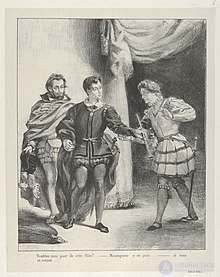
A striking example of successfully countering manipulation is Hamlet's behaviour in the famous recorder scene (“Hamlet”, Act 3, Scene 2). By offering Guildenstern the instrument to play, the hero of the tragedy thereby seized the initiative in his exchange with the manipulator. After Guildenstern refused, Hamlet consolidated his success by openly declaring that he had detected the manipulative threat: “You would play upon me. <…> Do you think I am easier to be played on than a pipe?”
Two defensive strategies can be set against a manipulator's actions:
- Dismantling the technological elements of the influence. Defensive activity of this type is aimed at counteracting the manipulator and corresponds to such elements of his technology as the covert nature of the influence and the exertion of psychological pressure.
- Ways of exposing covert influence:
- Uncovering hidden meanings, motives, etc.: “why are you bringing this up?”, “what are you getting at?”.
- Carefully tracking slips of the tongue, verbal mistakes, shifts in emphasis, etc.
- Building semantic and conceptual barriers: “your explanations are very unclear”.
- Ways of resisting psychological pressure:
- Mirroring (if the manipulator has set a deliberately slow pace of conversation to wear the other person down before an attack, the target of the manipulation can keep the conversation going at an even slower pace).
- Changing the situational setting (if the manipulator initiates the exchange in an enclosed space, it is advisable to move the conversation outdoors, etc.).
- Avoiding psychological contact with the manipulator.
- Concealing the emotions and feelings one is experiencing (this technique will not let the manipulator “detect” the target's true emotions and feelings and exert psychological influence on them).
- Avoiding predictability in one's behavioural reactions and actions (if the target of the manipulation behaves in a way that cannot be “calculated”, the manipulator will not be able to adapt to them).
- Using status- and role-based defence: “as a married man, I can't allow myself to do that”.
- Temporarily breaking off contact with the manipulator.
- Using the elements of the influence for one's own benefit. Defensive activity of this type consists of a deliberate transformation of the manipulative influence. If the manipulator steers the conversation off to one side, the target can “help” the other person along and support him, and then bring the conversation back onto its former course. If, on the other hand, the manipulator tries to nudge the target toward some action through hints, it can be useful to ask directly whether his intention has been correctly understood and, based on the other person's answer, “agree” to that turn of events.
To effectively counter manipulation it is important to apply both internal psychological defences and conscious techniques. The main steps for countering manipulation include analysing the situation and choosing a suitable resistance technique.
Analysing the situation
-
Identify the main sign:
- Determine whether there is an obvious contradiction between the actual outcome and the stated goals of the interaction.
-
Determine the type of manipulation or game:
- If one participant gains a practical payoff, it is manipulation. If the other participant gains a psychological payoff, it is a game. If there is no payoff, it is a game.
-
Identify the participants' true motives and goals:
- Determine the participants' motives to understand how the situation will turn out. You can also identify the specific form of manipulation from the known types.
Resistance
Passive resistance:
- Delaying spontaneous reactions: Do not react immediately to provocations.
- Limiting the speed of the attack: Slow down the pace of the interaction.
- Analysing the situation: Carefully assess what is happening.
- Pressuring the manipulator: Try to force the manipulator to reveal his intentions or abandon them.
Forms of passive defence:
- Ignoring: Fully or partially ignoring the manipulator's words.
- Unexpected silence: Tactful silence in response to the manipulation.
- Feigning inattention: Act as if you did not hear what was said.
- Agreeing with a questioning intonation: Confirming the manipulator's request, but with a questioning intonation to show doubt.
These forms of resistance may require considerable self-control from the victim. The following techniques can be used for this:
- Gazing elsewhere: Focus not on the manipulator's words but on his face or the surroundings.
- Reframing: Picture the manipulator in a different light or rise above him morally. Use pauses to come up with a worthy reply.
- Do not try to insult the manipulator: This can only make the situation worse.
These methods help maintain calm and effectiveness in the interaction, minimising the influence of the manipulation.
Active resistance to manipulation requires a more assertive and purposeful approach. It includes methods of exposing manipulation and taking countermeasures aimed at standing up to the manipulator. The main techniques of active resistance:
Active resistance
-
Openly discussing the unacceptability of manipulation:
- At the start of an exchange, one can state directly that manipulation is unacceptable. This can prevent manipulation before the interaction even begins. However, since this is not always possible, one should be prepared to use other methods.
-
Exposing the essence of the trick:
- If the manipulation has already begun, it is useful to publicly expose its essence. Explain exactly which manipulative technique is being used, who is using it, and what their intentions are. For example: “You are trying to manipulate us, Ivan Ivanovich!”
-
Repeating the reminder that manipulation is unacceptable:
- Hint to the manipulator that you have recognised his actions and are ready to expose them. This may make the manipulator back off or change his methods.
-
A counter-trick:
- Use manipulation techniques in response to the manipulator's manipulation. This is a contest of skill in manipulation, in which the winner is whoever can more effectively hold their ground or force the manipulator to back down.
Subconscious defences
When manipulation is suspected, basic subconscious defences often kick in:
- Withdrawal: Removing oneself from the situation when the manipulation becomes unbearable.
- Expulsion: An attempt to exclude the manipulator from the interaction.
- Blocking: Blocking attempts at manipulation, ignoring the influence.
- Control: An attempt to control the situation in order to minimise the manipulator's influence.
- Freezing: Waiting and observing without taking active action, which can allow for a better understanding of the manipulation.
- Ignoring: Fully or partially ignoring the manipulative actions.
These subconscious defences can sometimes lead to unsatisfactory outcomes, such as withdrawing from the situation, which does not always solve the problem of manipulation. More effective are conscious, controlled methods of resistance, which need to be specifically studied and practised.
See also
- lying
- deception
- [[b9308]]
- [[b12249]]
- communication
- Mind control
- Manipulation of mass consciousness
- Intent analysis
- Social influence
- Pickup artistry
- Machiavellianism
See also


Comments