
Lecture
The development of communication motives over the course of ontogenesis (the development of the individual from birth to maturity) can be represented as a series of stages, each characterized by its own features and needs in communication. Note that these stages develop sequentially, while certain traits and motives may manifest to varying degrees at different stages of life. Let us consider the main stages in the development of communication motives:
Early childhood stage (0-2 years): At this stage, the primary motive for communication is linked to satisfying physiological needs such as feeding, sleep, and physical comfort. For infants, communication with close adults is, first and foremost, a means of meeting physical needs and obtaining emotional support.
Preschool stage (3-6 years): During this period, children begin to show interest in social contacts and develop basic communicative skills. The motive for communication at this stage is connected with establishing social bonds, play, and interaction with peers and adults.
School age (7-11 years): During this period, children begin to master more complex social skills and become aware of the importance of communication for acquiring knowledge, learning, and strengthening their position within the social group. Communication becomes a means of learning and personality formation.
Adolescent period (12-18 years): In adolescence, the motive for communication becomes more diverse. Adolescents seek the recognition and approval of their peers, begin to form their own identity, and explore various roles in society. Communication becomes a means of expressing one's feelings and identifying with a particular social group.
Adult stage (after 18 years): Adults may have a variety of communication motives, including satisfying emotional needs, establishing and maintaining relationships, exchanging information, cooperation, entertainment, and much more. Communication motives may depend on the sphere of life and sociocultural factors.
Old age (over 65 years): In old age, communication motives may be linked to the need for social support, the exchange of life experience, strengthening ties with loved ones, and socialization. Communication can contribute to preserving psychological well-being and activity.
The study of needs is one of the hardest problems in psychology, because they cannot be observed directly, and one must judge a person's needs, their level of development and the specifics of their content, on the basis of
indirect data. Most psychologists assert that human beings have a special need for communication. But they either fail to define the nature of this need,
or formulate it tautologically, as a “striving for communication” or a “desire to be together”. Yet it remains unclear why people
are drawn to one another and why they need to be together.
Immediately after birth, an infant does not communicate with the adult at all: it does not respond to the addresses of older people and, of course, does not address them itself. After 2
months, infants begin to interact with adults in a way that can
be considered communication; they develop a particular activity directed at the adult, and strive to attract the adult's attention in order to themselves become
the object of the same kind of activity on the adult's part. But how can one determine more precisely whether
an infant already has a communicative need, and if not, at what stage of its formation it currently stands?
There are 4 criteria, the simultaneous presence of which indicates that the child already has a need for communication.
The first criterion is the child's attention and interest toward the adult.
This criterion reveals the child's orientation toward knowing the adult, and the fact that the adult has become the object of the children's special activity. The second
criterion, in our view, is the child's emotional expressions directed at the adult;
these reveal the child's evaluation of the adult, and the presence in the child of an attitude toward the adult that is inseparably linked with knowledge about him. The third criterion consists in the child's initiative-taking actions aimed at
attracting the adult's interest and presenting themselves to their older partner; this behavior reveals the child's striving to acquaint the adult with themselves
and, as it were, to once again see their own capabilities through the other person's reaction. Finally, the fourth criterion, for us, is the child's sensitivity to the adult's attitude, in which the children's perception
of the evaluation given to them by the adult, and of their own self-evaluation, is revealed.
The manifestations in children that correspond to the 4 criteria do not appear in
children's behavior all at once, but one after another in the sequence indicated. Taken together, in our view, they make it possible, first, to answer
the question of whether a given child has a need for communication with adults, and,
second, to characterize the level to which this need has developed.
Applying these criteria makes it possible to conclude that, in the first months of life,
children undergo a gradual formation of the need for communication, which is divided into 4 stages corresponding to the appearance of the 4 criteria and is completed by the 2nd month.
Where does a child's need for communication come from, if it is absent at birth and does not arise by itself? It is assumed that it can only be built on the basis of other needs that begin to function earlier.
Apparently, at first, certain elements of the future activity of communication are carried out as part of other kinds of activity, prompted by other needs. After all, any activity is always more multifaceted
than is envisaged by its initial task. And only later, gradually,
these elements become distinct, combine, and form a new kind of activity. At the same time, the activity of communication and the need for communication are constituted almost simultaneously, and in both cases the starting point is the singling-out of the adult as the object of the child's special activity.
Such behavior on the part of the adult, in the course of practical interaction with the infant, creates an additional necessity and opportunity for the child to single
the adult out as an object, but it also allows the child, over time, to perceive the adult as a subject as well, and gradually, with the adult's help, to discover new — subjective — qualities in themselves too. The specific nature of the communicative need
consists, as stated above, in the child's orientation toward understanding and evaluating themselves and other people — those with whom they communicate. Having arisen in the child with
the discovery of the fundamental property of subjectivity, of the “personhood” of the adult and of themselves, the need for communication continues to constantly prompt children to discover ever new qualities in themselves and in the people around them, their
capabilities and abilities important for the success of joint activity.
As is well known, the term “motive” is interpreted quite differently by different psychologists.
In the activity-based conception that we have adopted as the basis for interpreting communication, the concept of motive is closely linked with the concept of need.
A. N. Leontiev writes about this as follows: “In the state of need itself,
the object capable of satisfying the need is not rigidly fixed. Prior to its first satisfaction, the need “does not know” its object; the object still has to be discovered. Only as a result of such discovery
does the need acquire its objectivity, and the perceived (represented, conceived) object acquires its motivating and directing function for the activity, i.e., it becomes a motive.” Thus, the motive of an activity
coincides with its object. Consequently, for each participant in an interaction the motive for communication is the other person,
their partner in communication.
In the case of communication with an adult, the motive for communication that prompts a child to address the adult, performing an initiative act of communication, or to respond
to the adult, performing a reactive action, is the adult themselves. In communication with a peer, the motive for communication is the other child.
At different periods of childhood, a child is able to see in their partner
only part of the partner's actual qualities. As they grow, the child comes to know other people
in their increasingly essential and deeper properties. In parallel, what motivates children's social acts at the various
stages of preschool childhood also changes in the partner. This is how different categories of communication motives arise, and each of them develops.
It is very important to take into account the fact that in the process of communication all
participants in the interaction are active. Consequently, if communication unfolds between a child and an adult,
then not only does the adult turn out to be a motive of the child's social behavior: the child, too, necessarily becomes an object — and
therefore also a motive — of the adult's communicative activity. These two motives belong to different people: one — to the child, and the other — to their partner, but
they function within a single interaction between these people. In studying children's motives for communicating with adults and peers, we encountered an interweaving of their
mutual motives so close that in most cases they can only be separated by means of complex analysis.
We are constantly compelled to speak not
only about what attracts the child in the partner, but also about what the child receives from
the partner, in becoming the motive (object) of the latter's active communicative activity
of that partner.
The main groups of motives in children's communication with the people around them
The motives that prompt a child to enter into communication with adults are connected with three of the child's principal needs: these are
The works of many researchers testify to the existence in children of an acute need for impressions.
After coming into the world, a child displays a pull toward new impressions, eagerly catching rays of light, listening intently to various sounds, freezing at the touch of something on their body. At the same time, the more complex and unusual
the object, the more it captures attention, and the longer the child's interest in it lasts. Thus, the need for new impressions gives rise in children
to a striving to enter into contact with adults. This is how the first group of communication motives arises, which we call cognitive motives, or motives for children's communication with adults on cognitive topics. According to the proposed conception, this motive is the adult themselves in one particular capacity: as a source of information and as an organizer of the child's new impressions.
The need for active activity is inherent in children just as evidently
as the need for impressions. Anyone who has observed a child is struck
by their restless activity. Children's fidgetiness, their shifting during the day from
one activity to another, speaks to the acuteness of the hunger for activity that they experience. A child's lethargy, their passivity, serve as an unmistakable sign
of their poor state of health or developmental defects. It is possible that children's need for active activity represents a particular case of the phenomenon
known as the “need of an organ to function.” But for the purposes
of this analysis it is enough that such a need is inherent in children.
Over the course of the first 7 years, the activity displayed by children reaches
a high level of development, both in its form and in its content. But in order to achieve maximum effectiveness, children always require the participation and help
of an adult. This leads to interaction with the adult appearing in children's activity, and among the various kinds of interaction a permanent place
is consistently occupied by the particular kind that we call communication. Thus, children's need for active activity becomes a source of prompting for
addressing the adult, and gives rise to a special group of communication motives, called business-like. According to the views developed here, the business-like motive for communication is the adult in their special capacity — as a partner in joint
practical activity, a helper, and a model of correct actions.
Children's need for recognition and support is emphasized by many
researchers. On closer examination it turns out that children's need
for recognition and support is their striving for communication, because
only as a result of this activity can they obtain from those around them
an evaluation of their personality and realize their striving for a sense of commonality with other people. A characteristic feature of this kind of communication should be recognized as
its focus on the personality of people — on the personality of the child themselves, who is seeking support; on the personality of the adult, who acts as a bearer
of the rules of moral behavior, and of other people, knowledge of whom serves, in
the final analysis, the cause of children's self-knowledge and their knowledge of the social world.
That is why we have called the motives of the third group personal motives. Unlike cognitive and business-like communication motives, which play a subordinate role and
mediate more distant, ultimate motives arising from the needs for impressions and for active activity, personal motives receive
their ultimate satisfaction in the activity of communication itself. As this final motive, the adult appears before the child as a special personality, as a member of society, a representative of a particular group within it.
Cognitive, business-like, and personal motives appear during the period of the formation of communicative activity
practically simultaneously. In a child's real everyday practice, all three groups of motives coexist and
are closely intertwined with one another. But at different periods of childhood their relative role changes: now one, now another of them takes the leading position. The advancement of a particular group of motives is connected with
a change in the content of communication, and the latter reflects the features of the child's overall
life activity: the nature of their leading activity, and their degree of independence.
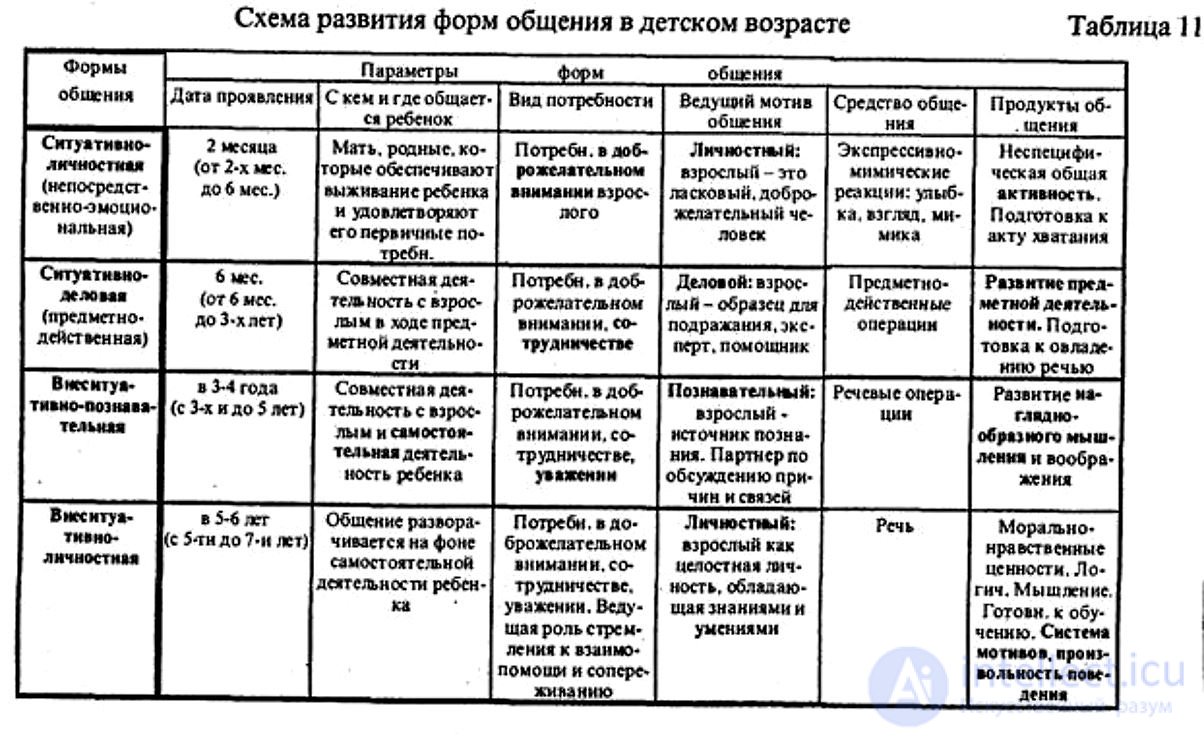
In the first half-year of life, the leading motive for children's communication with adults is the personal motive. It is embodied in the person of the adult as an affectionate
well-wisher, who at the same time serves as the central object of children's cognition and activity.
Beginning with the second half-year of life and later, up to 2.5 years, the leading motive for communication becomes the business-like motive. It is embodied in the person of the adult as
a skillful partner in play, a model to imitate, and an expert in assessing the child's skills and knowledge. In early childhood, children continue to value the
adult's attention, and rejoice at the adult's praise, but
their striving for joint activity comes to the fore. “Empty” affection,
unconnected with anything, usually irritates a small child,
and makes them dodge the stroking
hand, while praise for a successful action evokes both special joy in the child, and
even a search for the adult's attitude that anticipates it.
In preschool age, three periods are observed in the formation of communication motives: first, business-like communication motives take the leading place, then cognitive motives, and finally, as in infants, personal motives.
It is important to note that communication motives can change at different stages of an individual's life and are subject to the influence of sociocultural, emotional, and personal factors. The development of communication motives is an important part of the psychological and social development of the personality.

Comments