
Lecture
Social perception is a psychological process in which a person perceives, interprets, and understands other people, their emotions, actions, intentions, and personal characteristics within a social context. This process allows us to draw conclusions about what people are like and what kind of relationships can be established with them.
Communication as person perception is a process in which people interact with one another, exchange information, and form impressions of each other. This process plays an important role in interpersonal relationships and shapes each person's impressions of what other people are like in their eyes. Let's examine the key aspects of communication as person perception:
First impression: When people meet for the first time, they form a first impression of each other. This first impression may be based on appearance, manner of behavior, voice, and other sensory inputs. It can strongly influence subsequent perception and relationships.
Stereotypes: People may hold stereotypes or biases that can influence their perception of others. Stereotypes are based on commonly held notions of how representatives of certain groups or categories "should be".
Nonverbal communication: In the process of communication, a great deal of information is conveyed through nonverbal signals such as facial expressions, gestures, intonation, and body language. These signals can reinforce or alter the perception of messages and personalities.
Attribution: People often try to understand the reasons for others' behavior. This process is called attribution. Attribution involves determining whether another person's behavior is the result of internal characteristics (for example, personality) or external circumstances (for example, the situation).
Feedback: In the process of communication, people receive feedback from their interlocutors. This feedback can influence their perception and understanding of the people they are communicating with.
Interpersonal relationships: Communication contributes to the formation and development of interpersonal relationships. People form impressions of others based on their experience of communication and interaction.
A person cannot live in isolation. Throughout our entire lives we come into contact with the people around us, form interpersonal relationships, entire groups of people form connections with one another, and in this way each of us turns out to be a subject of countless and diverse relations. How we relate to an interlocutor and what kind of relationship we form with them most often depends on how we perceive and evaluate our communication partner. When entering into contact, a person evaluates each interlocutor both by appearance and by behavior. As a result of this evaluation, a certain attitude toward the interlocutor is formed, and separate conclusions are drawn about their inner psychological qualities.
The main aspects of social perception include:
Perception through the sensory organs: Our perception of other people begins with visual, auditory, tactile, and other sensory inputs. We pay attention to external features such as appearance, clothing, gestures, and facial expressions in order to obtain information about others.
Interpretation and analysis: After receiving sensory information, our brain analyzes it in order to understand what meanings and significances may be associated with the behavior and appearance of other people. This includes assessing emotions, intentions, and personal characteristics.
Attribution: Attribution is the process of ascribing causes and explanations to other people's behavior. We try to understand why people act the way they do and what motives they might have.
Formation of a first impression: Very often the first impression we get of another person has a strong influence on our subsequent evaluation of and attitude toward them. A first impression can be formed within a matter of seconds and can remain for a long time.
Stereotypes and bias: Our social perception can be subject to the influence of stereotypes and biases, which can distort our perception of other people based on their belonging to a particular group (racial, ethnic, social, etc.).
Interpersonal relationships: Social perception plays an important role in the formation of interpersonal relationships. Our impressions of other people influence how we interact with them and how the relationships develop.
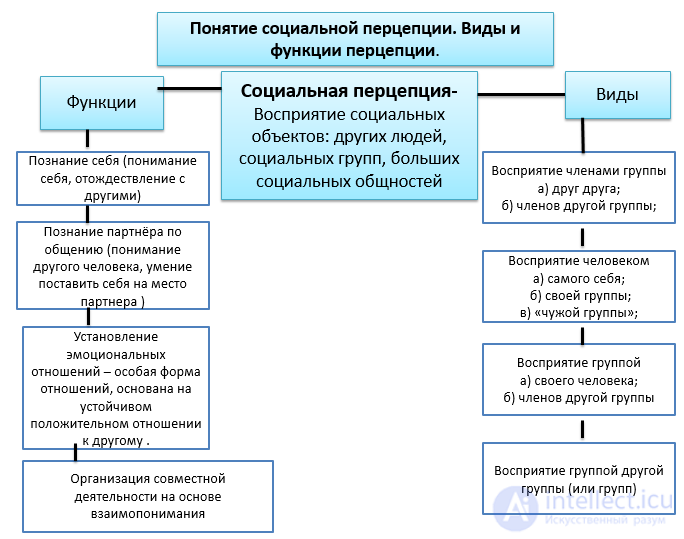
fig. functions and types of social perception.
This mechanism by which one person perceives another is an essential component of communication and belongs to social perception. The concept of social perception was first introduced by J. Bruner in 1947, when a new view of person perception was developed. Social perception is a process that arises in the relationship of people with one another and includes the perception, study, understanding, and evaluation by people of social objects: other people, themselves, groups, or social communities. The process of social perception is a complex and branching system for forming, in a person's consciousness, images of social objects as a result of such methods of people's comprehension of one another as perception, cognition, understanding, and study.
The term «perception» is not the most precise one for defining the formation of an observer's impression of their interlocutor, since this is a more specific process. In social psychology, a formulation such as «cognition of another 98 person» (A. A. Bodalev) is sometimes used as a more precise concept to characterize the process of person perception. The specificity of one person's cognition of another lies in the fact that the subject and object of perception perceive not only each other's physical characteristics but also their behavioral ones, and in the course of interaction, judgments are formed about the interlocutor's intentions, abilities, emotions, and thoughts.
In addition, an impression is formed of the relations connecting the subject and object of perception. This lends even greater significance to a range of additional factors that do not play as important a role in the perception of physical objects. If the subject of perception is actively engaged in communication, this implies the person's intention to establish coordinated actions with the partner, taking into account the latter's wishes, intentions, expectations, and past experience. Thus, social perception depends on emotions, intentions, opinions, attitudes, preferences, and prejudices. Social perception is defined as the perception of a person's external features, their comparison with that person's personal characteristics, and, on this basis, the interpretation and prediction of their actions and conduct. Thus, social perception invariably involves an evaluation of the other person, and, depending on this evaluation and the impression produced by the object, the formation of a particular attitude in emotional and behavioral terms. This process of one person coming to know another, evaluating them, and forming a particular attitude is an integral part of human communication and may conventionally be called the perceptual side of communication.
Communication as person perception is of great importance for interpersonal relationships, including in the family, in friendship, at work, and in society as a whole. Our impressions of other people may vary depending on context and situation. Understanding the processes of perception and the influences on them can help improve communication, resolve conflicts, and develop deeper and more trusting relationships.
Social perception is an important aspect of our social life, since it affects our decisions, communication, and interaction with those around us. This process can be either automatic or conscious, and understanding it helps us better understand how we perceive and interact with other people.

Comments