
Lecture
which describe negative aspects of communication between people. They point to various ways in which communication can be ineffective or even harmful. Here are their definitions:
Deficient communication: This term describes a situation in which communication is limited or insufficient. Deficient communication may involve a lack of information, openness, or active interaction between the parties. This can include silence, ignoring the other person, or the absence of feedback.
Defective communication: Defective communication is characterized by the presence of flaws or errors in the communication process. This can include improper use of language, unclear statements, misunderstanding of a message, or inappropriate use of nonverbal means of communication. Defective communication can lead to misunderstandings and miscommunication between the parties.
Destructive communication: Destructive communication implies that the interaction causes harm or damages the relationship between the parties. This can include aggressive communication, insults, threats, or manipulation. Destructive communication can worsen conflicts, create hostility, and even harm the psychological well-being of those involved in the communication.
A deficit of trusting close relationships leads to a painful sense of lost connection with people, to psychological loneliness.
Among the difficulties of communication whose basis, unlike shyness, is a deficit of trusting communication, one can include loneliness — understood not as a rupture of social ties but as a painful feeling, an experience of subjective disconnection, dissatisfaction, and superficiality
of one's existing relationships, i.e., a peculiar kind of psychological loneliness.
Loneliness is an episodically acute feeling of anxiety and tension associated with the desire to have friendly or intimate relationships.
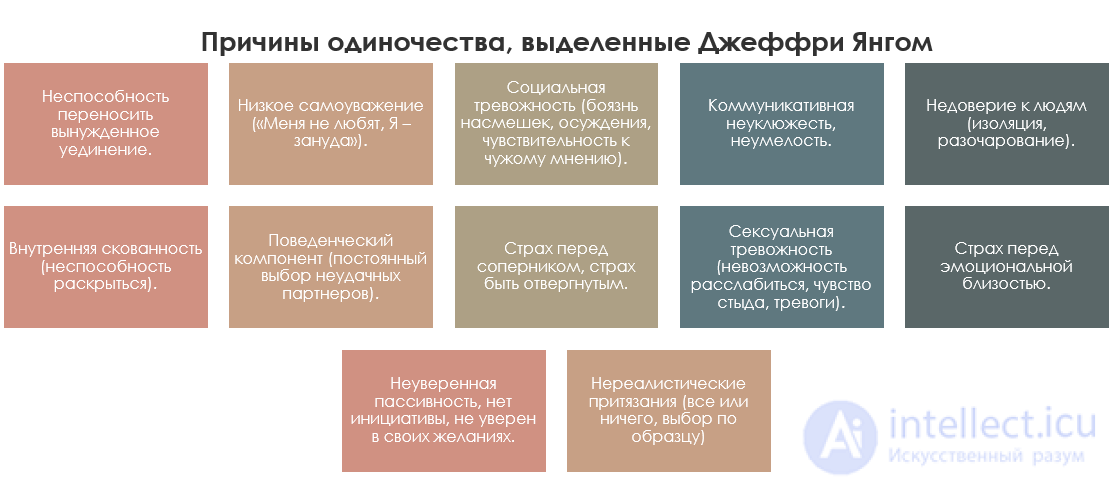 fig. Causes of loneliness identified by Jeffrey Young
Autistic-like traits are personality properties that occur within the norm and do not belong to the domain of psychopathology. To understand autistic-like traits as a
personal feature underlying a deficit of communication, it should be stressed that
autism and autization are terms denoting a pathological developmental course.
Autistic-like traits as a personality feature affect the person's entire sphere of contacts;
the deficiency of such a person's communication is partly compelled and partly inevitable. Many features of an autistic child's behavior
resemble a smoothed-over, poorly expressed form of autism.
Among the main psychological causes of autistic development, the following can be named:
1. Vulnerability, heightened sensitivity, fixation on unpleasant
impressions, poor tolerance of external influences, a predisposition to fears and anxiety.
2. Weakness of general and mental tone, hence rapid satiation with contacts, insufficient voluntary attention, and other voluntary forms of behavior being underdeveloped.
3. Autistic-like psychopathies, which can become serious and hard-to-overcome causes of loneliness. Alienation manifests itself as a feeling
of helplessness in the face of everyday problems, a sense of the meaninglessness of what is happening; disconnection, cooling, and a break with one's immediate environment,
and a dropping-out of social ties. Anomie forms a sense of aimless
existence, helplessness, a sense of one's own worthlessness; it makes the person
isolated, disconnected, alienated, and weakens their sense of responsibility. The person becomes "unfriendly" — cruel, indifferent, asocial.
An alienated person does not belong to a group; social ties are disrupted.
The communicative success of alienated individuals is significantly below the sample average, and
this is explained both by inner conflict and by a feeling of helplessness, loneliness, and real and psychological disconnection.
In recent years, young people experiencing all kinds of difficulties in communication have gained the opportunity to obtain professional consultation
and help from psychologists.
Self-esteem is low, and an acute sense of one's own inferiority is expressed. At the same time, despite an insufficient development of skills
and abilities, these individuals are not conflict-prone. At the same time, while experiencing a feeling of disconnection from people, they suffer from the impossibility of trusting communication.
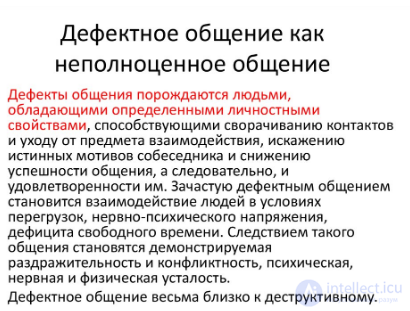
This is a relatively deficient form of communication that more often appears in
interpersonal relationships. It hinders the establishment of sincerity, trust, ease, and human closeness. Defects of communication are generated
by people possessing certain personal traits that promote the curtailing of contacts and avoidance of the subject of interaction, distortion of the interlocutor's true motives, and a decline in the success of communication and, consequently, in satisfaction with it. Defective communication often becomes the interaction of people under conditions of overload, nervous-psychological strain, and a lack of free time. Such communication results in displayed irritability and conflict-proneness, mental,
nervous, and physical fatigue.
Specialists in the field of communication have also noted that certain negative nonverbal
signals can have an irritating effect on the other person,
such as rocking from heel to toe during conversation, a meaningful raising of the eyebrow, a constantly sarcastically twisted mouth, licking the lips, a tendency to get distracted, and so on. A defensive posture on the part of the other person often affects the interaction negatively. A strongly developed psychological defense always negatively affects behavior and hinders the consideration of the problem and the achievement of the final outcome of the communication. Sometimes the other person displays a mask behind which their own insecurity is hidden,
fear, tension, and constraint.
Defective features of interaction are irrational in nature (from
the Latin — unreasonable). Unfortunately, they are not always recognized by the other person and
arise independently of their will each time a threat to their
self-esteem or dignity arises.
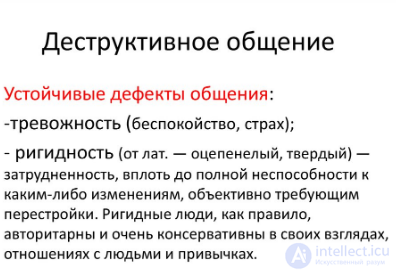
Destructive communication is usually understood to include those forms and features
of interpersonal contact that negatively affect the parties involved and complicate the process of mutual understanding. Destructive communication includes such forms of interaction as withholding information, unwillingness
to communicate, and silence when answering questions. Great harm to communication is also done
by the manifestation of such negative character traits as hypocrisy,
malicious joy at others' misfortune, cunning, vindictiveness, badmouthing others, causticity, cynicism, sanctimony, rivalry, and even criminal behavior.
Among the common forms of destructive behavior are deception
and lying, as well as ingratitude toward someone who has repeatedly helped.
Ungrateful behavior is hurtful to any person; lying and deception distort
the true state of affairs, promote the development of manipulation, and destroy communication.
Destructive behavior is usually distinguished by the fact that both
parties, and sometimes other people as well, are drawn into it. All participants become infected with negative
emotions, negative expression, and aggression, usually breaking out of their habitual way of life and entering into confrontation.
Aggressive-conflictual interaction likewise belongs to destructive behavior. It manifests itself in a wide variety of actions: from vindictiveness and hostility to reproaches and expressions of grievance, from shouting and public
quarrels to quiet grumbling and relentless criticism. This is often done in order to make a person's life unbearable, to keep them in constant
tension. Another form of aggressive-conflictual behavior is
resentment. It combines an emphasized self-pity with not always conscious
vindictive impulses. Aggressive behavior can also be a sign
of an inferiority complex. Some people, as a result of such a complex, become withdrawn and hide in their shells, while others react openly and aggressively.
In destructive communication a person is forced to defend themselves psychologically.
The most destructive aggression is called premeditated; its goal is
a deliberate intent to harm the other person with an awareness of the negative consequences. Such people, upon usually achieving their goal, derive
pleasure from it.
Suppression (imperative communication, from the Latin imperativus — commanding,
allowing no choice) — is authoritarian or directive interaction. In
terms of its effect on the other person, it too belongs to the group of destructive types of communication, since its main goal is for one of the
partners to subordinate the other, achieving control over their behavior and thoughts.
In such interaction, the individual characteristics and personal goals
of the other person do not matter; they are regarded not as a person but as a mechanism to be controlled, a means to another's ends. The
weakest point of this style of interaction is the unwillingness and inability
to acknowledge successes, to praise and support, and to encourage one's partners.
Thus, aggressive behavior almost always introduces into
the interaction negative traits of destructiveness and ruinousness,
which fosters the estrangement of people and their tension, and generates dissatisfaction and discomfort.
The next aspect of aggressive interaction has to do with the fact that aggressive behavior inflicts physical, material, or moral harm on the other person, and this is accompanied by deep emotional experiences such as anger, distress, malicious glee, and so on, as well as by expressive display, i.e., gestures of threat, hostility, and contempt.
Prejudice, as an attitude that hinders the adequate perception
of a message or an action, intensifies destructive interaction. As a rule,
a person does not understand, or does not wish to understand, that they are biased toward
their partner and views their attitude toward them as the result of an objective
evaluation of certain facts or actions.
Prejudice is often used by an individual to justify their own actions toward another individual. The social sources
of prejudices lie in direct interpersonal interaction.
It has been shown that a prejudiced attitude is stronger in those persons who
have a low social status or whose position has sharply deteriorated.
Unequal status also contributes to a biased attitude toward the other person.
Frustration, aggression, and authoritarianism intensify a biased attitude toward
one's interaction partner. Even the very process of thinking (categorization,
generalization, simplification, and so on) gives rise to prejudice.
Deception is a category characterized by an individual's conscious attempts
to create in the partner a mistaken, false, or illusory impression of
the subject under discussion. Like a lie, it can be equivalent to a misconception, and it may or may not involve direct distortions of the truth.
The phenomenon of deception should not be equated with lying; the difference between lying and deception is as follows.
A lie is a communicative phenomenon that is used to
establish good relations with a partner: it is not so much a means of deliberately distorting the representation of reality, a distortion of the truth, as it is
a way of establishing contact with a person;
Psychopathic individuals typically often tell untruths or half-truths without feeling shame or remorse. Even being exposed does not
stop them. That is why deception, hypocrisy, and gossip accompany such
individuals and their relationships for a long period of their life or their entire life
cycle.
Psychology also describes a category of people known as born liars. Unlike psychopathic individuals, who are capable of learning from their own experience, they may suffer pangs of shame for their
deception, even though they cause no harm to others. The basis of destructive communication
can be human egoism, i.e., in interpersonal relationships a person puts their own interests and goals of interaction first, at the expense
of the other person's interests.
Avoiding deficient, defective, and destructive communication is important for maintaining healthy and productive relationships. This includes improving communication skills, active listening, respect for the other person, and mindfulness in the process of communication. Understanding which types of communication can be harmful, and efforts to overcome them, contribute to more positive and constructive interactions.

Comments