
Lecture
The interactive side of communication means the interaction between participants in communication, in which each party actively participates in the process of exchanging information, and this interaction influences the course and outcome of the communication. Important aspects of the interactive side of communication include:
Active listening: Effective communication involves not only speaking but also active listening. Participants must attentively perceive each other's messages, ask clarifying questions, and show interest in what is said.
Dialogue: Dialogue involves an exchange of ideas, opinions, and information between the participants in communication. It is a two-way, open process in which each party has the opportunity to express its points of view and react to the points of view of others.
Feedback: Feedback involves providing information about how a message was perceived and understood. It can be positive (affirmation), neutral (confirmation), or negative (correction).
Adaptation: In the course of communication, participants may adapt their behavior and communication depending on the reaction and needs of the interlocutor. This helps improve mutual understanding and the effectiveness of communication.
Non-verbal communication: Facial expressions, gestures, intonation, and other non-verbal signals play an important role in the interactive side of communication. They can reinforce or change the meaning of statements and express emotions.
Conflict management: Conflicts and disagreements may arise in the process of communication. The interactive side of communication includes the ability to manage conflicts, resolve disagreements, and reach agreements.
Cooperation: Interactive communication can promote cooperation and joint problem-solving. It is important that participants be willing to work as a team and jointly achieve goals.
Support and empathy: Interaction within the interactive side of communication also includes support and empathy. Participants can show understanding and sympathy for each other's feelings and needs.
Communication is one of the subjects of socio-psychological research. Communication is a multi-aspect and multi-faceted process of forming, ensuring, and realizing interpersonal and intergroup contact, which is conditioned by the necessity of organizing, carrying out, and maintaining people's joint activity. The interactive side of communication is a conventional term denoting the characteristic of the components of communication connected with people's interaction, with the direct organization of their joint activity. The goals of communication reflect the needs of people's joint activity. Communication must always presuppose some result — a change in the behavior and activity of other people. Here communication acts as interpersonal interaction, i.e., a set of connections and mutual influences among people that develop in their joint activity. The most common division of all interactions is into two opposite types: cooperation and competition. Besides cooperation, one also speaks of agreement and conflict, accommodation and opposition, association and dissociation, and so on.
Behind all these concepts one can clearly see the principle of various types of interaction. In the first case, those manifestations are analyzed which promote the organization of joint activity and are "positive" from this point of view. The second group includes interactions which in one way or another "destabilize" joint activity, representing a certain kind of obstacle to it. Cooperation denotes the coordination of the individual forces of the participants (ordering, combining, summing these forces). An important indicator of the "closeness" of cooperative interaction is the involvement of all participants in the process. As for competition, here the analysis is more often concentrated on its most vivid form — conflict, a clash of goals, interests, positions, and views of opponents (subjects of interaction). One and the same person performs various roles. A multiplicity of role positions often gives rise to their clash — role conflicts. The interaction of people performing different roles is regulated by role expectations. The "performance" of a role is subject to social control and invariably receives a public evaluation, while even a slight deviation from the model is condemned. The initial condition for successful communication is the correspondence of the behavior of interacting people to each other's expectations. But communication is not always built successfully and is often not free of internal contradictions. In some situations an antagonism of positions is revealed, reflecting the presence of mutually exclusive values, tasks, and goals, which sometimes turns into mutual hostility.
In this case an interpersonal conflict arises. Interaction has also been examined from the standpoint of transactional analysis by the American psychologist E. Berne. In his view, three "selves" exist within every person: the Child (a dependent, subordinate, and irresponsible being); the Parent (independent, non-subordinate, taking responsibility upon itself); and the Adult (able to reckon with the situation, understand the interests of others, and distribute responsibility between itself and them). Acting from the position of the Child, a person appears subordinate and unsure of themselves; from the position of the Parent — self-confidently aggressive; from the position of the Adult — correct and restrained. In people's interaction these positions are coordinated only when one of the partners is willing to accept the position defined for them by the other partner. The most successful and effective communication is that of two interlocutors from the position of Adults, and two Children can also understand one another. A transaction is a unit of interaction between communication partners, accompanied by the assignment of a position to each. The essence of E. Berne's theory comes down to the fact that when the role positions of communication partners are coordinated, the act of their interaction gives both a feeling of satisfaction. If a positive emotion is present in advance in communication to the joy of the partners, E. Berne calls this type of interaction a "stroke."
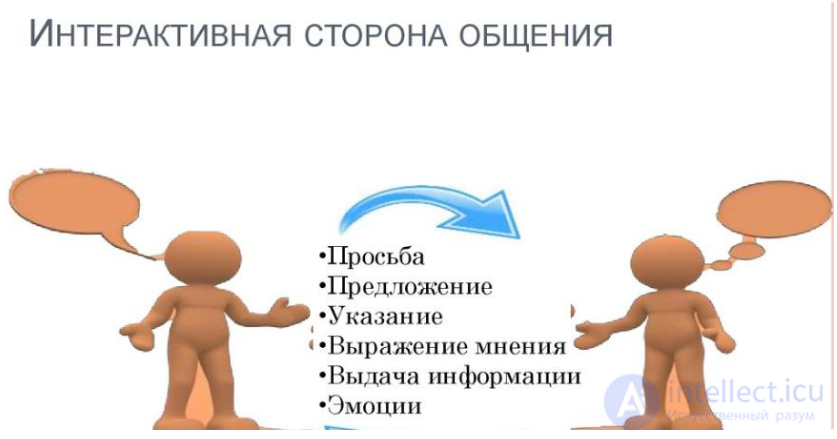
When positions are coordinated, whatever the interlocutors are talking about, an exchange of strokes takes place between them. Being deprived of a return stroke already offends a person. And if, contrary to their expectations, they are also addressed from an uncoordinated position, this evokes anger and can become a cause of conflict. From a psychological point of view, the content of a conflict can be very diverse in terms of the partners' role positions. For the whole dialogue, what may be of decisive importance is how correctly the position is chosen and how well it is coordinated between the communication partners. The position we take in a contact immediately determines the range of psychological roles we will have to perform. The place of interaction in the structure of communication. The interactive side of communication is connected with people's interaction, with the direct organization of their joint activity. In analyzing interaction, one distinguishes the structure of interaction, the positions of the participants, the style of actions, and the features of the situation. Social interaction occurs when people influence each other's behavior sufficiently constantly and steadily. As a result of these constant interactions, a change in the social relations in which people find themselves usually occurs.
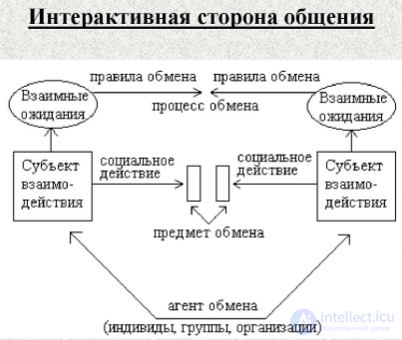
The structure of interaction: T. Parsons's theory. An attempt to establish a general categorical apparatus for describing the structure of social action. Activity is built up from individual acts (individual actions).
Elements:
The structure of interaction: according to L. Freeman. L. Freeman regarded the theory of social interaction as central to sociology, since from birth a person is part of certain interactions within society.
The interactive side of communication plays a key role in creating high-quality and productive interpersonal relationships, as well as in achieving shared goals. The ability to interact effectively with other people, to listen, to engage in dialogue, and to take into account the needs and points of view of interlocutors is an important skill in various spheres of life, including work, personal relationships, and education.

Comments