
Lecture
Basic concepts
The "technology of spontaneity" – this is what one of the world's most popular concepts, Gestalt therapy, could be called. Its author, Fritz Perls, created his brilliant work in order to fill the theoretical gaps of psychoanalysis. Many concepts of psychotherapy have been influenced by this "third
force" – behaviorist humanism, rational therapy, as well as newer theories such as feminist therapy and the theory of Black identity development.
Gestalt therapy is grounded in psychoanalytic ideas, phenomenology, existentialism, Eastern philosophy, general semantics, and other branches of knowledge about the human being. Existential philosophy helped F. Perls
move away from the psychoanalytic approach (his teacher and analyst was Wilhelm Reich, and his colleagues included Karen Horney, Otto Fenichel, and others), in which the main focus was on the history of individual development. Gestalt psychology helped F. Perls (who, early in his career, was
an assistant to the well-known Gestalt psychologist Kurt Goldstein) understand the importance of the phenomenology of present experience. Gestalt psychologists, unlike existentialists, who explain how people experience their existence in the
present moment, try to answer the question of how they
perceive their existence.
The concept of "gestalt" is understood as the perceived wholeness of the image
of an object itself and its meaning, derived from the interaction of the object,
the environment, and the specific situation. Gestalt psychology proceeds from
the understanding that the whole determines the parts, as opposed to earlier
views holding that the whole is merely the mechanical sum of all its elements.
Figure and ground. These terms are also borrowed from Gestalt psychology. The figure is the focus of interest, the object, the pattern, and so on; the ground is the context or situation in which the element appears. Any perceptual field
is structured as elements entering into interaction and influencing one
another. Thus, purple looks bluish against a red background and reddish against a blue one. The relationship between figure and ground is dynamic: in one and
the same situation, different figures can come to the fore. A figure,
made up of details, can itself become a ground, while one of its details turns into a figure.
The interaction of figure and ground is central to the theory
of Gestalt therapy: attention, interest, concern, and beauty signify a healthy formation of figure and ground, whereas boredom, anxiety, amnesia, and embarrassment indicate that the formation of figure and ground is impeded.
For a healthy psyche, the relationship between figure and ground is a process
of constant yet meaningful appearance and disappearance.
Gestalt therapy places awareness at the center of attention. The adequate functioning of awareness is the key to good health, while disturbances of awareness are the main cause of illness. Perls maintains that awareness is in itself a curative agent. For F. Perls, awareness is a kind of unobtrusive attention. It
is always directed at what is happening in the present moment, in the "here and now." In the "here and now," as in a drop of water, a person's personality and their
problem are reflected.
Formation and closure of the gestalt. An individual's experience arises from
the relationship between figure and ground. The specific situation in which an individual
finds themselves consists of their awareness of themselves (the self), the surrounding objects, and the relationships between them. This awareness of the relationships existing in a given situation constitutes a gestalt, that is,
a meaningful configuration. The formation of gestalts appears to be a natural process. Their formation and closure follow fairly simple principles. A completed experience (gestalt), successfully resolved in the immediate present, recedes into the background,
while something new emerges in the foreground.
Clarity of gestalts. Clear perception of the immediate present
leads to the formation of "good gestalts." Such gestalts arise
when the individual has no unfinished experience interfering with a clear, realistic
perception of the present situation. Clear gestalts are accurate, understandable, sharply defined, and we recognize them. They contribute to the effective resolution of problems.
Personality. The central value of Gestalt therapy is the personality. According to
F. Perls, personality is an integral unity; it is self-valuable and possesses the capacity to choose its own life path.
Personality, from within, is a complex system of objectified interactions:
beliefs, attitudes, and an understanding of oneself and the surrounding world. Each of these
structures is relatively stable, but their connections – with one another and with the external world – are mobile and changeable. Healthy functioning of the personality presupposes a dynamic relationship between the individual's perception and awareness of themselves, of other people, and of the environment.
Organism. F. Perls views the human being in interaction with the environment, emphasizing that not only the psyche but also
the body takes part in this interaction. He often uses the word "organism" to express the idea of
the close connection and constant interaction and mutual influence between the psychic and
the physical.
In every case, the feeling of closure is unique. In the body, sensations of satisfaction, fullness, and wholeness arise; tension subsides, and the brain
calms down and rests. It would seem that, given the cyclical formation and closure of gestalts, unresolved problems simply should not exist. However, in
reality, problems do exist. A person is born with hereditary tendencies that limit them in some way, physically, psychologically, or spiritually. As a result, behavioral styles, stereotypes, and defense mechanisms develop that are far from ideal. Therefore, the organism constantly encounters past experience that, for one reason or another, has not been completed. Unfinished gestalts surface in the same way,
as biological needs do – one after another. The most pressing need
stands out most sharply.
The self. F. Perls maintains that the self (Self) is the system of contact between the organism and the environment, integrating all levels of needs. As a process, the self evaluates the situation and chooses which need should
be satisfied at a given moment, which mode of defense or course of action to
prefer, and so on. In extreme situations, the self instantly grasps
the circumstances and acts for the most part spontaneously – consciously or unconsciously choosing the most optimal way of behaving.
The second aspect of the self is the self-concept (self-image). Changes in it occur only following new personal experience. This, too, is very important in
the work of a practicing psychologist: the self-concept governs the appropriateness of decisions
made at the moment of interaction with the environment. It develops from childhood and
can be altered by external influence, but these changes are very slow.
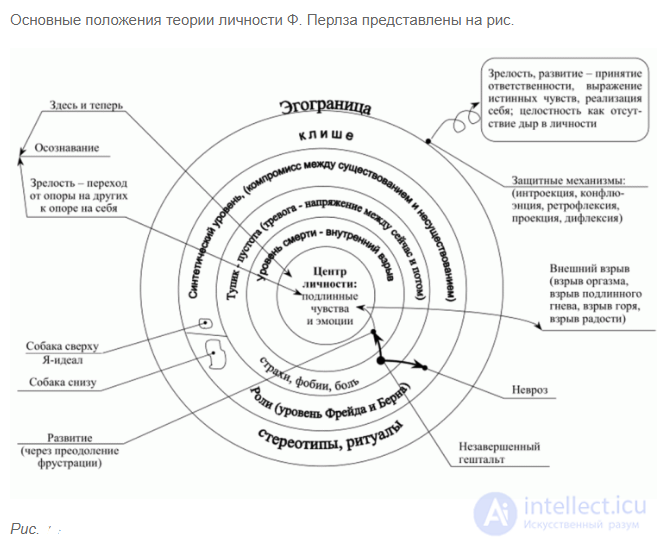
Zones of awareness. The ability to form and close gestalts is available to anyone who can fully be aware of themselves in the present moment. For
satisfying their needs, a person must maintain constant
contact with the zones of their inner and outer world.
Self-regulation. According to Gestalt theory, a person functions on
the basis of the principle of self-regulation. They maintain their vital balance,
satisfying emerging needs.
Balance is generated by the active process of forming and closing
a gestalt. A person perceives themselves (their self) and others at the same time.
That is why balance in the world is important to them.
Gestalt therapy focuses on restoring cheerfulness and vital energy. Gestalt therapists believe that every person who is aware of their problems has inner resources (energy) necessary for self-regulation. If you think or talk about your weakness,
dependency, or inability to live happily, this means that you have hidden mechanisms of health self-regulation. Seeking help is in itself already
a signal that a person has enough energy to achieve a state of wholeness and to set the process of self-regulation in motion.
Thus, the cycle of forming and closing a gestalt passes through several
stages – from the emergence of a need, when everything connected with it comes to
the fore and pushes everything else aside, to its satisfaction and the loss of significance of the objects of the need, which recede into the background and free up
room for a new impression.
If the gestalt cycle is not completed fully, "stuckness" is observed,
which can lead to a wide variety of problems and disturbances. For example, if a person did not allow themselves to express anger that urgently demanded expression, this "unfinished" emotion can become
the cause of inexplicable irritation or resentment that undermines communication.
Disruptions of the natural course of events lead to the formation of repressed
parts.
This is a very important concept, denoting both optimal mental health and
a sign of adulthood. F. Perls defines maturity as trust in
one's own opinion and intuition, self-regulation and self-control, reliance on
one's own abilities and resources. F. Perls places very high value on the autonomy and independence of the personality. A child (and a neurotic) tends to manipulate other people in order to make them satisfy their needs.
It is more correct, in F. Perls's view, to seek within oneself the means for solving problems. A mature person takes responsibility for their
decisions, actions, and their consequences.
Polarization and identification. Polarization is a way of structuring information, of classifying all phenomena and images on the basis of a two-valued evaluative criterion of "either–or." For example: "good–bad,"
"interesting–boring." Views built on the basis of polarization are usually stable, uncompromising, and unchanging. Polarization arises when
an individual identifies with a set of opposite characteristics. It
distorts the individual's adequate perception of themselves and others and subsequently leads to the denial of experience that does not fit into the polar paradigm.
Differentiation and integration. In a healthy, self-regulating organism, the process of awareness proceeds quickly and spontaneously. All parts
of the personality are acknowledged and balanced. Being in a state of balance, a person
responds spontaneously to events. In the early years of development, however, the process of self-regulation can be disrupted, because a person often denies certain
parts of themselves. Perls wrote on this subject: "We in effect deny
parts of ourselves, asserting: 'anger is not me,' 'hatred is not me.'"
The denial of certain parts of one's personality occurs through the mechanism of
identification: by identifying with one pole, the individual denies the other.
This produces a blockage of energy; the person experiences a feeling of hopelessness and is unable to solve the problems that arise. This is a dead end, behind which lies a hidden intrapersonal conflict. Gestalt therapy helps a person restore balance. To do this, it is necessary to rehabilitate previously rejected parts and accept them once again. This process of accepting previously rejected
parts of the personality and restoring inner wholeness is called integration. In the course of their development, every person assimilates a certain system of social and cultural values – through parents, school, friends,
and so on. These may include courtesy, conscientious work, home ownership,
a pleasant environment, a close-knit family, and respectful treatment of parents,
and so forth. Many of these values are hidden and unconscious. At the same time, some
values are stable and constant, while others change depending on the situation and the period of life.
Growing up. Growing up in Gestalt therapy is viewed as an organic process. It resembles the growth and maturation of all living things in nature. When, for example, we say of fruit: "It has ripened," we mean by
this that it not only has the corresponding mature form but also contains
a certain amount of substances corresponding to its ripe state. A ripe fruit contains not only flesh that can be enjoyed but also a seed capable, given soil, water, and sun, of sprouting and
becoming fruit-bearing. F. Perls defines a person's growing up in an analogous way – as a transition from dependence on an external resource to an internal one. A person's growing up proceeds more slowly than that of plants or animals, and liberation from external dependence takes quite a long time. The early stage of physical development represents a fairly successful advance from external dependence toward internal resources. Psychological growing up accelerates liberation from the external resource.
Since a human being is a social creature, the process of growing up continues constantly; no one can become absolutely self-sufficient or free
from society. Nevertheless, a person gradually becomes more and more independent, and their responsibility for themselves grows.
Having learned to walk, we gradually acquire emotional and psychological
autonomy, developing a sense of self-worth and mastering inner
wisdom. However, alongside gaining independence and autonomy,
a mature personality also acknowledges that there are situations in which outside help or support is needed.
Growing up is not a simple or easy process at all. It is often accompanied by psychological distress caused by the fact that a person is constantly
faced with the need to give up a situation that has become familiar and safe
and decides to undertake something previously undone, inaccessible,
to take a risk, to go beyond what is familiar and reliable but now no longer sufficient.
During the period of growing up, the inner world changes, and the uniqueness of the personality, one's true identity, develops. This endless process of constant change and growth throughout the whole of life leads a person to new knowledge of themselves and new awareness. New experience each
time requires ever-new development of inner resources and ever-greater trust in
one's own wisdom.
Thus, we see that growing up includes self-actualization and
authenticity (a genuine identity, a congruence between inner content and outer expression).
Authenticity is a very important aspect of growing up. The term "authenticity" in Gestalt therapy largely coincides in meaning with the word "congruence," which, translated from French, means a harmony of inner
content and outer expression, a state of consistency between feelings, thoughts,
and other components of a person's inner experience and their outward forms of expression. The state of congruence, or of identity between inner experience and
its outer expression, symbolizes the moment when the gestalt is closed. This
is the typical state of adulthood in Gestalt therapy.
In early childhood, a child assimilates a system of upbringing based on
the attitudes "you should," "you must," "you have no right to." Violating such prescriptions usually leads to condemnation, punishment, or the loss
of love or privileges, even if this set of prescriptions is never voiced aloud. Having learned from childhood that natural impulses, movements, and needs are undesirable, disapproved of by adults, and sometimes simply dangerous,
many learn to suppress them. In doing so, a person becomes convinced that spontaneous behavior can lead to undesirable consequences. A system of self-control is formed, which enters into conflict with the process of self-regulation. Conscious control takes the place of free activity and spontaneous awareness.
The essence of conscious control lies in the suppression of free self-expression. Up to a certain point this is necessary for everyone. However, excessive suppression breeds distrust of one's own needs and abilities,
a disruption of the functioning of the organism as a whole system. Unproductive styles of interaction are formed: "I am powerless," "I am a victim," "I am
wrong," "There is something wrong with me," and so on. Usually, a person under the influence of
such attitudes expends a huge amount of energy avoiding
contact with their own self and with other people. The organism thereby remains
in an unfinished state. The process of self-regulation is disrupted. How can this be determined?
You, like any other person, know and are able to feel a whole
range of different emotional states. Try to find, for each of
the states listed below, a response within yourself, and assess which state you have found yourself in most often recently.
We already know that if the cycle of spontaneous formation and
closure of a gestalt is disrupted, a blockage at any stage sends unfinished material into the background of experience and hinders the start of a new cycle. As a result,
stereotypes develop that become habitual and lead to the experience of discomfort. One of the tasks of Gestalt therapy is to analyze all the background material
of the personality, searching for the blocked link, the interrupted stage in the gestalt cycle.
However, we can also become aware, on our own, of certain aspects of our
immature behavior, conditioned by unconstructive attitudes formed as a result of disruption of the gestalt cycle. And, further, to sense
the possibility of mature behavior.
F. Perls believed that anxiety is a lack of faith that a person can cope with a situation in the future, or a lack of an individual
system of resources. Experienced as agitation, sometimes arising without any visible cause, anxiety blocks possible actions. The energy
needed for specific creative undertakings is spent on useless rumination, unconnected with either present experience or the future.
From the point of view of Gestalt therapy, agitation and anxiety are mental leaps into the past or future, while the body remains in
the present. Nevertheless, anxiety affects the present moment, everything,
happening in a person's physical and psychic spheres, all of their physiological, mental, verbal, and nonverbal reactions.
The maturation of the personality presupposes awareness of the features of one's contact and the elimination of the causes blocking normal contact. Developing new
relationships, gaining access to previously blocked abilities, a person changes their values and attitudes, acquires other skills, that is, expands the boundaries of their I. Or they may reject what they once believed,
destroy past relationships, and abandon what they used to be able to do and love doing.
And in this sense one can speak of a contraction or narrowing of the boundaries of the I.
Before proceeding to a description of the typical disturbances of the boundary of contact between the I
and the surrounding world, it is necessary to characterize the concept of the boundary of the I as used in Gestalt therapy. Every person distinguishes, in experience, between the I and the not-I: thoughts, feelings, and actions belonging to the I, and external events and the thoughts, feelings,
and actions of other people. Defense mechanisms are regarded as different kinds of disturbance of this boundary.
When this boundary is blurred, the neurotic mechanism of confluence operates: the person identifies with the group, believes that everyone thinks and feels
the same way as they do, and is unable to act on the basis of their own impulses,
or to take responsibility.
Introjection is the tendency to appropriate and experience as one's own
the attitudes, opinions, and beliefs of other people without any attempt to criticize or modify them. In this case, it is very difficult for an independent personality to form,
because the person does not have time to listen to their own opinion, being
preoccupied with assimilating other people's ideas and reconciling them. The most common
introjects are parental teachings about how one "should" behave,
absorbed without reflection.
Projection is the direct opposite of introjection. If the latter is an attempt
to represent moments external to the I as internal, projection, on the contrary,
places the causes and responsibility for what is happening within the I into the external
world. In this case, the world may seem to the person hostile or indifferent to them, whereas it is often they themselves who treat themselves coldly, or a person
tends to accuse someone else of having "bad" feelings toward them, when in fact it is they themselves who are experiencing those feelings.
The goal of Gestalt therapy is "putting things in order": identifying disturbances
of the I-boundaries and restoring the capacity for constructive contact.
The improvement of interpersonal interaction in this case occurs fairly painlessly: by making contact with the environment, a person becomes aware
of the needs of their organism and the gestalts that arise, and then, having weighed their desires and possibilities, acts to satisfy needs and close
gestalts, choosing in the process the most pressing desire and the most appropriate
action for the given moment. From the standpoint of Gestalt therapy, any
problem of a person is a set of undesirable reactions on the part of themselves or of other
people. Different people react to difficult situations differently: with a headache, a state of nervousness, or complaints about some particular
person.
In Gestalt therapy, the question of why a person behaves in one way or another is considered unproductive for achieving insight (a sudden illumination, the attainment of a new view of the problem, or, in essence, awareness of it), whereas understanding what and how a person does helps them take responsibility for their behavior and its consequences.
The paradoxical nature of change. A person can change only
when they are honest with themselves. Only by openly acknowledging who we
really are do we gain the possibility of becoming different. Attempts to deny or suppress something in oneself trigger the action of self-defense mechanisms and
increase rigidity.
The goal of Gestalt therapy is to change those basic principles by means of
which a person ends up in difficult situations. A state of conflict,
depression, or agitation is part of a person's relationships with the people around
them (the ground). Problems arising in a person's relationships with others can be resolved in the process of their interaction with a psychologist.
The role of the psychologist can be filled by a tactful friend. A good teacher is exactly
that for many of their students.
Gestalt therapy is a therapy of experience. Therefore, it is important that a person
clearly express what they want, allow themselves to experience what they feel, and carry out actions that were previously blocked. In doing so, they address their feelings not to the real person but to their own representation or image of that person (the two-chair technique). This is enough to release feelings that were previously trapped, as if in a snare, and to close an unfinished gestalt. F. Perls called this work "here-and-now" therapy.
The last important component of the process of change is the experience of a relationship at the "I-thou" level. Here, the psychologist (or the person taking their place) acts as a catalyst or filter.
Change begins from the moment a person understands that their
patterns of behavior reflect their habitual perception of the world, a system of beliefs that leads them away from reality. The main thing here is not
to impose one's own judgments, but to place the person before a choice:
to leave everything as it is or to change their views. Such a stance stimulates changes in attitudes and behavior, helping the person become aware of the possibility of choice and gradually change the style of their interaction with the world and
with specific people. Having chosen the path of change, a person focuses on awareness of certain aspects of their behavior. Avoiding awareness of their own
personal characteristics is merely a helpless attempt to escape from themselves, an unwillingness to accept their own personal experience or some part of their behavior that does not fit with their existing self-image. Escaping from oneself, from the truth, does not lead to
positive results.
Gestalt therapy does not aim to produce purely intellectual insights (illuminations). Instead, it teaches one to observe behavior, and
then to live through it directly. It is precisely this living-through, this new
experience that helps a person make certain discoveries that serve as the basis for
change. By focusing on their own behavior, a person gradually becomes aware of how they themselves block their own possibilities and how they avoid expressing their own
thoughts and feelings.

Comments