Ethics of professional and business communication is a system of norms, rules and values that regulate people's behavior and interaction in the workplace. It plays an important role in building trust, respect and effective cooperation among employees, clients, partners and other stakeholders. Here are the key aspects of this topic:
-
Honesty and integrity: It is important to be honest and principled in all business relations. This includes keeping promises, providing accurate information, and refraining from manipulation and deception.
-
Confidentiality: Maintaining the confidentiality of information, especially concerning clients, colleagues and the company, is a key aspect of ethics in business communication.
-
Respect: Respect for diversity and differences in opinions, cultural characteristics and communication styles is the foundation of ethics. Discrimination or demeaning treatment must not be allowed.
-
Professional conduct: Observing professional conduct, including compliance with codes of ethics and organizational rules, contributes to creating a favorable working environment.
-
Communication and conflicts: Ethics also concerns the way conflicts and communication are handled. Constructive discussion of disagreements with respect for the viewpoints of other parties helps preserve professional relationships.
-
Responsibility: Taking responsibility for one's actions and decisions, even when they are unsuccessful, is part of ethics in business communication.
-
Social responsibility: Taking into account the impact of business on society and the environment, and taking appropriate measures to minimize negative consequences, is also an aspect of ethics.
-
Corporate culture: Companies can develop corporate values and standards of conduct that reflect their ethical principles and standards.
Business communication is a necessary part of human life, the most important kind of relationship with other people. An eternal and one of the main regulators of these relationships are ethical norms, in which our ideas about good and evil, justice and injustice, the rightness or wrongness of people's actions are expressed. And when communicating in business cooperation with their subordinates, boss or colleagues, everyone, in one way or another, consciously or spontaneously, relies on these ideas. But depending on how a person understands moral norms, what content they invest in them, and to what extent they take them into account in communication at all, they can either make business communication easier, make it more effective, help in solving the tasks set and achieving goals, or make this communication more difficult or even impossible. It is hoped that this section will, to a certain extent, help the reader not only to become aware of those problems, often hidden at first glance, which arise in the process of business communication and stand in its way, but also to successfully cope with them.
Ethics (from the Greek ethos — custom, character) — the study of morality. The term "ethics" was first used by Aristotle (384-322 BC) to denote practical philosophy, which is meant to answer the question of what we must do in order to perform right, moral actions.
Morality (from the Latin moralis — moral) — is a system of ethical values recognized by a person. Morality is the most important means of normative regulation of social relations, communication and human behavior in the most diverse spheres of social life — family, everyday life, politics, science, labor, etc.
The most important categories of ethics are: "good", "evil", "justice", "the good", "responsibility", "duty", "conscience", etc. Norms of morality receive their ideological expression in general ideas, commandments, principles about how one should behave. Morality always presupposes the existence of a certain moral ideal, a model to be emulated, the content and meaning of which change in historical time and social space, i.e. in different historical epochs and among different peoples. However, in morality the ought does not always coincide with the is, with really existing moral reality, with the actual norms of people's behavior. Moreover, throughout the development of moral consciousness, the internal core and structure of its change is a "contradictory, tense relationship between the concepts of the is and the ought."
In this contradiction between the ought and the is lies also the contradictory essence of the motivation of communication(including business communication and human behavior). On the one hand, a person strives to behave in the morally proper way, while on the other, they need to satisfy their needs, the realization of which is very often connected with the violation of moral norms.
This internal conflict between the lofty ideal and practical calculation, moral duty and immediate desire, always exists and in all spheres of life. But it manifests itself especially intensely in the ethics of business communication, because it is precisely in this type of communication that the main subject, for the sake of which it arises, is external to the individuals.
Communication — the process of interaction of social subjects: social groups, communities or individuals, in which there is an exchange of information, experience, abilities and the results of activity. Communication acts as a way of being of society and of man. It is precisely in the process of communication that the socialization of the individual and their self-realization take place. According to Aristotle, the ability to enter into communication distinguishes man from "beings underdeveloped in the moral sense" and from the "superhuman". Therefore, "he who is incapable of entering into communication or, considering himself a self-sufficient being, feels no need for anything, is no longer an element of the state, becoming either an animal or a deity."
The specificity of business communication is due to the fact that it arises on the basis of and in connection with a certain type of activity related to the production of some product or business effect. At the same time, the parties to business communication act in formal (official) statuses, which determine the necessary norms and standards (including ethical ones) of people's behavior. Like any type of communication, business communication has a historical character; it manifests itself at different levels of the social system and in various forms. Its distinctive feature is that it has no self-sufficient meaning, is not an end in itself, but serves as a means for achieving other goals. Under market conditions, this is above all the obtaining of maximum profit.
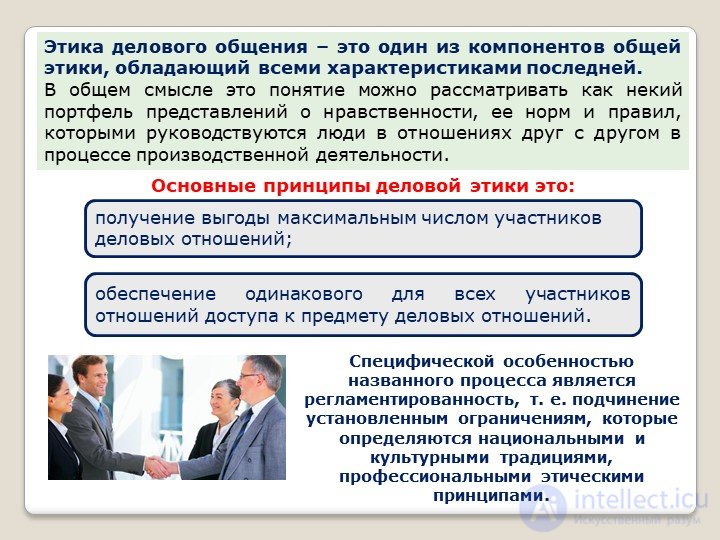
Taking all of the above into account, the ethics of business communication can be defined as a set of moral norms, rules and ideas that regulate the behavior and relations of people in the course of their productive activity. It represents a particular case of ethics in general and contains its main characteristics.
Ethics of business communication in traditional society
In socio-philosophical terms, the ethics of business communication is determined by the socio-economic system of society, the structure of its social organization, and the dominant type of social consciousness. In traditional society (a society of "mechanical solidarity" according to Emile Durkheim), based on the commonality of social life, collective representations, mythological consciousness and interpersonal relations, the main mechanism of business communication is ritual, tradition and custom. They correspond to the norms, values and standards of the ethics of business communication.
A distinctive feature of this type of community is >that here there is not yet that gap between the ethical norms of business communication and general notions of moral life, which will appear in a society with developed market relations. General moral norms are here also the norms of business communication. For the most part, they are not yet separated from one another or opposed to one another, just as business life is not opposed to personal life. But even when private and corporate interests arise within a traditional society, general moral norms still continue to play the main role.
In the absence of commodity fetishism and universal alienation, doing one's job well is regarded as a moral duty and serves as the main means of self-affirmation of the individual. A person of traditional society has not yet developed a servile psychology in themselves and does not bend their back trying to please their boss in every way, because ethical values have a self-sufficient significance here.
Such concepts as justice, honor, dignity, freedom, responsibility have here an existential meaning that is vitally important for human existence and are filled not with abstract but with real living content. People have often sacrificed their lives for the affirmation of these values. The pathos of this type of communication can be captured in the words of Martin Luther: "Here I stand and cannot do otherwise'".
We already find this character of the ethics of business communication in Ancient India. All human behavior and communication, including in the business sphere, is subordinated here to higher (religious) values. A person of this society must "pay no attention to what other people will say or think about us, or do; go to work just as soldiers go into battle, without worrying about the consequences; regard good reputation, honor, name, convenient circumstances, comfort, human attachments as nothing, if religious obligation requires sacrificing them."
Modern views on the place of ethics in business communication
This contradiction between ethics and business, between the ought and the is, is quite acutely manifested today as well in business communication, and at its most diverse levels: both between an organization and the social environment, and within the organization itself. Between managers, entrepreneurs and business people in general, there are two main positions with regard to this contradiction.
1. Those who consider themselves pragmatists believe that in business communication, and in business in general, ethics is in itself unnecessary.The sole duty of a corporate manager employed by the owner of a business is to maximize profit by any available means, "to make as much money as possible," while adapting in every way to the norms of society embodied in laws and ethical traditions.
From this position, which can be called "business Machiavellianism," ethical norms and the very language of ethics are regarded as an obstacle in business communication. In it, they try to avoid talk of morality, ethical ideals, duty and social obligations, since this results in "superfluous," "irrelevant" problems concerning moral and social responsibility.
An extreme case of unethical behavior by businessmen and heads of enterprises is violation of the law. But unethical behavior should also be considered various actions of companies that fail to take proper measures to eliminate defects in their products, which could lead to harmful consequences for the population. Therefore, the concept of the ethics of business communication also includes the concern of enterprise managers for the quality of their products, and responsibility for the harm it may cause to the population.
An example of unethical behavior, which has become almost classic, is the action of the Ford Motor Company, which objected to withdrawing the Pinto model from production or to redesigning its fuel system in order to eliminate the possible hazards associated with the fuel tank.
The essence of the matter was that in 1978 three women burned alive when the Pinto in which they were riding was struck from behind and the gas tank exploded. Meanwhile, the Ford company was aware of the technical defects of the fuel tank and even knew how to eliminate this defect. But, as calculations showed, paying compensation, should accidents occur, would cost the company less than the expenses of making a reliable fuel tank. And the company transgressed the norms of morality.
The ethics of business communication, of course, concerns not only the social responsibility of enterprise managers. It covers a wide range of issues relating to the goals and means of conducting business. In this connection, it should be noted that representatives of business pragmatism sometimes use unsuitable means to achieve their goals, such as bribes, corruption, etc. But besides this, the very goals of business communication can also be of an unethical character. In this case, communication may be regarded as unethical not because it is illegal, but owing to the incompatibility of the goals of business communication with moral values. An example can be the conclusion of deals and contracts for the construction of environmentally harmful enterprises.
2. The second position with respect to the contradiction between ethics and business consists in the fact that observance of ethical norms in business communication is recognized as important not only from the point of view of the responsibility of businessmen to society and to themselves, but also as necessary for the efficiency of production. In this case, ethics is regarded not only as a necessary moral imperative of behavior, but also as a means (an instrument) that helps increase profitability and contributes to strengthening business ties and improving business communication.
It seems that this approach is more civilized and, in the end, more effective, since an enterprise is a component of society, and by affirming the ethical norms of communication within itself, it simultaneously contributes to their spread in society, in the surrounding social environment. And the more favorable the ethical atmosphere in society becomes, the more favorable an environment is created for business as well. At the same time, unethical behavior and communication will sooner or later result, if not in direct economic losses, then in any case in social and moral costs both for the enterprise and for the social environment.
Therefore, having examined both views on the place of ethics in business communication, we should, in our deep conviction, side not with Niccolo Machiavelli, who preached the "liberation" of politics from morality, but with Benjamin Franklin, who asserted that "honesty is the best policy."
General ethical principles and the character of business communication
The ethics of business communication should be taken into account in its various manifestations: in relations between the enterprise and the social environment; between enterprises; within a single enterprise ~ between the manager and subordinates, between the subordinate and the manager, between people of the same status. Between the parties of one or another type of business communication there is its own specificity. The task is to formulate such principles of business communication that would not only correspond to each type of business communication, but also not contradict the general moral principles of human behavior. At the same time, they must serve as a reliable instrument for coordinating the activity of people involved in business communication.
The general moral principle of human communication is contained in the categorical imperative of I. Kant: "Act so that the maxim of your will could always also hold as a principle of universal legislation." Applied to business communication, the basic ethical principle can be formulated as follows: in business communication, when deciding which values should be preferred in a given situation, act so that the maxim of your will is compatible with the moral values of the other parties participating in the communication, and allows for the coordination of the interests of all parties.
Thus, at the basis of the ethics of business communication there should be coordination, and where possible harmonization, of interests. Naturally, if it is carried out by ethical means and in the name of morally justified goals. Therefore, business communication must be constantly checked by ethical reflection, justifying the motives for entering into it. At the same time, making an ethically correct choice and adopting an individual decision is often a far from simple matter. Market relations provide freedom of choice, but at the same time increase the number of possible decisions, giving rise to a complex of moral dilemmas awaiting business people at every step in the course of their activity and communication.
Raising the level of ethics in business communication
. There are various means and ways of raising the level of morality of business communication. As examples of raising indicators of ethical behavior among both managers and rank-and-file employees, the following can be cited: the development of ethical standards at the enterprise, the creation of ethics committees and commissions, conducting socio-ethical audits, training in ethical behavior.
Ethical standards of business communication and behavior should describe the general system and rules of ethics which, in the organization's opinion, its employees should adhere to. These standards are developed with the aim of improving business communication at various levels and in different spheres of the organization's activity. The purpose of their creation is to establish a normal moral atmosphere and to define ethical recommendations for decision-making. Every enterprise, if it values its reputation, will strive to establish for itself the highest standards of ethics of business communication, which is the most important component of business.
Thus, when concluding deals and other types of business communication, ethical standards usually prohibit bribes, "kickbacks," extortion, gifts, fraud, violation of laws, illegal payments to political organizations, etc. In the West, organizations usually bring ethical standards to the attention of their employees in the form of printed materials. Some firms create working groups or standing committees on ethics. Others hire a specialist in business ethics, called an ethics advocate. Their role comes down to working out judgments on ethical questions, including on the ethics of business communication. In Russia, unfortunately, the ethics of business communication, and business ethics in general, is not yet given due attention.
With regard to business at the international level, it should be borne in mind that in some countries government officials are accustomed to, and expect, small monetary gifts. According to specialists, it seems the time has come to take up the development of ethical standards applied throughout the world, and to ensure the withdrawal from a questionable market of any subject when major unresolvable ethical problems arise.
The task of raising the norms and standards of the ethics of business communication, as of business ethics in general, is put forward today in many countries as one of the most important. The problem is quite acute. Thus, according to public opinion polls, among broad strata of the US population there is a prevailing belief that the values of ethical behavior are steadily declining. In Russia, as is universally recognized, the situation with this is even worse. Therefore, organizations, firms, managers and entrepreneurs at all levels must make every effort to raise the ethical level of business communication, using for this various ways and means, including training in the ethics of business communication.
The ethics of professional and business communication plays an important role in building long-term relationships, maintaining reputation and business success. It helps establish high standards of behavior and cooperation, which, in turn, contributes to the sustainable development and prosperity of the company.
Review questions:
1. Give a definition of the concepts of "ethics," "communication," "business communication," "ethics of business communication."
2. What are the features of the ethics of business communication in traditional society?
3. Name the main positions on the relationship between ethics and business that exist today.
4. In your opinion, what is the role of ethics in business communication?


Comments