
Lecture
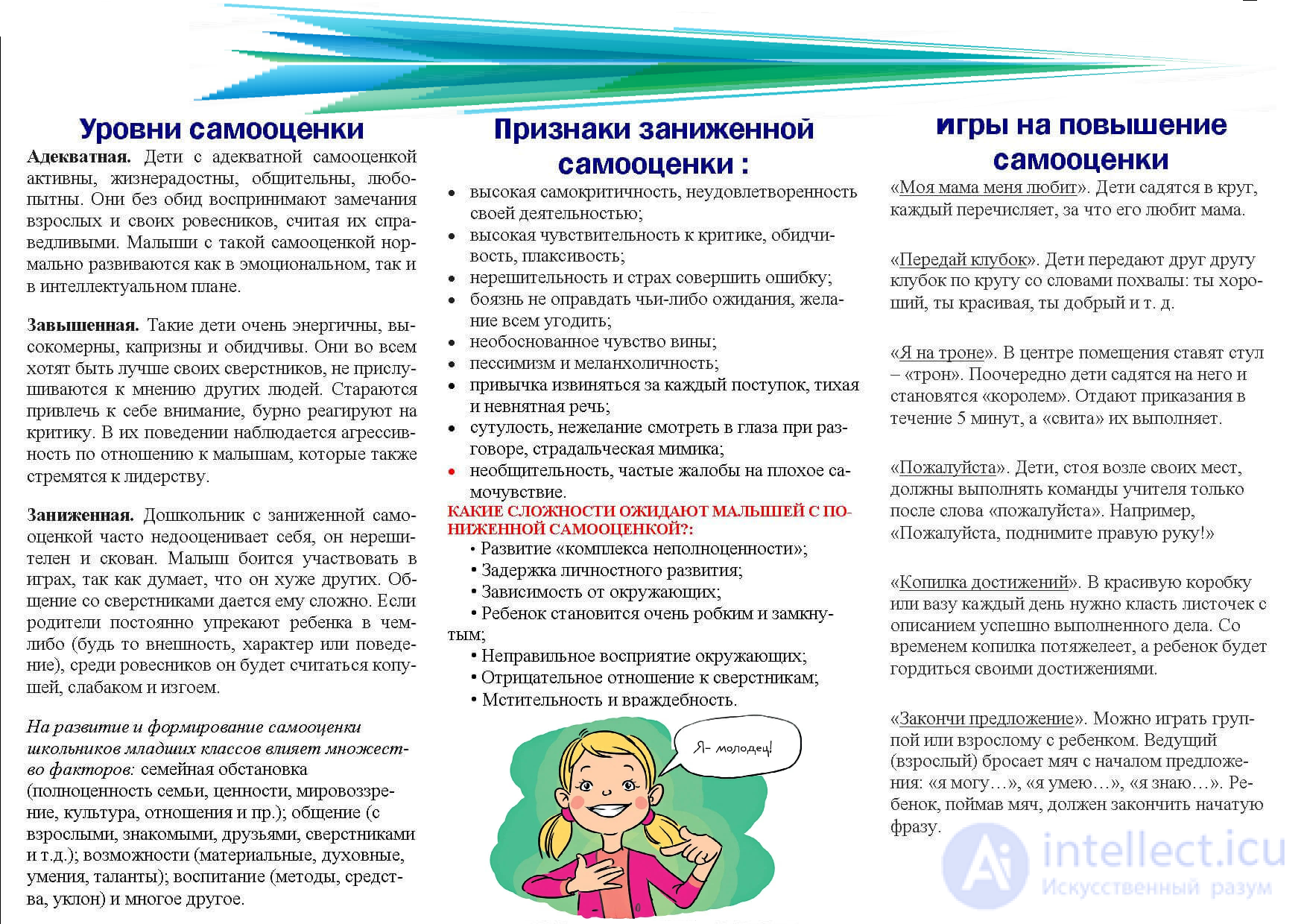
Self-esteem plays a significant role in the content and manner of a person's communication. Self-esteem is how a person evaluates himself, his abilities, values, and merits. It can strongly influence how a person interacts with the surrounding world and other people. Here are some of the ways self-esteem can influence communication:
Self-confidence and assurance: People with high self-esteem feel more confident and capable of successful communication. They often display openness and readiness for contact with others.
Aggressiveness and conflicts: Low self-esteem can lead to aggressive reactions and conflicts. A person who lacks confidence in himself may feel vulnerable and defend himself through aggressive behavior.
Tendency to compare: People with low self-esteem may compare themselves to others more often and feel less worthy. This can affect their ability to communicate openly and freely.
Positive relationships: High self-esteem can facilitate the ease of establishing positive relationships with others. People who value and respect themselves often show the same attitude toward those around them.
Empathy and attention to others: Self-esteem can also affect a person's ability to listen to and understand others. People with higher self-esteem may be more empathetic and attentive to other people's needs and feelings.
Shyness and social isolation: The problem of shyness, associated with low self-esteem, can lead to social isolation. A person may avoid communication out of fear of rejection and negative evaluation by others.
Positive or negative self-presentation: Self-esteem can shape a positive or negative self-presentation. People who consider themselves successful and worthy often display more constructive and positive communication.
To improve the influence of self-esteem on communication, it is important to work on developing a positive self-presentation and confidence. This can include self-acceptance, setting realistic goals, strengthening personal qualities and skills, as well as working to overcome negative beliefs about oneself. Psychological support and self-development can help in this process.
As F. Zimbardo notes (1991), shyness is a rather vague concept: the more closely we look at it, the greater the number of types of shyness we discover. According to F. Zimbardo, shyness is a trait
of a person associated with a tendency to avoid communication or to shun social contacts. Such a definition does not quite accurately reflect the essence of this
trait. After all, the same thing could be said about an introvert.
Shyness is a widespread phenomenon. According to F. Zimbardo, 80%
of the Americans he surveyed answered that at some period of their life they
had been shy. About a quarter of the respondents called themselves chronically
shy. Shy people have a certain biological predisposition of the sympathetic nervous system, which consists in excessive
sensitivity to conflicts and threat.
He draws attention to the fact that children prone to inhibition, and children
not prone to inhibition, do not simply represent two poles of one and the same
continuum – on the contrary, we are dealing with two separate types of different genetic origin. Some authors consider it appropriate to regard this phenomenon only as a predisposition, and consequently,
it is also necessary to take into account the role of cognitive factors and learning factors.
Shy people are often withdrawn into themselves and unsociable. They find it easier to interact with those younger than themselves than with older and more competent
people. The communication of a shy person is described in detail by V. N. Kunitsyna and
E. N. Boitsova (1983).
In a group of people, a shy person usually keeps to himself,
rarely enters into conversation, and even more rarely starts it himself. In conversation he behaves awkwardly, tries to get away from the center of attention, and speaks less and more quietly. Such a person always listens rather than speaks himself, does not venture to ask unnecessary questions or argue, and usually expresses his opinion timidly and hesitantly.
It is difficult to draw a shy person into conversation; often he cannot squeeze out
a single word, and his answers are usually monosyllabic. Such a person sometimes cannot
find the right words for conversation, often stammers, or even falls silent altogether; he is characterized by a fear of undertaking anything in front of people. The tension
experienced by a shy person when communicating with people can bring on neuroses.
Embarrassment. People often blush from embarrassment – a brief
acute loss of self-respect that all of us have to experience from time to time. We become embarrassed when some incident from our private
life attracts general attention to itself. Sometimes this happens when
someone tells other people something about us, for example, "Alice spent a whole hour
in front of the mirror. You should have seen her without makeup!" – such revelations
would probably embarrass any of us. On the other hand, the most modest among
us are often embarrassed by unexpected praise. We also become embarrassed when we realize
that other people see, or will soon see, our inability to do something
and will not praise us for it.
The state of embarrassment, caused by an awareness of one's own inadequacy, was investigated in the course of an interesting experiment conducted by Andre
Modigliani. Modigliani ran a series of "competitions," some of whose participants, without suspecting it themselves, were set up to perform poorly and thereby let down their entire team. Those who tasted the bitterness of defeat in
front of others were very embarrassed. They were embarrassed considerably more than those who were fortunate enough to fail not in public. The latter were not embarrassed very much, and even then mainly because of the fact that their failure
would soon become known to others. Those who were embarrassed the most made efforts to restore their shaken sense of self-respect
and desperately tried to "put on a brave face," which, in turn,
was achieved through attempts at self-confidence. Modigliani's study noted six tactical methods of saving face:
1. An attempt to shift attention onto someone else.
2. An attempt to make excuses.
3. An effort to display one's other merits.
4. An attempt to reject the very idea of the competition.
5. Denial of one's defeat.
6. A desire to seek support.
Since most shy people already have a low opinion of themselves, they may not resort to this distracting tactic. Instead, they
become accustomed to avoiding situations in which they might experience embarrassment, and in this way increasingly separate themselves from others, focusing
on their own shortcomings.
Some of those surveyed reported that they feel shy even when they remain
alone. They blush and become embarrassed, reliving their previous
mistakes, or worry about how they will behave in the future. Thus shyness
makes itself known even when we are alone.
Awkwardness. The most notable feature of a shy person –
awkwardness. Awkwardness is an outward manifestation of an excessive preoccupation
with one's own inner state. Self-knowledge, the striving to comprehend oneself, lies at the basis of many theories of harmonious personality development and is the goal of the most diverse therapeutic approaches practiced today. However, that same tendency toward self-analysis and the constant reassessment of one's feelings and thoughts, when it becomes an end in itself, points to a mental
disorder. Shy people not infrequently end up exactly there.
Awkwardness in public is reflected in a person's anxiety about the impression made on others: "What do they think of me?", "What opinion
are they forming of me?", "Do they like me?", "How can I find this
out?"
Awkwardness before oneself is the mind turned against itself. This
is not simply a process of turning attention inward, but a predisposition to seek out only negative qualities in oneself: "I am not adequate", "I
am not developed", "I am stupid", "I am unattractive", "I am good for nothing".
The distinction between these two varieties of awkwardness can be extended to shyness as a whole. A study conducted by Paul
Pilkonis identified two basic types of shy people: those who are shy in public, and those who are shy before themselves. The former are more concerned with how to avoid making mistakes, the latter with how to avoid unpleasant sensations.
The socially shy. Which of these two categories of people, in your view, has it worse? Apparently, the burden of shyness weighs with greater
force on the shoulders of those who are shy in society. The sensations they experience
affect their actions, which in turn affect the opinion that forms in other people's minds,
which then affects what the shy people themselves think of themselves. Unpleasant sensations – you feel out of place in the presence of others – an unfavorable opinion forms about you – your self-esteem suffers as a result. A vicious circle. So next time, duck down, fall silent, freeze – and no one, at
least, will notice you.
The socially shy speak reluctantly about their insecurities, fears, and about their good qualities and aspirations
; they are unwilling to open up even to
people who are well disposed toward them. As if having placed themselves in an impenetrable shell, they can get help, advice, or recognition of their merits from no one, not to
mention love, and yet from time to time all of us need genuine human involvement.
And, finally, one can guess that the socially shy are simply not
able to be leaders. In most groups, the people who become leaders are those
who have a good gift of the gab. It is not at all necessary for them to put forward many
good, new ideas: in the group's opinion, a leader controls the situation better than others merely because he picks up and develops these ideas. Studies have shown that when a person who was initially inconspicuous began to talk a great deal (a hidden electric
light signaled to him exactly when to speak), the other members of the group treated him with greater respect, and
his chances of becoming a leader increased accordingly. However, simply instilling
communication skills in a socially shy person is not enough. One must build up his self-confidence and develop in him a sense of self-worth.
Compared with socially shy introverts, shy
extraverts find themselves in a more advantageous position. Knowing what needs to be done to please others, to be accepted into a chosen circle, to get
ahead, people who are competent and shy only before themselves can succeed in life. Such people, if they are also gifted with abilities, can quickly attain a worthy place in their profession and
even become celebrities. But no one except themselves will ever know
how much effort it took them to create the illusion of unshakable self-confidence.
The problem of shyness associated with low self-esteem can also be resolved through training social skills, increasing self-confidence, and working to eliminate fears and negative beliefs that may be related to communication

Comments