
Lecture
Praise, encouragement, and punishment are important tools in pedagogical practice. However, their effectiveness depends on how they are applied. Let us examine effective and ineffective ways of using them:
Effective praise:
Specificity: Effective praise should be concrete and specific. Instead of general words of thanks, indicate exactly what the student did well. For example, "You did a great job when you carefully researched this topic and prepared an interesting project."
Positive reinforcement: Encouragement should be positive reinforcement. It should strengthen the desired behavior. For example, if a student regularly completes assignments on time, this behavior should be encouraged so that they continue doing so.
Individualization: Teachers should take into account the individual needs and characteristics of each student. What may be motivating for one may not work for another.
Ineffective praise:
General words of praise: Empty general phrases such as "Well done" without concrete evidence or indication of achievements do not give students a clear idea of what exactly was good.
Encouragement only for the result: If praise is always linked only to the result (for example, a high grade), this can create stress and a competitive atmosphere rather than motivation to learn.
Effective encouragement:
Positive reinforcement: Effective encouragement strengthens the desired behavior. This can include praise, small rewards, additional time for interesting projects, etc.
Timeliness: Encouragement should be timely, so that the student can associate it with a specific action or effort. Delayed encouragement can lose its effectiveness.
Ineffective encouragement:
Effective punishment:
Fairness and proportionality: If punishment is used, it should be fair and proportionate to the violation. It is important for students to understand exactly what they are being punished for.
Explanation and instruction: The teacher should explain to the student why they were punished and help them understand how to avoid this mistake in the future.
Ineffective punishment:
Unfairness and arbitrariness: Punishment applied arbitrarily and without explanation can cause resentment and negative emotions in students.
Physical punishment and humiliation: Physical punishment and humiliation of students are absolutely unacceptable and fraught with serious consequences.
A particular area in which the ability for pedagogical communication is displayed
is the teacher's use of praise, which, as is known, can be effective or ineffective1
, and the use of encouragement and punishment
.
The effectiveness of using praise is presented in a summary
table, which shows that teachers do not always know how to praise.
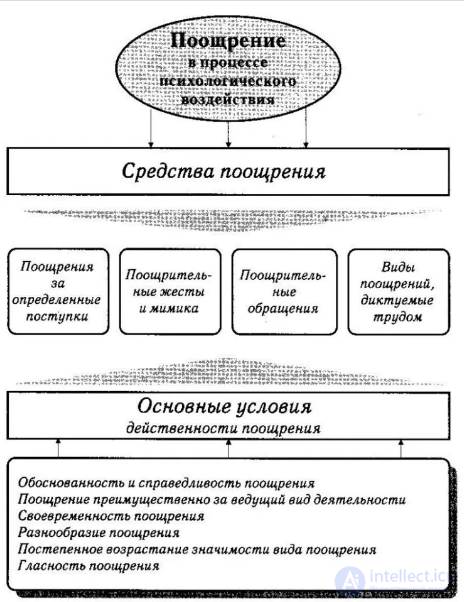
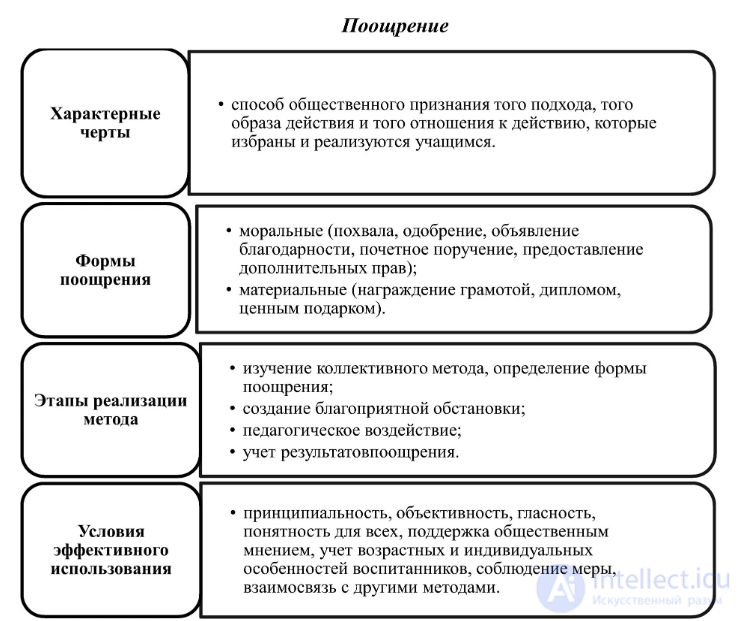
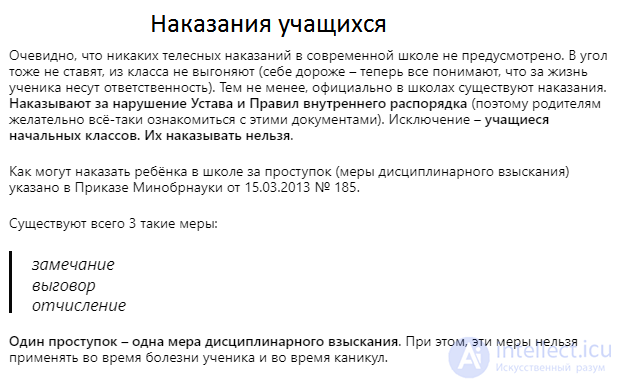
fig. punishment of students
It is noted that praise is determined not so much by what the student actually did, but by what, in the teacher's personal perception, the student needs to do. That is why praise is not used often enough. At the same time, it does not always encourage the desired behavior and does not raise students' self-esteem, and they lose
motivation. Encouragement and punishment stimulate a student's successes when they
are deserved and fair.
Table 1
| Effective praise | Ineffective praise |
| Given on a well-founded basis | Used randomly and unsystematically |
| Specifies the action for which the student is praised |
Limited to a general positive reaction |
| Has a spontaneous and varied form and other signs of sincerity; focuses attention on the student's specific results |
Minimal attention and standard, unchanging expressions |
| Encourages the attainment of specific performance criteria (diligence, for example) |
Encourages mere participation, without regard for specific results |
Gives students information about their competence or their achievements |
Gives no information at all, or only information about status |
| Sets students up for a positive attitude toward completing the task and toward task-oriented behavior |
Sets students up for comparison with one another and encourages competition |
| Uses students' previous achievements as the context for evaluating current achievements |
Uses the achievements of classmates as the context for evaluating current achievements |
| Takes into account diligence and success in difficult tasks |
Does not take into account the effort or the significance of the result achieved |
| Attributes success to diligence and ability, emphasizing that success is possible in the future as well |
Attributes success only to ability or external factors (luck, for example) |
| Stimulates endogenous attitudes (students believe that they are trying because they enjoy it or because they want to learn something) |
Stimulates exogenous attitudes (students believe that they are trying because they are thereby achieving something – pleasing the teacher, winning a competitive contest, etc.) |
| Focuses students' attention on their behavior while performing the task | Focuses students' attention on the teacher as an external authority who controls them |
| Stimulates a positive attitude toward tasks after their completion | Intrudes on the process, diverts students' attention from performing the task |
The pedagogical justification of rewards and punishments determines their
stimulating role. In this connection, the author provides detailed characteristics of pedagogically effective and ineffective rewards.
It is important to remember that effective encouragement and punishment should take place within a healthy, supportive, and safe educational environment. The goal should always be the development of positive relationships and motivation for learning.

Comments