
Lecture
Communicative competence is a person's ability to communicate successfully and effectively in a language, to possess communicative skills, and to build interaction with other people. This term is often used in linguistics and communication studies to describe a person's ability to create and interpret texts and messages based on linguistic and cultural norms.
Communicative competence is the command of complex communicative skills and abilities, the formation of adequate skills in new social structures, knowledge of cultural norms and constraints in communication, knowledge of customs, traditions, and etiquette in the sphere of communication, observance of propriety, good manners, and orientation in the communicative means characteristic of a given national or class mentality and expressed within the framework of a given profession. 84 Communicative competence is a generalizing communicative property of the personality, encompassing communicative abilities, knowledge, skills and abilities, and sensory and social experience in the sphere of business communication.
The key components of communicative competence include:
Linguistic competence: This is knowledge and understanding of the language, including grammar, vocabulary, syntax, and the rules of linguistic interaction. Linguistic competence enables a person to construct correct and grammatically sound statements.
Sociocultural competence: This is an understanding of sociocultural norms, rules, and customs that influence communication. This competence includes knowledge of which topics and styles of communication are appropriate for different contexts and audiences.
Discursive competence: This is the ability to construct texts and statements with regard to the context and purpose of communication. Discursive competence includes knowledge of text structure, the logic of argumentation, and the ability to organize information logically and consistently.
Strategic competence: This is the ability to choose appropriate communicative strategies in different situations. Strategic competence includes the ability to listen, ask questions, resolve conflicts, and adapt to changing circumstances.
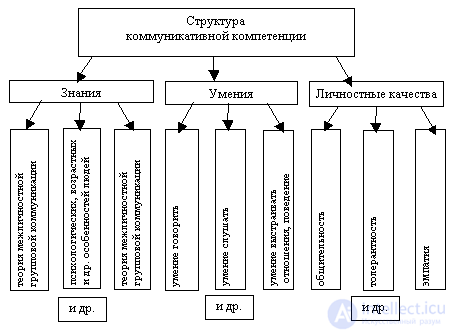
Communicative competence is made up of the abilities:
Communicative competence acts as an integral quality that synthesizes general culture and its specific manifestations in professional activity. One of the conditions for communicative competence is the observance of certain rules and requirements.
The most significant of these rules are as follows:
With this approach to characterizing communicative competence, it is useful to consider communication as a systemically integrating process that has the following components:
a) communicative-diagnostic (diagnosis of the socio-psychological situation and conditions of future communicative activity, identification of
possible social, socio-psychological, and other contradictions that the individual may possibly encounter in communication);
b) communicative-prognostic (assessment of the positive and negative aspects of the upcoming communication situation);
c) communicative-programming (preparation of a communication program, development of texts for communication, choice of style, position, and distance of communication);
d) communicative-organizational (organization of partners' attention in communication, stimulation of their communicative activity, management of the communication process, etc.);
e) communicative-performative (diagnosis of the communicative situation in which the individual's communication unfolds, forecasting the development of this situation, carried out according to a previously thought-out individual communication program).
Each of these components requires special sociotechnological analysis; however, the scope of this account allows us to dwell only on the communicative-performative part. We shall consider it
as the communicative-performative mastery of the individual.
A communicative personality plays an important role in creating a positive atmosphere in society and in interpersonal relations. Its skills and qualities can be useful both in personal life and in professional activity, since they contribute to effective communication, cooperation, and the solving of various tasks

Comments