
Lecture
"The Technology of Ideal Communication" is a concept developed by Charles and Gerald Toich (Charles and Gerald Toich) as part of their work on improving communication skills and relationship management. They presented this concept in their book . The Toichs' concept involves using certain principles and methods to achieve more effective and harmonious communication.
According to the core idea, the genetic code determines much of a person's life prospects and basic behavioral patterns even before birth. Information about ancestors' experience is preserved together with information about appearance in the DNA molecule. Every person has their own basic inner direction – a unique combination of genetic, unconscious and conscious factors, in accordance with which they move through life, gain experience and «play» their roles – regardless of their own conscious reactions and interpretations. The «radiation» of this basic inner direction affects a person's behavior, success and health. Psychogenetics asserts: as long as we do not become aware of the negative programs of our genetic code, we will remain victims of circumstances, chance encounters, and someone else's will. Awareness of the negative aspects of one's genetic program helps one become the master of one's own life and, with one's own hands, mind and will, create one's present and future well-being.
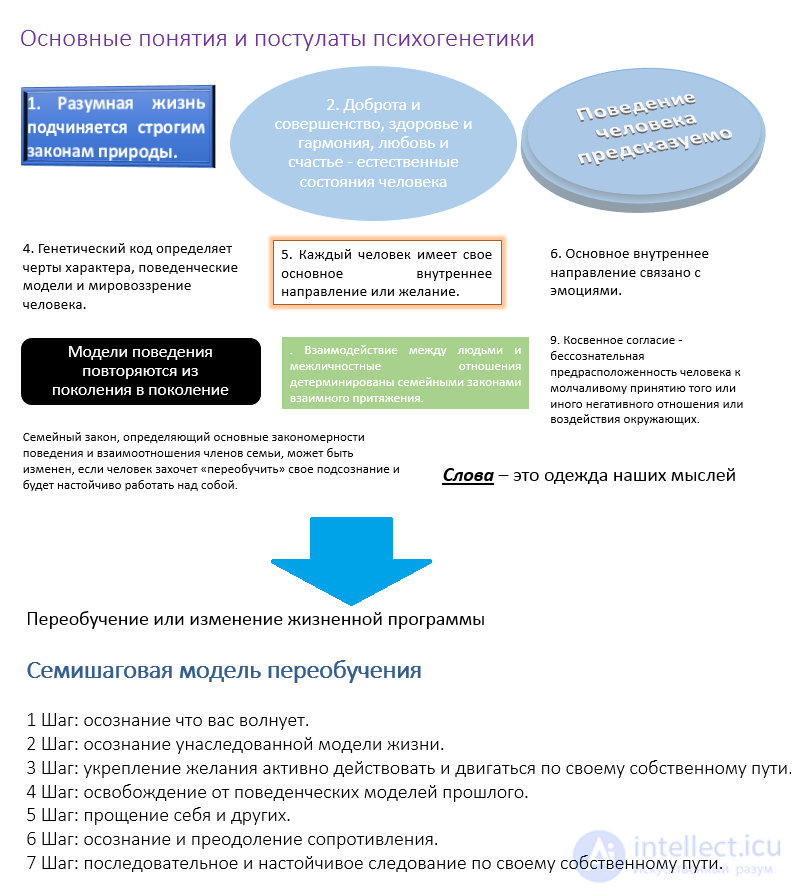
And both psychological science and life itself confirm: freedom belongs not to every person, but only to those who understand the external and internal forces acting on them, have a sense of orientation in life, and are resolutely capable of reversing an unfavorable course of events, getting out of a situation, actively intervening in what is happening. Basic Concepts and Postulates of Psychogenetics Rational life obeys the strict laws of nature. Having analyzed extensive scientific information about the macrocosm and microcosm, Ch. Toich concluded that the classical scientific view that the mind is synonymous with the concepts of «brain» and «the body's control center» is unjustifiably limited. Ch. Toich, referring to Descartes' discovery, considers the mind to be a separate electromagnetic continuum, more extensive than the human brain. The mind can exert a controlling influence on a person and use their cells as a computer for storing information, and therefore a person's knowledge, skills and behavioral features depend on this mind. Ch. Toich is convinced that life, for all its contradictoriness, is nevertheless extremely rational. Human behavior is predictable. In his concept there are no accidents or coincidences; all happy and painful circumstances obey strict laws. The genetic code determines a person's character traits, behavioral patterns and worldview.
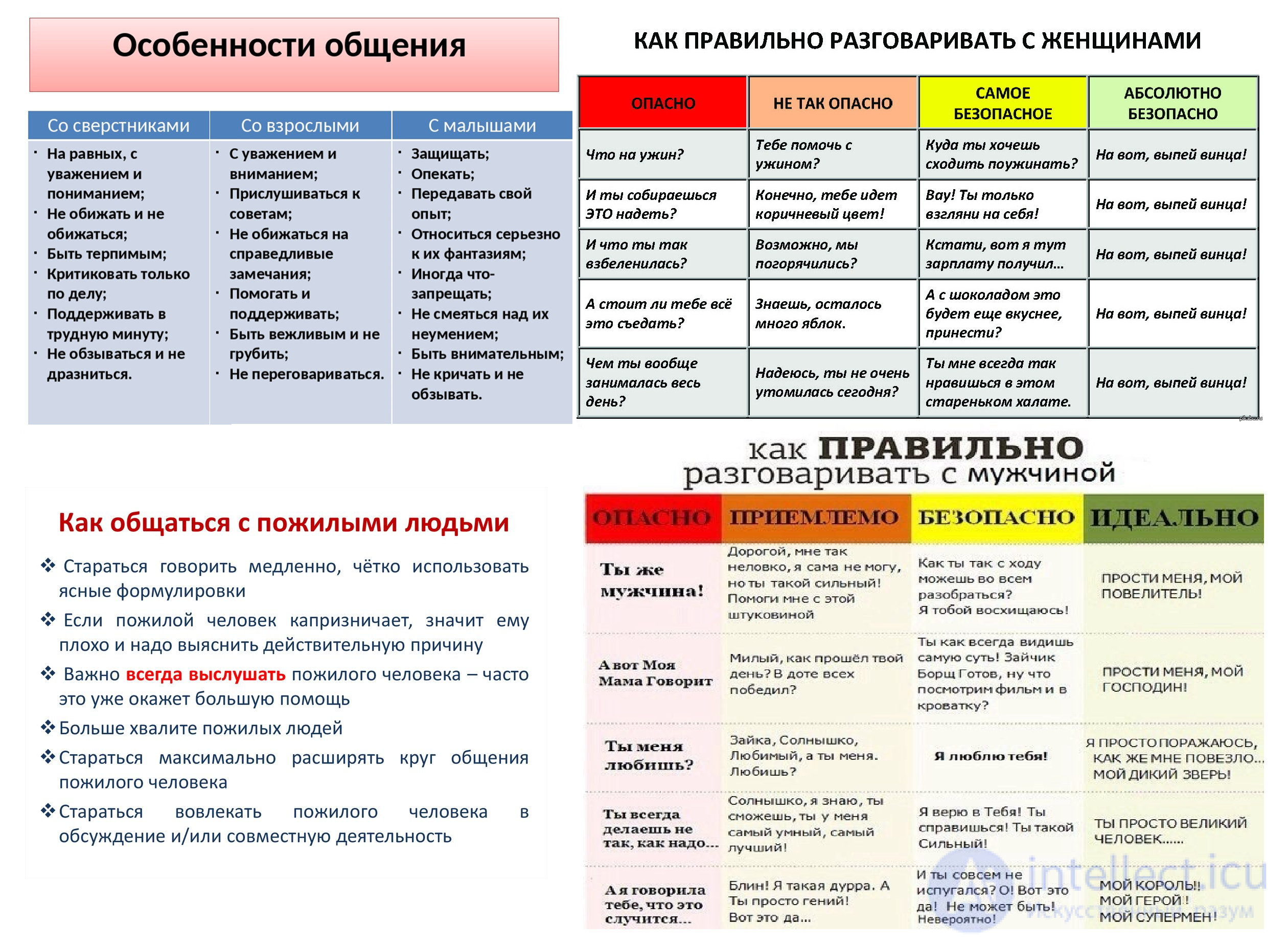
fig. features of communicating with children, men, women and the elderly
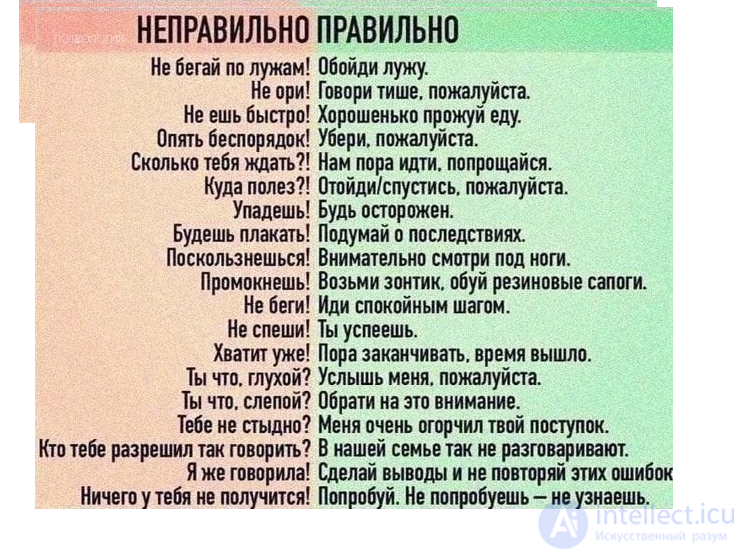
Fig. features of communicating with a child
Communication with different categories of people, such as children, men, women and the elderly, requires taking into account and adapting to their characteristics and needs. Here are some general recommendations for communicating with each of these groups:
Communicating with children:
Communicating with men:
Communicating with women:
Communicating with elderly people:
what should not be said to a wife?
To maintain a healthy and harmonious relationship with your wife, it is important to avoid rudeness, insults and negative remarks. Here are some general principles of what should be avoided when communicating with your wife:
Insults and derogatory remarks: Never use offensive or derogatory words toward your wife. Respect for her and her feelings is very important.
Criticism without constructive suggestions: Criticism in itself is not a problem, but it should be accompanied by constructive suggestions and an attempt to find a solution together.
Comparisons with others: Avoid comparing your wife to other women or to members of her family. This can cause resentment and jealousy.
Personal attacks: Do not resort to personal attacks during conflicts. Conflicts should be resolved based on the essence of the matter, not by attacking your partner's personality.
Forgetting acknowledgment and expressions of gratitude: It is important to express recognition and gratitude to your wife for her efforts and contribution to the relationship.
Avoid ignoring her: Do not ignore your wife's feelings and needs. Listen to her and try to understand what matters to her.
Secrets and secretiveness: It is important to maintain open and honest communication. Secretiveness and withholding information can cause resentment and distrust.
Refusing to apologize: If you made a mistake or did something that hurt your wife, be ready to apologize and try to restore the relationship.
Neglect: Do not disregard your wife's feelings and opinions. Her opinion and feelings are just as important as yours.
Bringing up past grievances: Try not to bring grievances from the past into current disputes. Resolve conflicts and let go of past misunderstandings.
The exception is your wife's individual preferences and boundaries. It is important to open a dialogue and discuss exactly what she considers unacceptable in communication. Your relationship should be built on mutual respect and understanding.
what should not be said to a husband?
As with communicating with a wife, it is important to maintain respectful and caring communication with your husband. Here are some general principles of what should be avoided when communicating with your husband:
Insults and derogatory remarks: Never use offensive or derogatory words toward your husband. Respect for him and his feelings is very important.
Criticism without constructive suggestions: Criticism in itself is not a problem, but it should be accompanied by constructive suggestions and an attempt to find a solution together.
Comparisons with others: Avoid comparing your husband to other men or to members of his family. This can cause resentment and jealousy.
Personal attacks: Do not resort to personal attacks during conflicts. Conflicts should be resolved based on the essence of the matter, not by attacking your partner's personality.
Forgetting acknowledgment and expressions of gratitude: It is important to express recognition and gratitude to your husband for his efforts and contribution to the relationship.
Avoid ignoring him: Do not ignore your husband's feelings and needs. Listen to him and try to understand what matters to him.
Secrets and secretiveness: It is important to maintain open and honest communication. Secretiveness and withholding information can cause resentment and distrust.
Refusing to apologize: If you made a mistake or did something that hurt your husband, be ready to apologize and try to restore the relationship.
Neglect: Do not disregard your husband's feelings and opinions. His opinion and feelings are just as important as yours.
Bringing up past grievances: Try not to bring grievances from the past into current disputes. Resolve conflicts and let go of past misunderstandings.
things not to say to a husband - belittling his possessions or insulting him based on property, physical characteristics or intimate aspects of his personality is unacceptable in communication , for example - what a small apartment, bathroom, car, penis you have, etc.
The exception is your husband's individual preferences and boundaries. It is important to open a dialogue and discuss exactly what he considers unacceptable in communication. Your relationship should be built on mutual respect and understanding.
General rules of communication with a husband or wife (spouses)
Communication with a spouse, whether husband or wife, has its own peculiarities and depends on many factors, such as the individual characteristics of the personalities, the dynamics of the relationship, shared values and traditions, as well as cultural aspects. However, below are some general recommendations for successful communication with a partner, regardless of gender:
Listen attentively: Listening and respecting your partner's point of view is a key aspect of successful communication. Pay attention to their feelings and opinions.
Be honest: Honesty is important in any communication, especially in relationships. Share your thoughts, feelings and expectations openly and honestly.
Use "I-messages": Instead of blame or criticism, express your feelings and needs using "I-messages". For example, "I feel hurt when..." instead of "You always..."
Respect differences: You and your partner may have different points of view and approaches to things. Respecting differences and seeking compromises is an important part of communication.
Spend time together: Quality time together helps strengthen the relationship. Find shared hobbies and interests.
Resolve conflicts constructively: Conflicts are inevitable in relationships. It is important to learn to resolve them constructively, discussing problems and seeking solutions together.
Maintain positive feedback: Appreciating and encouraging each other creates positive communication. Do not forget to express your gratitude and recognition.
Give each other space: It is important to give each other space for personal growth and self-expression.
Do not forget about humor: Humor can help relieve tension and create closeness.
Learn together: Continuous learning and developing your relationship can be a fun and exciting experience.
It is important to remember that every person is unique, and communication can vary depending on individual characteristics and circumstances. Listen to each other, show understanding and a willingness to adapt in order to create healthy and harmonious relationships. There are no universal rules, but these recommendations can serve as a good starting point for successful interaction with different categories of people.
Thus, a person has a genetically determined favorable or unfavorable predisposition that determines not only their style of interaction with others, but also the nature of their health, family life and career. A rather controversial but nonetheless noteworthy claim by Ch. Toich is that the main purpose of human life is the purification of DNA through individual or collective efforts – conscious, subconscious or unconscious. It is with this process, believes Dr. Ch. Toich, that the need for children to take on the psychological problems of their elders is connected. The history of a family will keep repeating itself until a person learns the lesson it is trying to instill in them. This applies in the same way as it does to psychological heredity.
In general, the technology of ideal communication of Charles and Gerald Toich represents a comprehensive approach to communication that involves empathy, active listening, nonverbal communication and the ability to manage relationships. It is aimed at improving the quality of communication and creating more harmonious relationships in various spheres of life.

Comments