
Lecture
Interaction is understood as a system of actions in which the actions of one person or group of persons condition certain actions of others, and the actions of the latter, in turn, determine the actions of the former.
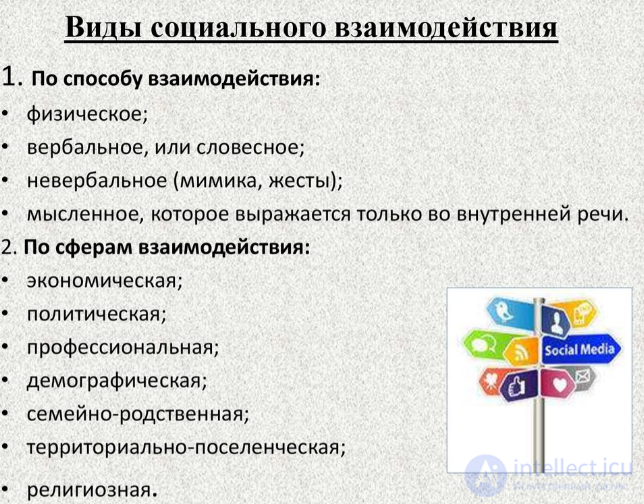
fig. types of social interaction
In the process of communication, people interact with one another in various ways, which may depend on the context, the goals of communication and the type of relationship. Here are several basic ways people interact in the process of communication:
Conversation and dialogue: This is the classic form of communication, in which participants exchange ideas, information and opinions. Conversation and dialogue can take the form of a face-to-face talk, a phone call, a video conference, or a written exchange.
Listening and questioning: Active listening and asking questions are ways of participating in a conversation. This helps to understand the interlocutor, clarify their point of view and show interest in their opinion.
Nonverbal communication: Facial expressions, gestures, manner of communicating and intonation are also ways of communicating. They can reinforce or change the meaning of messages and express emotions.
Written communication: Letters, emails, text messages and other forms of written communication allow people to communicate at a distance and leave a record of the communication.
Support and empathy: An important form of interaction is showing support and empathy toward an interlocutor. This can include words of support, listening to the interlocutor's problems and feelings, and a willingness to help.
Teamwork: In a work environment and in joint projects, people interact to achieve common goals. Teamwork involves cooperation, delegation of tasks, coordination of actions and exchange of information.
Conflict management: Conflicts and disagreements can arise in the process of communication. Conflict management involves ways of resolving disagreements, finding compromises and preserving a working atmosphere.
Feedback: Exchanging feedback, both positive and constructive criticism, enables participants to learn and grow. Feedback helps improve the quality of communication and achieve better results.
Mediation and intermediary services: Mediators and intermediaries can take part in resolving conflicts between parties and help them reach an agreement.
Use of communication tools: With the development of technology, means of communication such as social networks, video conferencing, messengers and others have become widely used for communicating at a distance.
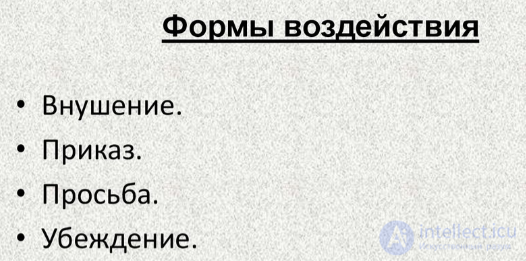
fig. forms of interaction
It is noted that interaction can also take place when relatively independent individual activities are being performed, but in that case it
is not incorporated into the structure of that activity and does not introduce fundamental changes into it. Evidently, this type of interaction corresponds to the model
of "jointly individual activity" according to L. I. Umansky.
Group integration is the process by which a group turns into a single whole on
the basis of the mutual adaptation of the group's members to one another.
Group differentiation is the division of a group into participants occupying different positions in the system of interpersonal relations.
Professor of psychology Lev Ilyich Umansky (1921–1983) devoted himself
to the study of the psychology of organizational activity. The professor proposed
a typology of joint activity.
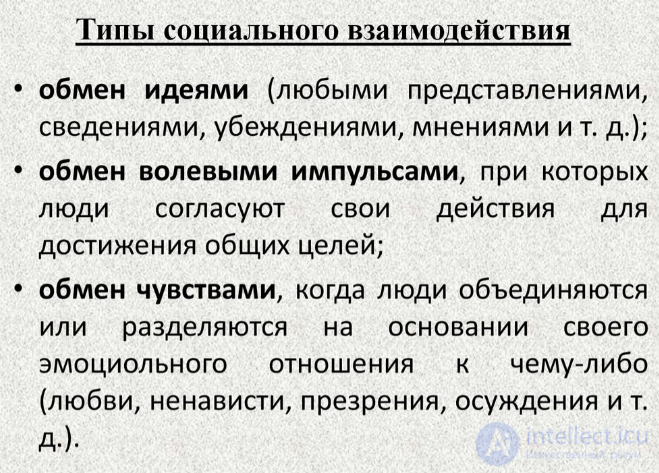
fig. types of social interaction
By the type of joint activity, or the form of organization of joint activity, is meant the way in which participants in a group interact when solving tasks or problems.
According to L. I. Umansky's classification, three basic types of joint activity can be identified: jointly interacting, jointly sequential, and jointly individual.
1. The jointly interacting type of activity is characterized by the obligatory participation of everyone in solving the common task. Here, the intensity of the performers' labor is, as a rule, roughly the same, and the features of their activity are determined by the leader and are, as a rule, not very variable. The effectiveness of the group depends equally on the contribution of each of its
participants. An illustration of this variant of organizing joint activity could be the joint carrying of heavy loads.
2. The jointly sequential type of activity differs from the jointly interacting type in the temporal distribution, as well as the order
of each person's participation in the work. Sequencing implies that first one participant is involved in the work, then a second, a third, and so on.
The distinctive feature of each participant's activity is set by the specific goals of jointly transforming the raw material into the final product.
A typical example of the jointly sequential type of interaction is an assembly line, when the product of the activity of one of the participants in the process, passing
to another, becomes an object of labor for the latter.
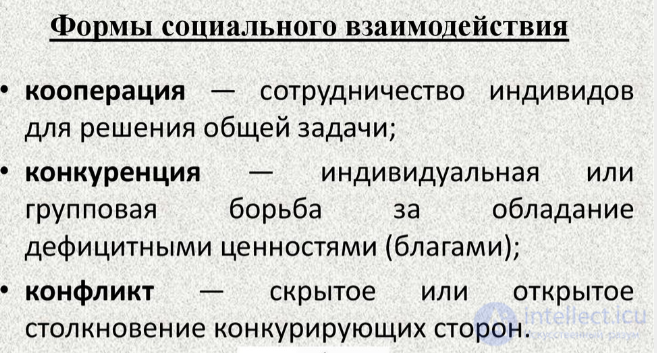
fig. forms of social interaction
So, for example, in the manufacture of boards, first someone fells the tree,
then someone transports it to the factory, then someone separates the trunk from the branches,
then someone measures the trunk and calculates how many boards of what size
can be obtained and what the cutting plan should be, and only then does the trunk go for sawing.
3. The jointly individual type of activity is distinguished by the fact that
interaction between the participants of the labor is minimized. Each of the performers carries out their own volume of work, and the specifics of the activity are set by the individual characteristics and professional standing of each. Each
of the participants in the process presents the result of their labor in the agreed form and at the
designated place. Personal direct interaction may be practically absent and may take place in indirect forms (for example, by telephone, computer networks, etc.). What unites the different performers is only
the object of labor, which each of the participants processes in a specific
way. Examples of this type of activity are the individual carrying of heavy loads, or the independent analysis of different aspects of the same phenomenon
by different specialists.
Recently, specialists have identified a special type of joint activity – jointly creative activity. This type of organizing collective activity originated in the fields of science and art, where participants in a scientific or creative project created something entirely new, often unique, that could not be created according to existing rules and technologies. In
these collectives a special type of activity arises – co-creation, in which
each participant in the process is an equal creator of the new. The laws
of creativity require taking into account everyone, even the most "crazy" vision, because in the cauldron of general discussion, even the most absurd idea can give rise to
a discovery. This type is characterized by the special activeness of each of the participants in the process of interaction, namely: activeness in terms of increasing one's own professional competence through participation in collective
activity. On the one hand, the features of the jointly creative type of activity give each participant the opportunity to try different ways
of working, to enrich themselves with methods of work characteristic of other specialists and fields of labor, and on the other hand, the synergistic (mutually enriching) effect gives a powerful impetus to the development of the group itself, which carries out the
activity. However, in activity of this type, the "traces" of individual
contributions of the participants are, in principle, not distinguishable.
Members of such a collective get the opportunity to work in a wide variety of professional positions and to perform various collective roles depending on the task facing the group. Therefore, such groups usually possess a high degree of flexibility and variability, both in composition and in internal structure, depending on the tasks set and the conditions for their performance. This is how creative collectives work, in which each person is given full opportunity for self-expression, and yet the goal of the group as a whole is achieved – the creation of a new, culturally valuable work or product.
For people in a situation of jointly interacting activity, a high orientation toward collective goals, commitment to the leader's authority, orientation toward group morality (norms and values), and traditional patterns of behavior are characteristic. For a participant in an organization with this type of technology, a high commitment to the group is characteristic, and the harshest punishment is expulsion from the group of one's own kind.
For employees of an organization with the jointly sequential type of activity, a high degree of technological discipline is characteristic, along with adherence to the norms and rules formulated in instructions, regulations and other normative documents. This kind of technology is typical of
complex industrial production and manufacturing industry.
For participants in the process of jointly individual activity, high initiative, passionate drive, and orientation toward results and
individual achievements are characteristic. Such specialists place their own goals and values at the forefront, tend to work out ways
of achieving the goal independently, and are able to act effectively in a situation of intra-organizational competitiveness. This kind of technology is typical of modern knowledge-intensive production and complex technologies that require very high qualifications. Labor collectives working within such technology may encounter problems organizing joint activity among different specialists who know their own work well but are poorly oriented toward understanding the specifics of their colleagues' work, concentrating instead on the problems of their own activity rather than on the problems of the organization
as a whole.
Participants in jointly creative activity are characterized, as has been noted, by a special orientation – an orientation toward professional development. This
differs fundamentally from the aspirations of participants in jointly individual activity; in this case, it is not so much a matter of deepening within the bounds of a single
problem or specialty as of working in the borderline areas of human activity. A professional, unlike a mere specialist, is able and even
tends to go beyond the bounds of their specialty and to work using the tools of other specialists, which allows them not only to find something new, but also to deepen their understanding of problems.
Thus, participants in the jointly creative type of activity possess a pronounced orientation toward cooperation with specialists from different fields, flexibility in changing positions, and an orientation toward individual development. For collectives working in this type of activity, the principal value becomes the attainment of new knowledge, the creation of conditions for individual development, and respect for the rights of each participant. Unlike the jointly interacting type of activity, in organizations of the jointly creative type it is impossible to resolve problems by majority vote or to impose the dictatorship of the majority. Problems must be resolved by consensus, and the final decision must, without exception, leave room for the realization of the legitimate interests of the minority; their rights can never be violated.
The choice of a way of interacting depends on the goals of communication, the context and the preferences of the participants. Effective communication often involves a combination of different methods and skills in order to achieve the desired results.

Comments