
Lecture
Communication can have different levels, depending on how deeply and thoroughly information or ideas are exchanged between participants. Four main levels of communication are usually distinguished:
Surface communication:
Factual communication:
Emotional communication:
Deep communication:
Amid the whole variety of dialogues and their variations, six levels of
communication are distinguished.
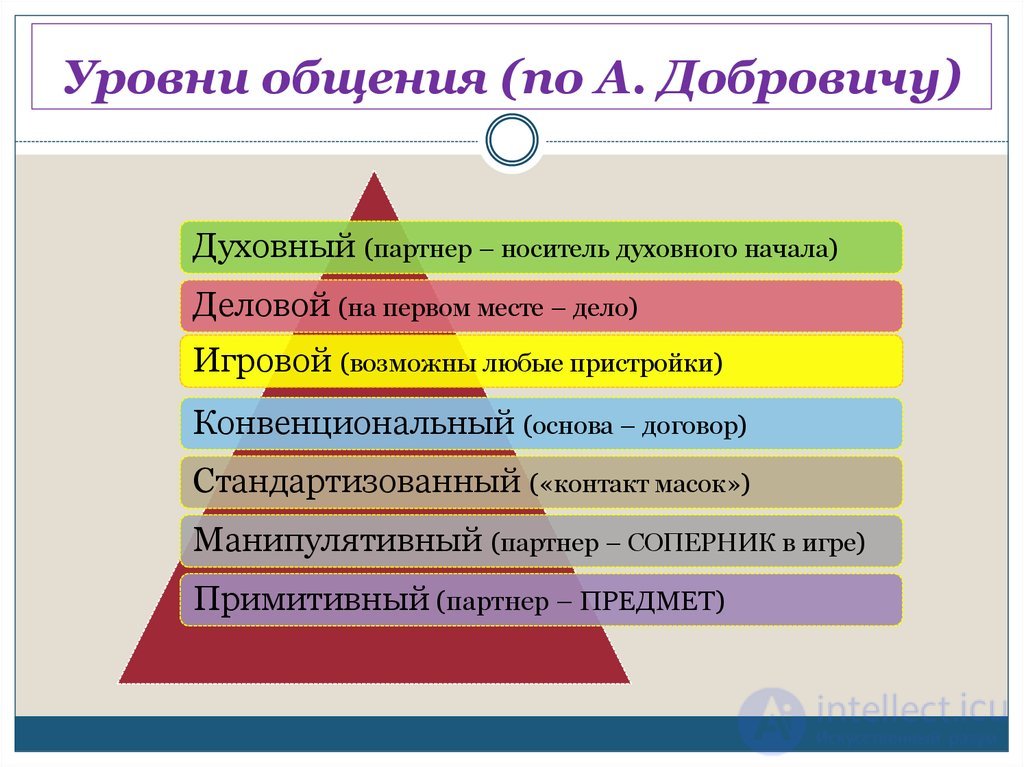
Primitive. The interlocutor sets up contact without particularly worrying about how adequately and correctly you will perceive him. A drunk person unashamedly confesses to a stranger on a bus. The interlocutor prefers to talk more than to listen; he does not care about the feelings he produces in those around him. The same can be observed when dealing with a bureaucratic system or with a rude salesperson. Note that such people's vocabulary is usually quite poor; their speech tempo is excessively fast, because their sole aim is to overwhelm you and throw you off balance; and their attitude toward communicating with you is like talking to the chair you happen to be sitting on – that is, no attitude at all. Your response to such an interlocutor should be aimed at tempering his ardor, without raising your tone, speaking evenly. If you show courtesy while remaining firm and even somewhat tough in your manner, it will be hard for him to answer this with aggression. We would like to stress that humor on your part is only appropriate if it does not touch on the personal qualities of your interlocutor, however unremarkable he may be.
Manipulative. At this level of communication the interlocutor is perceived as a tool for achieving some goal; this level of communication is an integral part of many professions (diplomat, sales manager). Manipulation is often necessary for certain everyday processes
(a wife indirectly lets her husband know that she has nothing to wear, thereby inducing him to willingly buy her a new fur coat). Manipulation is often characterized by feigned interest and courtesy. Threats and flattery are also extreme forms of the manipulative level of communication.
Business-like. The interlocutor is attentive to your personal views and tastes; he pays attention to your character and age. The goal that unites you determines your relationship – that is why this is not manipulation (although, admittedly, a skilled player can easily combine several levels of communication at once, depending on his objectives). The business-like level of communication in everyday life applies to people with whom a certain distance must be maintained. We draw your attention to the fact that a businesslike manner is also a conscious, serious perception of the interlocutor, so this level of communication is, to some extent, applicable not only in business and entrepreneurial relations.
Playful. A level of communication based on improvisational forms, which can be light-hearted, joking, even grotesque.
Thus, several friends, chatting animatedly and exchanging jokes, may not notice how a fairly long logical chain builds up. Women's flirtation is also one of the most vivid examples of communication at the level of mutual play. This level of communication is directly linked to a sense of humor and is very important for any informal relationships. For example, family relationships are unlikely to be sufficiently harmonious and constantly refreshed without
mutual play and humor.
Spiritual. The name shows that this level of communication is characterized by the greatest degree of self-disclosure and immersion into the personality of the interlocutor. This level sometimes requires considerable inner effort,
of which far from everyone is capable. The spiritual level of communication is used by
some especially close relatives and friends. Confession to a priest, a sincere account of oneself, will inevitably require an especially deep spiritual level of communication. A distinctive feature of the spiritual level of communication is
an unhurried pace of speech, caused by a special trusting attitude toward the interlocutor and toward communicating with him.
The level of masks. Everyone can count up many masks within themselves. The interlocutor involuntarily puts on a mask of friendliness, seriousness, politeness, since
sometimes it is simply psychologically impossible to invest all of one's mental resources and charm into communication. It is also worth taking into account contacts that are not only verbal – no less often we encounter someone with just a glance, silently shake someone's hand, and this too takes energy, and we defend ourselves with the help of masks. Note that when you give a not entirely sincere compliment, you put on a mask so as not to be hurt by your own insincerity. Such a concept as lying is directly connected with the system of masks. The level of masks also includes the concepts of the «formal level», the «level of maintaining contact», and the «level of standard conversation» (according to Bugental). The formal level is characterized by maintaining a certain impression of oneself and keeping
a certain distance. The level of maintaining contact is communication between people in a more relaxed manner, communication at the level of facts and opinions. The
level of standard conversation represents everyday dialogue between close people and acquaintances
The level of communication may change depending on the context and the relationships between participants. For example, with close friends or a partner, you may more often exchange deep emotions and ideas than with colleagues at work. It is important to be able to adapt the level of communication to the situation and the level of trust between participants in order to create more effective and harmonious relationships.

Comments