
Lecture
According to V. N. Myasishchev's viewpoint, from the very beginning of its existence personality represents a "dialogical formation." This means that personality is formed and develops through interaction with other people and the experience of communication. A key aspect of this concept is that a person's individual identity is a product of this interaction.
Myasishchev emphasizes that a person's relations to different aspects of reality and to different people can never be identical. This diversity of relations influences the ways in which a person deals with other people. Thus, individual experience of communication shapes each person's unique approaches and styles of communication.
However, Myasishchev also draws attention to the fact that internal deviations in subjective relations can lead to the formation of stable states of inner orientation. These states affect a person's perception, memory, thinking, attention, and emotional sphere. Thus, communication and relations between people have a profound effect on the psyche and behavior of each individual.
V. N. Myasishchev's research in this area emphasizes the importance of understanding the interrelation between communication and the formation of personality. His works help us more deeply understand how external influences and interactions shape our inner worldview and perception of the world, as well as how internal aspects of communication can affect our psychological processes.
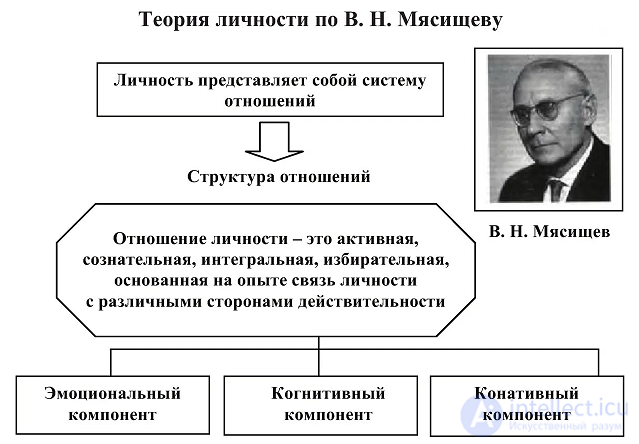
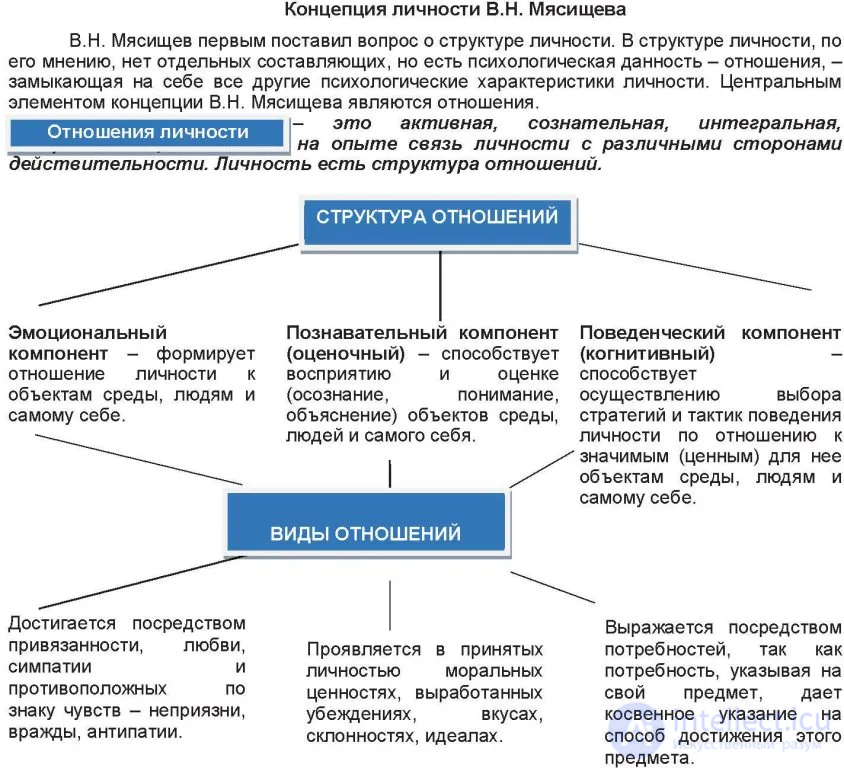
V. N. Myasishchev viewed the three-component structure of communication as a unity of various aspects that make up the complex interaction between people. This structure included the following components:
Reflection (cognitive component): This aspect denotes the process by which one person comes to know another. Mutual understanding and perception of the other person's character, convictions, and values play a key role in this part of communication. Reflection helps people better understand one another and build deeper relationships.
Communication (emotional component): This component is related to the emotional aspects of interaction between people. Emotional reactions, feelings, and responses evoked by communication with another person play an important role in shaping relationships. Communication involves the manifestation of empathy, sympathy, trust, and other emotional reactions.
Conduct (behavioral component): This component covers people's actions and behavior in the process of communication and contact with one another. This includes both verbal and nonverbal communication, as well as actions that take place during interaction. Conduct is of major importance in determining the character and quality of communication.
From this, in turn, follows the conclusion that these processes, like all personality components in general, can be corrected and optimized through organized communication or the therapeutic interaction between physician and patient.
Addressing the question of the psychological nature of neurotic disorders, Myasishchev pointed out that neurosis is based on an experience "representing, by its very nature, a person's social conflict with the surrounding
reality, a conflict that disrupts his social ties and isolates him." At the same time, Myasishchev defined conflict as a person's experience of a clash between relations that are incompatible with one another but are the most significant for
that particular person's "relations." At the same time, Myasishchev emphasized that the roots of a neurotic conflict should be sought not in the experiences themselves, but in the conditions under which a person's relations were formed, i.e., in the individual
experience of communication with the most significant people.
Psychological conflict leads to the development of prolonged inner
emotional tension associated with the contradictory character of the person's relations to the situation that gave rise to this conflict, a situation that is not necessarily actually present at a given moment but most often exists latently and is not
consciously recognized by the person, while nevertheless continuing to exert its psychotraumatic
effect. At the level of interpersonal interaction, this, as a rule, manifests itself in the well-known phenomenon of the "vicious circle" of communication, which provokes, on
the one hand, constant interpersonal conflicts, and, on the other, blocks the possibility of an independent correction of these conflictual relations on the part of the subjects themselves who are involved in the communication.
The psychological mechanism of this "vicious circle" is well explained in the context of the position on the three-component
structure of communication put forward by Myasishchev.
Thus, V. N. Myasishchev viewed the three-component structure of communication as a unity of
The three-component structure of communication proposed by V. N. Myasishchev represents a combination of reflection, communication, and conduct in the context of interaction between people. These aspects are interrelated and influence one another, forming a rich and multifaceted understanding of the processes of communication and relations.

Comments