
Lecture
Communicative personality is an individual who possesses well-developed communicative competence and the ability to interact successfully and effectively with other people through language and other means of communication. This concept implies that a communicative personality has skills that allow them to build relationships, exchange information, resolve conflicts, and influence other people in social situations.
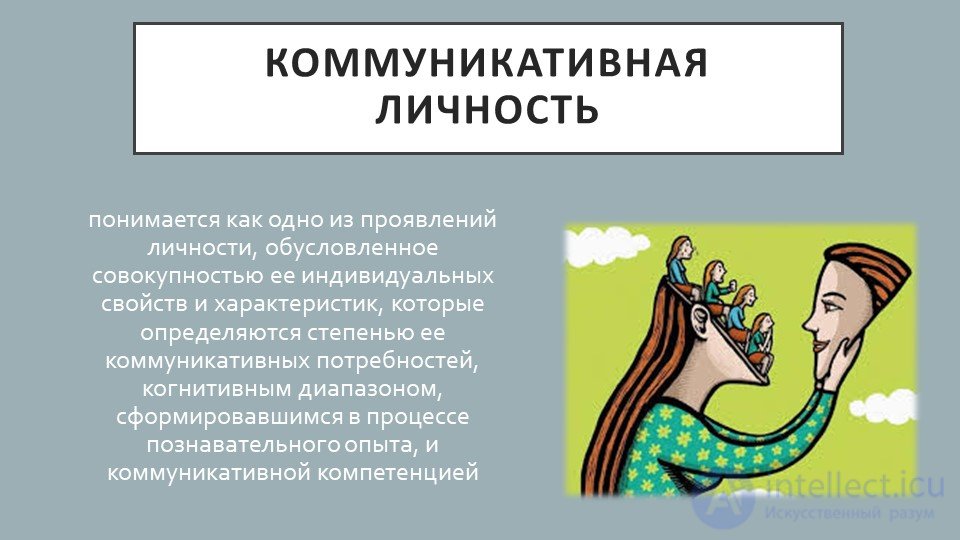
Communicative personality — one of the manifestations of personality, conditioned by the totality of its individual properties and characteristics, which are determined by the degree of its communicative needs, the cognitive range formed in the process of cognitive experience, and communicative competence proper — the ability to select a communicative code that ensures adequate perception and purposeful transmission of information in a specific situation.
The main features of a communicative personality include:
Empathy: A communicative personality has the ability to understand and empathize with the emotions and feelings of other people. Empathy makes it possible to establish close, trusting relationships and helps resolve conflicts.
Active listening: A communicative personality not only speaks but also knows how to listen attentively to their interlocutor. This contributes to deeper understanding and strengthens communicative ties.
Ability to express oneself: A communicative personality can clearly and effectively express their thoughts, feelings, and ideas. This is important for the clear and understandable transmission of information.
Ability to resolve conflicts: A communicative personality possesses conflict-resolution skills and the ability to find compromises and seek solutions that satisfy both parties.
Sociocultural adaptation: A communicative personality takes into account cultural and social norms in communication, which helps avoid misunderstandings and conflicts in interpersonal relationships.
Confidence: A communicative personality usually feels confident when communicating with different people and in different situations. Confidence contributes to successful communication.
Adaptability: A communicative personality knows how to adapt to different situations and audiences. They can use different communication styles depending on the context.
In communication theory, the concept of "communicative personality" is used to designate the subjects of the communicative
process. By communicative personality we shall understand the totality of an individual's communicative strategies and tactics, cognitive, semiotic, and motivational
preferences, formed in the processes of communication as the individual's communicative competence. Personality is a systemic quality of a person,
conditioned by their inclusion in the system of social relations and institutions, acquired by the individual through activity and communication. Personality is a product of the individual's development in society.
Personality in the communication system is considered above all from the point
of view of its role in the processes of speech formation, the mechanisms of expressiveness,
and the features of individual speech. A personality capable of creating and perceiving speech texts is called by some authors a "linguistic personality".

So, communicative personality is a personality possessing a set of individual properties and characteristics that provide
not only the ability to choose a scheme for transmitting information adequate to a specific situation, but also the ability to correctly perceive information. Communicative personality is characterized by motivational, cognitive, and functional parameters. There are various socio-psychological
methods for studying the communicative characteristics of a personality.
A communicative personality possesses communicative potential,
including knowledge and experience, communicative competence, and communicative need. Mastery of this complex (need, knowledge, and competence) allows a communicative personality to confidently orient itself
in the communicative environment. Depending on the degree to which a personality uses its own
communicative potential, it may be assigned to one type or another.
There are several types of communicants:
1. The dominant communicant strives to seize the initiative, does not
like being interrupted, and speaks sharply, mockingly, loudly. When interacting with such a communicant it is useless to use their own methods and manner of communication; it is better to adopt a strategy of "verbal wearing-down" (joining in
through a pause, quickly formulating one's position, questions, and requests).
2. The mobile communicant easily enters into conversation, moves from one topic
to another, talks a lot, with interest and pleasure, does not get lost in an unfamiliar
communicative situation, and gets so absorbed in the course of the conversation that they sometimes need to be brought back to the topic.
3. The rigid communicant has difficulty establishing
contact. It is therefore recommended to "warm up" such a communicant by conversing with them
about the weather, about recent political and international events. After this, the communicant will state their position clearly and logically.
4. The introverted communicant does not seek to seize the initiative in
the process of communication, is characterized by shyness and modesty, and feels
constrained in an unexpected situation. When communicating with such a person, one should
constantly perform the phatic function, in both verbal and nonverbal communication, without interrupting.
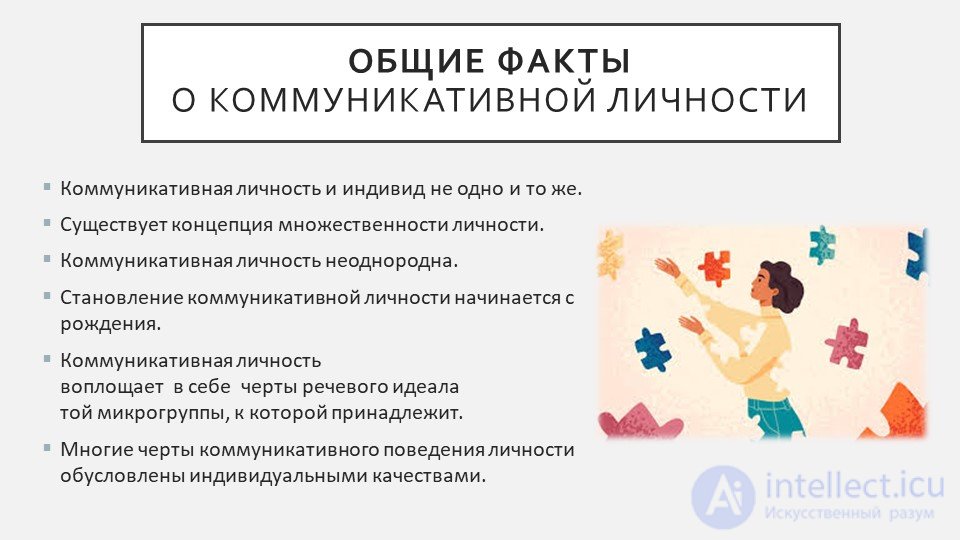
Communicative personality is an active person, possessing
communicative competence, able to form individual
communicative strategies and tactics, possessing cognitive, semiotic, and motivational orientations. Communicative personality is the
content, center, and unity of communicative acts directed at other communicative personalities. Communicative personality is heterogeneous. It
may include various roles. Thus, for example, one person can be a politician, a businessman, a speaker, a father, a husband, etc.
Three parameters are defining for a communicative personality: motivational, cognitive, and functional.
The motivational parameter is determined by communicative needs and occupies a central place in the structure of a communicative personality. If there is no need, there is no communication either, or there is pseudo-communication as a psychological need for communication, i.e., in this case
there is no transmission of a message or information, but rather the appearance of
communication, a game of communication (for example, the "newspaper internet" – correspondence via
newspaper personal ads, or American small talk, carried out not so much
according to content as according to the formal scheme three a principle: answer-add-ask).
On the basis of the communicative need a communicative attitude is formed, which is determined by the communicative personality in the process of communicative activity (the means of communication and tactics vary).
The cognitive parameter of a communicative personality includes
a range of characteristics related to the individual's cognitive experience, which forms their inner world; this is knowledge of communicative codes,
the ability to carry out introspection and auto-reflection, i.e., self-observation and
self-awareness, metacommunicative skills, the ability to adequately assess
the cognitive and communicative horizon of a partner – the communicant, myths
and prejudices, stereotypes and beliefs. The success of communication, and one's impact on the interlocutor, depends to a large extent on the cognitive characteristics of the communicants.
The functional parameter includes communicative competence – a set of knowledge, abilities, and skills, social both in form and
in content; the ability to command verbal and nonverbal means
for carrying out communication; the ability to vary communicative
means in the process of communication in connection with changes in the situation and conditions
of communication; the construction of discourse in accordance with the norms of the code and the rules
of etiquette.
A person's personality is formed in the process of interaction with people. If in the early period of life a person is not free to choose the people
who make up their immediate environment, then in maturity they can themselves largely regulate the number and composition of the people who surround them and with whom they communicate. A person thus secures for themselves, from this environment, a certain stream of psychological
influences.
Modern communication theory presents a number of models of communicative personality. The most developed model is the one proposed by V. Konetskaya. This model, to one degree or another, is reproduced by most authors of domestic textbooks.
According to V. Konetskaya's approach, communicative personality is formed by three parameters — motivational, cognitive, and functional.
«The motivational parameter is determined by communicative needs and occupies a central place in the structure of communicative personality». It is precisely the need to convey something or to obtain necessary information that serves as the most powerful stimulus for communicative activity.
Communicative need is determined by the pressing necessity of individuals to exchange semantic and evaluative information for the purpose of interaction in various spheres of their existence and of influencing one another under conditions of communication of various types.
The cognitive parameter, in this approach, includes «a range of characteristics, formed in the process of an individual's cognitive experience, that make up their inner world on the intellectual and emotional planes». Such characteristics include: the individual's ability to adequately perceive information, their ability to influence others, evaluation and self-evaluation, as well as knowledge of the norms of communicative codes.
Into the functional parameter, V. Konetskaya includes such personality characteristics as practical command of an individual stock of verbal and nonverbal means for actualizing the functions of communication; the ability to vary communicative means in connection with changing conditions of communication; the construction of discourses in accordance with the norms of the chosen communicative code and the rules of speech etiquette.
Kashkin defines communicative personality as the totality of an individual's communicative strategies and tactics, cognitive, semiotic, and motivational preferences, formed in the processes of communication as the individual's communicative competence, their «communicative passport», «business card». Communicative personality — the content, center, and unity of communicative acts directed at other communicative personalities — a communicative actor.
As is known, a person's immediate environment is made up of the people with whom they live, play, study, relax, and work together. The person
reflects all of them psychically, gives an emotional response to each, and practices a particular mode of behavior toward each. The character of the psychic reflection,
emotional attitude, and behavior of the person communicating with them depends to a great extent on the personal characteristics of these people.
Numerous facts show that the frequency and character of a person's communication with others depend on how, through their outward and inward appearance, knowledge, abilities, and actions,
those others satisfy the needs of the person communicating with them. The correspondence between the characteristics borne by
the people who communicate with him and the features of his need-motivational sphere determine the subjective significance of each of these people for him.
Changes in the subjective significance of other people for a personality are, as a
rule, conditioned, on the one hand, by that personality's own position with respect to themselves
within the system of needs, and, on the other, by the attitude toward them on the part of the people who make up their circle of communication. These attitudes of other people toward them, significant to varying degrees for the person, affect not so much their leading needs
as the tendencies subordinate to them for defending one's own "self", manifested in
the search for, and the implementation of, modes of behavior that assert this "self".
Thus, communication is of enormous importance in the formation
of the human psyche, in its development, and in the establishment of rational, cultured behavior. Through communication with psychologically developed people, thanks to
broad opportunities for learning, a person acquires all their higher cognitive abilities and qualities. Through active communication with developed
personalities, they themselves become a personality.
The manifestation of communicative personality is conditioned by the totality of individual properties and characteristics that provide the ability to choose
a scheme for transmitting information in a specific situation and to adequately perceive information. Communicative personality is characterized by motivational,
cognitive, and functional parameters.
The evaluation of communicative personality as a social phenomenon depends on the degree of effectiveness in performing the main socially significant functions.
The effectiveness of communication depends on the degree of social significance of the communicative attitude. Communicative attitudes are viewed
as a system of internal resources necessary for building effective communication in a given range of situations of interpersonal interaction.
The possibility of establishing and maintaining contact is conditioned by the interaction of various (spatial, temporal, psychological, social) conditions of communication. The social and communicative conditions of communication form the basis of interpersonal communication, determining
the presence or absence of contact between communicants, and value orientations, which presuppose an evaluative attitude toward the participants in communication.
The ability to communicate, the capacity to accurately perceive another person's inner world while preserving emotional and semantic nuances,
the capacity to sense another's joy or pain as they themselves sense it, and to correctly
perceive its cause – these are, without doubt, the most important characteristics of the successful activity of a communicative personality.
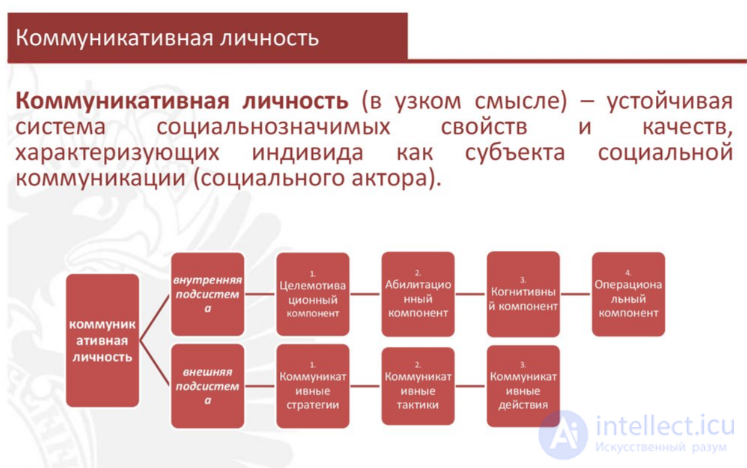
From the point of view of this model, in order to adequately reflect the internal structure of communicative personality one must draw on structural and functional approaches, based both on the model of personality as such and on the model of the communication process. These approaches include:
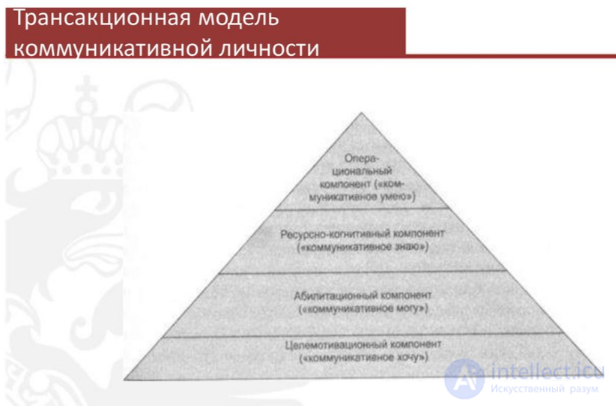
The goal-motivational component
In a specific situation a personality becomes a communicative personality when it has an actualized need that can be satisfied not directly, but by means of a communicative action.
The abilitative component
The resource-cognitive component
The operational component
Communicative personality plays an important role in creating a positive atmosphere in society and in interpersonal relations. Its skills and qualities can be useful both in personal life and in professional activity, since they contribute to effective communication, cooperation, and the solving of various problems.

Comments