
Lecture
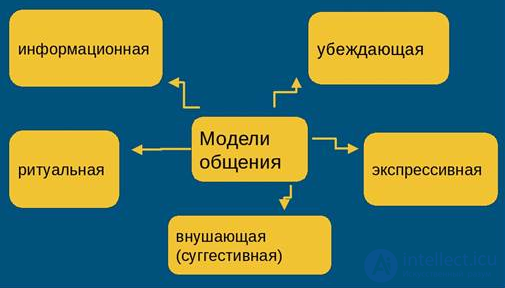
Models of communication are abstract concepts or theoretical frameworks that help explain how communication between people occurs and what factors influence this process. For effective interaction, every person needs to be able to draw on the whole variety of existing communication models. There are several models of communication, each of which emphasizes different aspects of this process. Here are several of the main models of communication:
Linear model (Shannon-Weaver model):
In this model, communication is viewed as a process in which a message is transmitted from a sender to a receiver through a communication channel. This model emphasizes a one-directional flow of information and focuses on encoding, transmitting, and decoding the message. However, it does not account for feedback or context.
Osgood-Schramm-Nebitt model (OSN):
This model extends the linear model by including factors such as context, feedback, and noise. The OSN model assumes that the sender encodes a message and transmits it through a channel where distortion (noise) may occur, after which the receiver decodes and receives the message. Context and feedback influence how the message is understood.
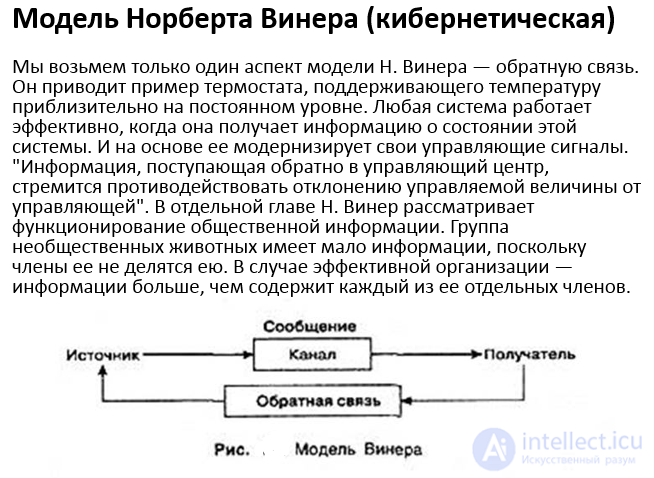
Wiener's model (cybernetic model):
This model draws attention to the role of feedback and regulation in the communication process. It assumes that adjustments and adaptations arise during communication to ensure effective interaction between the sender and the receiver.
Transactional Analysis model (TA):
This model pays special attention to interaction and relationships between people. It assumes that communication takes place within a "game" or "transaction," in which each participant plays a certain role. The TA model helps to understand what hidden messages may be embedded in communication.
M. Lebedinsky's model:
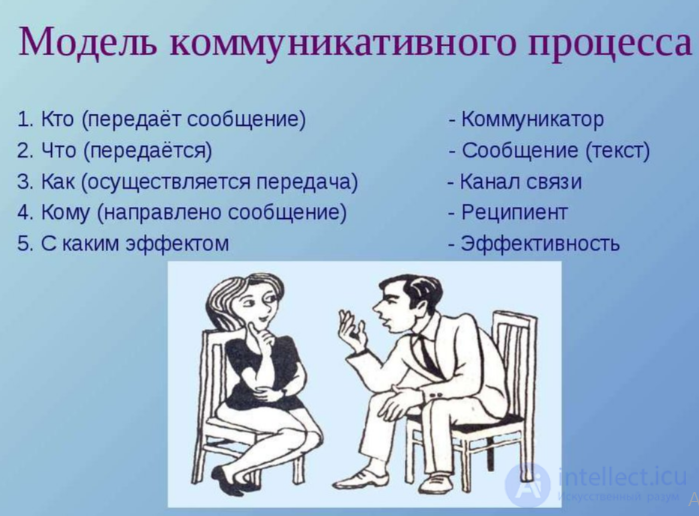
This model, also known as the "5W" model, identifies five key questions that can help clarify the meaning and content of communication. These questions include "Who?", "What?", "Where?", "When?" and "Why?" and help analyze the context and goals of communication.
Communicative competence model (J. Habermas):
This model focuses on people's ability to communicate effectively and ethically. It includes developing listening skills, the ability to express thoughts, and the ability to take into account the interests and needs of others.
The "Interpersonal Influence Process" model (William Schutz):
This model describes the process of interaction between people in three phases: inclusion, shift, and exclusion. It helps to understand how communication changes depending on the degree of closeness and trust between the participants.

It is usually used to transmit and receive information, analyze, interpret, and comment on it. The information transmitted expands the informational fund of the participants in communication, conveys innovative data, clarifies the circumstances of the current situation, and provides specific facts and figures. When information intended not for a single person but addressed simultaneously to a group of people (for example, in a lesson, lecture, or seminar) is being transmitted, generally accepted rules come into play. The speaker must be confident both in the content of the information they are about to present and in the form in which they intend to present it.
a) purpose – to convey information and expand each other's informational fund;
b) conditions – taking into account the cognitive capacities of the communication partners, their intellectual abilities, and their attitudes toward communication;
c) forms of communicative processes of influence:
– a report on activity;
– a message about the results of activity;
– a lecture on principles of understanding or ways of solving a problem;
– an abstract based on the results of studied primary sources of information;
– an informational-analytical presentation;
d) technological features of organizing the communicative action:
– concentrating attention on the subject of the information being given;
– rationalizing the presentation of the material;
– logically flawless argumentation;
– substantiating all the propositions put forward;
– a detailed characterization of cause-and-effect and conditional-consequential relationships.
a) purpose – to evoke certain feelings in the communication partner and to shape certain orientations and attitudes;
b) conditions – relying on the partner's receptivity and emotional culture;
c) forms of communicative processes of influence:
– a ceremonial speech,
– a congratulation,
– a farewell address,
– a compliment;
d) technological features of organizing the communicative action:
– relying on the partner's emotional mood;
– taking into account counter-argumentation and one partner's critical stance toward the other;
– an emotional attitude toward the subject of communication.
This model makes it possible to turn the participants in communication into like-minded allies. Persuasion — is a complex communicative process, and not everyone manages to use this model of communication with maximum effectiveness. Basic principles of the model: spoken, positive messages, restrained emotional appeals, and logical conclusions based on facts and solid arguments.
Strong arguments include:
Untenable arguments are usually based on distorted facts and refer to questionable sources.
The purpose of this model of communication is to shape a psycho-emotional mood in the participants of the interaction, convey feelings and experiences, prompt the necessary social action, and involve them in specific actions.
At the same time, this model should not be overused specifically in a lesson or academic lecture, at a meeting, or at a conference. It is necessary to constantly manage the emotional intensity of the session so that disputes and the expression of differing points of view do not escalate into conflict.
a) purpose – to convey feelings and experiences, to form a shared psycho-emotional mood, and on that basis to prompt the partner toward one or another form of (usually mass) social action;
b) conditions – reliance on the partner's emotional sphere in order to shift the balance of activity and reactivity toward a stimulating influence of emotion on the will, broad use of means of artistic and aesthetic
influence, and reliance on the mechanism of socio-psychological expression;
c) forms of communicative processes of influence:
– recounting one's own experiences and feelings related to the subject of communication;
– a motivated appeal;
– an analysis of possible consequences;
d) technological features of organizing the communicative action:
– brevity of presentation,
– situational conditioning,
– vividness of gesturing,
– demonstrative posture,
– vocal intonation,
– affectation and acceptance,
– fascination through artistic reinforcement.
The suggestive model of communication – that is, the model based on suggestion – the art of suggesting rather than explaining, is widely used in interactive practice, for example at business meetings or in educational conversations with people in need of motivational correction. Suggestion (from Latin suggestio — "suggestion") is a psychological influence of one person (or group) on another, whereby a certain effect is produced on the latter's beliefs, attitudes, and decisions. Susceptibility to suggestion is called suggestibility.
Factors contributing to suggestibility include the following human characteristics:
The strength of suggestion is also influenced by situational factors:
a) purpose – to exert a suggestive influence in order to change the motivation of value orientations and attitudes of the personality;
b) conditions – an uncritical attitude of one partner toward the other, a weak level of counter-suggestion, and the suggestibility of the partner who has taken on the communicative role of the recipient;
c) forms of communicative processes of influence:
– suggestion through the motivational sphere of consciousness,
– suggestion through identification,
– suggestion through references to authority,
– suggestion through warning;
d) technological features of organizing the communicative action:
– relying on the suggestive potential of the negotiating partner,
– the continual clarification of the attitudes being suggested,
– forming attraction as a necessary component of suggestive communication,
– intonational stimulation of the suggested information,
– remote management of emotional tension, etc.
In professional activity, people turn to the ritual model of communication when it is necessary to: consolidate and maintain formal relationships within the business environment; ensure the regulation of social psychology in large and small groups of people; preserve the ritual traditions of the organization associated with its corporate culture. If a team has a developed system of informal relationships, corporate celebrations, and collective traditions, then people's feelings and thoughts are more natural and free, constraint in communication disappears, trust and mutual respect grow, and compatibility and teamwork improve. As forms of such interaction, communicators usually use the following: framing, ceremonial, and memorial speeches; ritual acts, ceremonies, rites; celebrations, inaugurations, and tributes.
a) purpose – to consolidate and maintain norms of relationships, to ensure the psychoregulation of social psychology in large and small groups;
b) conditions – an artistically arranged environment, the canonization of actions and concentration of attention on the algorithm of their performance, the ceremonial nature of the interaction and its orientation toward a binary effect (on those perceiving and those performing the ritual simultaneously);
c) forms of communicative processes of influence:
– ritual acts,
– ceremonies,
– rites,
– ritual complexes;
d) technological features of organizing the communicative action:
– reliance on national and territorial-professional traditions and norms of communication,
– a preliminary agreement on the order of the ritual,
– concentrating attention on the intrinsic value of ritual actions,
– theatricalization of communicative behavior.
These models of communication provide different perspectives for understanding and analyzing communication processes. The choice of model depends on the specific situation and the goals of the research or analysis.

Comments