Это продолжение увлекательной статьи про тесты по философии.
...
«human being»;
b) a generic concept, i.e. one expressing the general features inherent in the human race;
*c) a stable system of socially significant traits, a characterization of a person as a member of society;
d) the set of physical abilities of a particular person;
e) a social «mask».
3. When the concept of «personality» is used, it implies such qualities as:
- a) differences in age;
- b) physical differences;
- *c) spiritual and social qualities acquired by each individual person;
- d) neurodynamic differences (properties of the nervous system).
4. The unique distinctiveness of a particular person (appearance, character, habits, features, etc.), as opposed to typical traits, is:
- a) individual;
- b) individuality;
- *c) personality;
- d) subject;
- e) specimen.
5. The specificity of philosophical anthropology consists in the fact that it;
- a) studies the biological parameters of the human being;
- b) studies the origin and formation of the human being;
- *c) tries to determine the essence of the human being, the human within the human;
- d) studies the social determinants of human behavior;
- e) tries to determine the direction of humanity's further development.
6. The term «anthropogenesis» means:
- *a) the process of the historical-evolutionary formation of the physical type of the human being;
- b) the process of the historical formation of the social essence of the human being;
- c) the process of the formation of the «superman»;
- d) the process of a person's development from birth to death.
7. The term «phylogenesis» means:
- *a) the process of humanity's development from primitiveness to the present day;
- b) the process of the historical formation of the social essence of the human being;
- c) the process of the formation of the «superman»;
- d) the process of the formation of the state;
- e) the process of a person's development from birth to death.
8. The term «ontogenesis» means:
- a) the process of humanity's development from primitiveness to the present day;
- b) the process of the historical formation of the social essence of the human being;
- c) the process of the formation of the «superman»;
- d) the process of the formation of the state;
- *e) the process of a person's development from birth to death.
9. Medieval philosophers asserted that the human being:
- a) is the result of biological evolution;
- *b) is created in the image and likeness of God;
- c) is a product of social reality;
- d) is a product of speech activity.
10. This quality in a human being was considered the most important in the philosophy of the Modern era:
- a) emotionality;
- b) piety;
- *c) rationality, reasonableness;
- d) creativity.
11. Biologizing conceptions assert that:
- a) all people are born equal by nature, and only the social environment makes them different;
- *b) a person's life is determined by their genotype;
- c) a person's life is determined by the process of upbringing;
- d) a person's life is determined by fate (destiny).
12. The category of «activity» means:
- a) the purposeful action of a subject upon a subject;
- b) the instinctive activity of a living being;
- *c) the purposeful action of a subject upon an object (where a particular case of an object may be another subject);
- d) the action of an object upon a subject.
13. The process of socialization means:
- a) a person's active participation in social life;
- b) a person's belonging to one or another social group;
- *c) the assimilation and use of sociocultural experience by a person;
- d) a person's participation in the socialist movement.
14. The term «culture» means (choose the most correct answer):
- a) culture is custom, language;
- b) culture is a generally accepted way of thinking (mentality);
- *c) culture – is a fusion of modes of activity and the results of that activity in the form of a set of created material and spiritual values;
- d) culture – is, above all, a phenomenon of art.
15. From the standpoint of hedonism, the meaning of life consists in the fact that:
- a) life — is renunciation of the world and the mortification of the flesh for the atonement of sins;
- b) life — is the pursuit of happiness as the true purpose of the human being;
- *c) life — is pleasures, preferably as varied as possible, here and now;
- d) to live — means to derive benefit from everything;
- e) life – is the striving toward God.
16. The subject matter of ethics is:
- a) society;
- b) man;
- *c) morality;
- d) the meaning of life;
- e) the ideal.
17. A person's responsibility for their actions is possible only in the presence of:
- *a) choice;
- b) guilt;
- c) force majeure;
- d) necessity;
- e) predetermination.
18. Supply the missing paired ethical categories:
- a) good – evil;
- *b) freedom – responsibility;
- c) life – death;
- *d) rights – duties.
19. The branch of philosophy that studies morality and the specific phenomena of social life:
- a) ontology;
- b) axiology;
- c) aesthetics;
- *d) ethics;
- e) anthropology.
20. Axiology — is the study of:
- *a) values, their origin and essence;
- b) beauty;
- c) good and evil;
- d) the spiritual culture of society and man;
- e) the essence of human history.
21. The requirement of nonviolence primarily means renouncing:
- *a) imposing one's opinion on others;
- b) an attempt on another person's life;
- c) an attempt on another person's property;
- d) commanding other people.
22. The author of the term "ethics" is:
- a) Heraclitus;
- b) Protagoras;
- c) Spinoza;
- d) Plato;
- *e) Aristotle.
23. The author of the term "morality" is:
- a) Socrates;
- b) Aristotle;
- *c) Cicero;
- d) Augustine of Hippo;
- e) Thomas Aquinas.
24. Scientific discoveries that contributed to the destruction of the anthropocentric picture of the world:
- a) the discovery of the cell;
- *b) the creation of the heliocentric system of the world;
- *c) the theory of human descent from an ape-like ancestor;
- d) the theory of the heat death of the universe;
- *e) the theory of the unconscious.
tests on the topic Society and History
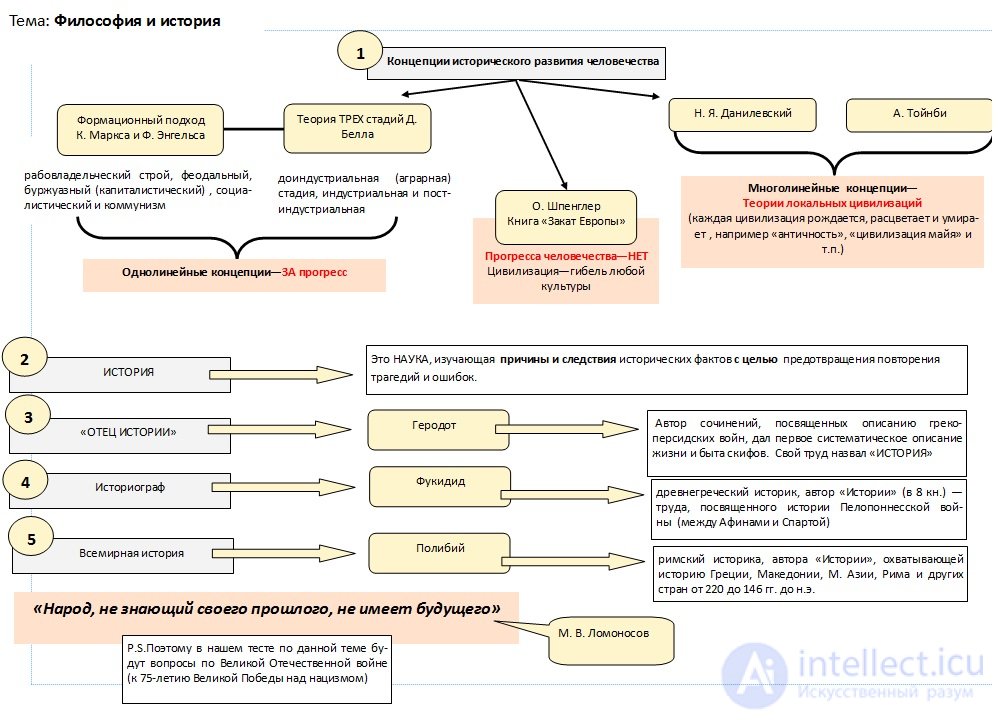
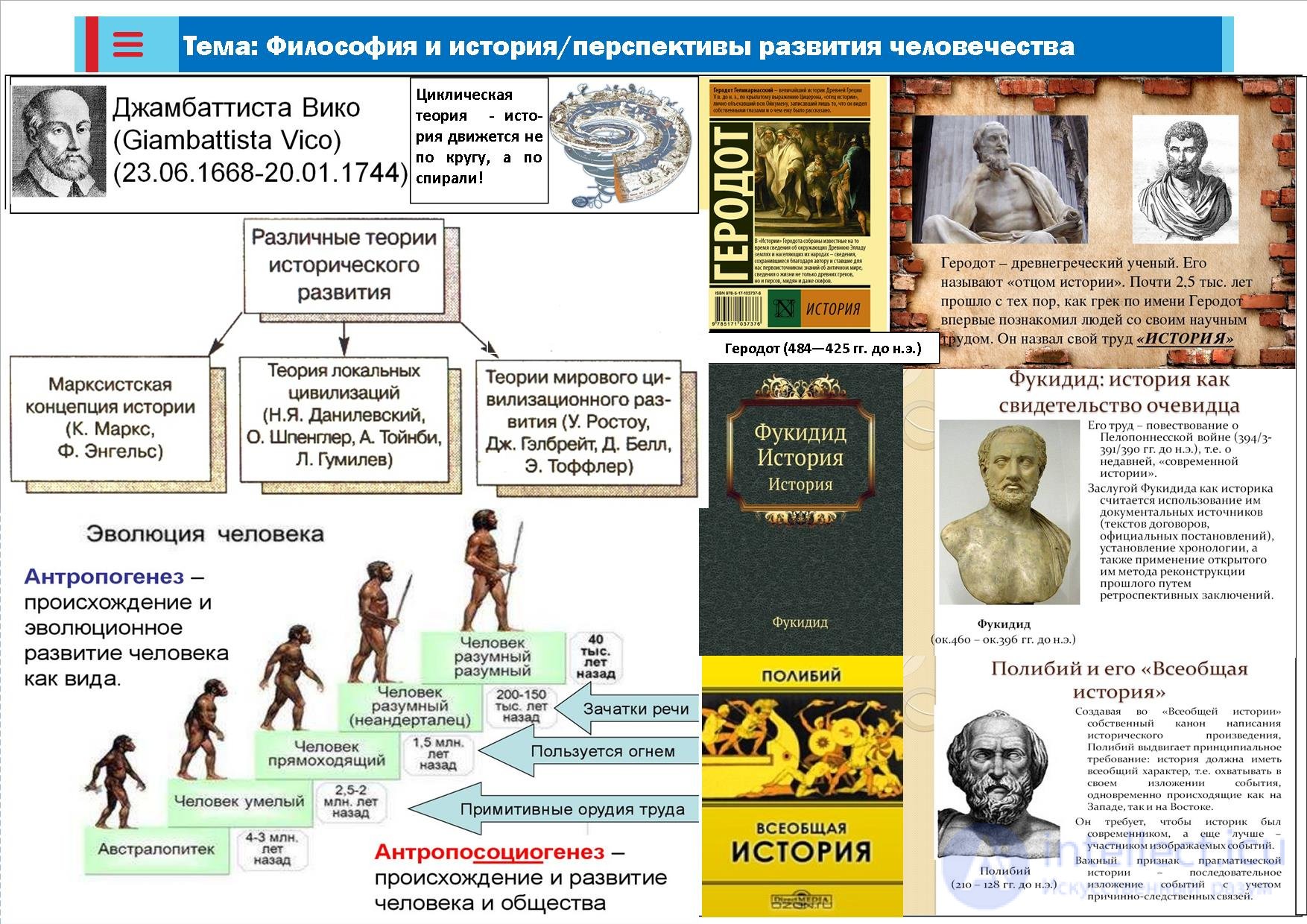
1. This philosophical position asserts that social life is an arena of the struggle for existence:
- a) anthroposociogenesis;
- *b) social Darwinism;
- c) cosmogenesis;
- d) historiosophy.
2. The most closed social group is:
- a) clan;
- b) class;
- *c) caste;
- d) estate;
- e) stratum.
3. The concept of class is key in the philosophy of:
- a) Saint-Simon;
- b) Hobbes;
- *c) Marx;
- d) Hegel.
4. The concept asserting that the state arises as a result of the division of labor in society
- is called:
- a) conventional;
- *b) socio-economic;
- c) paternalistic;
- d) theocratic;
- e) psychological.
5. The theory of a single global civilization was formulated by:
- a) Huntington;
- b) Danilevsky;
- c) Spengler;
- *d) Moiseev.
6. F. Fukuyama, in his philosophy, proclaimed:
- a) the end of politics;
- *b) the end of history;
- c) the end of the economy;
- d) the end of the state;
- e) the end of man.
7. According to A. Toynbee, every historical human community develops according to the principle of:
- a) cause and effect;
- *b) challenge and response;
- c) class struggle;
- d) racial struggle.
8. Making global forecasts is the concern of:
- a) computer science;
- b) eugenics;
- c) synergetics;
- d) cosmology;
- *e) futurology.
9. In the philosophical teachings of Teilhard de Chardin and V.I. Vernadsky, the sphere of humanity's conscious activity (the "thinking layer of the earth") is called:
- a) the spiritual sphere;
- b) the semiosphere;
- *c) the noosphere;
- d) the stratosphere;
- e) the biosphere.
10. In contemporary times, the dominant type of culture is:
- *a) pop culture;
- b) elite culture;
- c) counterculture;
- d) anti-culture;
- e) marginal culture.
11. Society is the subject of study of the following philosophical discipline:
- a) cultural studies;
- *b) social philosophy;
- c) epistemology;
- d) political science;
- e) economics.
12. The philosophical teaching of the essence and development of human society is:
- a) ontology;
- b) metaphysics;
- *c) social philosophy;
- d) anthropology;
- e) history.
13. The integrity and stability of the social organism is based on:
- a) aesthetic values;
- b) logical principles;
- c) creative activity;
- *d) the system of traditions;
- e) economic relations.
14. Alienation in the relationship between man and society occurs when:
- a) a person continuously reproduces themselves as a subject uniting natural, social, and spiritual qualities;
- *b) there occurs a dissolution of the person into abstract social qualities, and a loss of control over the results of their activity in society;
- c) a person masters the diverse conditions and forms of activity, its fruits and results;
- d) the stable, ordered patterns of activity developed by culture become, for the individual, their own way of life in society.
15. The social institution that represents the way people appropriate the products of material and spiritual production, as well as natural objects, is called:
- a) family;
- b) the state;
- *c) property;
- d) power;
- e) law.
16. In the "noospheric" model of human civilization, the principal role is assigned to:
- a) the state;
- b) the nation;
- c) the economy;
- *d) science;
- e) religion.
17. Proponents of the civilizational interpretation of human history are (indicate all options):
- *a) Toynbee;
- *b) Spengler;
- c) Marx;
- d) Comte.
18. What was understood by civilization in the 18th century?
- a) a theocratic state formation;
- *b) an ideal society based on the principles of reason and justice;
- c) a certain level of scientific and technical development;
- d) a classless society.
19. From Huntington's point of view, relations between civilizations in the future will lead to:
- *a) conflict;
- b) peace;
- c) the self-isolation of civilizations;
- d) a single civilization;
- e) a classless society.
20. The forms of state government are (indicate all answer options):
- *a) monarchical;
- *b) republican;
- c) judicial;
- d) executive;
- e) religious.
21. On the question of the origin of the state, contemporary philosophy holds that:
- a) the state is a divine formation;
- b) the state is founded by a heroic individual;
- c) the state has always existed;
- *d) the state has not always existed, but arose at a certain stage in the increasing complexity of social development.
22. Civil society – is:
- a) a branch of state power;
- *b) a system of non-state social formations that assists the state and opposes it in cases where it fails to perform its functions effectively;
- d) a party-political system;
- e) a constitutional form of government.
23. "Formation" is a key category in the teaching of:
- *a) Marx;
- b) Plato;
- c) Kant;
- d) Nietzsche.
24. Match the understanding of society to its corresponding historical era:
- a) Antiquity 3 1. People living in accordance with a social contract they themselves established;
- b) The Middle Ages 4 2. A system of people's social actions, whose meaning is determined by
- the production of values (Weber, Parsons, Sorokin, and others);
- c) The Modern Age 1 3. A collection of people living more or less successfully by the laws of justice.
- d) The 20th century 2 4. The "Earthly City," striving toward the "Heavenly City."
25. Match the interpretation of society to its corresponding philosopher:
- a) the formational approach; 2,4 1) Spengler;
- b) the civilizational approach; 1,3 2) Marx;
- 3) Toynbee;
- 4) Comte.
tests on the topic Philosophical Terms and Categories
a system of views and ideas.
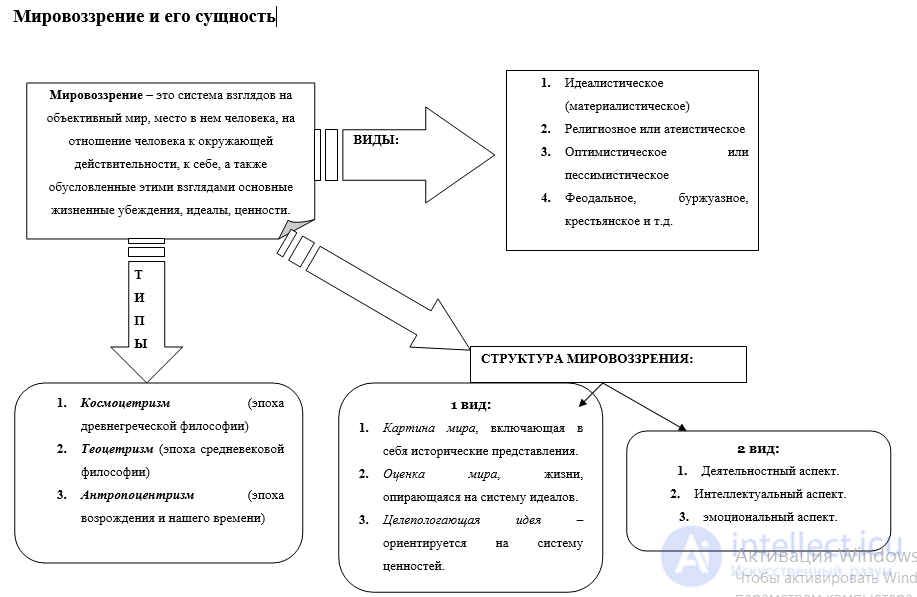
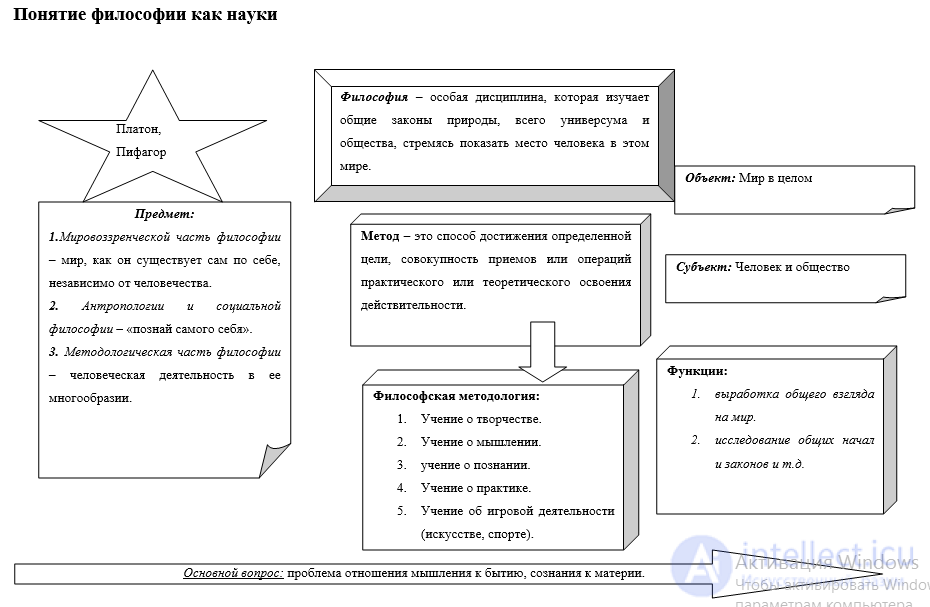
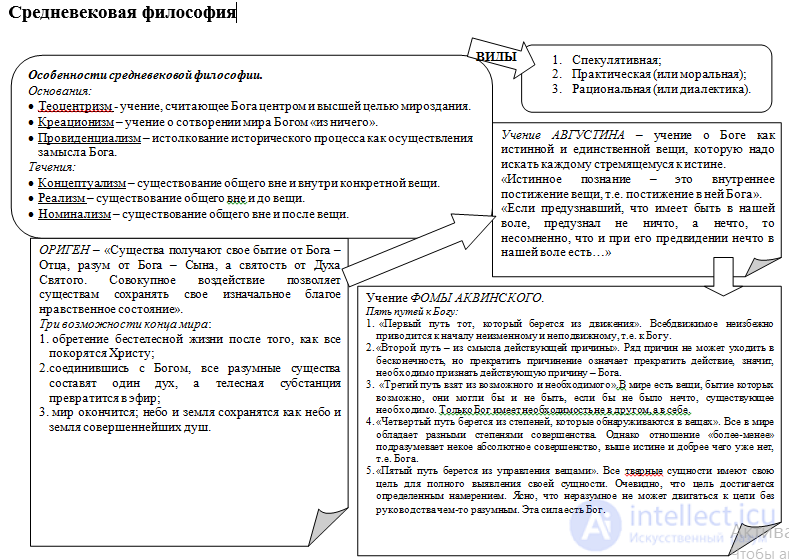
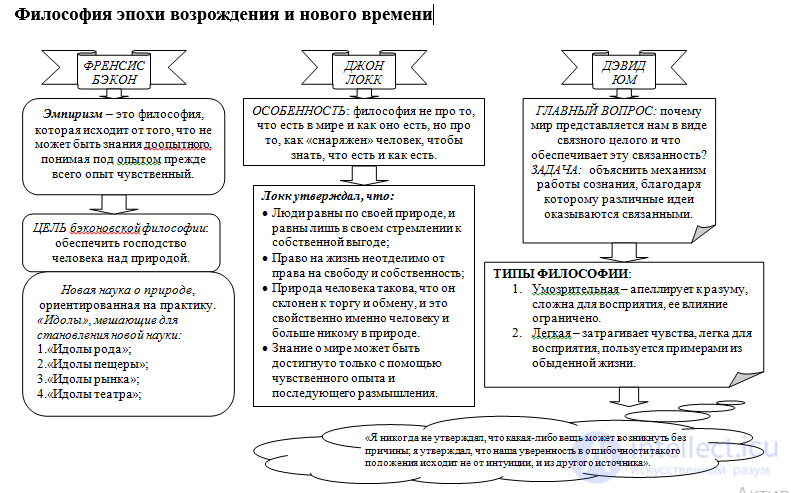
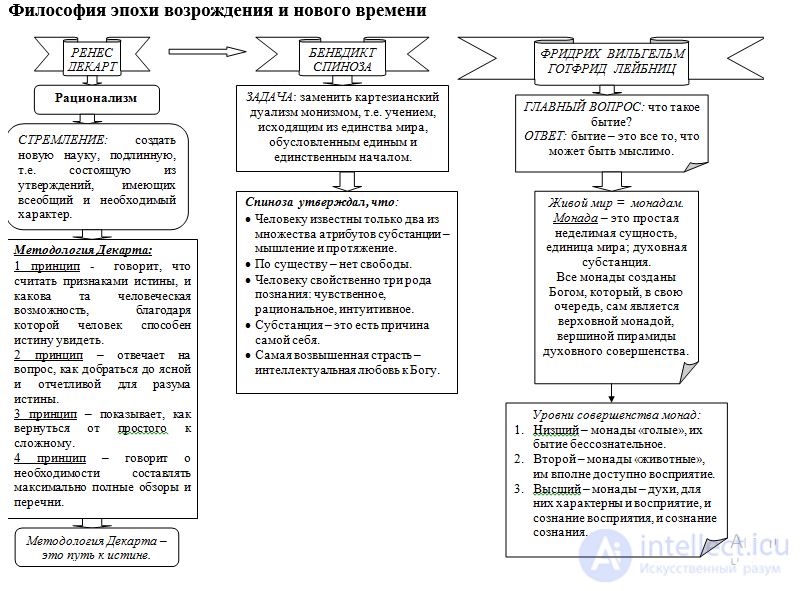
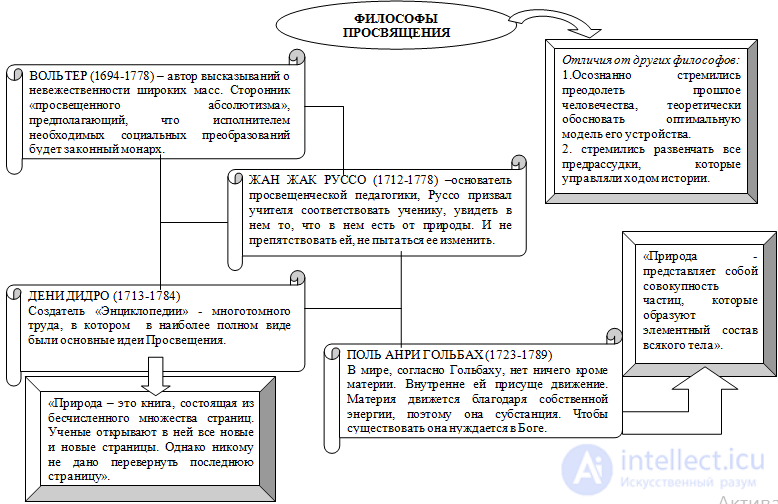
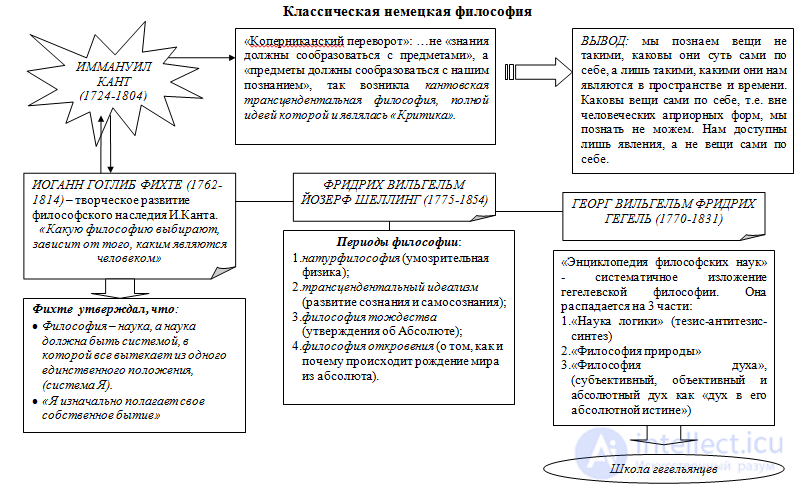
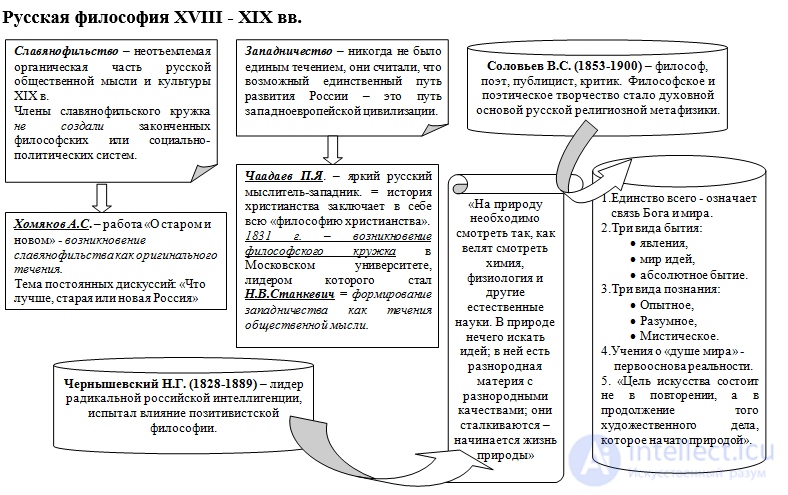
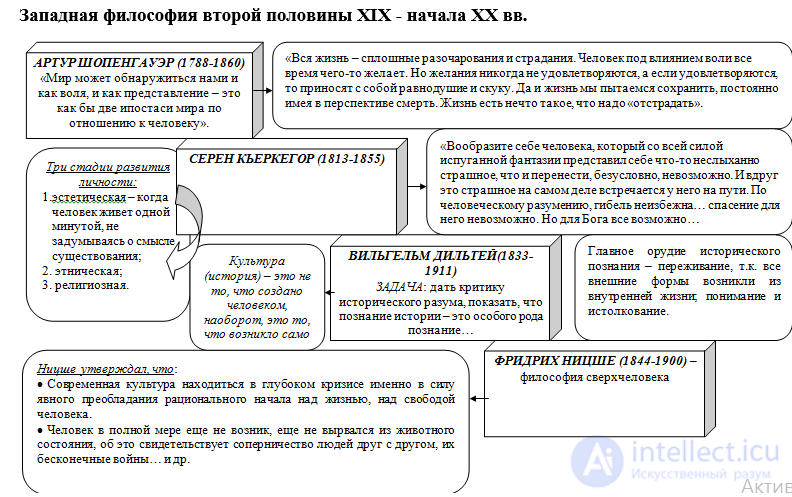
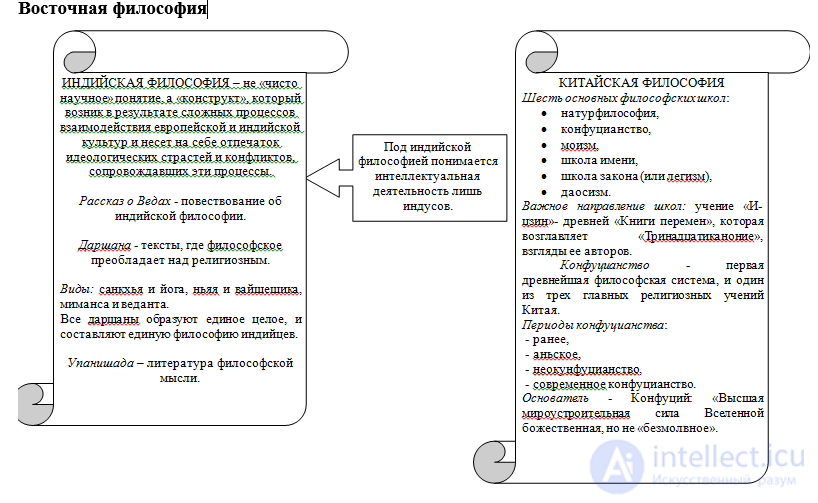
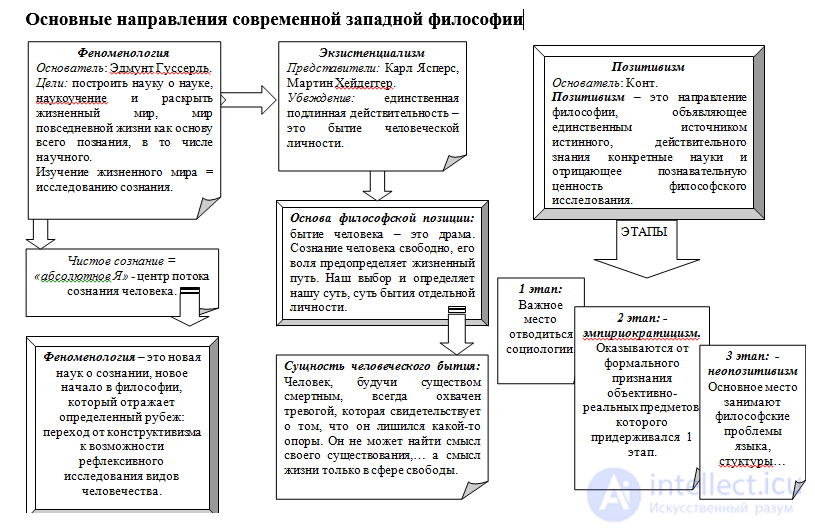
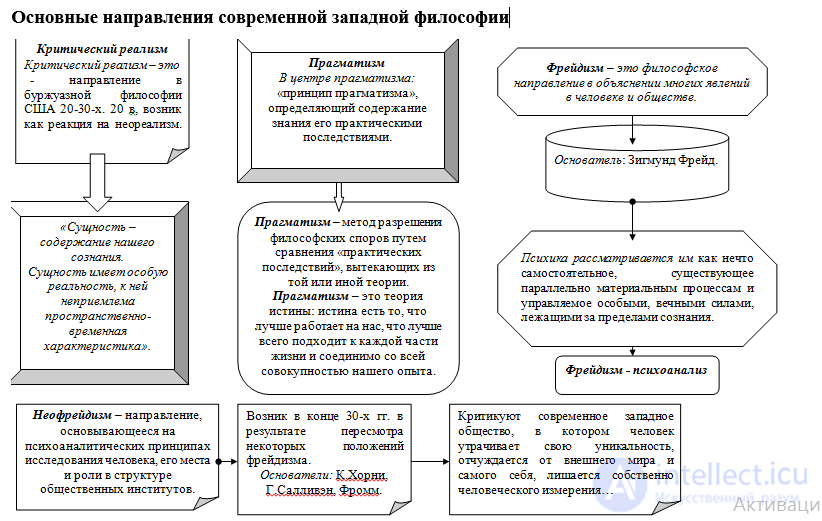
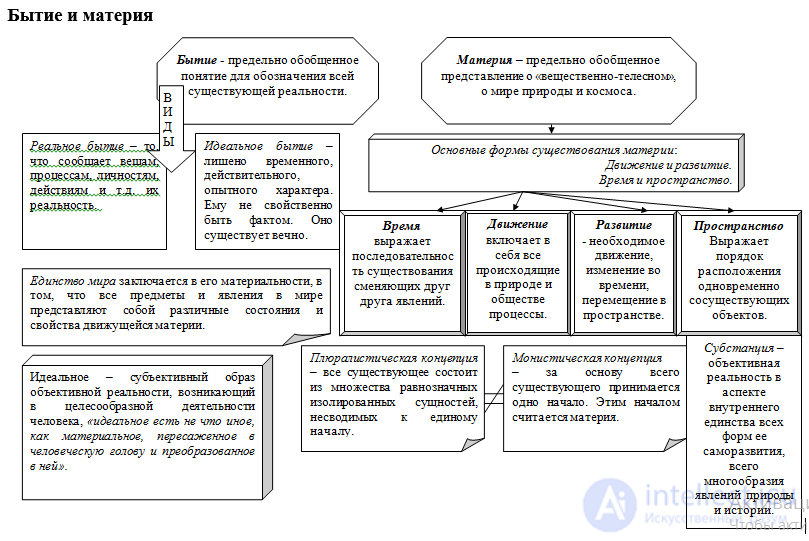
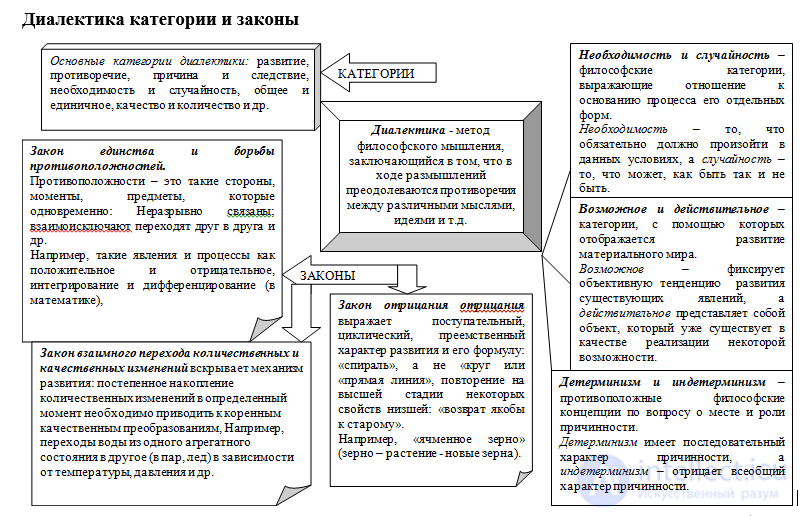
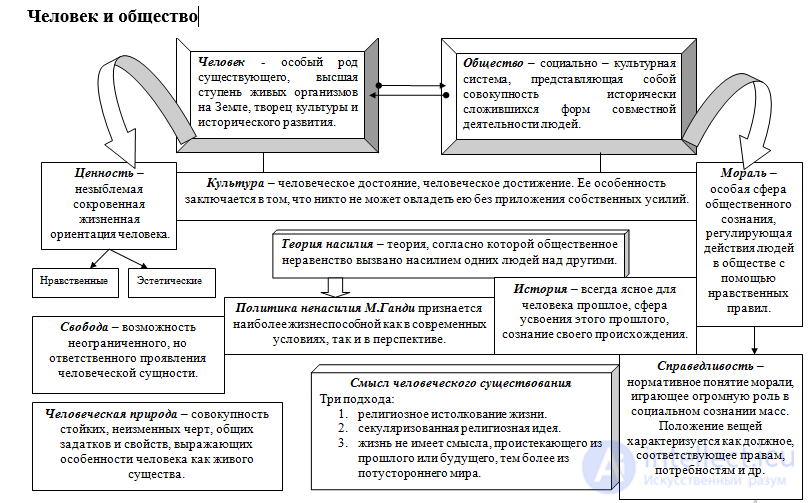
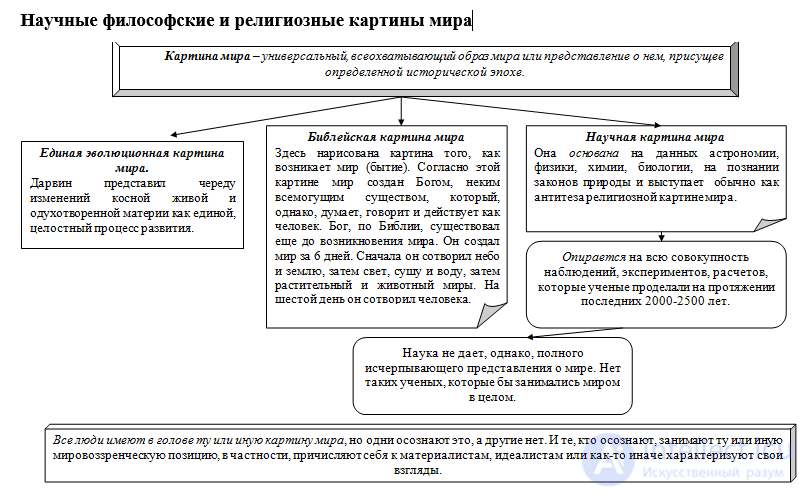
Culture - a totality
1. Fill in the key word in the definition:
- Determinism – the philosophical doctrine of the objective, lawlike causal connection and mutual conditioning of things, processes, and phenomena of the real world.
2. Fill in the key word in the definition:
- Idealism – the philosophical direction that proceeds from the primacy of the spiritual over the material.
3. Fill in the key word in the definition:
- Materialism – the philosophical direction that proceeds from the primacy of the material over the spiritual.
4. Fill in the key word in the definition:
- Humanism – philosophical views based on recognizing the intrinsic worth of man and his right to absolute freedom for the purpose of development and self-expression.
5. Fill in the key word in the definition:
- Ontology – the study of Being
6. Fill in the key word in the definition:
- Epistemology – the study of Cognition
7. Fill in the key word in the definition:
- Axiology – the study of Values
8. Fill in the key word in the definition:
- Scientism – the absolutization of the role of Science in society.
9. Fill in the key word in the definition:
- Irrationalism – a philosophical doctrine that denies the fundamental significance of Reason
10. Fill in the key word in the definition:
- Nihilism – a philosophical doctrine that denies the fundamental significance of Values
11. Fill in the key word in the definition:
- Sensualism – a philosophical direction that derives all cognition from Sensation
12. Fill in the key word in the definition:
- Pantheism – is the notion that God exists everywhere in the world (in nature).
13. Fill in the key word in the definition:
- Hylozoism – a philosophical direction that considers all matter to be Living and animate.
14. Fill in the key word in the definition:
- Rationalism – a direction in the theory of knowledge that puts Rational, abstract knowledge in the foreground.
15. Fill in the key word in the definition:
- Empiricism – a direction in the theory of knowledge that puts Sensory knowledge in the foreground.
16. Fill in the key word in the definition:
- Mechanism – a one-sided method of cognition based on recognizing the Mechanical form of motion as the sole objective one.
17. Fill in the key word in the definition:
- Subjectivism – a worldview position that denies the existence of Objective laws of nature and society.
18. Fill in the key word in the definition:
- Natural philosophy (the philosophy of Nature) – a philosophical direction that created a new picture of the world, free from theology, drawing on the achievements of natural science.
19. Fill in the key word in the definition:
- Relativism – a methodological principle that absolutizes the Relativity and conditionality of the content of knowledge.
20. Fill in the key word in the definition:
- Theocentrism – a picture of the world that places God at the center of the universe
21. Fill in the key word in the definition:
- Anthropocentrism – a picture of the world that places Man at the center of the universe
22. Fill in the key word in the definition:
- Conventionalism – a philosophical direction that emphasizes that scientific postulates rest on the Agreement, the covenant of scientists.
23. Fill in the key word in the definition:
- Hedonism – an ethical direction that regards Pleasure, enjoyment, as the principal motive of human activity.
24. Fill in the key word in the definition:
- Voluntarism – a philosophical direction that recognizes the Will as the first principle of being
25. Choose the term opposite to the concept "materialism."
26. Choose the term opposite to the concept "idealism."
27. Choose the term opposite to the concept "realism."
28. Choose the term opposite to the concept "nominalism."
29. Choose the term opposite to the concept "pessimism."
30. Choose the term opposite to the concept "induction."
31. Choose the term opposite to the concept "deduction."
32. Choose the term opposite to the concept "dialectics."
33. Choose the term opposite to the concept "empiricism."
34. Choose the term opposite to the concept "rationalism."
35. Choose, in epistemology, the term opposite to the concept "truth."
36. Choose the term opposite to the concept "causality."
37. Which of the concepts is redundant in this list:
- *a) blind will;
- b) will to power;
- c) will to live;
- d) élan vital.
38. Which of the concepts is redundant in this list:
- a) first principle;
- *b) consciousness;
- c) matter;
- d) substance.
39. Which of the concepts is redundant in this list:
- a) ontology;
- b) epistemology;
- c) ethics;
- *d) philology.
40. Which of the concepts is redundant in this list:
- a) I (Ego);
- b) It (Id);
- *c) Super-It;
- d) Super-Ego.
41. Establish the sequence in which the philosophical categories arose:
- 2 a) being;
- 1 b) first principle;
- 5 c) existence;
- 3 d) substance;
- 4 e) sublimation.
42. Establish the sequence in which the philosophical categories arose:
- 4 a) formation;
- 1 b) logos;
- 2 c) idea;
- 3 d) morality;
- 5 e) falsification.
43. Establish the sequence in which the philosophical categories arose:
- 3 a) ethics;
- 4 b) universals;
- 1 c) first principle;
- 2 d) dialectics;
- 5 e) thing-in-itself.
44. Establish the sequence in which the philosophical categories arose:
- 1 a) being;
- 2 b) metaphysics;
- 3 c) humanism;
- 4 d) formations;
- 5 e) will to power.
45. Establish the sequence in which the philosophical categories arose:
- 3 a) universals;
- 2 b) idea;
- 4 c) natural law;
- 1 d) atom;
- 5 e) Super-Ego.
46. Find the correspondences between the branch of philosophy and its principal category:
- a) ontology; 4 1) beauty;
- b) epistemology; 3 2) morality;
- c) ethics; 2 3) truth;
- d) aesthetics; 1 4) being.
47. Match the philosophical categories with their authors:
- a) idea; 3 1) Nietzsche;
- b) sociology; 2 2) Comte;
- c) superman; 1 3) Plato;
- d) will to live; 4 4) Schopenhauer.
48. Establish the correspondence between the philosophical category and its author:
- a) moral imperative; 3 1) Democritus;
- b) atom; 1 2) Aristotle;
- c) ethics; 2 3) Kant;
- d) being; 4 4) Parmenides.
Tests on the Topic Philosophy of the 20th Century
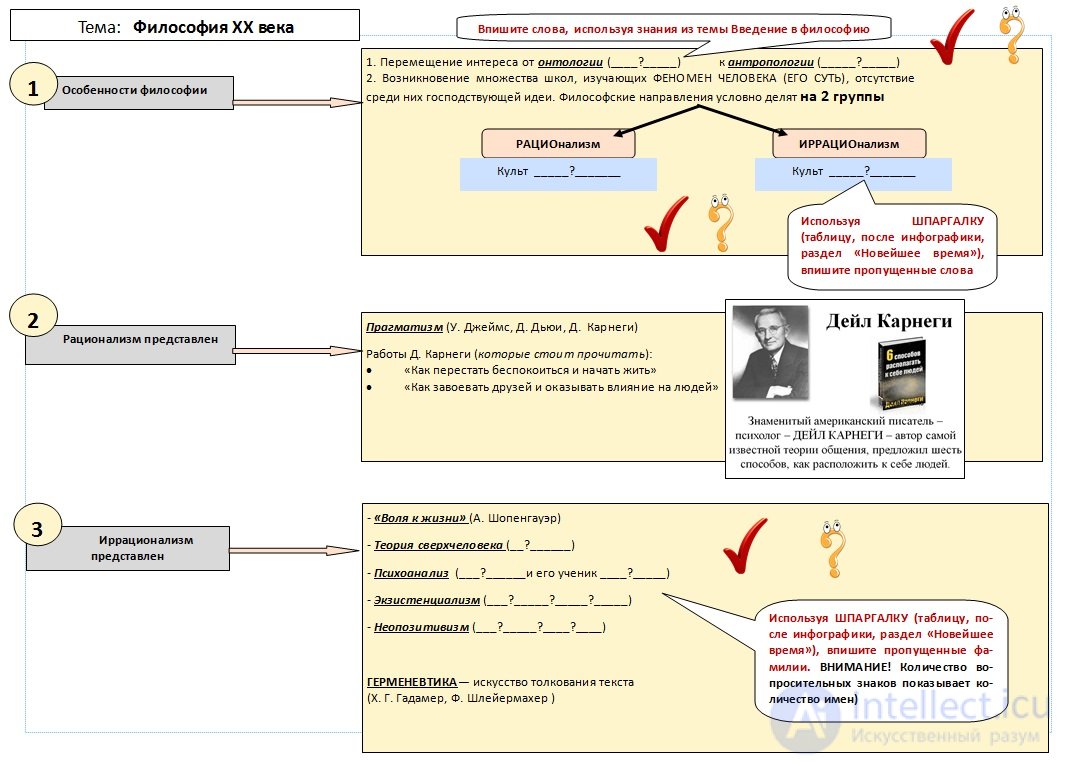
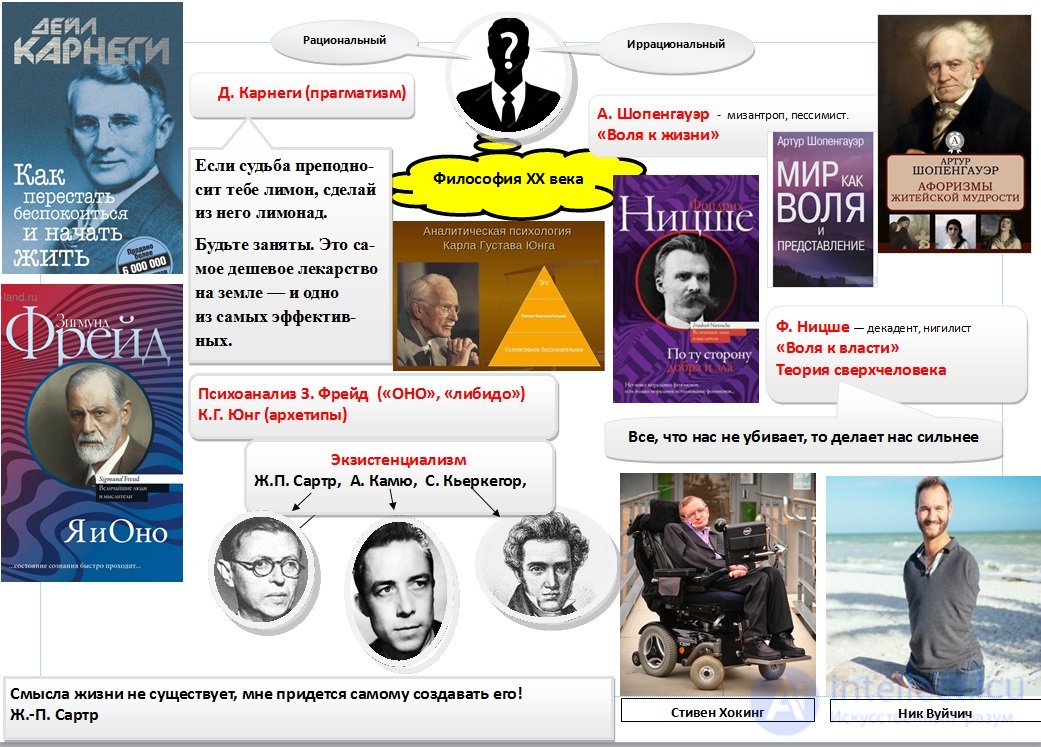
Match the following
| 1 |
Pragmatism |
A |
S. Freud |
| 2 |
Psychoanalysis |
B |
J.-P. Sartre |
| 3 |
Nihilist and decadent |
C |
A. Schopenhauer |
| |
|
D |
B. Russell |
| 4 |
Existentialism |
E |
D. Carnegie |
| 5 |
Neopositivism |
F |
F. Nietzsche |
Using the crib sheet («the most recent period»), fill in the gaps in the table. Write the answer as follows: A – answer. B – answer, etc.
| Philosopher /
direction
|
Concept introduced |
Idea |
|
A
(name of philosopher)
|
«Will to life» |
Life – is a subjective perception of objective reality |
| B
(name of philosopher)
Theory of the superman
|
«Will to power»
Superman
|
«Everything is permitted to me, but nothing must possess me». |
| C
(name of direction)
S. Freud
|
ID (libido)
(the unconscious)
|
THE ID (the unconscious principle in man) – is natural instincts (libido –sexual drive) – that determine our desires (caprices) |
| Psychoanalysis
C. Jung
|
D
(term)
|
Collective unconscious |
| Existentialism
E
(names)
|
Existence – being |
In order to evaluate life (to determine true values), one must find oneself in a boundary situation |
Number 1. Indicate the period of formation of irrationalist philosophy
- (1) 19th–20th century
- (2) 18th–19th century
- (3) 17th–18th century
2. Irrationalism in philosophy – is
- (1) a philosophical trend that does not recognize the rational mode of cognition
- (2) a philosophical trend that denies the ability of man to know the world
- (3) a philosophical trend that regards feeling as the main source of cognition
- (4) a philosophical trend that limits or denies the role of reason in the process of cognition
3.Mark the characteristic features of irrationalism
- (1) materialism
- (2) idealism
- (3) skepticism
- (4) agnosticism
2 1.What is the main subject of philosophy according to Kierkegaard
- (1) human being
- (2) social reality
- (3) cognition
- (4) subjective reality
2.What is Kierkegaard's critique of the preceding philosophical trends:
- (1) the preceding trends tried to explain the world in a rational way
- (2) philosophers always tried to know man through the surrounding world
- (3) the preceding trends recognized the absolute of human reason
- (4) the preceding trends were rationalistic
3.How does human existence manifest itself according to Kierkegaard
- (1) in thought
- (2) in social reality
- (3) in emotions, feelings, experiences
- (4) in ideology
3: 1. The method of cognition in Kierkegaard's philosophy
- (1) intuition
- (2) self-reflection
- (3) sensory experience
- (4) divine revelation
2. Why does Kierkegaard hold that it is impossible to know man by rational methods
- (1) because of the limitations of human cognition
- (2) because of the impossibility of objectifying subjective reality
- (3) because of the limitations of the methods of scientific cognition
- (4) because of the imperfection of the methods of scientific cognition
3. A characteristic of Kierkegaard's philosophy, mark the correct one
- (1) sensualism
- (2) anthropologism
- (3) anthropomorphism
- (4) subjectivism
4: 1. Kierkegaard distinguished the following stages of human life:
- (1) rationalistic
- (2) aesthetic
- (3) religious
- (4) mythical
2. Determine the sequence of the stages of human life according to Kierkegaard (Ethical(1), Religious(2), aesthetic(3))
- (1) 2,3,1
- (2) 3,2,1
- (3) 3,1,2
3. Establish the correspondence between the stage of human life and the literary-historical character in Kierkegaard's philosophy (Ethical(1), Religious(2), aesthetic(3); Abraham(a), Socrates(b), Don Juan(c))
- (1) 1-b, 2-a, 3-c
- (2) 1-c, 2-b, 3-a
- (3) 1-a, 2-c, 3-b
5: 1. The main ontological category of Schopenhauer's philosophy is
- (1) love
- (2) will
- (3) reason
- (4) soul
- (5) faith
2. Will, in Schopenhauer's philosophy, is a category that is, mark the correct one
- (1) irrational
- (2) transcendent
- (3) transcendental
- (4) rational
3.Mark the ontological characteristic of Schopenhauer's philosophy
- (1) subjective idealism
- (2) dialectical idealism
- (3) objective idealism
- (4) transcendent idealism
6: 1. mark the main work of A. Schopenhauer
- (1) The World as Will and Representation
- (2) will in human destiny
- (3) voluntarism
- (4) will and religion
2. The main gnoseological method of Schopenhauer's philosophy
- (1) reasoning
- (2) observation
- (3) intuitive contemplation
- (4) contemplation
3.A. Schopenhauer considered the substance, the first principle of the world, to be
- (1) will to power
- (2) will to life
- (3) world spirit
- (4) life impulse
7.1. The philosophical direction that denies or limits the role of reason in cognition, placing will, contemplation, feeling and intuition in the foreground
- (1) irrationalism
- (2) rationalism
- (3) empiricism
- (4) skepticism
2. Mark the stages of the objectification of will noted by Schopenhauer
- (1) the organic world
- (2) the cosmos
- (3) man
- (4) society
- (5) the inorganic world
3. Schopenhauer's claim that the cause of human suffering is desires and passions is similar to the philosophy of
- (1) skepticism
- (2) Buddhism
- (3) Taoism
- (4) Epicureanism
8: 1.The ethical ideal of Schopenhauer's philosophy is
- (1) hedonism
- (2) autarky
- (3) asceticism
- (4) apraxia
2. One of the main stimuli of human actions, according to Schopenhauer, is
- (1) love
- (2) egoism
- (3) reasoning
- (4) mercantilism
3. The foundation of morality, for Schopenhauer, is
- (1) will
- (2) love
- (3) compassion
- (4) fear
9:1 The main ontological category in Nietzsche's philosophy
- (1) will to life
- (2) will to power
- (3) will to knowledge
- (4) will to success
2. The main characteristic of Nietzsche's philosophy
- (1) rationalism
- (2) irrationalism
- (3) teleologism
- (4) skepticism
3. What main characteristics of life does F. Nietzsche distinguish
- (1) love
- (2) becoming
- (3) striving for knowledge
- (4) will to power
10:1. Which ontological conception does Nietzsche develop in his philosophy
- (1) dialectical development
- (2) eternal recurrence
- (3) reincarnation
- (4) obedience
2. The ethical ideal of Nietzsche is
- (1) the monk
- (2) the ascetic
- (3) the superman
- (4) the sage
3. The ethical characteristics of the superman in Nietzsche's conception
- (1) compassion
- (2) honesty
- (3) non-adherence to common morality
- (4) agreement with oneself
- (5) absence of suffering
Topic: Fundamental Characteristics of Man
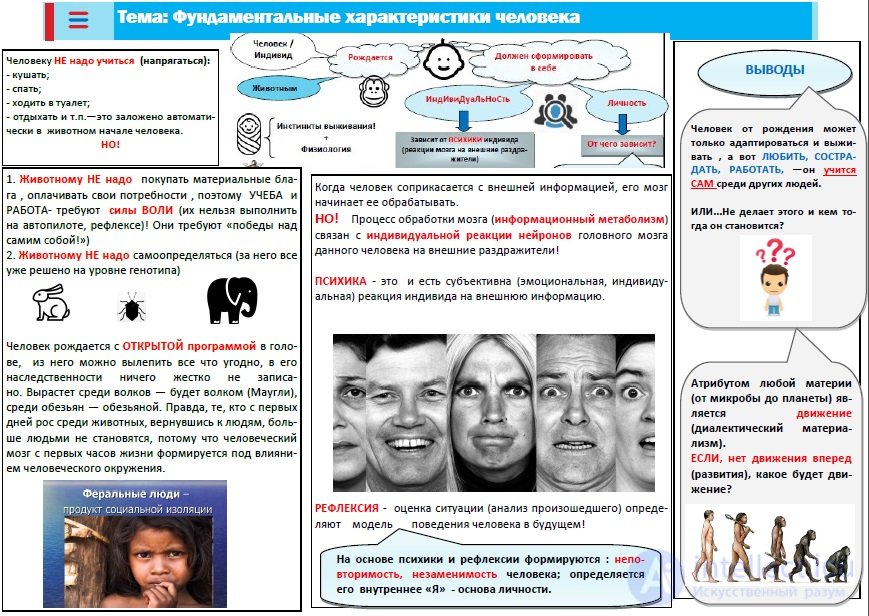
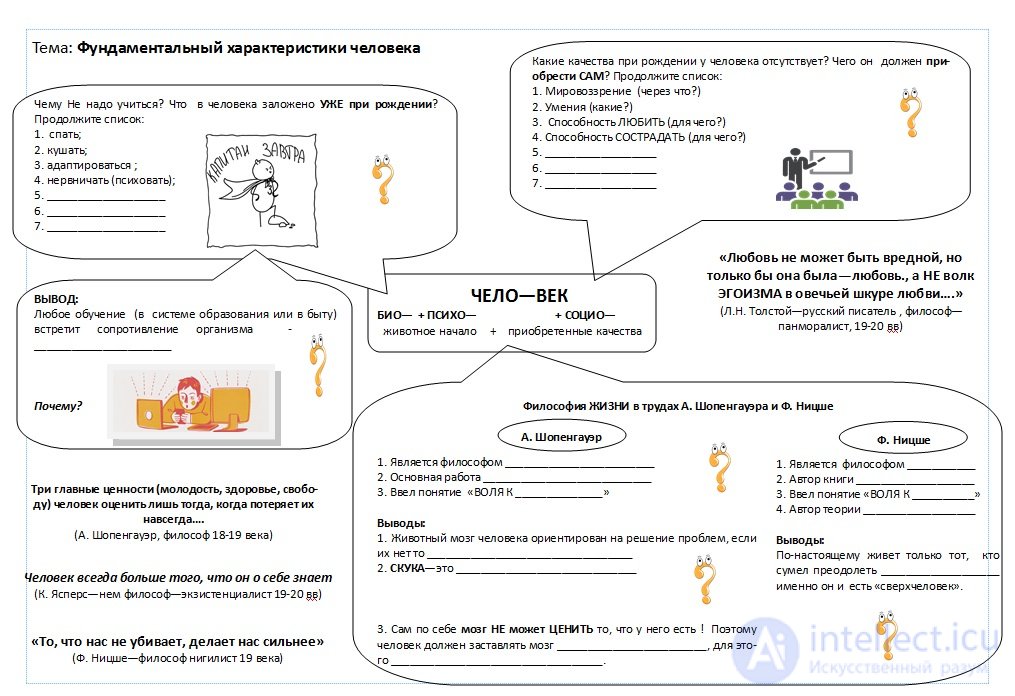
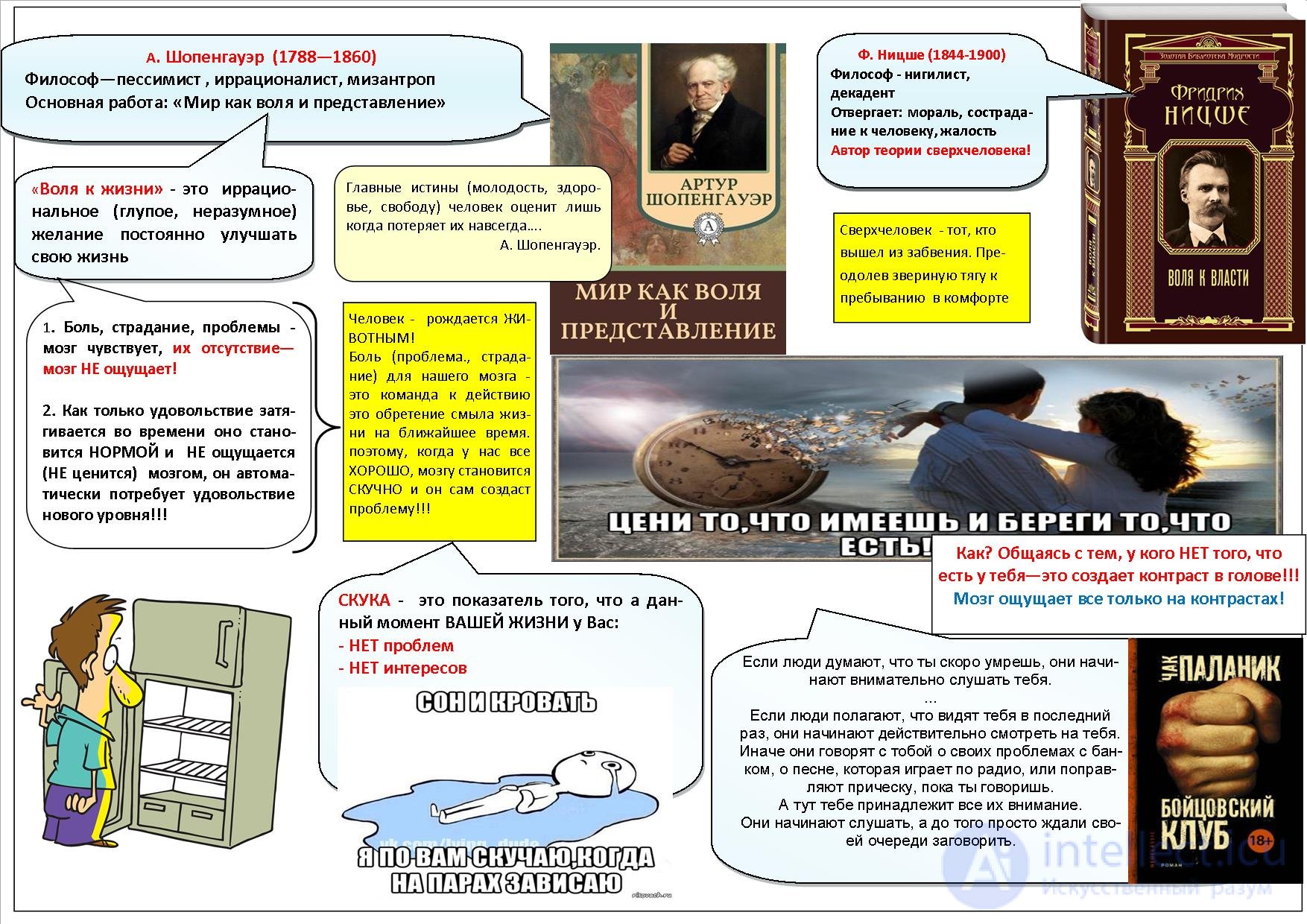
more than one correct answer
- Among the residents of village P. traditional conceptions of the world, based on common sense, are widespread. What OTHER features indicate that the villagers are dominated by an everyday worldview?
- a) strives toward ever deeper truth
- b) is formulated in an abstract conceptual apparatus
- c) is generated by the immediate conditions of life
- d) is passed down from generation to generation
- In country L. a worldview is widespread among the population, the basis of which is the sacred books of the Buddhists. What OTHER features indicate that a religious worldview predominates among the residents of this country, a religious worldview?
- a) insufficient attention to the achievements of science
- b) recognition of a supernatural principle
- c) reliance on everyday experience
- d) orientation toward solving problems connected with man's spiritual needs
- e) theoretical generalization of the results of human cognition's achievements
- f) grounding assertions by appealing to human reason
- Galina, whenever the question of needs arose, always placed first the striving for truth and the desire to do good for people. Choose from the list the characteristics of these needs:
- a) social
- b) physiological
- c) psychological
- d) acquired
- e) innate
- f) biological
- Choose the features characteristic of a scientific worldview:
- a) creativity
- b) logicality
- c) rationality
- d) mythologicality
- e) supernaturalness
- f) critical-mindedness
- In class a pupil compared human activity with animal activity. What features inherent to human activity did he draw attention to?
- a) instinctive character
- b) transformative character
- c) programmed character
- d) productive character
- e) social character
- f) consumptive character
6. The saying «Don't wade into water without knowing the ford!» largely arose on the basis of common sense. What OTHER features prove that this is a matter of everyday knowledge?
- a) admonition
- b) personal experience
- c) tradition
- d) experiment
- e) formalization
Topic: The Fundamental Categories of Human Being
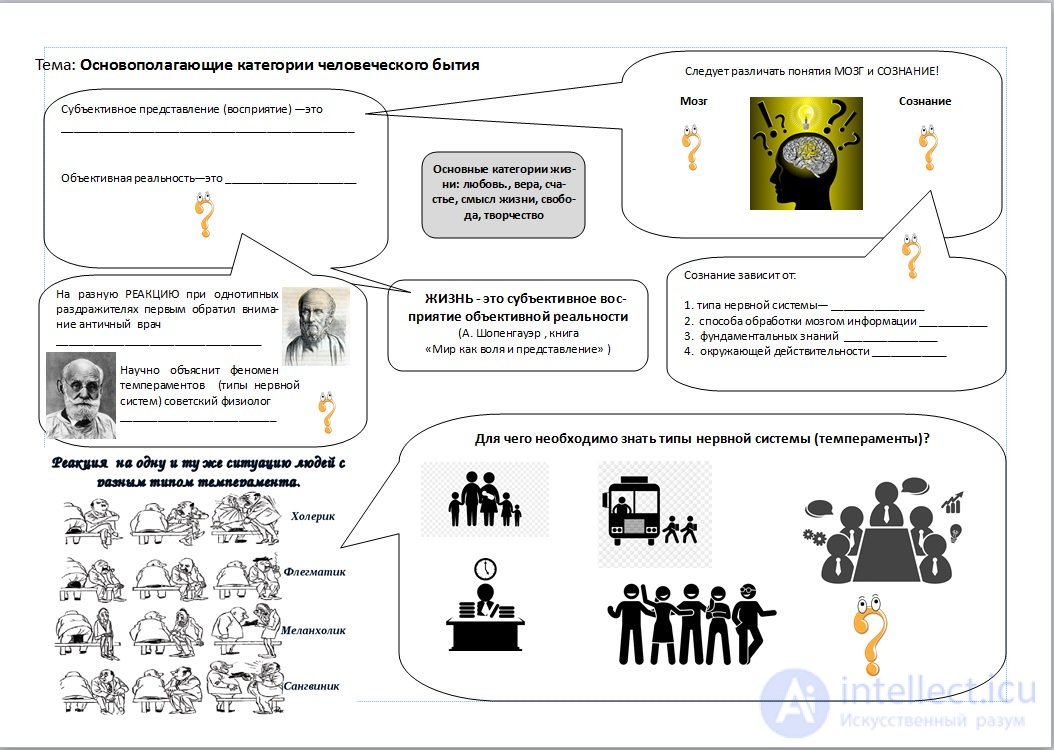
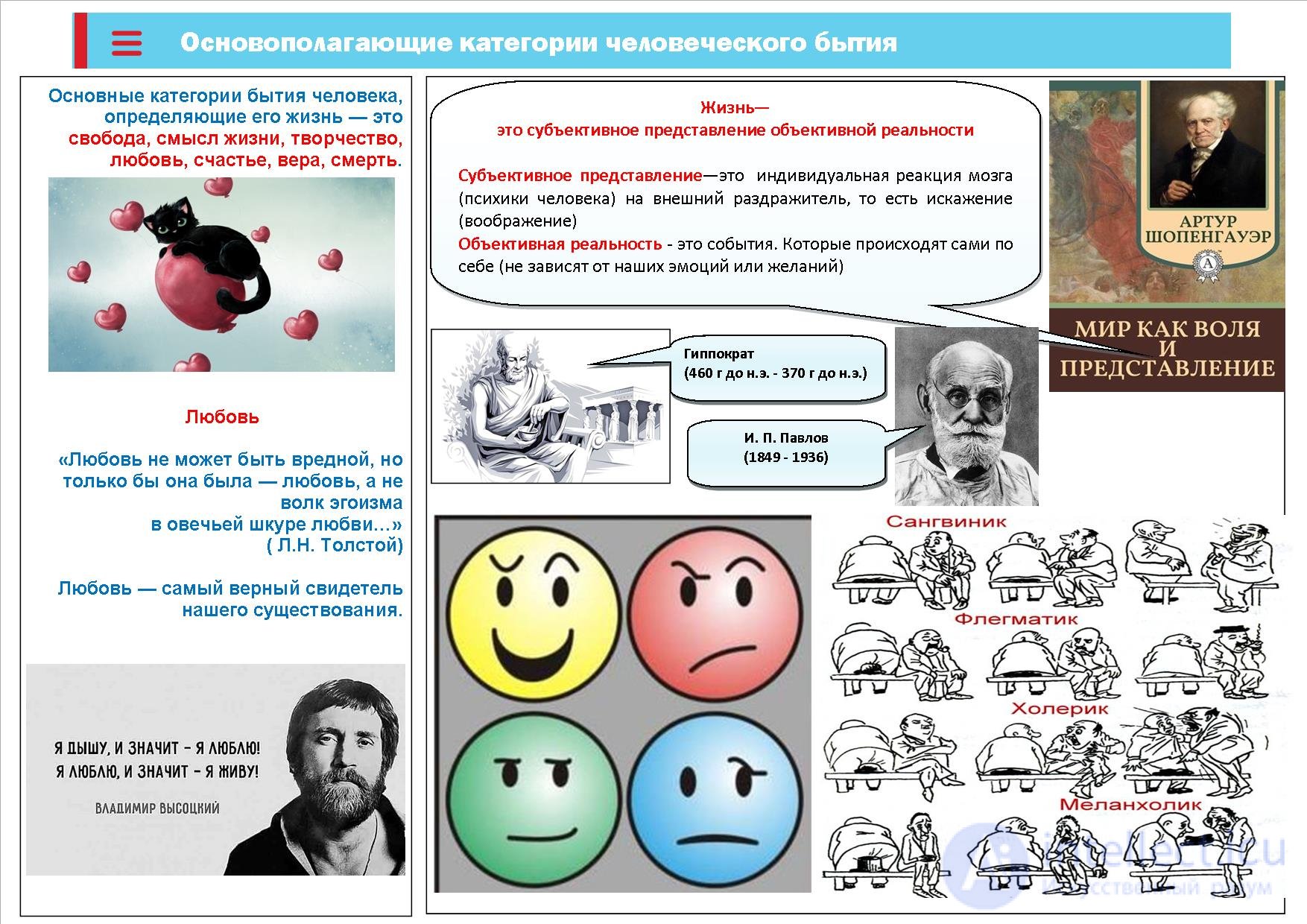
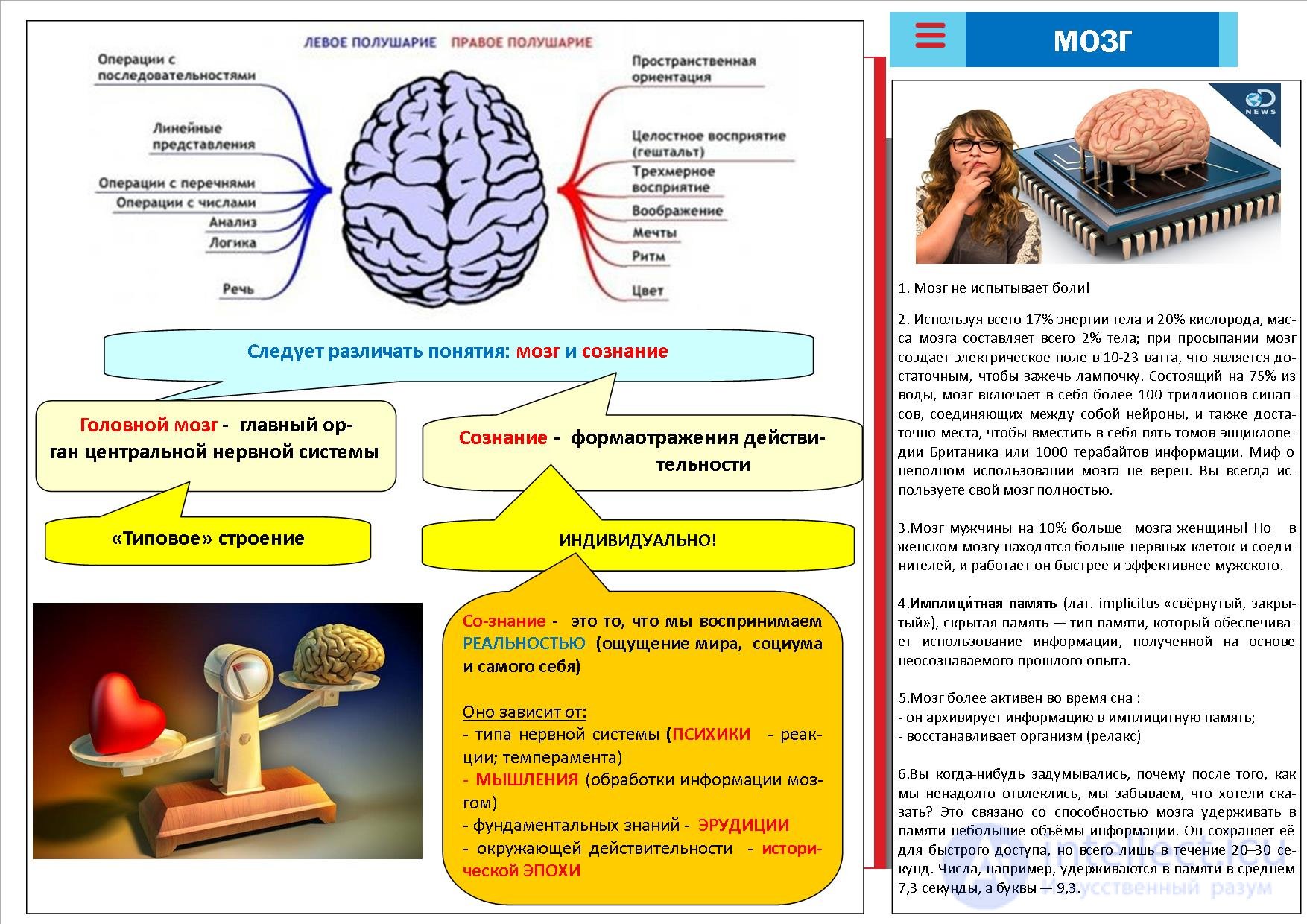
Determine the temperament from the remarks :
1. … this temperament is recognized by hot-headedness, irascibility, ambition.
- choleric,
- phlegmatic,
- sanguine
- melancholic
2. … are difficult to throw off balance, they are constant in their likes and dislikes, interests and occupations.
- choleric,
- phlegmatic,
- sanguine
- melancholic
3 … this temperament is connected with anxiety, apprehension, pessimism.
- choleric,
- phlegmatic,
- sanguine
- melancholic
4 … — a joker, a good conversationalist, easily makes friends. …
- choleric,
- phlegmatic,
- sanguine
- melancholic
5… thoughtful, but constantly doubt the correctness and success of their activity, distrustful, worried, joyless..
- choleric,
- phlegmatic,
- sanguine
- melancholic
6… is not able to remain upset for long, their sorrows are not deep.
- choleric,
- phlegmatic,
- sanguine
- melancholic
7… take a long time to get going when starting an activity, but perform it with quality and responsibility
- choleric,
- phlegmatic,
- sanguine
- melancholic
freedom, creativity,
1. The psychology of creativity – is:
- *a) a part of the psychology of art;
- b) a philosophical discipline;
- c) an interdisciplinary field of knowledge.
2. Imagination – is…
- a)the creation of new sensory images;
- b) the creation of new mental images;
- c) the transformation of images;
- d) the transformation of existing representations into new ones;
- *e) all answers are correct;
- f) all answers are incorrect.
3. Aptitudes as anatomical-physiological preconditions for the development of abilities…
- a)are formed during one's lifetime;
- b) are multivalent;
- c) are directed toward the content of a specific activity;
- * d) are acquired in the course of life activity;
- e) all answers are correct;
- f) all answers are incorrect.
happiness,
1. To the Cynics belongs the assertion:
- 1) fate exists above the world
- 2) happiness – is pleasure
- 3) happiness lies in freedom from passions
- 4) the ideal of life – is indifference to everything external
2.Happiness as freedom from all fetters and, above all, from unfounded opinions. Such is the point of view of:
- a) Epicurus;
- b) Pyrrho;
- c) Diogenes.
3.Happiness lies « in freedom from sorrow, in the moderation of feelings and the disposition of the soul, which sets bounds to everything, as ordained by nature», from the point of view of:
- a) the sophists;
- b) the Epicureans;
- c) the skeptics.
4. At the center of the philosophy of the Renaissance was:
- a) natural-cosmic life;
- b) religious life and the problem of salvation;
- c) human activity in this world and for the sake of achieving happiness in this life.
love,
1. «Love as principle, order as foundation, progress as goal» – is the motto of the philosophy of:
- a) Marxism;
- b) positivism;
- c) the philosophy of life.
2. The main concept describing the essence of man, according to Sartre:
- a) love;
- b) freedom in the form of choice;
- c) fear;
- d) despair.
3. The main theme of the philosophy of A. Camus:
- a) love;
- b) guilt;
- c) freedom;
- d) suicide.
4. What is the determinant of personality, according to A. Adler?
- a) a feeling of compassion;
- b) striving for superiority;
- c) love.
5. Platonic love – is love of.
- 1) a beautiful body.
- 2) the soul.
- 3) knowledge.
- 4) nature.
- 5) Plato himself
the meaning of life,
1. Choose a synonym for the expression «the meaning of life»:
- 1 meaningfulness of one's actions
- *2 the goal of life
- 3 the planning of life
- 4 the fullness of life with events
2. Can the progress of humanity (material, technical, intellectual) be the goal of life?
- 1 yes, since it will be easier, more comfortable and more interesting for subsequent generations to live
- *2 no
- 3 unknown
- 4 yes, it can, for in the event of successful progress medicine will find saving remedies against disease and death; and the complete robotization of production will free man from the need to labor: everyone will be happy
3. Life can have meaning only from the point of view of:
- 1 the past, as the cumulative experience of humanity's reflection on life
- 2 the present, since meanings can change in one or another period of the life of a person or society
- *3 eternity, as the result of life
4. What can matter for a person's posthumous fate in eternity?
- 1 the quality and quantity of food digested
- 2 pleasures received (aesthetic and physiological)
- 3 the amount of property and monetary capital accumulated by the moment of death
- 4 achievements in science and art, etc.
- 5 emotional and cultural development
- *6 something else
5. Which of the following terms is not used to designate philosophical views on the meaning of human life?
- 1 hedonism
- 2 eudaimonism
- 3 utilitarianism
- *4 communism
- 5 corporatism
- 6 perfectionism
- 7 humanism
- 8 pragmatism
6. What is the name for the worldview based on the idea that scientific knowledge is the highest cultural value and a sufficient condition for human orientation in the world?
- 1 gnoseophobia
- *2 scientism
- 3 Scientology
Correct answer: No. 2
7. The birth and upbringing of children is a good for a person. Nevertheless, wherein lies the illusoriness of seeking the meaning of life in one's children?
- 1 in that they may not live up to our hopes
- 2 in that they are mortal, as we are
- *3 in that the lives of all people are of equal worth
8. Who determines the true meaning of human life?
- 1 the person themselves
- 2 society
- 3 philosophers
- *4 the Creator of the universe
9. In what way did God reveal to His creations - human beings - the meaning of their life?
- 1 He gave them the opportunity to guess the meaning of their existence themselves
- 2 He gave the wisest representatives of humanity the opportunity to compose special religious, philosophical, and moral-ethical books
- *3 by personally proclaiming and revealing it to people
- 4 He communicated it through various spirits (angels and demons)
10. Which of the following is not the meaning of life?
- 1 fasting
- 2 spiritual reading
- 3 ascetic feats
- 4 humility
- 5 mercy
- *6 all of the above
The above are not the meaning but the means to deification as the meaning of human life.
11. How do the problems of „human nature“ and „the meaning of life“ relate to one another?
- a) Both problems reveal the purpose of man.
- b) They are identical to one another.
- c) They coincide with one another.
- d) There is no correct answer.
12. From the standpoint of hedonism, the meaning of life consists in the fact that:
- *life is pleasure, preferably as varied as possible, here and now
- to live means to derive benefit from everything
- life is renunciation of the world and mortification of the flesh for the atonement of sins
- life is the striving for happiness as man's true purpose
61. What is philosophical anthropology:
- a) the science studying the problem of the origin of man;
- b) the philosophical understanding of the biological evolution of the ancestors of modern man;
- c) a heterogeneous philosophical current claiming to provide a theoretical understanding of contemporary knowledge about man and to achieve a new philosophical understanding of human nature;
- d) all answers are correct.
62. The main thematic direction of reflection in philosophical anthropology is the question:
- a) of the relationship between the individual and society;
- b) of the formation of the social essence of man;
- c) of the correlation between the material and the ideal in individual human existence;
- d) of the nature of man and the peculiarities of his existence.
63. Concepts of the changing nature of man were presented in the works of:
- a) Aurelius Augustine;
- b) K. Marx, F. Engels;
- c) N. Berdyaev;
- d) I. Prigogine, I. Stengers;
- e) all of the above.
64. According to K. Marx, at a certain historical stage the semi-animal turns into a special kind of human being, namely:
- a) into «homo ludens»;
- b) into «homo soveticus»;
- c) into «homo sapiens»;
- d) into «homo symbolicus»;
- e) into «homo sexualis»;
- f) into «homo faber».
65. Universal behavioral variability (the ability to adapt to diverse living conditions) is a consequence of the undermining of instinctive behavior, which makes man a «sick animal» - this is the point of view on human nature from the standpoint of:
- a) biocentrism;
- b) sociocentrism;
- c) anthropocentrism.
66. Sociocentrists see the qualitative differences between man and animals in the presence of:
- a) the capacity for selective action;
- b) reason, rationality;
- c) inner spiritual life;
- d) special physical qualities (strength, endurance, etc.).
- e) personal individuality;
- f) the capacity for reflection;
- g) morality;
- h) upright walking;
- i) the capacity for love;
- j) the capacity for transcendence;
- k) freedom.
67. Reflection (from Latin reflexio – turning back) – is:
- a) the recollection of knowledge which, according to Plato, man possessed before his birth;
- b) the substantive examination of knowledge itself, a critical analysis of its content and methods of cognition;
- c) the activity of self-knowledge, revealing the inner structure and specific character of man's spiritual world;
- d) a principle of human thinking that directs it toward the comprehension and awareness of its own forms and premises.
68. What calls into question a person's responsibility for their actions?
- a) the recognition of insurmountable external circumstances;
- b) the denial of free will.
69. According to J.-P. Sartre, man «is not what he is», because:
- a) man goes beyond the boundaries of his present being;
- b) the way a person appears in the eyes of others does not correspond to what he is in himself;
- c) appearance does not correspond to essence;
- d) it is impossible to judge a person within the limits of earthly life.
70. Which of the judgments below is closer to the truth?
- a) the biological in man dominates over him;
- b) the social determines the essence of man;
- c) in some situations the biological determines the essence of man, in others - the social;
- d) man is a biopsychosocial being embodying a living contradiction.
71. As V. Frankl wrote, until his last breath a person does not know whether he has truly realized the meaning of his life or merely believes that this meaning has been realized. But what is truly significant, according to V. Frankl, is:
- a) a person's attitude toward the fate that has fallen to their lot;
- b) the degree of recognition by society;
- c) the weight of the contribution to human culture.
72. The question of the meaning of life becomes relevant when:
- a) a person perceives their real existence as not corresponding to their own essence;
- b) «…when life could not be worse for a person» (V. Frankl);
- c) all other philosophical questions have already found their solution.
faith,
1 What way out of the resulting «impasse» does F. Nietzsche propose?
- a) the creation of a new morality embodied in the Superman;
- b) the further development of science;
- c) faith in God.
2. What does faith mean in the Christian sense of the word?
- 1 the acceptance of religious postulates without confirmation by personal experience, on faith
- 2 trust in God
- 3 trust in a religious book or authority
3 Faith is
- -a form of worldview
- -«love of wisdom»
- an act that regulates certain social relations
- a positively colored emotion that arises from tense anticipation of the fulfillment of what is desired and that anticipates the possibility of its realization
- *– a way of comprehending the world, a special state of the subject's consciousness - conviction, deep certainty about someone or something
- confidence in someone's good faith, sincerity, in the correctness of something
The spiritual life of man (science,
продолжение следует...
Продолжение:
Часть 1 1000 Online Philosophy Tests with Answers, Diagrams, and Infographics
Часть 2 - 1000 Online Philosophy Tests with Answers, Diagrams, and Infographics
Часть 3 tests on the topic Society and History - 1000 Online
Часть 4 Topic 1 Philosophy and the scientific picture of the world


Comments