
Lecture
Это окончание невероятной информации про немецкая классическая философия.
...
subject, that is treated as the main factor determining the mode of cognition and constructing the object of knowledge.
• Kant elevated epistemology to the rank of the basic and first element of theoretical philosophy. The subject of theoretical philosophy should not be the study of things themselves — nature, the world, and man — but the investigation of cognitive activity, the establishment of the laws of human reason and its limits. In this sense, Kant calls his philosophy transcendental.
There must exist things acting on a person's organs
of sense, otherwise the emergence of sensations
remains unexplainable.
1. Sensory experience
"Without doubt, all our knowledge begins with experience, for how else would the faculty of cognition be awakened to activity, if not by objects that act upon our senses."
A priori forms of sensibility: space and time.
Impressions are produced from without; we intuit them, and arrange them in order in space and time.
2. The understanding.
Besides sensibility as the capacity for impressions, there exists the understanding as the capacity for thought. "Objects are given to us by means of sensibility, but they are thought by means of the understanding." I. Kant. Sensibility produces intuitions, the understanding — concepts.
The understanding thinks, by means of concepts, the content delivered to it by sensibility.
There exist a priori forms of the understanding. These are the categories — forms by means of which what is sensibly
given is connected into definite structures.
Kant names 12 categories of the understanding, grouped
in threes: categories of quantity (unity (measure),
plurality (magnitude), totality (the whole)),
of quality, of relation, and of modality. Kant says that reliable knowledge can only be
a synthesis of sensibility and understanding.
Sensations by themselves, without the concepts of the understanding, are blind,
and the concepts of the understanding by themselves, without sensations, are empty.
3. Reason
Reason is directed toward creating rules for the activity of the understanding.
Reason creates ideas and ideals. These are ideals, such as pure water, pure air, and so on, which are necessary in
science.
"Although one cannot admit the objective reality
(existence) of these ideals, nevertheless one cannot on
this ground consider them chimeras: they provide
reason with a necessary measure, since it needs
the concept of that which is complete in its kind, in order to
evaluate and measure by it the degree and the shortcomings
of the imperfect."
(I. Kant)
The world of things in themselves — noumena. The world of appearances — phenomena. Objective reality: this is what objects are in themselves, independent of cognition.
The external stimulus of sensations. These are "intelligible things," located outside experience (the world as a whole, God, the soul). Ideas and ideals of reason.
An appearance is that which is not at all located in the object itself, but is always encountered in its relation to the subject and is inseparable from the representation
of it.
Monument to Kant in Königsberg (now Kaliningrad). "The philosophy of nature deals with everything that is, while moral philosophy deals only with what ought to be." I. Kant. Kant asserts the "autonomy," or independence, of morality from religion. The moral law is not derivable
from religious commandments.
Kant's categorical imperative — the chief law of morality:
"Act so that the maxim of your will could at the same time hold good as a principle of universal legislation."
The philosophy of absolute idealism. The absolute idea (reason, thought) is the foundation of everything natural and spiritual. "Reason is substance, namely that through which and in which all reality has its being." (Hegel). "The Idea is essentially a process."
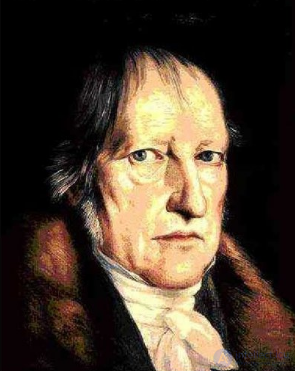
Hegel's system includes three parts:
The self-development of the Absolute Idea is the activity of self-cognition. The Absolute Idea creates the world and man for the purposes of self-cognition. The highest act of this self-cognition is absolute knowledge — philosophy.
Three laws of dialectics as a method:
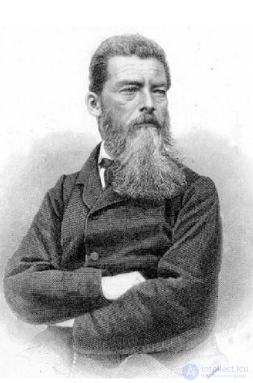
The break with Hegel's idealism. The transition to materialism and atheism. "In what, then, does my method consist? In reducing, by means of man, everything supernatural to nature, and, by means of nature, reducing everything supernatural to man, but always relying solely on clear, historical facts and examples."
How are synthetic a priori judgments possible in mathematics? By mathematics, Kant understood only arithmetic and geo-
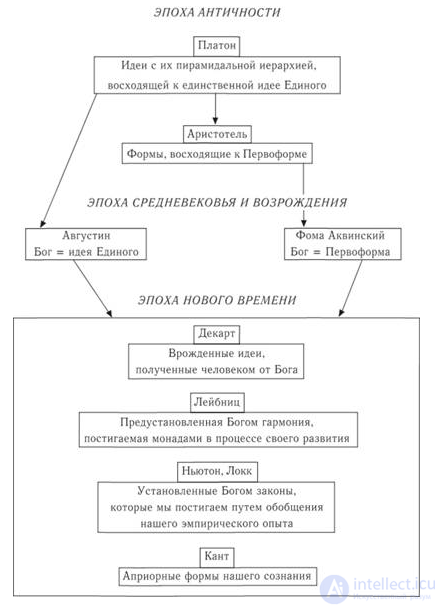
Diagram 120. The origins of the universality and necessity of scientific laws
metry , and so this question was posed only for them. He regarded the elements of mathematical knowledge (geometrical figures and numbers) not as concepts, but as sensory intuitions or visual representations, based on the sensory intuition either of space (in geometry) or of time (in arithmetic) . At the same time, he did not consider space and time to be objectively existing independent entities (as absolute space and time in the Newtonian tradition) or properties of material bodies (as relative space and time in Newton).
According to Kant, space is the a priori form of external sensory intuition, that is, an innate way, for man, of organizing and perceiving sensory impressions received from objects of the external world . We do not know how the objects of the external world are structured, or what the relations between them are (all this is "things-in-themselves"). But when our organs of sense receive certain sensations from the external world, already at the level of sensory cognition these sensations, by virtue of the a priori form of external perception — space — are organized in such a way that it appears to us that objects are arranged in space in a certain way relative to one another, and that these objects themselves have certain spatial characteristics (length, width, depth). Likewise, time is the a priori form of internal sensory intuition.
The very synthesis of the sensory data entering consciousness from without, from the objectively existing world, with the form of external (space) or internal (time) sensory intuition inherent in the subject — man — is called by Kant transcendental apperception (diagram 121).
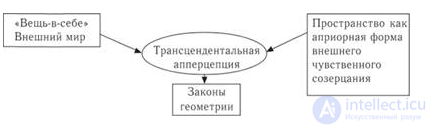
Diagram 121. Transcendental apperception
The laws of mathematics (geometry and arithmetic) acquire the form of universality and necessity in the process of transcendental apperception, owing to the forms of sensory intuition. And it is precisely thanks to these forms (space and time) that synthetic judgments are a priori. If our mind were organized differently, the laws of mathematics known to us today would not appear to us as universal and necessary.
How are synthetic a priori judgments possible in theoretical natural science? Theoretical natural science is the domain of the activity of the understanding. The understanding possesses 12 categories (unity, plurality, totality, reality, substance, causality, and so on) as pure a priori concepts. All these categories belong to the understanding itself, not to the objects being studied. In the process of cognition, a combination (synthesis) of sensory intuition with the categories of the understanding takes place. Thus, the laws of natural science acquire the form of universal and necessary, that is, synthetic a priori, judgments. The most important precondition for such a synthesis is the unity of our consciousness. It is expressed above all in the fact that the understanding thinks any natural objects as subject to three laws, belonging again to the understanding itself and not to the objects of the external world, namely: the law of the conservation of substance, the law of causality, and the law of the interaction of substances.
Thus, theoretical natural science constructs a picture of the world ("the thing-for-us") on the basis of the forms and laws of the understanding, and not of natural objects. Therefore, "the thing-in-itself" and "the thing-for-us" are not identical. Natural objects in themselves ("the thing-in-itself") remain unknown and uncognized to us.
How are synthetic a priori judgments possible in metaphysics? Metaphysics (theoretical philosophy) is the domain of the activity of reason. Kant understands reason as the capacity for inference leading to the formation of ideas. According to Kant, ideas are concepts of the unconditioned. But since everything we receive in our experience is always conditioned, ideas are that which cannot be perceived by the senses in experience. Reason forms three ideas (diagram 122):
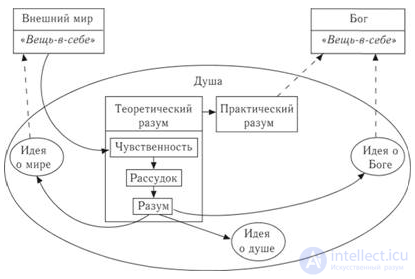
Diagram 122. The generation by reason of three ideas of the unconditioned: transcendent entities (that is, lying beyond the soul)
In our experience we always deal only with conditioned phenomena, and therefore only the following are possible:
A science of God as the unconditioned cause of all conditioned phenomena is impossible. The existence of God is a matter of faith, not of reason. In the sphere of theoretical reason, the existence of God cannot be proved, and all the previously known medieval proofs (the five proofs of Thomas Aquinas) can be refuted, as Kant does.
Table 81
The antinomies of pure reason
|
Thesis |
Antithesis |
|
1. The world has a beginning in time and is limited in space |
1. The world has no beginning in time and is not limited in space |
|
2. Every complex substance in the world consists of simple parts, and in general only the simple exists, or that which is composed of the simple |
2. No thing in the world consists of simple parts, and in general there is nothing simple in the world |
|
3. Causality according to the laws of nature is not the only causality from which all the phenomena of the world can be derived. To explain phenomena, it is also necessary to admit a free causality |
3. There is no freedom at all; everything in the world takes place solely according to the laws of nature |
|
4. To the world there belongs, either as a part of it or as its cause, an absolutely necessary being |
4. There is nowhere any absolutely necessary being — neither in the world nor outside the world — as its cause |
Commentary. In the "Critique of Pure Reason," Kant formulates four antinomies (unresolvable contradictions) to which we come when we try to think the world as an unconditioned whole. In his view, this proves the impossibility of thinking the world as a single whole. In constructing the antinomies, he chooses the most fundamental characteristics of being, which since antiquity have been the subject of discussion and dispute in philosophy.
Ethics. The problems of ethics (of proper human conduct) and of the existence of God are analyzed by Kant above all in the work "Critique of Practical Reason." The doctrine of "pure reason" turns out here to be the theoretical foundation necessary for constructing and grounding "practical reason."
Among the central problems of Kant's ethics (as of all the ethics of the Enlightenment) are the problems of freedom and necessity. Man, on the one hand, is merely one of the "appearances" ("things-for-us") in the world of nature and, like any appearance, is subject to the necessity that prevails in the world of appearances. But, on the other hand, man belongs to the number of intelligible "things-in-themselves," is a subject of moral consciousness, and is therefore free. Hence man appears as a necessary being (an appearance) in one respect and as a free being (a "thing-in-itself") in another.
Following Rousseau, Kant asserts that every person, every individual, is an end in himself. Therefore, a person cannot be a means in the solution of any task, even tasks aimed at achieving the common good. From this follows Kant's categorical imperative, which has two formulations:
But even when following the categorical imperative in his behavior, a person may do so for two reasons:
Kant classifies acts of the first type merely as legal, and only acts of the second type as moral.
But, as experience shows us, there is no direct connection between moral or immoral behavior and, correspondingly, happiness or unhappiness in this life. On the contrary, we often see that great success is achieved by thoroughly vicious, unprincipled, and immoral individuals. Whereas people who follow moral duty often suffer because of their decency, live in poverty, receive no recognition, and so on. This situation contradicts our moral consciousness, which demands a just correspondence. But since this correspondence does not exist in the world of appearances, it remains to assume that it takes place in the intelligible world. And the guarantor of justice can only be God.
The fate of the doctrine. The whole of German classical philosophy developed under the direct influence of Kant; at the end of the 19th century Neo-Kantianism arose, and besides this Kant influenced the philosophy of life, phenomenology, positivism, and many other currents (diagram 123).
Each antinomy is constructed as a pair of contradictory propositions: a thesis and its negation — the antithesis.
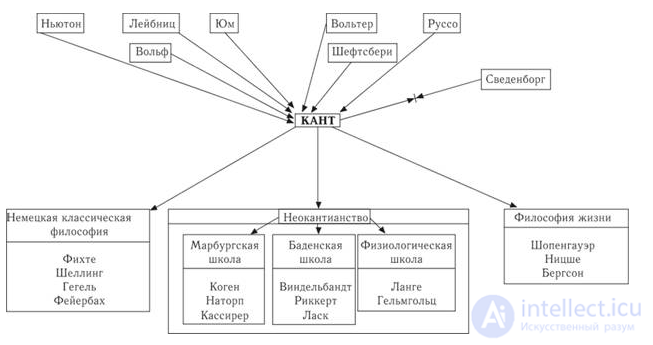
Diagram 123. Kant: origins and influence
German philosophy is a generalized name for philosophy in the German language, as well as for the philosophy of German thinkers.
German philosophy has been extraordinarily diverse in the views it presents, occupying a central place within both the analytic and continental philosophical schools over the centuries, from Gottfried Leibniz, Immanuel Kant, Georg Hegel, Karl Marx, Arthur Schopenhauer, Friedrich Nietzsche, and Ludwig Wittgenstein, to contemporary philosophers such as Jürgen Habermas.
Classical German philosophy of the late 18th to mid-19th century is the summit of world philosophical thought, since in it philosophy showed itself in its highest, "purest" form: it, in Hegel's words, "by the movement of purely worldview categories alone, showed us the world and our place in this world."
The main problems of classical German philosophy: the wholeness and structuredness of being, its knowability, the activity of consciousness, the connection between consciousness and cognition, the principles of development, the essence of man, and the universality and generality of the forms of morality.
Summarizing what has been said, it must be stated: classical German philosophy is not only the highest level but also the completion of the development of European philosophical thought. This does not at all mean that the development of philosophical thought ends with classical German philosophy. Just as the development of the content of our worldview and our place in this world cannot stop, so too the development of philosophical thought by the peoples of the still-existing European culture cannot stop. Nevertheless, it must be recognized that after classical German philosophy, the philosophy of the European peoples goes beyond the bounds of the European peoples proper and begins to develop on a world scale.
Among the general features and merits of the philosophy of this period, the following achievements may be noted:
being fundamentally socio-centric in nature, it turned theoretical thought toward the problems of freedom and values, and their role in human life.
it developed methods of development and cognition corresponding to contemporary science — the dialectical and the historical — which, owing to their uniqueness, made possible a sharp advance in the cognition of the world.
it contributed to the formation of a new conception of the model of the world, and to the emergence of original approaches to its cognition.
Classical German philosophy is a testament to the intellectual awakening of the German people. The economic immaturity and political weakness of the German bourgeoisie, and the territorial fragmentation of Germany, left their mark upon it. At the same time, German philosophy made use of the results of the development of the philosophical thought of Italy, France, England, and Holland.
Classical German philosophy is one of the most important expressions of the spiritual culture of the 19th century.
Why does Kant call his philosophy criticism?
What is the difference between appearance and the thing in itself in Kant's philosophy? What can we know?
What are a priori forms and what is their role in cognition? What is transcendentalism? What are the levels of cognition, according to Kant?
What is the problem of the relationship between morality and freedom in the philosophy of I. Kant?
What is the "categorical imperative"? What is its role in the realization of freedom by man?
Compare the systems of idealism of Fichte and Schelling.
What is the essence of Hegel's method? What is it called?
Characterize Hegel's system of philosophy.
Часть 1 The Classical Stage of Modern Philosophy: German Classical Philosophy (Late 17th – Early 19th Centuries)
Часть 2 The stages of cognition according to Kant: - The Classical

Comments