
Lecture
Ethics ( Lat. Ethica , from Greek Ήυος - custom ) is one of the oldest philosophical disciplines, whose object of study is morality, morals.
The ethics of German philosophical rationalism became the highest achievement of the ethical theory of the modern era. This is the period of the creation of complete systems of philosophy, whose highest expression is seen in "practical philosophy" — ethics and aesthetics. Its outstanding representatives are: Immanuel Kant ( 1724 - 1804 ), Johann Fichte ( 1762 - 1814 ), Friedrich Schelling ( 1775 - 1854 ), Georg Hegel ( 1770 - 1831 ).
Kantianism is the philosophy of Immanuel Kant, a German philosopher born in Königsberg, Prussia (now Kaliningrad, Russia). The term Kantianism is also sometimes used to describe contemporary positions in the philosophy of mind, epistemology and ethics.
The philosophy of Immanuel Kant is transcendental philosophy. Many call Kant an agnostic.
Kant's ethical teaching is set out in the following of his works:
* "Lectures on Ethics" (1782)
* "Groundwork of the Metaphysics of Morals" ( 1785 )
* "The Metaphysics of Morals" ( 1797 )
* "On the Radical Evil in Human Nature" ( 1792 )
* "Critique of Practical Reason" ( 1788 ).
Kantian ethics is deontological, revolving entirely around duty rather than emotion or ultimate ends. All actions are performed in accordance with some underlying maxim or principle, which differ considerably from one another; it is on this basis that the moral worth of any action is evaluated. Kant's ethics is grounded in his view of rationality as the highest good and in his belief that all human beings are fundamentally rational beings. This led to the most important part of Kant's ethics — the formulation of the categorical imperative, which is the criterion for whether a maxim is good or bad.
Put simply, this criterion is a thought experiment: to try to universalize the maxim (imagining a world in which all people necessarily acted in this way under the corresponding circumstances), and then to see whether the maxim and the actions associated with it would still be possible in such a world. For example, holding the maxim kill anyone who annoys you, and its universal application, would lead to self-destruction. Thus, to adhere to this maxim is irrational, since ultimately it cannot be adhered to.
The universalization of a maxim (statement) results either in its being valid, or in one of two contradictions — a contradiction in conception (where the maxim, once universalized, is no longer a viable means to the end) or a contradiction in the will (where a person's will contradicts what the universalization of the maxim implies). The first type leads to «perfect duty», and the second to «imperfect duty».
Thus, Kant's ethics focuses only on the maxim underlying actions, and evaluates them as good or bad solely on the basis of how they conform to reason. Kant showed that many of our common-sense views of what is good or bad conform to his system, but he denied that any action performed for reasons other than rational ones could be good (saving a drowning person purely out of great pity for them is not a morally good deed). Kant also denied that the consequences of any action in any way contribute to the moral worth of that action; his reasoning was (put very simply, for brevity) that the physical world lies outside our full control, and thus we cannot be held responsible for the events that occur within it.
Formulations of the categorical imperative:
Among the philosophical treatises on ethics, the works of I. Kant stand out in particular. Kant's ethics was in many respects the summit of modern moral philosophy. Among the classic figures of German philosophy, Kant devoted the greatest attention to morality (specifically to its distinctive nature), and his ethical conception, consistently developed across a whole series of specialized works, was the most elaborated, systematic and complete. Kant posed a whole series of critical problems connected with defining the concept of morality. One of Kant's achievements consists in the fact that he separated the questions of the existence of God, the soul, and freedom — questions of theoretical reason — from the question of practical reason: what ought I to do? Kant's practical philosophy had an enormous influence on the generations of philosophers who followed him (A. and W. von Humboldt, A. Schopenhauer, F. Schelling, F. Hölderlin and others).
Kant devoted the greatest attention to the question of morality and its ethical conception. Consistently developed across a whole series of specialized works, it was the most elaborated, systematic and complete. Kant posed a whole series of critical problems connected with defining the concept of morality. One of Kant's achievements consists in the fact that he separated the questions of the existence of God, the soul, and freedom — questions of theoretical consciousness — from the question of practical reason.
Kant's analysis of moral philosophy is undertaken to resolve the contradiction between " the world of nature " and "the world of freedom" . The philosophy of nature investigates objective laws, "according to which everything happens" . Here the principle of necessity reigns. However, on the basis of knowledge of the laws of nature one cannot explain the ideas present in human consciousness of the unity of the world, the eternity of the soul, and the existence of God. In Kant's view, moral philosophy, which determines the laws "according to which everything ought to happen" , can overcome the contradiction between necessity and freedom.
He distinguishes two levels of moral philosophy: the empirical and the "pure" , that is, reliance on a priori principles. If one relies on empirical philosophy, universal laws can never be found. Therefore moral philosophy is based entirely on its "pure part" , that is, on a priori principles. They stimulate the faculty of judgment so as to recognize them and help the will to give them practical application. As Kant notes, " the metaphysics of morals has to investigate the idea and the principles of a possible pure will".
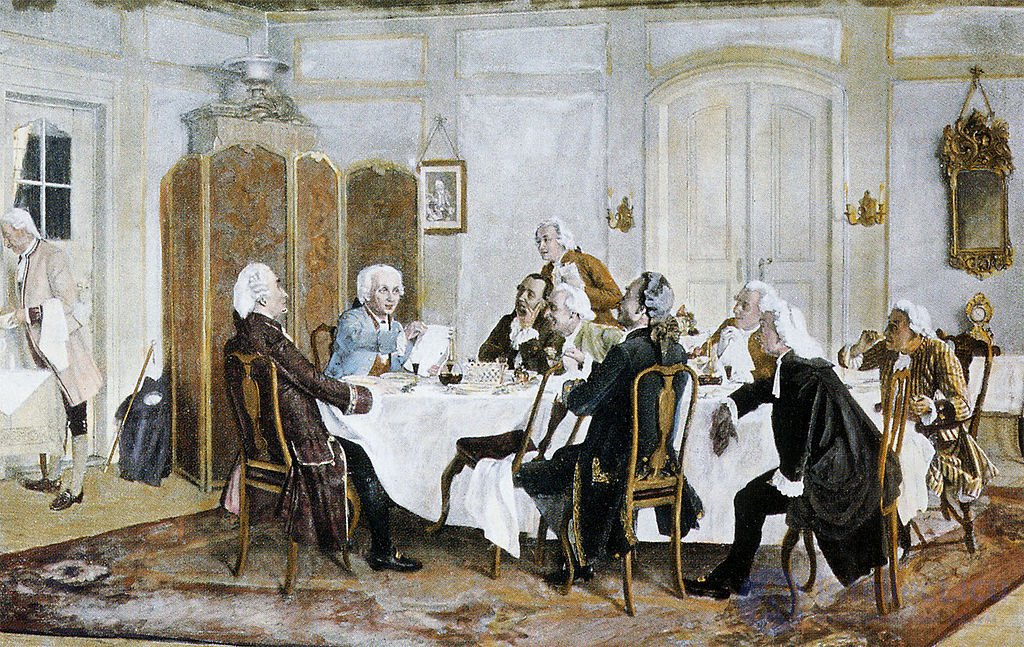
"Among our concepts ... the concept of morality is the most important"
The true purpose of reason is not to generate the will as a means to some end, but a good will in itself. Accordingly, the value of a deed lies not in the end for the sake of which it is performed, but in the "principle of volition" irrespective of the objects of desire. Freedom is seen precisely as the realization of what is morally valuable, in accordance with the principle of the pure will, and not on the basis of some self-interested considerations. The latter include, for example, inclination, sympathy, etc. Kant warns: "An action from a feeling of duty must completely eliminate the influence of inclination, and with it every object of the will".
The dialectic of freedom and necessity is structured as follows: duty necessarily requires acting out of respect for the law; freedom is the subjective principle of volition. Freedom is real on condition that the universal — the moral law — manifests itself in activity. In a word, the subjective principle of volition in the form of pure respect for the practical law is a maxim; the objective principle of the relation is a law. Moral imperatives (an unconditional rule) hold force for the will of every rational being. They are either hypothetical in character (containing prescriptions of skill), or categorical (containing moral laws). Comparing the ways in which the will acts, Kant contrasts the sensuous and the rational among its motives and acknowledges the superiority of the latter. The basis for this is the consistency with which the will is able to act. If the will dominates in spite of personal feeling, this means that the moral requirement has become the maxim of behaviour. But if the object of influence dominates, this is an arbitrary choice, in which truth is absent.
In Kant's ethics, pure reason and practical reason are contrasted. The philosopher separates the two concepts in order to reveal the specific character of each in the formation of objective moral laws and in the activity of the individual on the basis of these laws. He therefore puts forward the concept of "pure practical reason" . It reflects the unity of the universal in morality (a priori moral laws) and of the individually unrepeatable (moral maxims). The problem is defined thus: can pure reason contain within itself a practical basis, so as to move the will toward the rational (manifested in the forms of humanity) self-realization of the person. In other words, Kant seeks universal grounds for free moral activity: for the subject's necessity to feel itself a free personality and to be such according to the objective results of its activity. He uncovers all the possible motives for practical self-realization and shows that they subordinate the will to their own needs. That is, a person acting in accordance with "material practical rules" determines the direction of freedom "below the faculty of desire" .
Speaking of reason's ability to be "legislative reason" , Kant names as the condition for this the capacity of reason to determine the will by itself (and not by inclinations). Under this condition it is a manifestation of "the true highest faculty of desire" . The will is free in the strictest, that is transcendental, sense, on condition that its basis is "a universal legislative form". According to Kant, the fundamental law of pure practical reason requires: "Act in such a way that the maxim of your will could become the basis of universal legislation" - that is, so that every one of your acts might be an example for everyone " .
Reason, which determines the will, or "pure reason" , is itself practical reason. It is reason that gives people the universal law, which is the moral law.
The universality of moral laws is manifested in the fact that every subject acquires a notion of the conformity of his acts to the law. It is another matter that everyone is compelled to resort to imperatives. Thus the will's relation to the law is one of dependence. This dependence appears in the form of an obligation, which is what impels one to act. "The pure moral law" Kant calls "sacred" on the ground and on the condition that its consequence is a subjective choice (maxim) that corresponds to the universal moral law.
In the ability to rationally choose moral good and act by choice, a person affirms his human dignity. In the philosopher's view, man exists as an end in himself, and not merely as a means.
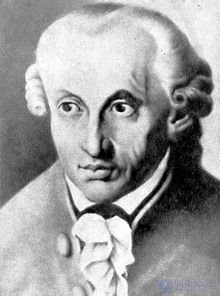
In connection with the concept of the universal moral law, the concept of " happiness " is examined. In Kant's ethics the requirement to be happy takes on the meaning of a moral duty: "man ought to be happy, inasmuch as he ought to be" . Happiness, in turn, means activity and pleasure not on the basis of inclination, but out of a sense of duty. The meaning of happiness is seen as located not in the empirical, but in the intelligible world. Elaborating on this view, the philosopher writes that in practical premises one can conceive, at least as something possible, "a natural and necessary connection between the consciousness of morality and the expectation of a happiness commensurate with it" . But on the condition that happiness is a consequence of morality. The principles of seeking happiness cannot give rise to morality. Morality is an end in itself. Proceeding from this, Kant gives the following definition of happiness: "Happiness is that state of a rational being in the world in which everything in its existence proceeds according to its will and desire ..." . For such a state to be possible, a correspondence between happiness and morality is necessary. The existence of a priori moral laws proves, in Kant's view, the existence of some "higher cause" that determines the correspondence of the will of rational beings with the moral law. It is precisely for this reason that the " reward " for morality lies in the sense of eternity, that is, in the sense of belonging to something higher than individual (empirical and contingent) being. The existence of the moral law, in accordance with which a person acts, defining it as a law for himself, so as to feel himself, for his own good, a human being, leads, according to Kant, to the immortality of the soul. In the "Conclusion" to the "Critique of Practical Reason" Kant's well-known thought about man's place in the universe is heard: "Two things fill the mind with ever new and increasing admiration and awe, the more often and steadily we reflect upon them: the starry heavens above me and the moral law within me " .
The asceticism of Kant's ethics grew in large part out of the Christian picture of the world and of man's place in it. The philosopher gave a theoretical grounding to the value of charity as against the subjectivity of human feelings. At the same time, in his ethics man is placed above God, since the assumption of God's existence is derived from the presence in man of a priori moral laws.
Kant asserts the primacy of practical reason over theoretical reason, of activity over cognition. But what is the "practical"? In the broad sense of the word, he includes in practical philosophizing ethics, the doctrine of the state and law, the philosophy of history and religion, and anthropology. But in the narrow sense of the term, practical reason in Kant means legislating reason, that is, reason that creates the principles and rules of moral behaviour. [5, p. 116]
The theory of ethics is set out in the "Critique of Pure Reason". In accordance with Kant's views on morality, "the practical is everything that is possible through freedom" [7, vol. 3, p. 658].
At the basis of Kant's "practical reason" lies the very same reason that was theoretical in the "Critique of Pure Reason". It is one and the same reason, but applied differently, since Kant's "practice" does not rest on cognition. The philosopher desires a scientific ethics.
Kant adheres to the principle of the primacy of questions of the morality of human behaviour over questions of scientific cognition. For him, theoretical cognition is capable, at most, of prompting a person's moral thought into activity. On the other hand, there arises the hope that in the sphere of moral action a person will manage to unite with the transcendent, to become party to it, to partake of its content.
Ethics is the main part of Kant's philosophy. It was precisely with reflection on the antinomies that the formation of his "criticism" began. Kant built an ethics founded on the principles of the ontological duality of man, rationalism, anti-naturalism, orientation toward the ought, autonomy, and apriorism. By "autonomy" is meant here the independence of moral postulates from extra-moral arguments and grounds.
Man, as an ontologically dual being partaking of two different worlds - that of appearances and that of things in themselves - inevitably arrived, in Kant's system, at an ethical splitting of himself and of the sphere of his behaviour. The empirical individual and the transcendent person cannot be judged, chosen, and acted upon by one and the same standard, so that ethics must be built with the understanding that man is a citizen of two worlds in moral respects as well, and that the higher morality cannot be derived from the motives of empirical life.
The rationalism of Kantian ethics means that it is not sensuous inclinations, not outbursts of passion, and not impulses of the heart, but reason that must judge of good and evil. Ethics founded on sensuous needs does not secure the purity of morals. The strict normativism of Kant's ethics is set against descriptive ethics with its orientation not toward the ought but toward what actually exists. He took this position because he proceeded from his doctrine of the duality of human nature. Kant considers the scheme of any actually existing moral behaviour to be in principle insufficient and defective [5, p. 119]
Kant's ethics is autonomous. It is oriented toward an ideal supposedly independent of any extraneous considerations and incentives. Neither sensuous desire, nor egoistic calculation, nor appeals to benefit or harm should be taken into consideration at all [7, vol. 4, p. 275].
Kant proclaims morality independent of religion, and the moral law underivable from religious commandments. Kant's philosophy holds that anything that does not arise out of morality and out of its freedom cannot make up for the absence of morality. For itself, morality "has no need whatsoever of religion; by virtue of pure practical reason it is self-sufficient" [7, vol. 4, p. 7].
Thus Kant recognized morality as autonomous, independent of religion. Moreover, he made faith in God itself dependent on morality. Man is not moral because God prescribed morality to him. On the contrary, man believes in the existence of God because, as Kant asserts, morality requires this faith. "Practical" reason takes precedence over "theoretical" reason [3, p. 320].
However, Kant did not carry his conception of an autonomous ethics through to the end. He only diminished the significance of religion, but did not reject religious faith. For Kant, God is not the creator of morality, nor the source of the moral law, but is the cause of the moral order in the world.
Kant's teaching about man is pessimistic. The core of this theory is the thesis of "radical evil," supposedly inherent in human nature. Kant believed that people, by their empirical nature, are more evil than good, for animal egoism drives them to malice and cunning, despite their possessing an inclination toward sociability and the makings of humaneness and personal dignity [7, vol. 4, part 2, p. 29].
Kant introduces the concept of the moral law, the basis of which must be sought "not in the nature of man nor in the circumstances of the world in which he is placed, but a priori, exclusively in the concepts of pure reason" [7, vol. 4, part 1, p. 223]. According to Kant, all moral philosophy proceeds from its own pure basis. It takes nothing from anthropology, but gives man, as a rational being, a priori laws. The moral law, in turn, can be found only in a "pure philosophy." Kant held that a philosophy that combined a priori principles with empirical ones could not even be called philosophy, and especially not moral philosophy. Therefore the basis of ethics is the "metaphysics of morals," which must investigate the idea and the principles of a possible pure will, and not the actions and conditions of the human will.
Kant examines various kinds of imperatives in ethics. The philosopher calls an imperative a form of command. An imperative addresses a will that, by its own nature, is not necessarily determined by that imperative.
Imperatives say that to act in such and such a way is good, but they say this of "a will that does not always do something merely because it is presented with the idea that doing it is good" [7, vol. 4, part 1, p. 251].
Imperatives always presuppose the imperfection of the will of a rational being.
There are two basic kinds of imperatives: hypothetical and categorical. We are dealing with a hypothetical imperative if the act it prescribes is good only as a means to something else. And when we speak of the categorical imperative, the act is presented as good in itself, or as necessary for the will, with the will itself being in accord with reason.
In connection with the categorical imperative, the main features of Kant's ethics are singled out:
1. the extremely formal character of the ethics;
2. the refusal to build ethics as a doctrine of the conditions and means leading man to happiness;
3. the opposition of moral duty to inclination, above all to sensuous inclination [3, p. 327].
For Kant, the moral law is entirely formal. If one were to use the moral law as prescribing some determination of a moral act by its content, then, as Kant holds, this would prove incompatible with the very foundations of the moral law: with its unconditional universality, with its complete independence from any empirical circumstances and conditions whatsoever, and with its autonomy, that is, its independence from every interest.
The moral law cannot include a practical precept that would contain a material, and consequently an empirical, condition. For any "matter" of practical rules is always based on subjective conditions. However, these conditions are not capable of giving it universal validity for rational beings, except a conditional one.
Consequently, the necessity expressed by the moral law must not be a natural necessity; it can consist "only in the formal conditions of the possibility of a law as such" [7, vol. 4, part 1, p. 351].
The formalism of Kant's ethics is the guise of its idealistic essence, as well as of its opposition to every attempt to ground morality empirically. Everything empirical, in Kant's view, is not only utterly unfit to add anything to the formal principle of morality, "but is in the highest degree harmful to the purity of morals themselves" [3, p. 328].
Another feature of Kant's theory is its anti-eudaemonism, i.e. the denial of the possibility of grounding ethics on the principle of happiness.
For Kant, the need for happiness concerns only the "matter" of the faculty of desire, and this "matter," in turn, relates to the subjective feeling of pleasure or displeasure that underlies the desire itself.
Consequently, it is impossible to regard the goal of achieving happiness as a law, because the "material" basis is known by the subject only empirically.
What each person sees his happiness as consisting in depends on a particular feeling of pleasure or displeasure, and even within one and the same subject it depends on the difference of needs corresponding to changes in this feeling.
Consequently, the practical principle of striving for happiness is an entirely contingent principle; it differs from subject to subject and, therefore, can never serve as a law. [3, p. 330]
Thus, in the principles underlying the construction of ethics, we see that Kant placed in the
first place the questions of the morality of human behaviour. He built an ethics founded on the principles of the ontological duality of the person, rationalism, anti-naturalism, autonomy, and apriorism. The German philosopher's teaching sets out for us various kinds of imperatives in ethics. The features of Kant's ethics are also singled out: formalism, anti-eudaemonism, and the opposition of ethical duty to inclination.
1. Define the concept of «conscience» according to Kant. Interpret the expression «a pure, calm conscience».
2. Elucidate the ethical assessment of love in Kant's teaching.
3. Why, from the standpoint of Kant's ethics, is suicide immoral:
4. What is the purpose of revolt according to Kant:
5. Which acts does Kant classify as moral:
6. Morality, according to Kant, is the result and purpose of:
7. The absolute and highest good for I. Kant is:
8. In the treatise «Toward Perpetual Peace» Kant asserted:
9. In order to ground the truth of morality, one must assume the existence of some other reality, said:
10. Virtue is always in a state of progressive motion, and yet it always begins anew, said:
11. The sole moral motive, in Kant's view, is:
12. The imperative of morality, in Kant's view, can be:
13. Kant divided all forms of government into:
14. Kant believed that the political system most prone to despotism, — is:
15. Kant believed that war would overcome itself, because in the future:
16. . Kant asserted that the highest goal of the political order — is the establishment of ...
17. The categorical imperative — is:
18. The categorical imperative in Kant's system is:
19. The necessity of acting out of respect for the moral law Kant calls:
20. The principle of the autonomy of the will is itself, in Kant's view, ...
21. Kant calls the subjective principle of the good will:
22. The judgment: “The more civilized people are, the more they are actors” was formulated by:
23 The treatise «Toward Perpetual Peace» was written by:
24. The phrase «Act so that the maxim of your will might become a principle of universal legislation» belongs to:
25. kant's ethics is:

Comments