
Lecture
Это окончание невероятной информации про детская речь.
...
bast, and the fox made of ice. After the hare had built the hut, he went to Gostiny Dvor on Nevsky and bought himself a TV. Of course, he bought a first-class TV set, “Horizon-101,” with a screen that was wow — 65 centimeters! It has 19 lamps. The hare brought the TV into the hut and set it up — it didn’t need a table, it stood on its own legs. He stuck in the antenna, plugged it in, and began to watch all the programs, all the channels!” (Fig. 40). What happened to the poor fox in her icy hut remains unknown - the narrator's entire interest was focused on the hare's television.
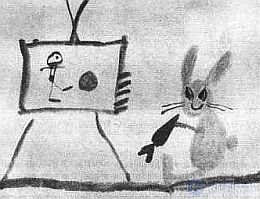
Fig. 40. The hare watches TV in his hut. Shurik (5 years 5 months).
In adventure tales, on the contrary, there are very few descriptions and details, but many events.
Five-year-old Slavik makes up exactly these kinds of tales, the hero of which is a very strong and brave boy with an amazing name Grmuk. Here is one of his tales: “Once upon a time there lived a boy, his name was Grmuk — there is such a name. Grmuk was very strong: he could lift a stone this big and throw it over the house! And he was not afraid of anything! Grmuk went to be an astronaut. They accepted him — they said, it doesn’t matter that he is not an uncle yet. Since he is so strong and brave, it is possible! Grmuk put on a helmet, a suit, on his chest it was written: “USSR”. Grmuk got into a spaceship. There are a ton of devices in it! And weapons too - suddenly he will have to fight with someone and free someone! And indeed - Grmuk flew to Mars, and there the red and white Martians were fighting. Grmuk bang - into one white Martian, bang - into another, bang - into a third! Well, the rest see - things are bad and run! The main red Martian shook Grmuk's hand and said: "Thank you, Grmuk! Stay with us!" And Grmuk said: "I serve the Soviet Union!" - and flew home." Marisha's fairy tale, told by her at the age of five years and six months, also has an adventurous character: "Once upon a time there lived devils, as many as a hundred. So they went for a walk along Moskovsky Prospekt and met a girl named Tanya (Fig. 41).
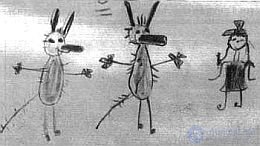
Fig. 41. Tanya met the devils. Marina (5 years 6 months).
Tanya says:
"Devils, devils, what are you doing here?" - "We are looking for an empty house to live in, because our apartment in the forest is bad: eagles fly to us and offend our children, peck them!" Tanya says: "Well, I will show you. There is a house being finished on Dekabristov Island, ask the workers to let you in." The next day the devils went there with Tanya. The devils ask the workers: "Let us live in this house!" And the workers say: "This house is for people! Build yourselves the tenth floor of this house!" The devils were happy and began to build: some lay bricks, others pour cement, they are doing well. This is what their house turned out to be" (Fig. 42).
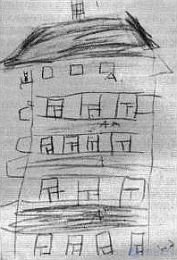
Fig. 42. The floor added by devils.
This tale arose in the following way. Marisha read Slavic tales with her grandmother, in which there are many devils, and the theme of construction appeared because new buildings were being built next to and opposite the house where the girl lives.
It is interesting to note that each child tells tales of only one specific nature: either descriptive or adventure. Of course, this is not accidental, but an expression of the interests of the storyteller. Slavik, for example, says nothing about the structure of the spaceship or those devices that are “in bulk” there - he does not know this, and it does not interest him. But Igor, Shurik and Seryozha are interested in the structure and purpose of the things they talk about; their tales are knowledge bursting out about how this or that object is arranged, how it works; there is no room for events here.
In all fairy tales, it is not only their content that is interesting, but also the verbal stereotypes that are used in them and the ways of using them.
Here, the template beginning is preserved ("once upon a time"), one or another fairy tale character is often encountered (a hare, a priest with a thick forehead, Baba Yaga, etc.), and verbal stereotypes associated with this character immediately emerge. However, the combination of these stereotypes no longer has the same mechanical character as in children of three or four years old. In these fairy tales, there is a main idea (the electrical wiring in the priest's house, the structure of a mortar-helicopter, etc.), and verbal stereotypes are chosen accordingly.
Igor describes the design of a fuse in the same expressions as in B. Zhitkov's book; Shurik remembered almost word for word the description of the Gorizont-101 TV set read aloud by his father, etc.
The main thing that distinguishes the verbal construction of fairy tales of five- and six-year-old children is a fairly free combination of learned verbal stereotypes.
Fairy tales composed by preschool children are a complex alloy of what they have learned, heard earlier, and what they see now.
If a child tells and at the same time draws, illustrates his fairy tale, it usually turns out to be more coherent and integral in content - the drawing helps the child in the development of his thoughts.
When telling a fairy tale, the child learns to use previously learned phrases. He uses them here not mechanically, but in new combinations, creating something of his own, something new. This is the key to the development of the creative abilities of the human mind.
Anyone who has observed the development of children knows very well that a baby expresses his thoughts in loud speech. Having seen an object that is attractive or unpleasant to him, the child immediately declares it at the top of his voice. Having seen his mother, he shouts: "Mom-ma!"; at the sight of a cat, he loudly exclaims: "Kitty! I want a kitty!"
Only in the fourth year does whispered speech appear, and around 5 years - speech "to himself", when the child begins to think in words silently. This is called internal speech.
Throughout this book, we have constantly emphasized the closest connection between speech and thinking. Here is another aspect of the manifestation of this connection.
Psychologist A. N. Sokolov suggested that in early childhood, the brain develops connections between a particular sound and the corresponding muscular sensation obtained during its articulation. Thus, the heard and spoken words are connected. In the first years of life, the role of muscular sensations is so great that the child cannot inhibit them, which is why he is not yet capable of whispering, much less speaking “to himself.” Later, as the child’s speech develops, the role of muscular sensations decreases somewhat, and then they can be inhibited.
This assumption of A. N. Sokolov is confirmed by the observations that were made on children in our laboratory. At the beginning of this chapter, we already talked about the experiments of G. S. Lyakh. They showed that onomatopoeia in a one-and-a-half to two-month-old infant can only be induced if he sees the articulatory facial expressions of an adult and can imitate them. Then, as a result of the fact that the muscular sensations obtained during the imitation of facial expressions coincided many, many times with the sounds pronounced by adults, conditioned connections are established. Only now, having heard a sound pronounced by an adult, will the child be able to reproduce it, no longer seeing the adult’s facial expressions.
Later, when the baby begins to imitately articulate words, the entire complex of muscular-sound sensations is associated with the object. The play of two- to three-year-old children (whose speech is developed) is necessarily accompanied by the naming of toys and the actions performed with them. Sonya (3 years old) rocks a doll in her arms and says: “Sonya will put Lyalya bye-bye... a-a-a! a-a-a! Lyalya closed her eyes” ... Suddenly the girl squealed shrilly and immediately began to speak soothingly: “Don’t cry, don’t cry, I’ll buy you something new! Aha, shut up!”
Only in the fourth year does a child begin to play silently, performing various actions with an object. Thus, Lenochka (4 years 6 months) silently, concentratedly swaddles the doll, puts her to bed and then quietly, so as not to wake her, begins to “tidy up” the doll’s room. True, these silent actions do not last long. Soon (after two or three minutes) Lenochka begins to whisper: "That's it, and now I'll go to the store, I need to buy some milk and porridge!"
It can be observed that when playing together or three children for some time already do something in silence. Gradually, with age, such intervals of silent games become longer. These are the moments when a child uses inner speech.
Inner speech is more difficult for children than loud. This can be seen at least from the fact that with every complication of the mental task, the guys move to a loud speech. Even at an older age, when learning to read and count, children begin to speak loudly. They cannot learn to read “for themselves” for a long time and say the words being read loudly, then after some period of training they begin to read in a whisper and, much later, in silence. When writing, children also tend to repeat what they write.
A. ii. Sokolov wanted to check how important motor impulses from articulatory organs are for the mental activity of an adult and children. To do this, the subject was given a task, but during its solution he had to clamp his tongue with his teeth and squeeze his lips. It turned out that this did not interfere with the adults and they coped with the task, but in children the mental activity was very noticeably inhibited. Hence, speech kinesthesia (i.e., impulses from articulation organs) are necessary for the child’s mental activity.
Although the role of impulses with speech muscles in adults is much less than in children, but still they have a certain value here. So, with difficulties (for example, when solving a complex task, etc.) and in adults, there is an increase in the flow of impulses from the speech muscles, although they do not say anything out loud.
In children, inner speech, which is close in form to that in adults, develops only at school age.
The Soviet psychologist L. S. Vygotsky emphasized that children's speech from the very beginning has a social character, that is, it is aimed at establishing communication with other people. The child wants to call someone, ask something, complain to someone — to get the attention and participation of the mother, father, nanny, and for this it starts using speech very early.
It is necessary to make a reservation, however, that at first only words addressed to an adult have a character: at the end of the first year of life, these are clearly expressed requests, calls, complaints.
Interestingly, up to nine or ten months of age (sometimes longer), children do not notice each other, even if they are seated side by side! They may draw attention to a bright button or pompon on the clothes of another child, but not on himself. The first words that one baby says to another do not have the nature of communication: it is not a call or a request, but rather a learned speech reaction to a situation.
The Twins of Light and Ira G. for two months were constantly in the arena for two months, but they still could not play together. If one girl saw another attractive toy in her hands, she would snatch it and say: “Siba!” (Thanks). Offended little sister with crying took away a toy and, having seized it, through tears, too, repeated: “Siba!”
The girls were taught to say "thank you" when they received something in their hands, but this was not yet an expression of gratitude, but only an automated reaction to getting things. Neither Sveta nor Ira said to each other “give-and-give” or “on!”, Which they often turned to their parents.
Kira, at the same age, playing in the playpen in the nursery, quite often took away toys from other kids and at the same time said: “Ta-ak, ta-ak”. It turns out that when he was taught to take the object correctly with his fingers and he succeeded in doing so, the teacher usually praised the baby: “So, so!”
Thus, the first words that the child seems to say to another, in fact, are not even addressed to him - just the child is taught in this situation to pronounce a certain word, like Irochka with Sveta or Kiryusha.
Only in the second half of the second year of life do children really begin to contact each other, their verbal communication takes on a social character. At first, gesticulation plays a big role, and the word serves as an addition to it.
Natasha a year ten months clutched at the doll, which played her age-mate Galya, and with pleading intonation repeats: “Yes-ah! yes-ah! ”Galya resisted at first, but when Natasha began to cry, she handed her the doll:“ Ziyami! ”(take it).
Borya at the age of two became very interested in young children and often tried to talk to them. Once he played in the garden in the sand and, seeing a boy standing nearby, about the same age, he began to call him: “De Boe! Di igat! "
(Go to Bor! Go play). At the same time, Boris was gesticulating hard with his hands.
As children grow up, the forms of their verbal communication become more complex, but this requires an increase in vocabulary.
Some psychologists tried to find out how knowledge of the right words or the lack of such knowledge affects the ability of children to coordinate their actions.
American psychologists S. Gluksberg and R. Krauss conducted interesting research in this direction. Two groups of children were taken (2 years 7 months - 4 years and 4 years 3 months - 5 years 2 months), and they began to hold the game of cubes with them. On the four sides of each cube there was a simple image of some animal familiar to children; in the center of the cube there was a drilled hole through which a rod was threaded. The game was as follows: two children of the same age were seated at a table divided by an opaque screen. The children did not see each other and what the second child was doing, but they could talk. Both children had a set of cubes and a rod. One child (the “speaker”) had cubes in a special box, from which they could only be reached, but only in a certain order, he took out the cube, called him and put them on the rod. Before the second child (the “listener”) the cubes were scattered on the table, he had to find a cube that the speaker called and also put it on the rod. So both children during the game had to build the same pyramids of cubes.
It turned out that in the younger group one verbal communication was not enough to solve this problem - the “listeners” could not pick up exactly those cubes that called “speaking” (although they knew the names of the animals depicted on them), and strung them in random order. Older children - at the age of about five - learned relatively easily how to properly fulfill the requirements of the game and willingly played it.
Then these children were given cubes, on which geometric figures were depicted, the names of which the children did not know; All other conditions of the game were the same. “Speakers” invented verbal designations for these geometric figures, for example, “it looks like daddy’s shirt”, “like a wheel”, etc. “Listeners” could not understand these descriptions, i.e. they could not relate them to any figure, and in one test was not obtained a satisfactory result.
Thus, for “own use” a child may somehow designate an object with a word, but this is not enough to establish communication with another child. Only in the case when both children associate the word with the same subject, does a two-way communication between children develop.
These experiences not only show what is needed for the word to become a means of social intercourse. Such games can be successfully used as samples to determine the degree of “social maturity” of a child.
Of great interest is the study of various forms of communication and the sequence of their development in children.
The Romanian scientist T. Slama-Cazacu dealt with this issue a lot. She conducted observations on what forms of verbal communication are characteristic of children in different age periods. Slama-Kazaku recorded children's conversations on a walk, during washing, eating and specially held games on tape.
It was possible to identify three main forms of speech reactions in children:
1. Speech reactions in the absence of a partner is the most elemental form.
2. Monologue - one of the children speaks in the presence of others, who are like an audience.
3. Dialogue - two people are active in a conversation; one addresses the other with questions and requests, the second answers, in turn asks questions, etc. This is a higher form of verbal communication.
Children are "lonely" (the only child in the family, for example), but having a sufficient development of speech, are prone to monologues. In a game with a doll, folding cubes, etc., the child talks about what he does or what the doll does.
Dialogue presents significant difficulties for toddlers and is usually very brief.
In her observations, Slama-Kazaku invited children to play a toy phone, and the content of the conversation was recorded. The conversation of children aged 2-3 years was reduced to the stereotypical repetition of the question: “What are you doing?” - “Nothing. What are you doing? ”-“ Nothing. And what are you doing? ”, Etc.
Older children (4–5 years old) are having a more connected conversation on the phone and touch on several topics, however, easily jumping from one to another, often without any visible connection. 6-7-year-old children in this game find the ability to talk with each other fairly freely and longer to focus on one topic.
In the games "at the doctor", "cooking dinner" the same age-related features of the conversation of children came to light. Younger children confine themselves to complaining: “she coughs” or “stomach ache”, a three-year-old doctor listens to the patient and prescribes a mustard plaster (regardless of what the complaints were about). The older children tell in detail how the child has caught a cold, that he has a pain, and the doctor asks many questions, advises how to treat the patient.
Dialogue as a form of speech communication is extremely important, because it contributes to the development of social relations in children. Through dialogue, one child engages the other in a common game, occupation, and establishes contact with him. Unfortunately, it is often necessary to see that even well-speaking children sometimes find it difficult to keep up the conversation in the form of a dialogue with other children. To this you need to pay the most serious attention, since if the ability to talk is not developed in childhood, it will continue to be insufficient. In games like the ones we have listed, where there are roles for talking children and topics are prompted by the situation of the game, a conversation with a two-way exchange of questions, answers and comments is greatly facilitated.
According to our observations, the development in children of this form of verbal communication is extremely helpful in memorizing small scenes from fairy tales, etc. Children then learned the turns of speech that they then use as ready-made material in their improvisations. (We have seen earlier the inclination of children to use ready-made stereotypes on the example of fairy tales and stories written by children.)
"Homemade" children have the greatest difficulty in communicating with other children. It is very important to find a child a girlfriend or comrade and teach them to "talk on the phone", play "doctor", "seller and buyer", etc. Particularly interesting for children and give excellent results of dramatization, but they can of course arrange only under the guidance and with the help of adults.
It is also necessary in a conversation with children to try to get answers, replicas from their side. Unfortunately, very often an adult himself is talking with the child, even when it is possible to build this conversation in the form of questions and answers (although this requires more effort on the part of adults).
It should be borne in mind that such games or conversations with children should not be very long: five to ten minutes two or three times a day - this is completely enough. Therefore, the work on the development of speech communication of the child will not be too burdensome for parents.
... Often the question arises whether it is possible to simultaneously teach a child to speak two languages? Parents sometimes fear that this may cause stuttering and other speech disorders.
However, practice shows that children quite easily cope with this task and the simultaneous use of two languages does not cause them any complications, children do not even confuse them. It is known that in a number of countries there are two state languages and children from the first years of life both teach. So, in Belgium, they learn French and Flemish, and in our country in all the Union republics, children immediately learn their native language (for example, Armenian, Latvian, Estonian, Uzbek, etc.) and Russian. The number of children with speech disorders in these republics is not at all higher than in the RSFSR, where children begin to speak only one thing - Russian.
Interestingly, the system of each language with “bilingualism” develops independently. The three-year-old Estonian Imbi is already quite fluent in both Russian and Estonian; her mother is Russian, her father is fluent in Russian, and in conversation with them the girl usually uses Russian, and with her grandmother (who almost does not understand Russian), Estonian. At the same time, Imbi does not have any confusion of languages, but she still cannot translate from one language to another. For example, a girl is asked to speak Russian, which her grandmother just asked her, but she repeats her words in Estonian. “No, you say it in Russian!” - “No, Grandma said not in Russian!” And vice versa, when Imbi is asked to translate from Russian into Estonian, she also cannot do this.
All young children, who early learn two languages as spoken, have difficulty in correlating the words of the other language. This becomes possible only about four years.
In the same case, when a child is taught from the very beginning to correlate the words of both languages, he is more likely to be capable of translation. True, then he often has a confusion of words and turns of speech in both languages. For example, Galya began to learn English for about three years. At the same time, her mother constantly said to her: “The table is in English the table. Say: the table ”,“ Kisa in English the cat ”,“ Give me a doll ”will be in English give me a doll”, etc.
The girl eagerly memorized English words and phrases, and asked herself every now and then: “What about English bed? And the pillow? And how to say - I don’t want to sleep? ”Galya could translate learned phrases from one language to another, but quite often they heard from her:“ Where is my ball? ”,“ I want the orange! ”
Thus, there is no reason to be afraid of violations in the development of the speech of children, if they simultaneously learn to speak two languages. It is only necessary to bear in mind that the assimilation of these languages takes place differently, depending on whether both languages are spoken in the family or one of them is taught the child specifically, constantly matching words, building phrases, etc. This method It seems somewhat more difficult for babies.
Complications of “bilingualism” occur only in cases of overload of children with a weak nervous system or upon the presentation of exorbitant demands to them.
- A cat-ta-ta-ta! And kota-ta-ta-ta! - then laughing, then the mother speaks seriously, leaning toward her four-month-old son, and he responds with joyful squeals. From the outside it is ridiculous to listen to - well, what kind of "cat-ta-ta"? And why both - and mother and baby so much fun? Yes, because in the first six months of life a child needs emotional communication with adults.
The teachers of N. M. Aksarin, V. A. Petrova and others emphasize that during this period in a conversation with a child it is important not content, but cheerful intonation, a smile - this causes revival and strengthening of voice reactions in a baby.
But this does not last long. After six months, one emotionality in dealing with a child is not enough: now we need to teach him to understand some words. A mother or nanny is shown on a doll and called her "La-la!", Showing a nose, eyes, etc., and everyone calls it. It is necessary to call the subject on which the child’s attention is now focused, then the necessary conditional connections will arise quickly and be durable.
When the baby is about a year old, we are already trying to achieve a repetition of words. In girls, it succeeds to a goal, in boys a little later. In a year and a month, sculpturing for a cup: “This is a cup, a cup!” Says the mother, showing and letting her hold an object of interest to her son, and he repeats after her: “Ty-sa ... so long!” This is repeated many times, and Lyonya himself, without a hint, points at a cup and says: “Fuck! Hush! ”One-year-old Katya bursts out of her grandmother’s hands on the floor. “Kate wants a top-top?” - asks the grandmother and puts the girl on the floor, letting her cross her legs: “Top-top! Katya is top-top! ”After some time, Katya herself already declares her desire to walk on the floor with the words:“ Top-top! ”
Often parents and sisters-educators complain that they talk a lot with the child, and it’s not possible to get him to repeat the words. The reason for this is easily explained: they simply talk to the children at the moment about what is outside their circle of attention. Here, my mother dresses Alik, one year old, for a walk and tells him how they will now go to the kindergarten, and there many children are already walking, and Alik will play with them. “Alik is walking! Well, say: “Gulyat!” But the boy does not listen to his mother and diligently catches stockings, which she puts on him at this time. Of course, he will not say the words that are expected of him now, but if at that moment his mother spoke about the stocking, called him, gave him touch, pull, etc., Alik would probably have responded.
The nanny feeds Tanya (1 year and 2 months) and says: “And in-he flies a bird! Come on, bird, fly here to us!” - and Tanya is busy with a porridge and does not listen to the conversation about the bird. That is why, if you want to get an answer from small children, you need to talk only about what they themselves see, what they are busy with, what they are doing.
Finally, it is very important to create such conditions that the child feels the need to ask an adult for something or answer him in words. Sometimes it is useful to observe, especially in a family where a lot of attention is paid to the child, that his desires are anticipated before he has time to express them in words. As soon as he reaches for an apple, his mother or grandmother immediately gives it to him: “Take it, take it, little one!” He takes his mother by the hand and pulls her toward the door: “Does the kitten want to go for a walk? Let's go now.” In such conditions, the baby does not need to use speech: adults will say everything for him themselves - and he will not try to speak.
Quite recently, a boy of three years and four months was brought to the author of this book. He understands almost all words addressed to him, reacts to them correctly, but explains himself with gestures and sounds. Slavik is a flourishing, cheerful child, doctors consider him healthy. Why doesn’t he speak? This became clear in just a few minutes. After we greeted him, his mother said to him: “Do you want to come with me?” — and immediately picked him up and sat him on her lap. “Are you hot? Should I take off my hat?” — and immediately took off his hat and unbuttoned his son’s jacket. Our conversation with his mother was constantly interrupted by her remarks towards Slavik — she was constantly guessing what he wanted. Why should the boy bother himself with conversations if those around him guess everything and do it themselves, without even waiting for him to somehow react to their words? In such cases, the hardest thing is to cope with the child’s relatives, to convince them of the need to achieve the baby’s verbal requests and only then satisfy them. Slavik, described here, was given to a relative for two months, who was advised to make sure that the boy showed verbal reactions; by the end of this period, Slavik was speaking in complete sentences.
In children's institutions, the nanny or the nurse-educator also very often addresses the children in a form when a verbal response from them is not required: "Children, go wash your hands!", "Sit down at the table! Anya, Vova! Sit down at the table!" The child gives the correct motor responses - after all, he has developed the corresponding conditioned connections to these words, but he does not need to speak himself, and his speech activity is not developed. Of course, such orders are also necessary, but along with this, both the teacher and the nanny should ask the children questions from time to time, ask them to name something, etc., and in such cases, you should address a specific child, and not the entire group. For example, a child is playing, and he should be asked: "What is this?" or "What is the doll doing now?" and so on. These appeals will evoke a verbal response from the baby.
It should also be borne in mind that a child at the end of the first - beginning of the second year of life can repeat after an adult only light, short words, mostly ending with a vowel sound. Therefore, at first, onomatopoeic simple words are acceptable: avka, kisa and others.
It is very important to ensure that all sounds pronounced by adults are clear, and the rhythm of speech is not too fast: after all, the mother, father, employees of the child care institution do not just speak - they give children material to imitate. If the speech of one of the caregivers has defects (burr, lisp, stutter), then these defects will be reproduced by the child, and it will be very difficult to get rid of them in the future. Therefore, people caring for children should try to get rid of the shortcomings of their speech.
When you talk to a child, do not speak in vain. Quite often you have to observe that a mother or grandmother constantly talks to the baby, and, of course, he gets tired of this and no longer listens. In this case, the speech of an adult becomes something like the sounds of a radio that is constantly on - they are no longer noticed.
Three-year-old Sveta asks to go for a walk, and her grandmother is busy: "I'll wash the dishes now, sweep the floor and then we'll go," promises her grandmother. "Don't whine, don't whine, we'll go soon! We'll walk along the embankment, we'll go to the Rumyantsev Garden ..." - this continues for about half an hour. Finally, the grandmother is free: "Let's go get dressed, Svetochka! Do you hear?" No, Svetochka has long since stopped listening, and now the grandmother has to raise her voice so that the girl pays attention to her words.
This applies to older children as well. A mother reminds her first-grader son: "It's 2 o'clock now, at 3 you have to sit down to do your homework, but for now you can play." A few minutes later, Mom noticed that Vasya was very engrossed in his construction set and became worried: "Well, now you won't be able to tear yourself away from him, and you'll soon have to start doing your homework." Over the course of an hour, Mom repeatedly said that "it's almost time to start doing your homework," and when she announced that it was time, Vasya didn't pay any attention to her words. So don't waste your words in vain.
sn: tell your child only what is necessary and when it is necessary.
In conversations with children, parents usually try to give as much information as possible, caring about the child's development. But even in this, a certain sense of proportion is needed. You cannot overload the child with a lot of information - here you need a system and consistency. At the same time, you do not need to give everything ready-made, give exhaustive answers to questions; you need the child to try to guess about something himself, and for this, ask him leading questions. The child's activity is the main condition for his full development ...
So, at different periods of the child's development, parents and educators face different tasks. Let's summarize very briefly. At any stage of speech development, the child needs the attention and help of adults. At the earliest stage - the main thing that adults should participate in is the creation of a positive emotional background. Next, it is necessary to talk to the baby several times a day for 3-5 minutes, observing the following conditions: the child must see the speaker's face, the adult speaks clearly and slowly, and finally, talks about what has attracted the child's attention, what he is doing. Both when teaching the child to name objects and when forming concepts in him, it is necessary to ensure that the child is not a passive listener, so that he has the opportunity to act with objects; it is also necessary to achieve verbal reactions from the baby.
Babies should not be given verbal instructions of a general nature right away, which imply a chain of actions. First, you need to give instructions for each action ("roll up your sleeves" - "open the tap" - "take soap", etc.) and only after strengthening the chain of actions move on to general instructions ("wash your hands"). In older preschool children, the ability to correctly respond to general instructions should be developed, otherwise children will find themselves in a difficult situation at school. A. A. Lyublinskaya, for example, emphasizes that some children in the first grade do not know how to coordinate their actions with the instructions given by the teacher. "Get your notebooks out and get ready to write," says the teacher. Most children take a notebook out of their school bag, put it on the table, open it and take a pen. But some children limit themselves to taking out a notebook and waiting for instructions for the next action, since they are accustomed to this at home, and sometimes in kindergarten. It is necessary to remember that as the child grows and develops, it is necessary to complicate what we tell him, both in content and in form. A two-year-old child was shown - here is a dog running, there is a bird flying, they told him a fairy tale about a speckled hen, gave him instructions for each action and showed them. With a five-six-year-old child, a father discusses the advantages of one TV over others, plans for the weekend and gives him instructions that require performing a number of actions. A. S. Makarenko said that the older a child becomes, the greater and greater the goals that need to be set for him. And we, physiologists, say that the ability to plan his actions is formed in a child as his brain matures, but the maturation process itself largely depends on training. If you do not exercise the functions of the brain, then their development will be delayed. The maturation of the child's mental and speech activity, the transition to higher levels is largely determined by what and how we talk to him.
only pronounces it with a different, angry intonation. Mother, father, grandfather and grandmother talk to the boy for a long time, but weeks and months pass, and his speech does not develop. He still explains himself with gestures and individual sounds.
It is precisely such cases as with Sasha, when the child is healthy, has individual care, they constantly talk to him, and he is silent and silent, that make one doubt that the development of a child's speech is determined mainly by how much or little they talk to him.
In order to check the importance of verbal communication for children's speech development, special observations were made. In the Zhdanovsky District Children's Home in Leningrad, together with speech therapist M. N. Rudneva, we selected 20 healthy and physically normal developing children aged from 1 year 1 month to 1 year 4 months. (FOOTNOTE: A speech therapist is a specialist in the treatment of speech defects.) Their speech development was significantly delayed. All of these children turned around and looked at the person speaking (i.e., they gave an orienting response to the voice); three of the children understood several phrases, but only in the appropriate situation (for example, the correct response to the words "take a spoon" was given - they took the spoon - only at the table during feeding; there was no response to the same words in the playpen or in the crib); two children rarely pronounced syllables, and none of them repeated words. These children were given daily two-minute speech development sessions, which consisted of showing the child a toy and naming it. For example, the teacher would place a toy dog in front of the child and say: "woof-woof", show a cow and say: "moo-moo", etc., trying to get the child to imitate sounds.
In addition, with each
the group staff and laboratory workers began to talk to the child while washing, dressing, feeding, and specially played with him. The total duration of speech communication with each child was about an hour a day - this is a lot. However, the achieved results were insignificant: the check carried out after a month, and then after 3 months, revealed only minor shifts - rare vocal reactions appeared ("a-ah!", "oo-oo-oo", etc.) during speech development classes.
It turns out that the degree of speech communication with adults does not play such a big role as expected. Of course, this is a necessary condition for the child to speak, but, obviously, some other conditions need to be taken into account. What are they? This had to be found out.
Here, a humorous riddle involuntarily comes to mind: "When is it easiest for a black cat to get into the house?" Usually they answer that it is in the dark, but the correct answer is different: when the door is open. This riddle is designed for a certain stereotype of our thinking: the answer is suggested by the indication of the black color of the cat. However, if all the doors are closed, then darkness will not help the cat get into the house.
When talking about the development of a child's speech, we usually associate it with the degree of verbal communication with adults - this is also suggested by the very formulation of the question. But maybe we forget about some "door" that needs to be opened?..
Часть 1 3. The kid spoke himself
Часть 2 INNER SPEECH OF A CHILD - 3. The kid spoke

Comments
To leave a comment
Pedagogy and didactics
Terms: Pedagogy and didactics