
Lecture
Это окончание невероятной информации про современная западная философия.
...
Consciousness, in its essence, is fundamentally non-objectual; it cannot be represented as an object causally determined and functionally regulated. Consciousness discloses itself as directedness toward an object (this is precisely meaning), as the being of awareness, but not as aware objecthood. In Heidegger, the distinction between the non-objectual and the objectual is the distinction between being and beings; in Sartre, between being-in-itself and being-for-itself (the latter being pre-objectual); in Merleau-Ponty, between the «invisible» and the «visible.» Fundamental distinctions: meaning – object, meaning – sign, meaning – image. Husserl shows, first, that what is spoken about is not identical to what is said (asserted) – both with regard to material and ideal objects (an equiangular and an equilateral triangle – the same object has different meanings); second, that the experiencing of meanings is possible outside of communication – in individual psychic life, and consequently linguistic expression is not identical to meaning, a sign being only one of the possibilities (alongside contemplation) for realizing or filling meaning; third, that there is no equality between meaning and a visual image: there is no image of meaning, there is an image of the object and the meaning of the image. In Heidegger these distinctions are refracted as the distinctions: being – beings; language as the house of being – language as a means of communication; the artwork – aesthetic experience.
Husserl identifies the ideal with the general; the intuition of the general is not an intellectual operation but a special «categorial intuition.» He criticizes both the empiricist theories of abstraction (Locke, Berkeley, Hume) and the hypostatization of the general (Platonism). An ideal object is not necessarily tied to any particular kind of perception, memory, and so on. A distinction is drawn between idealization and ideation (the intuiting of ideas). The former is carried out as the construction of concepts and objects outside the real sphere of perception (a point, mass, social structure), while the latter gives preference to the world of perception – the fundamental structure of the life-world.
Time is considered in phenomenology not as objective time but as temporality, the temporality of consciousness itself. Two tendencies in the understanding of time should be distinguished: a) time as the synthesis of the internal phases of experience, as the synthetic unity of the stream of meanings – the «intentional line» that pervades and unites the stream of phenomena (Husserl), whose determining point is the present; b) time as pure ecstasy, temporalizing itself from the future… Temporality reveals consciousness as simultaneously active and passive, as a combination of the foreground of perception – objects, their forms, colors, and so on – and the background. Temporality is the basis of the unity of consciousness, and reflection is just as temporal as spontaneous subjectivity.
One of the basic principles of phenomenology: sense (meaning) cannot be transmitted to others or received from others «ready-made,» like a material object: objects, signs, and symbols are merely means for transmitting a sense that is constructed (and interpreted) by subjectivity.
Historicity is grounded, first, in the primary temporality of individual human consciousnesses, the condition for the possibility of the temporal and meaningful field of any community of monads, and, second, in the «theoretical attitude» that arose in Ancient Greece, uniting people for the joint work of creating a world of meaningful structures. Variants of phenomenology differ in the starting point from which they describe the fundamental circle of «human being – consciousness – being.» The invariant of phenomenology is the doctrine of the being of consciousness, its underivability and irreducibility to… At the same time, phenomenology has points of contact with practically all currents of contemporary Western philosophy and with some schools of ancient and contemporary Eastern philosophy. Closeness is found wherever the problem of meaning, sense, and interpretation comes to the fore, wherever analysis presupposes the irreducibility of meaning to what is not meaning or a meaning-forming act.
An even greater departure from classical philosophical problems and attention to the human being as an individual personality is characteristic of existentialism – a movement that formed in Europe after the First World War and became especially popular after the Second. Representatives of existentialism did not try to penetrate the methodological secrets of science, to reveal the nature of art, morality, and religion, or to propose global historical constructions. At the center of their attention are individual questions of life's meaning – guilt and responsibility, decision and choice, one's attitude toward death. Unlike classical philosophy, for which the human being was of interest above all through creative spiritual activity, existentialist philosophy is focused on the problem of the human being's spiritual fortitude, thrown into an irrational flow of events beyond their control. This is a philosophy of crisis, reflecting the radical disillusionment of a thinking person confronted with the cruelty and absurdity of a world in which war overturns all rational constructions of history as progress and the triumph of reason.
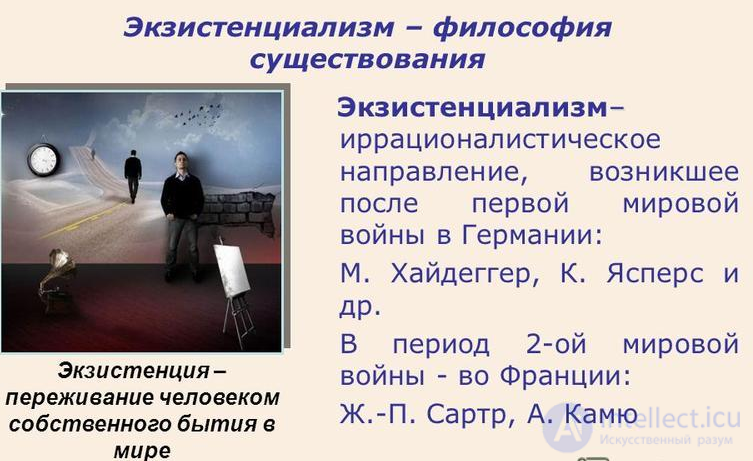
Existentialists believe that the catastrophic events of recent history exposed the instability, fragility, and inescapable finitude of all human existence. Therefore they consider the deepest and most adequate conception of the human being to be the awareness of one's own mortality and imperfection, which every individual possesses. The idea of death as a self-evident absolute boundary of any human undertaking pervades the works of all representatives of existentialism. This motif is vividly expressed in the existentialist doctrine of «boundary situations» – hopeless, extreme life circumstances in which the essence and meaning of human existence is revealed most fully. The experience of a boundary situation turns into a kind of «peephole» through which one can see the world in its authentic existence.
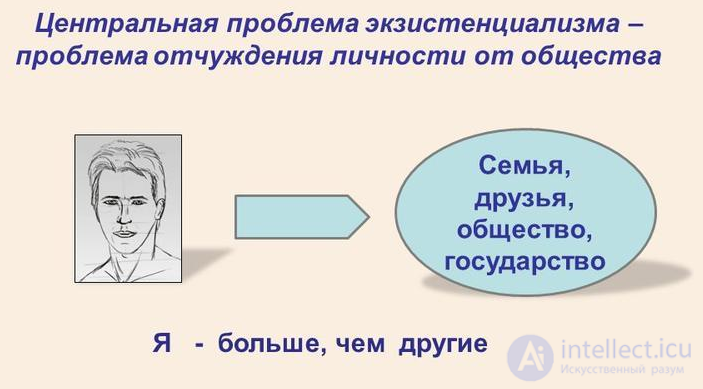
The concept of existence, introduced by Kierkegaard, expresses that perpetually elusive feeling with which the human being perceives the world as a constant balancing on the edge between outer and inner. From the point of view of existentialists, this state can best be understood and felt through the consideration of the individual in a historical situation.
One of the significant figures of existentialist philosophy is K. Jaspers (1883 – 1969). In 1931 his book «The Spiritual Situation of the Age» was published, in which he diagnosed the postwar mass consciousness. In historical relativism, cynicism, and nihilism, Jaspers sees the inevitable price for unjustified trust in history, for the deification of historical progress. Meanwhile, according to Jaspers, an authentic person, under any conditions, would not sink into a state of spiritual decline and would remain faithful to a conviction once accepted; in the experience of their actions they would aspire toward eternity regardless of the real disappearance of any prospect for the future. The human being is a creature condemned to dwell within history and unable to live outside society, but capable of steadfastly enduring the prospect of history's decline if they stop seeking their purpose within it. History is not a common task that humanity solves, but a common fate of each individual person living among people. This is the commonality of «what is borne together.»

In accordance with this, the basic task of the individual is to accept any social collisions in the sense of circumstances, components of a situation, rather than in the sense of a directive toward a goal. Philosophy, according to Jaspers, must fulfill the same task: it is directed toward inner action, toward giving the human being the opportunity to speak out and be heard, rather than toward intervening in the processes of changing the world.
Jaspers denies the possibility of scientific prediction of the future and the existence of objective laws of history. In history, from his point of view, four «cross-sections» can be distinguished: 1) the emergence of languages, the invention of tools, the beginning of the use of fire; 2) the emergence of high cultures in Egypt, China, India, and Mesopotamia; 3) the «axial age» – the formation of modern humanity in the 8th–2nd centuries BC simultaneously in China, India, and Greece; 4) the birth of the scientific-technical era, the formation of which is completed in the 20th century. In the future, Jaspers supposes, a new axial age may appear, in which humanity will be united on the basis of principles worthy of it – legal and moral ones.
In 1939–1945, France becomes the center of the existentialist movement. Among the French existentialists, the philosophy of J.-P. Sartre (1905–1980) gains the most significant influence on a mass audience. Sartre's distinctiveness lies in the fact that for a long time he was an adherent of the idea of historical progress, in the course of which the realization of left-radical ideals would become possible. The victory of fascism in Germany, and the situation that developed in France afterward, put an end to these progressivist illusions, which were replaced by a protest against any trust in the rationality of reality. This protest is expressed in the representation of the reality of human existence as the constant collapse of the imaginary, of those meaning-image structures of consciousness that constitute the essence of human existence. Consciousness is illusory from the outset, and its collision with reality inevitably gives rise to «bitterness,» which is an invariable attribute of truth.
The world, according to Sartre, is a «universal not-that,» a complete absence of anything corresponding to human expectations, images, and concepts. The real is alien to consciousness, contingent, and, in the limit, absurd. If the world does not allow one to rely or count on it in the slightest degree, the logical consequence of this must be the denial of the world's ability to act upon the human being, to prompt them, to determine their actions. Human behavior is absolutely unconditioned, spontaneous; therefore a person can always be held to account for everything they have done, without any reference to circumstances. Sartre's rigorist morality knows only one duty – the readiness to answer for everything that has occurred with one's participation, even if unconscious. A person must possess the resolve to «shoulder the burden of being,» the resolve of «choice.»
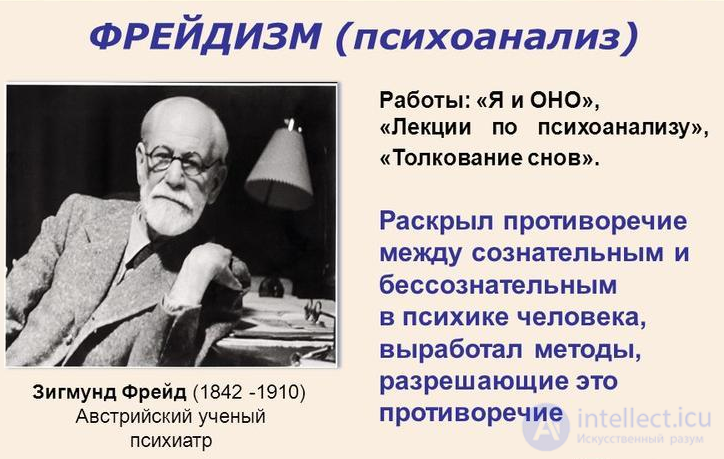
Psychoanalysis, as a special philosophical conception based on the works of Freud (1856–1939) and his followers, can also be assigned to the anthropological direction in philosophy.
The study and treatment of neuroses led Freud to the idea of the unconscious in the psyche: neuroses often arise without any visible external causes, and consequently the factor behind the neurotic reaction must be sought in the structure of the psyche. It can be represented as consisting of three regions: consciousness, which perceives the surrounding world; the unconscious – the region of desires, subject to the pleasure principle and constituting the main source of the psyche's activity; and the preconscious, which controls the desires of the unconscious and does not admit those that contradict social and cultural requirements. The unconscious, in its activity, when not admitted by the preconscious to the level of a specific action or deed, may manifest itself «by a roundabout way» – in dreams, in various kinds of slips of the tongue («Freudian slips»). The unconscious is a «boiling cauldron of instincts.»
Another important concept in Freud's theory was the concept of «libido.» Psychic energy is understood as the energy of libido – sexual drive. Later Freud reduced the structure of the instincts to the action of two primary drives: Life and Death.
Later Freud reconceived the structure of the psyche in terms of the Ego, the Id, and the Super-Ego (the representative of society, of external ideals and authority).
The worldview potential of Freud's teaching is connected with his reconception of the human being and culture. The natural principle (the sexual and aggressive impulses of the unconscious) is in a state of antagonism with culture. Culture is based on the renunciation of the satisfaction of unconscious desires and exists at the expense of the sublimated energy of libido. Progress in culture leads to a decrease in human happiness. Religion is understood as a «collective neurosis,» for Freud proceeded from the conviction that collective and individual psychic regularities are similar.
Freud's culturological conception is set forth in the works: «Totem and Taboo. The Psychology of Primitive Culture» (1913) and «Civilization and Its Discontents» (1930). At the base of the conception is the principle of the unity of phylogeny and ontogeny, proposed by E. Haeckel. Applied to the analysis of culture, this means that the individual development of a person (ontogeny) recapitulates, in condensed form, the stages of development of the human race (phylogeny). Culture is understood by Freud as the sum of all the achievements and institutions that distinguish human life from the life of animal ancestors. It serves two purposes: protecting people from nature and regulating relations between people.
The first achievements of culture in the distant past were the use of tools, the building of dwellings, the mastery of fire. As a result, the human being became a «god with prosthetics» – armed with «auxiliary means»: tools with the help of which they improved their organs.
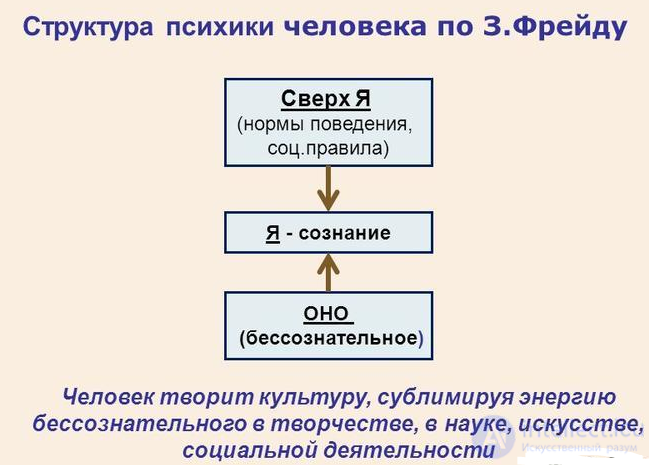
Culture involves not only utility – the striving for beauty is also an achievement of culture. Also belonging to cultural achievement is the limitation of the individual's power in favor of the power of society. «Cultural prohibitions» – the restriction of sexual life and aggressiveness. The human being in culture secured relative safety for themselves at the cost of losing a happy life in which there is no restriction on their desires.
Psychoanalysis begins with the organization, in 1902, of a circle, then the Vienna Psychoanalytic Society, and then spreads throughout Europe and America. Psychoanalytic philosophy is oriented toward identifying the foundations of human existence, the structural elements of the psyche, the principles of the unfolding of an individual's life activity, and the motives of personal behavior. Ontology is bracketed out of the analytical investigation, which strives to uncover the internal structures and processes arising within human existence itself – the ontologization of the being-character of the human being in the world. What is studied is not simply the inner world of the person, but that sphere of the psychic within which the most essential and significant processes and changes occur, exerting an influence on the organization of the whole of human existence… Psychoanalysis relies on the hypothesis of the existence of an unconscious layer of the human psyche, exerting a significant influence on human behavior and differing from the processes of the sphere of consciousness. The unconscious is compared to a large antechamber, where all psychic impulses are located, and consciousness to a narrow adjoining room – a salon. On the threshold between the antechamber and the salon stands a guard, closely scrutinizing every psychic impulse and deciding whether to let it pass from one room to the other. The antechamber is the abode of the unconscious, the salon is the receptacle of the preconscious, and only beyond it lies the chamber of consciousness. According to Freud, humanity has suffered three blows: the cosmological blow, dealt by Copernicus, which shattered the notion of the Earth as the center of the Universe; the «biological» blow, dealt by Darwin, who showed that the human being is merely a rung in the evolution of the animal world; and the «psychological» blow, stemming from the doctrine of the «unhappy Ego,» which is not master even in its own house. Human psychic life is constantly shaken by conflicts. The possibility of resolving them is determined by the presence of defense mechanisms that allow adaptation to the external world. A person is guided in life by two principles. The first is the «pleasure principle» – a program of the functioning of psychic processes inherent in every person, within which unconscious phenomena are automatically directed toward the channel of obtaining maximum pleasure. The second is the «reality principle,» which corrects the course of psychic processes in accordance with the demands of the environment and sets guidelines that help avoid the shocks connected with the impossibility of immediate and instant satisfaction of drives. Defense mechanisms, while coping with the resolution of conflicts with external reality, are not effective with respect to resolving deep conflicts conditioned by psychic reality. Socially unacceptable impulses and desires are repressed into the sphere of the unconscious, thereby creating only the appearance of a resolved conflict, since the desires can burst out at any moment. The resolution of internal conflicts must be achieved through the conscious mastery of desires, their direct satisfaction, or sublimation. Psychoanalysis performs precisely this work of translating the unconscious into consciousness. To do this, the psychoanalyst, using specific methods (the decoding of «free associations,» the interpretation of dreams, of slips of the tongue), reconstructs the chain of past events that had a traumatic effect and were repressed into the sphere of the unconscious. The determining role in the traumatic effect belongs to the Oedipus complex – the primary sexual drives under whose influence, according to psychoanalysis, all human activity is structured. In psychoanalytic philosophy, a duality is fixed in the human being's existence in the world, connected with the natural and moral determination of their life activity.
Jung (1875–1961), a pupil and initially a follower of Freud, diverges from him in his understanding of the role of the sexual principle in mental life and in his interpretation of the nature of the unconscious. All phenomena of a person's conscious and unconscious life are regarded by Jung as various manifestations of a single libidinal energy. Neuroses are capable of reversing this energy, and then archaic images are reproduced in consciousness, which can be regarded as primary forms of human adaptation to the surrounding world. The unconscious, in connection with this, includes not only subjective and individual but also collective and impersonal psychic content, with roots reaching deep into antiquity. Jung called the images – bearers of the collective unconscious – that «surface» in consciousness archetypes, which can be found as symbolic components of the ancient myths of all the peoples of the world. Accordingly, Jung introduced into scientific research such objects as had previously been classified by the European rationalist tradition as unquestionably irrational: the symbols of mystical teachings, alchemical texts, and elements of the ancient mystical teachings of the East.
E. Fromm (1900–1980) belongs to the current of neo-Freudianism and calls his own conception radical humanism. The list of the intellectual sources on which this conception is based is extremely diverse. It includes the theories of S. Freud, K. Marx, as well as the Israelite prophets and the Buddha. Fromm's idea is that practically any teaching — whether religious or secular — contains both an authoritarian and a humanistic component. Here, if a teaching is in power, the first tendency begins to predominate, while if it is in opposition, the second predominates. Fromm believes that the real boundary lies not between different teachings, but between these two tendencies within all teachings. He illustrated this idea by reading excerpts from K. Marx's «Economic and Philosophic Manuscripts of 1844» to various people and listening to their guesses as to the authorship of these excerpts. Both Thomas Aquinas and contemporary theologians were named, while the popularizer of Zen Buddhism in the West, Daisetsu Suzuki, said that it was Zen (source)
The name «radical humanism» speaks for itself — this approach rejects any super-human (not supra-personal, but precisely super-human) goals for the human being. What unites the intellectual inspirers of the conception of radical humanism listed above is an orientation toward a resolute struggle against the irrational forces dominating people. Sigmund Freud encroached upon the sphere of irrational instincts, applying to them the power of the cognizing reason. Karl Marx invaded the sphere of social inferno in an analogous way, striving to overcome it through the restructuring of society on the foundations of reason and freedom. The prophets fought against all forms of idolatry, considering the human being higher than idols. Johann Jakob Bachofen, who reconstructed an egalitarian and peaceable stage in the development of society, struck a blow against the illusion of the naturalness of the predominance of such patriarchal values as aggressiveness, exploitation, competition and social hierarchy. The overcoming of any illusions that hold us captive was preached by the Buddha — the most radical champion of human independence.
Adherents of radical humanism uphold the human being's freedom from subjection to any higher powers. This constitutes negative freedom, «freedom from». But freedom also has a positive aspect — «freedom to». Bare «freedom from» alone is unbearable for the human being, Fromm asserts in the book «Escape from Freedom». Therefore a personality that has failed to develop into positive freedom, having received negative freedom, saves itself from it by fleeing into the embrace of a new dependency.
Studying totalitarian regimes (chiefly on the example of Nazi Germany), Fromm sees in them a mechanism of escape from freedom in the form of a person's subordination of his will to an external authority — the party, the state, «law and order» as a value in itself. This applies equally to the masses and to the leaders — Hitler considered himself an instrument of Fate, the Nation and Nature; Stalin was guided by the interests of the State (a la Machiavelli). Fromm calls the characterological type dominant in these societies (the social character) authoritarian («sado-masochistic»).
In the democratic regimes of the 20th century Fromm also observes an escape from freedom, but its mechanism is somewhat different. Here the personality does not subordinate itself to an external force, but instead fully integrates itself into it. A person, as it were, wraps himself in colorful packaging, in order to «sell» himself more advantageously on the «market of personalities» — in getting a job, in making business acquaintances, and so on. Fromm called this type of character conformist (in other works — the marketing character). Not on the social but on the personal plane, a variant of escape from freedom is drug addiction, with the same destructive effect.
For Fromm, drawing on the rich experience of a practicing psychologist and psychoanalyst, escape from freedom and an orientation toward having are a departure from human nature, a «sin against the Holy Spirit», to speak in theological language. «Thus, good in humanistic ethics is the affirmation of life, the unfolding of human powers. Virtue is responsibility toward one's own existence. Evil is an obstacle to the development of human capacities; vice is irresponsibility toward oneself», said Erich Fromm in the book «Man for Himself» (1947).
The most authoritative current of religious philosophy is Neo-Thomism, which continues the tradition of Thomas Aquinas in the direction of modernizing and renewing the faith in accordance with the conditions of the present day and of scientific instrumentation. The representatives of Neo-Thomism believe that they are capable of rising above the polarity of materialism and idealism, of scientism and anti-scientism. At the foundation of all Neo-Thomist conceptions lies the totality of pure divine being, engendering the diversity of creation. Divine being is interpreted as inexpressible by means of categories and fixed only by specific supra-categorial definitions, among which are unity, truth, goodness and beauty. In Neo-Thomism a distinction is made between ontological and logical truth. The first is the product of the correspondence of a thing to the intellectual design of God; the second is connected with the cognitive activity of the human being. Cognition is characterized as a process of dematerialization of the content received by the subject in the reflection of reality. Science, in this view, is treated as providing only the recording and explanation of empirical phenomena, while the philosophy of nature lays claim to a worldview synthesis of its data, relying on metaphysics.
One of the most interesting and well-known results of the realization of such a program is the conception of Teilhard de Chardin (1881–1955), set out in his work «The Phenomenon of Man». His understanding of the human being is based on the conception of the noosphere, which he put forward under the impression (as he himself wrote) of the lectures on geochemistry, imbued with the doctrine of the biosphere that he was creating at the time, which V. I. Vernadsky delivered at the Sorbonne in 1922–1923.
Teilhard de Chardin adopted the basic idea and argumentation of Vernadsky concerning the enormous work (in the physical sense) carried out by living organisms in the chemical transformation of the matter of the Earth's outer shells, but he interpreted this too literally. Vernadsky himself was partly to blame for this. He called the outer shells of the Earth embraced by life the biosphere, and emphasized above all the work of «living matter» itself (as he called the totality of organisms, in contrast to the inert matter of the planet). Moreover, at the beginning of the 20th century very little was yet known about the deep interior of the Earth and the upper layers of the atmosphere. Therefore, in his lectures and in the book «The Biosphere» (1926), Vernadsky underestimated the extent of the biosphere. In his later works he continually expanded the boundaries of the biosphere, slowly but surely transforming it from a region embraced by life into a region of the manifestation of the consequences of its geochemical work, the source of which is the energy of the sun's rays.
Thus for Vernadsky the biosphere is, above all, a natural-historical, namely a geological, body, the outer shell of the planet, in turn consisting of several geospheres: the troposphere together with the lower part of the stratosphere, the liquid hydrosphere, and a significant part of the Earth's crust, including its granite-metamorphic layer. Vernadsky called this last the region of «former biospheres», emphasizing with this metaphor the continuity of the biosphere's existence in time. Since it is precisely in this region that human reason, realized in the form of practical activity, has already become a mighty geological force, for Vernadsky the noosphere was above all the newest and final stage in the evolution of the biosphere.
For Teilhard de Chardin, the noosphere, and before it life (the biosphere, as they understood it), were ascending levels of the progressive spiritualization of originally inert matter, successively built up one upon another in the course of the evolution of Nature. Hence their noosphere is a special supra-biospheric «thinking layer», which has embraced the planet just as life once embraced it
The chief achievement in P. Teilhard de Chardin's approach to the noosphere turned out to be precisely what was lacking in V. I. Vernadsky's approach. He found the inner source of reason — reflection. By this word he meant the capacity of consciousness «to concentrate upon itself and to take possession of itself as an object» of thought, «the capacity no longer merely to know, but to know oneself; not merely to know, but to know that one knows». The human being, embracing with his reflecting reason not only himself but the whole of surrounding Nature, becomes in a certain sense the focal point of the Universe, which through his help has embarked upon self-cognition and thereby upon self-consciousness of itself.
In the fundamental resolution of the problem of reason, Teilhard de Chardin was undoubtedly helped by his deeply experienced faith, religious culture and theological education.
Teilhard de Chardin considered the fundamental flaw of orthodox Thomist doctrine to be its static character, which he sought to overcome on the basis of the theory of evolution. Rejecting the Old Testament myth of the creation by God of the first man — the progenitor of all humanity — he held that the human being is the most perfect result of the many-thousand-year evolution of the organic world, which in turn developed on the basis of the evolution of the inorganic world. He distinguished three successive, qualitatively distinct stages of evolution: pre-life (the lithosphere), life (the biosphere) and the phenomenon of man (the noosphere).
Rejecting both dualism and materialism and spiritualism, Teilhard de Chardin defined his own philosophical position as «monism». The unity of matter and consciousness is based on the fact that matter is the «matrix» of the spiritual principle. Opposed to physical («tangential») energy, which decreases according to the law of entropy, is spiritual («radial») energy. The spiritual principle is immanent in all that exists: as a source of integrity it is already inherent, in hidden form, in the molecule and the atom. In living matter consciousness acquires a psychic form. In the human being it becomes «self-consciousness» (the human being «knows that he knows»).
The driving force of evolution is a goal-directed consciousness («orthogenesis»). Evolution takes on a teleological form: its final attracting force — the summit of progress — is the «Omega Point» (a symbolic designation of Christ). «Cosmogenesis» is transformed into «Christogenesis».
The appearance of the human being is not the completion of evolution, but the key to the world's ever-increasing perfection. The becoming human of the Son of God (Teilhard de Chardin disputes the birth of Jesus from the Virgin Mary) expresses the exceptional role of the human being in the further evolution. The existing world is imperfect. Human suffering, symbolized by the crucifixion of Christ, is a symbol of the human being's active contribution to the perfecting of existence. Self-consciousness — the source of «personalization» — entails a striving toward «socialization», understood as «unanimity».
Tillich (1886–1965) approached the task of creating an integral worldview conception, one that eliminates the gap between theology and everyday life, from a somewhat different angle. He seeks to construct a universal theological system, encompassing the problems of ontology, existential anthropology, and the philosophy of history and culture.
To combine the naturalistic grounding of ideas drawn from the philosophy of life, expressed in the famous thesis of «reverence for life», is what Schweitzer (1875–1965) proposes. On this basis he aspires to formulate the basic rules of a new ethics, combining the conception of the divine origin of the human spirit with a call to humanism and creative activity.
The picture of contemporary philosophy should be supplemented with the movement of postmodernism, represented by a multitude of schools which, for all their differences, are characterized by a common orientation toward the revision of the deep structures determining both human existence and thought.
Часть 1 Contemporary Western Philosophy
Часть 2 The philosophy of the convergence of the positions of religion

Comments