
Lecture
Logic (Ancient Greek λογική — «the science of correct thinking», «the ability to reason», from Ancient Greek λόγος — «logos», «reasoning», «thought», «mind», «meaning») — is a normative science of the laws of logic and the methods of intellectual (mental) cognitive activity
Since new knowledge is obtained by means of reason, logic is also defined as the science of the forms and laws of thought. Because thought takes shape in language in the form of reasoning, particular cases of which are proof and refutation, logic is sometimes defined as the science of methods of reasoning, or the science of methods of proof and refutation. Since thought manifests itself only in language, logic, in studying the laws of thought, turns to language as the only material available to it . Logic as a science studies the methods of attaining truth in the process of cognition by an indirect route, not from sensory experience, but from previously acquired knowledge, and it can therefore also be defined as the science of the methods of obtaining inferential knowledge.
In any science, logic serves as one of the principal tools . Logic is a branch not only of philosophy but also of mathematics, and Boolean algebra is one of the foundations of computer science .
The main branches of logic are the theory of reasoning (which has two variants: the theory of deductive reasoning and the theory of plausible reasoning), metalogic and logical methodology .
Because the results of mental activity are expressed in linguistic form, research in logic is closely tied to the study of linguistic constructions. This is the concern of logical semiotics, which includes logical syntactics, logical semantics and logical pragmatics .
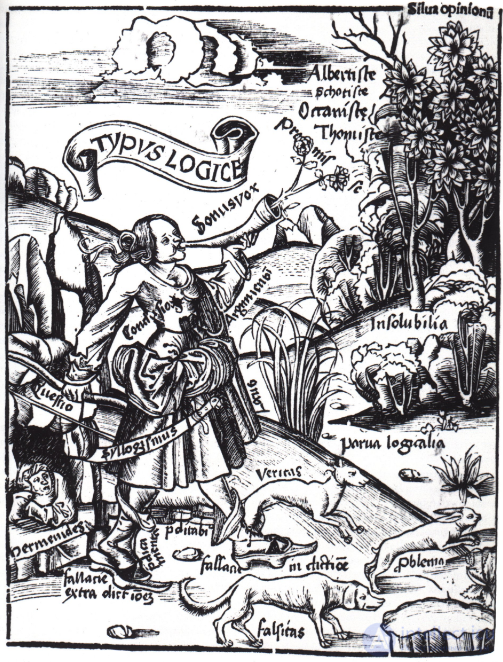
Gregor Reisch. «Logic Presents Her Central Themes», Margarita Philosophica, 1503/08 (?). Two dogs, veritas (from Lat. — «truth») and falsitas (from Lat. — «falsehood»), pursue a hare, problema (from Lat. — «problem»), while logic, armed with the sword of the syllogism, hurries along behind. At the lower left, in a grotto, Parmenides is depicted, through whom logical argumentation made its way into philosophy.
Classical logical theory is far from perfect: its main content is formulated in a special language created for its own purposes, and it uses object-based thinking. It does not envisage the use of control over pragmatic errors, inaccuracies, nonlinearities of the reference systems used, boundary errors of description, or scaling relativism (the relativity of objects and their spatial characteristics, for example: a person is large relative to an ant, but at the same time small relative to an elephant), and so on. As a result, it is considered normal for its language to contain paradoxes and a priori statements, clustering effects of vocabulary, and so on.
Just as the ability to speak existed even before the science of grammar arose, so too the art of correct thinking existed long before the science of logic. Logical operations — definition, classification, proof, refutation and others — are often applied by every person in their mental activity unconsciously and with errors. Some are inclined to regard their own thinking as a natural process requiring no more analysis and control than, say, breathing or movement, but real thinking cannot be reduced simply to a logical sequence. Also essential in the process of solving problems that arise are: intuition, emotions, an imaginative vision of the world, and much more . However, the fact that thinking is not rigorous does not mean that it is not subject to logic .
The main goal (function) of logic has always remained unchanged: the investigation of how some statements can be derived from others. Here it is assumed that the inference depends only on the way in which the statements it contains are connected and on their structure, not on their specific content. By studying «what follows from what», logic reveals the most general, or, as they say, formal conditions of correct thinking. The sphere of logic's specific interests has changed substantially over the course of its history.
The word «logic» is also used in the senses of «an internal regularity inherent in certain phenomena» or «a correct, reasonable course of reasoning» . In particular, this word can be used to refer to the following things in:
Informal logic (a term adopted primarily in English-language literature) is the study of argumentation in natural language. One of its main tasks is the study of logical errors — see Logical semantics, philosophical logic, argumentation theory, logical analysis of language. Any inference made in natural language has purely formal content (the meaning of an argument can be divided into the form of the thought and the content itself) if it can be shown that it is a particular application of an abstract universal rule that abstracts from any specific object, property or relation. It is precisely this inference with purely formal content that is called logical inference and the principal subject of logic. The analysis of inference that reveals this purely formal content is called formal logic.
Symbolic logic studies the symbolic abstractions that fix the formal structure of logical inference.
Dialectical logic is the science of thinking in Marxism. Here the concept of thinking is used in the sense of the Logos as a subject of ancient philosophy, whereas dialectical logic is used already in the sense of a separate science, like physics or formal logic. Dialectical reasoning takes into account the laws of formal logic. At the same time, in carrying out an analysis of the dynamics by which concepts pass into their opposite, it allows that opposites can coincide, and it is guided by the laws of dialectics.
Within formal logic there is a group of logics referred to as non-classical (sometimes the term «alternative logics» is also used). This group of logics differs substantially from classical logics through various variations of laws and rules (for example, logics that abolish the law of excluded middle, that change truth tables, and so on). Thanks to these variations it is possible to construct various models of logical consequence and logical truth .
Historically, logic was studied as part of philosophy and rhetoric. Today symbolic logic is also studied as part of mathematics and computer science.
1. What is the value of logic?
– Logic is impartial. Its language is dry, un-emotional. Its strength lies in warning us, in cautioning us of danger. And in this respect logic has no competition.
2. What does logic teach?
– The complex skill of navigating life's circumstances and making the right decision. The slightest error in the logic of proof can lead to catastrophe. Modern people, who aim to be educated and intelligent, lack the ancient understanding of logic – as the coordination of one thought with another, the ability to listen and to hear. Socrates, Plato and, especially, Aristotle – one of the most universal thinkers, the founder of scientific language – taught all of this.
3. Where can one learn logic? As Nepeyvoda believes, logic can be learned on one's own.
– It is difficult, and therefore possible!
Metalogic
Conceptions of logic differ from one another chiefly in how they resolve the metatheoretical problems of logic connected with the foundations of mathematics:
Although many cultures developed elaborate systems of reasoning, logic as an explicit analysis of methods of reasoning initially received substantial development only in three traditions: the Chinese, the Indian and the Greek. Though the exact dates are not very reliable (especially in the case of India). Modern logic, formally sophisticated in its development, ultimately derives from the Greek tradition (Aristotelian logic), which, however, was adopted not directly, but through the mediation and commentary of Arab-Muslim philosophers and medieval European logicians. The following historical and regional forms of logic can be distinguished (their names, historically existing and accepted in the literature on the history of formal logic, are also given)
In its development, logic passed through three thresholds:
Logic appeared in China during a period marked by the emergence of a great number of schools, and competition and debate among them. Confucius's contemporary Mozi («Master Mo», «Sage Mo»; 5th—4th centuries BCE) was known as the founder of Mohism (the Mo Jia school), whose representatives sought the sources of reliable reasoning and the conditions for its correctness. In the field of argumentation they preferred developing reasoning by analogy over developing deduction. In the process of analyzing the semantics of language, the Mohists developed a method for classifying names by degree of generality and dividing things into kinds (the method of the «three rules», the «three fa»).
One offshoot of Mohism, the logicians (Ming Jia, the School of Names, 5th—3rd centuries BCE), took up the study of formal logic proper (its representatives arrived at the discovery of the categorical syllogism earlier than, or at the same time as, its formulation by Aristotle).
Later, under the Qin dynasty, this line of research disappeared in China, since the philosophy of Legalism at that time brutally suppressed all other philosophical schools. Logic reappeared in China only with the penetration there of the Buddhists' Indian logic, and thereafter fell far behind the development of European and Middle Eastern logic.
The origins of logic in India can be traced in grammatical texts of the 5th century BCE. Two of the six orthodox Hindu (Vedic) schools of Indian philosophy — Nyaya and Vaisheshika — dealt with the methodology of cognition, and it was out of this problem field that logic emerged.
The very name of the school «Nyaya» means «logic». Its main achievement was the development of logic and methodology, which subsequently became common property (cf. Aristotelian logic in Europe). The school's main text was the Nyaya Sutras of Akshapada Gautama (2nd century CE). Since the Naiyayikas considered the attainment of reliable knowledge to be the only path to liberation from suffering, they developed refined methods for distinguishing reliable sources of knowledge from false opinions. There are only four sources of knowledge (four pramanas): perception, inference, comparison and testimony. The strict five-membered scheme of inference included: the initial premise, the reason, the example, the application and the conclusion.
Buddhist philosophy (which was not among the six orthodox schools) was the main opponent of the Naiyayikas in logic. Nagarjuna, the founder of Madhyamaka (the «middle way»), developed a form of reasoning known as «catuskoti», or the tetralemma. This four-sided argument systematically examined and rejected the affirmation of a statement, its negation, the conjunction of the affirmation and the negation, and, finally, the rejection of both its affirmation and its negation.
With Dignaga and his follower Dharmakirti, Buddhist logic reached its peak. The central point of their analysis was the establishment (determination) of necessary logical concomitance (inclusion in the definition), «vyapti», also known as «invariable concomitance» or «pervasion». For this purpose they developed the doctrine of «apoha», or exclusion, concerning the rules for including features in a definition or excluding them from it.
The school of Navya-Nyaya («new Nyaya», «new logic») was founded in the 13th century by Gangesha Upadhyaya of Mithila, the author of the «Tattvacintamani» («The Jewel of Thought on Reality»). However, he too relied on the works of his 10th-century predecessors.
In the history of European logic the following stages can be distinguished:
The logic of antiquity
The ancient Greek philosopher Aristotle is considered the founder of logic in ancient Greek philosophy, since he is held to have worked out the first logical theory. Aristotle's predecessors in the development of the science of logic in ancient Greece were Parmenides, Zeno of Elea, Socrates and Plato. It was Aristotle who first systematized the available knowledge of logic and established the forms and rules of logical thinking. His cycle of works, the «Organon», consists of six works devoted to logic: «Categories», «On Interpretation», «Topics», «Prior Analytics» and «Posterior Analytics», and «Sophistical Refutations».
After Aristotle, logic in ancient Greece was also developed by representatives of the Stoic school. A great contribution to the development of this science was made by the orator Cicero and the ancient Roman theorist of oratory Quintilian
Logic in the Middle Ages
As the Middle Ages approached, logic became more widely disseminated. It began to be developed by Arabic-speaking scholars, for example al-Farabi (c. 870—950). Medieval logic is called scholastic logic, and its flowering in the 14th century is associated with the names of the scholars William of Ockham, Albert of Saxony and Walter Burley.
Logic in the Renaissance and the Early Modern Period
This historical period in logic is marked by the appearance of a great many publications of extreme importance to the science.
In 1620 Francis Bacon published his «Novum Organum», containing the foundations of inductive methods, later refined by John Stuart Mill and given the name of the Bacon–Mill methods for establishing causal connections between phenomena. The essence of induction (generalization) lies in ascending (in the process of cognition) from particular cases to general rules. It is also necessary to look for the causes of one's own errors.
In 1662 the textbook «The Port-Royal Logic» was published in Paris; its authors, P. Nicole and A. Arnauld, created a logical doctrine on the basis of the methodological principles of René Descartes.
At the end of the 19th and the beginning of the 20th centuries, the foundations of so-called mathematical, or symbolic, logic were laid. Its essence lies in the fact that mathematical methods can be applied to determine the truth value of natural-language expressions. It is precisely the use of symbolic logic that distinguishes modern logical science from traditional logic.
An enormous contribution to the development of symbolic logic was made by scholars such as G. Boole, A. De Morgan, G. Frege, C. Peirce and others. In the 20th century mathematical logic took shape as an independent discipline within the science of logic.
The beginning of the 20th century was marked by the emergence of the ideas of non-classical logic, many of whose important propositions were anticipated and/or laid down by N. A. Vasiliev and I. E. Orlov.
In the middle of the 20th century the development of computing technology led to the appearance of logic elements, logic blocks and computing devices, which was linked to the further development of such areas of logic as the problems of logical synthesis, logical design and the problems of logical modeling of logical devices and computing equipment.
In the 1980s, research began in the field of artificial intelligence based on logic programming languages and systems. The creation of expert systems also began, employing and developing automated theorem proving, as well as methods of proof-carrying programming for the verification of algorithms and computer programs.
Changes in education also began in the 1980s. The appearance of personal computers in secondary schools led to the creation of computer-science textbooks that included the study of elements of mathematical logic in order to explain the logical principles underlying the operation of logic circuits and computing devices, as well as the principles of logic programming for fifth-generation computers, and to the development of computer-science textbooks studying the predicate calculus for the design of knowledge bases.
Concepts of logic necessary for understanding the subject:
A law of logic is a universally valid principle of some logical theory, the formula of which takes the value «true» for any values, admissible in that theory, of the non-logical symbols. In logical calculi, their theorems, provable using the deductive means of the calculus, are likewise recognized as logical laws. In traditional logic there were four basic logical laws[10]:
In some theories of modern logic, not all the traditional logical laws are applicable[10].
See also: De Morgan's laws, Clavius's law and the laws of division
Main articles: Mathematical logic and Classical logic
Algebra of logic
Propositional logic
Predicate logic
Logical semantics
Model theory
Proof theory
Many-valued logics
1. The cognitive function of logic.
Like every science in general, logic deals with the discovery and investigation of objective laws, with the one essential difference that these are laws not of the external world, but of thought. In this sense, occupying an important place in the general system of the cognition of the world, and of thought. In this sense, occupying a place in the general system of the cognition of the world, it performs above all a general scientific - cognitive function, i.e. an explanatory and predictive one. It gives a more or less precise explanation of a certain group of phenomena and processes of thought, and, on this basis - a prediction of the conditions under which the attainment of true knowledge is possible and what the consequences of an incorrect course of reasoning are.
2. The worldview function of logic.
Logic, as noted above, is a special science. Whereas in the natural and social sciences thinking serves merely as a means of cognizing reality, in logic it is - the direct aim of cognition. Therefore, in uncovering the regularities of thought as one of the most important spheres of investigation alongside nature and society, this science thereby makes its own, and indeed weighty, contribution to one or another resolution of the fundamental philosophical problem - the relation of thought to being. Consequently, it actively participates in shaping people's worldview - the more or less coherent totality of their generalized views on the world as a whole and on the relation of man to this world. This is the sense in which one speaks of its worldview function.
3. The methodological function of logic.
Like any theory in general, logical theory, being the result of the prior cognition of its object, becomes a means, and consequently a method, of its further cognition. But as a very broad theory, which investigates the process of thinking and manifests itself in all sciences without exception, logic also provides them with a definite method of cognition.
4. The ideological function of logic.
Originating and developing in class society, logic has never been neutral in ideological struggle. It served as an important means of substantiating one ideology, a weapon in the struggle against another. Within logic itself there has always unfolded an ideational confrontation between the most important philosophical currents - materialism and idealism, dialectics and metaphysics. Hence - its ideological function.
Logic has always performed its most important functions, at every stage of its development, although they appeared at different times in different ways. Under present-day conditions its role and significance are increasing especially. The need for logic, particularly symbolic logic, is becoming ever more tangible - amid the new stage in the unfolding of the scientific and technological revolution, associated with the broad informatization of production, management and services.
The achievements of formal logic are applied in jurisprudence, psychology, linguistics, management theory, pedagogy and other sciences. Some branches of logic are the theoretical foundation of mathematics, information theory and cybernetics.
The study of logic develops:
But still, the main significance of logic lies in the fact that it trains one to think and strengthens a person's mental abilities.

Comments