
Lecture
Polymers (from Greek πολύ «many» + μέρος «part») — substances consisting of «monomer units» joined into long macromolecules by chemical bonds. Polymers can be inorganic or organic, amorphous or crystalline substances. A polymer is a high-molecular-weight compound: the number of monomer units in a polymer (the degree of polymerization) must be sufficiently large (otherwise the compound is called an oligomer). In many cases the number of units can be considered sufficient to classify a molecule as a polymer if adding one more monomer unit does not change the molecular properties . As a rule, polymers are substances with a molecular weight ranging from several thousand to several million .
If the bond between macromolecules is provided by weak Van der Waals forces, they are called thermoplastics; if by chemical bonds — thermosets. Linear polymers include, for example, cellulose; branched polymers include, for example, amylopectin; there are also polymers with complex three-dimensional spatial structures.
In the structure of a polymer one can distinguish the monomer unit — a repeating structural fragment comprising several atoms. Polymers consist of a large number of repeating groups (units) of identical structure, for example polyvinyl chloride (−CH2−CHCl−)n, natural rubber, and others. High-molecular-weight compounds whose molecules contain several types of repeating groups are called copolymers or heteropolymers.
A polymer is formed from monomers as a result of polymerization or polycondensation reactions. Polymers include numerous natural compounds: proteins, nucleic acids, polysaccharides, rubber, and other organic substances. In most cases the term refers to organic compounds, but many inorganic polymers also exist. Large numbers of polymers are produced synthetically from the simplest compounds of naturally occurring elements through reactions of polymerization, polycondensation, and chemical transformation. The names of polymers are formed from the name of the monomer with the prefix poly-: polyethylene, polypropylene, polyvinyl acetate, and so on.
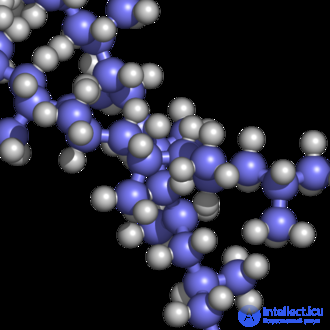
Chains of polypropylene molecules
Polymer science began to develop as an independent field of knowledge by the start of World War II and took shape as a unified discipline in the 1950s, when the role of polymers in technical progress and in the life processes of biological organisms was recognized. It is closely connected with physics, physical chemistry, colloid chemistry, and organic chemistry, and can be regarded as one of the basic foundations of modern molecular biology, whose objects of study include biopolymers.
Special mechanical properties
Characteristics of polymer solutions:
Special chemical properties, for example the ability to sharply change their physico-mechanical properties under the action of small amounts of a reagent (vulcanization of rubber, tanning of leather, and so on). The special properties of polymers are explained not only by their large molecular weight but also by the fact that macromolecules have a chain structure and possess flexibility.
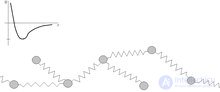
Gaussian bead model, interaction potential of centers (Morse potential)
A chain molecule consists of bonds forming certain valence angles with one another, which change only slightly during deformational vibrations. These vibrations can be considered harmonic, if one considers the equilibrium configurations determined by fixed values of the valence angles. Let each unit correspond to a vector  where
where  The end-to-end distance of the chain is determined by the vector

Therefore 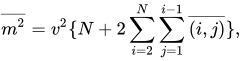
where  — is the average cosine of the angle between the vectors
The standard Gaussian model, shown in the figure, is a chain of interacting spherically symmetric beads strung on a massless thread with Gaussian correlations between the positions of neighboring units. From the standpoint of volume interactions, a bead is, as it were, representative of a chain segment of length on the order of a. Although the central potential, that is, one depending only on the distance between centers, has only a conditional meaning for interactions between such beads, it is nevertheless qualitatively clear that the potential should roughly correspond to what is shown in the figure: at small scales, repulsion should correspond to the presence of the units’ own volume, while at large distances the beads should attract each other through van der Waals forces. To describe a system of interacting beads, one must consider them outside the chain: the Gibbs distribution for the polymer system is represented as

where  — is the bonds,
  — is the interactions, that is, the energy of the volume interactions in the microconfigurations
  (for example, for the standard Gaussian model
  ). The system of broken units is a system with the Gibbs distribution:

In statistical physics, the description of volume interactions is carried out in terms of the thermodynamic characteristics of the system of broken units.

Lattice model of a chain
Lattice models are convenient for certain analytical calculations and for computer modeling of polymer systems. In such models a polymer chain is represented as the trajectory of a random walk along the edges of some spatial lattice.
In the simplest case, volume interactions are specified by the condition of self-avoidance of the walk, that is, a prohibition on visiting the same lattice site twice with the chain (repulsion), and by assigning an energy of −E<0 to each pair of non-adjacent (along the chain) units separated by one lattice edge (attraction).
Polymers made from different monomers or from chemically bonded molecules of different polymers are called copolymers. For example, high-impact polystyrene is a copolymer of polystyrene-polybutadiene .
Copolymers differ in structure, manufacturing technology, and resulting properties. As of 2014, the following technologies have been developed :
Comb-shaped copolymers can be composed of materials with different properties, which gives such a copolymer fundamentally new properties, for example liquid-crystalline properties .
In block copolymers composed of components with different properties, superlattices arise, built from blocks of different chemical nature that have separated into their own phase. The size of the blocks depends on the ratio of the starting monomers. For instance, brittle polystyrene gains tensile resistance of up to 40 % through copolymerization with 5—10 % polybutadiene, producing high-impact polystyrene, while at 19 % polystyrene in polybutadiene the material displays rubber-like behavior .
By chemical composition, all polymers are divided into organic, organoelement, and inorganic.
Organic polymers are formed with the participation of organic radicals (CH3, C6H5, CH2). These are resins and rubbers.
Organoelement polymers contain, in the main chain of organic radicals, inorganic atoms (Si, Ti, Al) combined with organic radicals. They do not occur in nature. An artificially produced representative — organosilicon compounds.
Inorganic polymers do not contain C−C bonds in the repeating unit, but they can contain organic radicals as side substituents.
In engineering, polymers are often used as components of composite materials, for example fiberglass. Composite materials are possible in which all the components — are polymers (with different composition and properties).
By the shape of the macromolecules, polymers are divided into linear, branched (a special case — star-shaped), ribbon-like, flat, comb-shaped, polymer networks, and so on.
Polymers are also classified by polarity (which affects solubility in various liquids). The polarity of a polymer’s units is determined by the presence in them of dipoles — molecules with an uneven distribution of positive and negative charges. In nonpolar units, the dipole moments of the atomic bonds cancel each other out. Polymers whose units possess significant polarity are called hydrophilic or polar. Polymers with nonpolar units are called nonpolar, hydrophobic. Polymers containing both polar and nonpolar units are called amphiphilic. Homopolymers, each of whose units contains both polar and nonpolar large groups, have been proposed to be called amphiphilic homopolymers.
With respect to heating, polymers are divided into thermoplastic and thermosetting. Thermoplastic polymers (polyethylene, polypropylene, polystyrene) soften when heated, even melt, and harden again on cooling. This process is reversible. Thermosetting polymers undergo irreversible chemical degradation on heating without melting. The molecules of thermosetting polymers have a nonlinear structure obtained by cross-linking (for example, vulcanization) of chain polymer molecules. The elastic properties of thermosetting polymers are higher than those of thermoplastics; however, thermosetting polymers have practically no flow ability, and as a result have a lower fracture stress.
Natural organic polymers are formed in plant and animal organisms. The most important of them are polysaccharides, proteins, and nucleic acids, which make up a large part of the bodies of plants and animals and which sustain the very functioning of life on Earth. It is believed that the decisive stage in the emergence of life on Earth was the formation of more complex — high-molecular-weight — molecules from simple organic molecules (see Chemical evolution).
Humans have long used natural polymer materials in their lives. These are leather, fur, wool, silk, cotton, and so on, used for making clothing, as well as various binders (cement, lime, clay), which, when appropriately processed, form three-dimensional polymer bodies widely used as building materials. However, industrial production of chain polymers began at the start of the 20th century, although the prerequisites for this appeared earlier.
Almost immediately, the industrial production of polymers developed in two directions — by processing natural organic polymers into artificial polymer materials, and by producing synthetic polymers from low-molecular-weight organic compounds.
In the first case, large-scale production is based on cellulose. The first polymer material made from physically modified cellulose — celluloid — was obtained back in the mid-19th century. Large-scale production of cellulose ethers and esters was organized before and after World War II and continues to this day. Films, fibers, paint-and-varnish materials, and thickeners are produced on their basis. The development of cinema and photography became possible only thanks to the appearance of transparent nitrocellulose film.
The production of synthetic polymers began in 1906, when Leo Baekeland patented the so-called bakelite resin — a condensation product of phenol and formaldehyde that turns into a three-dimensional polymer on heating. For decades it was used to make housings for electrical devices, batteries, televisions, sockets, and so on, while today it is more often used as a binding and adhesive substance.
Thanks to the efforts of Henry Ford, the rapid development of the automobile industry began before World War I, at first based on natural rubber, and then — also on synthetic rubber. Production of the latter was mastered on the eve of World War II in the USSR, England, Germany, and the USA. In the same years, industrial production of polystyrene and polyvinyl chloride, which are excellent electrically insulating materials, was mastered, as well as of polymethyl methacrylate — without the organic glass known as «Plexiglas» mass aircraft production during the war years would have been impossible.
After the war, the production of polyamide fiber and fabrics (kapron, nylon), begun even before the war, resumed. In the 1950s, polyester fiber was developed and the production of fabrics based on it, under the name lavsan or polyethylene terephthalate, was mastered. Polypropylene and nitron — artificial wool made from polyacrylonitrile — close out the list of synthetic fibers that modern humans use for clothing and industrial activity. In the former case, these fibers are very often combined with natural fibers made of cellulose or protein (cotton, wool, silk).
An important event in the world of polymers was the discovery, in the mid-1950s, and rapid industrial adoption of Ziegler — Natta catalysts, which led to the appearance of polymer materials based on polyolefins and, above all, low-pressure polypropylene and polyethylene (before that, production of polyethylene at a pressure of about 1000 atmospheres had been mastered), as well as stereoregular polymers capable of crystallization. Polyurethanes were then introduced into mass production — the most widespread sealants and adhesive porous soft materials (foam rubber) — as well as polysiloxanes — organoelement polymers that, compared with organic polymers, possess higher heat resistance and elasticity.
The list is closed out by the so-called unique polymers synthesized in the 1960—1970s. These include aromatic polyamides, polyimides, polyesters, polyester ketones, and others; an essential attribute of these polymers is the presence in them of aromatic rings and (or) aromatic condensed structures. They are characterized by a combination of outstanding strength and heat-resistance values.
Many polymers, such as polyurethanes, polyester and epoxy resins, are prone to ignition, which is often unacceptable in practical applications. Various additives are used to prevent this, or halogenated polymers are used instead. Halogenated unsaturated polymers are synthesized by including chlorinated or brominated monomers in the condensation, for example hexachloroendomethylenetetrahydrophthalic acid (HET acid), dibromoneopentyl glycol, or tetrabromophthalic acid. The main drawback of such polymers is that when burning they can release gases that cause corrosion, which can be harmful to nearby electronics.
The action of aluminum hydroxide is based on the fact that under high-temperature exposure it releases water, which impedes combustion. To achieve the effect, large quantities of aluminum hydroxide must be added: 4 parts by mass to one part of unsaturated polyester resins.
Ammonium pyrophosphate acts on a different principle: it causes charring, which, together with a glassy layer of pyrophosphates, isolates the plastic from oxygen, inhibiting the spread of fire.
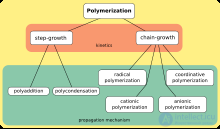
Polymerization — is the process of combining many small molecules, known as monomers, into a covalently bonded chain or network. During polymerization, some chemical groups may be lost from each monomer. This happens in the polymerization of PET polyester. The monomers are terephthalic acid (HOOC — C 6 H 4 — COOH) and ethylene glycol (HO — CH 2 — CH 2 — OH), but the repeating unit is — OC — C 6 H 4 — COO — CH 2 — CH 2 — O —, which corresponds to a combination of two monomers with the loss of two water molecules. A separate fragment of each monomer that is incorporated into the polymer is known as the constitutional unit.
Laboratory synthesis methods are usually divided into two categories: step-growth polymerization and chain-growth polymerization . The essential difference between them is that in chain-growth polymerization, as the chain grows, monomers are added to the chain only one at a time , for example in polyethylene; whereas in step-growth polymerization, monomer chains can join directly with one another , for example in polyester. More modern methods, such as plasma polymerization, do not fit into either of these categories. Synthetic polymerization reactions can be carried out with or without a catalyst. Laboratory synthesis of biopolymers, especially proteins, is an area of intensive research.
To initiate polymerization, chemical methods are predominantly used, introducing initiators into the monomers or their solutions in the case of polymerization proceeding by a radical mechanism, and catalysts — in the case of ionic polymerization. Thermal and photochemical initiation methods are limited (the first due to unfavorable conditions for chain growth at elevated temperatures and the secondary processes that arise as a result, the second — due to its low efficiency and the technological complexity involved, related to the influence of the medium’s optical properties on the course of photochemical reactions). A radiation method of polymerization is also used, in which initiation of the chain process is carried out by the action of ionizing radiation .
Thanks to their valuable properties, polymers are used in mechanical engineering, the textile industry, construction, agriculture, medicine, automobile and ship building, aircraft manufacturing, and in everyday life (textile and leather goods, dishware, adhesives and varnishes, jewelry, and other items). Rubbers, fibers, plastics, films, and paint-and-varnish coatings are made on the basis of high-molecular-weight compounds. All the tissues of living organisms are high-molecular-weight compounds.

Comments