
Lecture
From the material of the previous sections, you have become familiar with organic compounds belonging to the class of alkanes. Alkanes are also called limiting hydrocarbons. The name limiting hydrocarbons is due to the fact that alkane molecules contain the maximum possible number of hydrogen atoms.
The carbon atoms in alkane molecules are joined only by single bonds. Such substances are called saturated. Unlike saturated hydrocarbons, the molecules of unsaturated compounds contain carbon atoms joined by double or triple bonds. Examples of unsaturated hydrocarbons:
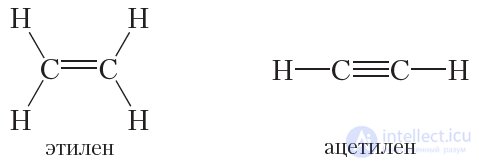
We will study unsaturated hydrocarbons later; for now, let us focus our attention on saturated hydrocarbons — alkanes.
So far we have become acquainted with only a few representatives of alkanes, but it is clear that there can be an enormous number of compounds in this class, both because carbon chains of various lengths can form and because of isomerism. The composition of all alkanes is described by the general formula CnH2n+2.
It is easy to see that the composition of the ethane molecule differs from that of the methane molecule by one carbon atom and two hydrogen atoms — CH2. The same difference in composition is found between the molecules of propane and ethane, and of n-butane and propane:
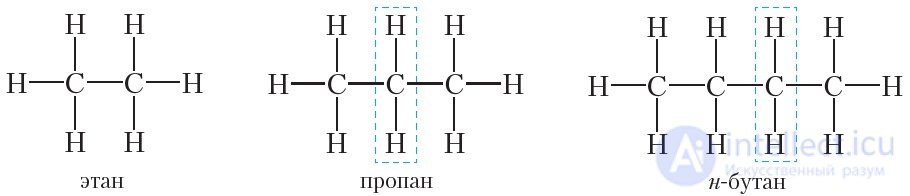
At the same time, the composition of n-butane and ethane differs by two CH2 groups. Thus, the molecules of alkanes differ from one another in composition by one or more CH2 groups. At the same time, the molecules of alkanes have a similar structure: the bonds between carbon atoms are single, and the remaining bonds are formed between carbon and hydrogen. This is why different alkanes have similar chemical properties.
| Substances that are similar in structure and chemical properties and that differ in the composition of their molecules by one or more CH2 groups are called homologs and form a homologous series. |
For example, methane, ethane, and propane are homologs.
The concept of «homologous series» is important in organic chemistry. Because of the enormous number of organic compounds, it is not possible to study the chemical properties of every single organic substance, so substances that are similar in structure are grouped into homologous series, and the general properties of the members of a given homologous series are studied. We will not examine the chemical properties of methane separately, then those of ethane, and so on. Instead, we will study the properties common to all alkanes.
Let us consider the physical properties of alkanes. Table 8.1 shows the boiling points of unbranched alkanes whose molecules contain from one to ten carbon atoms.
Table 8.1. Boiling points of unbranched alkanes
|
Molecular formula |
Structural formula |
Boiling point (tb.p., °C) |
|
CH4 |
CH4 |
–162 |
|
C2H6 |
|
–89 |
|
C3H8 |
 |
–42 |
|
C4H10 |
 |
–0,5 |
|
C5H12 |
 |
36 |
|
C6H14 |
 |
69 |
|
C7H16 |
 |
98 |
|
C8H18 |
 |
126 |
|
C9H20 |
 |
151 |
|
C10H22 |
 |
174 |
From the data in the table, it is evident that the boiling points of methane, ethane, propane, and butane are below 0 °C, and therefore these substances should be gaseous under normal conditions. Indeed, methane, ethane, propane, and n-butane are colorless gases at room temperature. Alkanes with a larger number of carbon atoms in the molecule (from 5 to 15) are liquids with a distinctive odor. These alkanes are components of gasoline, kerosene, and many solvents. Alkanes with an even larger number of carbon atoms in the molecule (16 or more) are solids. They are well known to you — paraffin candles are made from solid alkanes. The name paraffins (from Lat. parum — little and affinis — having affinity) — is another name for alkanes. This name points to the low chemical reactivity of alkanes, whose chemical properties will be examined later.
Alkanes are insoluble in water, but dissolve well in organic solvents. Recall the rule known to you from the course in inorganic chemistry, «like dissolves like». This means that substances with a similar structure usually mix well with one another. For example, water, whose molecules are polar, readily dissolves substances with ionic and polar covalent bonds — acids, alkalis, salts. Conversely, substances whose molecules are formed by nonpolar or weakly polar covalent bonds do not dissolve in water, but do dissolve in liquids made up of nonpolar molecules. Here is an example: a stain from machine oil on fabric can practically never be removed with water, but it can be successfully removed with gasoline, since machine oil and gasoline consist of substances of similar structure, hydrocarbons.
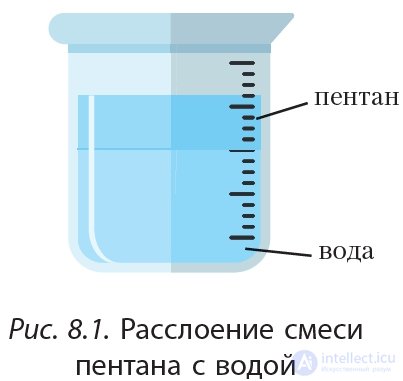 Liquid and solid alkanes have a density of less than 1 g/cm3, that is, less than the density of water. If water is placed in a beaker, and pentane is then added, the resulting mixture will separate into two layers, with the pentane collecting in the upper part, and water below (fig. 8.1).
The same effect is observed when oil gets into water. In this case, a film of oil forms on the surface of the water, which causes enormous damage to living organisms. This is why accidents involving oil spills are especially dangerous for the environment.
|
Hydrocarbons in which the carbon atoms are joined only by single bonds are called saturated. Alkanes are saturated hydrocarbons. Alkanes are also called limiting hydrocarbons, since alkane molecules contain the maximum possible number of hydrogen atoms. Alkane molecules have a similar structure and differ from one another in composition by one or more groups CH2. Substances that are similar in structure and chemical properties, and that differ in the composition of their molecules by one or more groups CH2, are called homologs and form a homologous series. In the homologous series of alkanes, boiling points rise as the number of carbon atoms in the molecule increases. Alkanes do not dissolve in water, but dissolve in organic solvents. |
1. Why are alkanes called limiting and saturated hydrocarbons?
2. What compounds form a homologous series? Are methane and ethylene homologs?
3. An alkane with an unbranched chain of five carbon atoms is called n-pentane. Write the formulas of two isomers and two homologs of n-pentane. Is the hydrocarbon of composition C7H16 a homolog of pentane?
4. Give the formulas of alkanes that are gaseous under normal conditions. Isobutane (an isomer of n-butane) has a boiling point of –12 °C. In what state of matter is isobutane under normal conditions?
5. During car repairs, parts contaminated with machine oil are sometimes washed with kerosene. Can water or aqueous solutions of acids or alkalis be used for this purpose, and why?

* Avogadro's law.
Relative density
of gases. Volume fraction
of a gas in a mixture
6. Alkanes are found in petroleum. What physical properties of alkanes explain the formation of a film on the surface of water when petroleum products get into it?
7. Plot a graph of the boiling point of alkanes as a function of the number of carbon atoms in their molecules.
8. Among those listed, identify the formulas of limiting hydrocarbons: C2H6, C3H6, C8H14, C9H20.

Comments