
Lecture
It was mentioned earlier that the simplest unsaturated carboxylic acid is acrylic acid:

Acrylic acid is a colorless liquid with a pungent odor, highly soluble in water; its boiling point is 141 °C.
Since, along with the carboxyl group, acrylic acid contains a double bond C  C, it exhibits properties characteristic of both acids and alkenes. Indeed, acrylic acid possesses all the properties of carboxylic acids — it reacts with metals, metal oxides, and alkalis, and forms esters with alcohols. Like alkenes, acrylic acid undergoes addition reactions at the double bond C C. For example, acrylic acid decolorizes bromine water:
Like alkenes, acrylic acid and its derivatives undergo polymerization reactions:
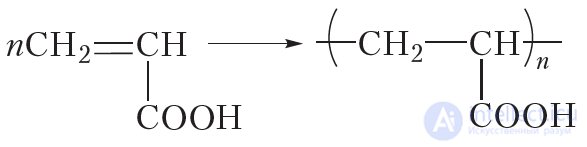
Polymers based on acrylic acid are widely used to produce acrylic glass, synthetic fibers, and other materials.
Among unsaturated monobasic carboxylic acids, oleic C17H33—COOH, linoleic C17H31—COOH, and linolenic C17H29—COOH acids are of particular interest, whose hydrocarbon radicals contain one, two, and three double bonds respectively.
All of these acids have an unbranched structure; their structural formulas are:
 Residues of these acids are part of fats. Therefore, like palmitic and stearic acids, they are called higher fatty acids.
Like palmitic and stearic acids, unsaturated higher fatty acids are insoluble in water.
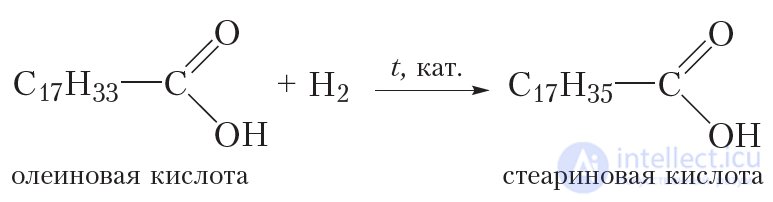
Oleic, linoleic, and linolenic acids, like unsaturated hydrocarbons, can undergo addition reactions at the C C bonds. For example, as a result of the addition of hydrogen, oleic acid is converted into stearic acid:

Video 35.1. Decolorization
of bromine water
by oleic acid
Unsaturated higher fatty acids decolorize bromine water (Video 35.1).
Linolenic acid is one of the so-called omega-3 acids, since it contains a double bond in the omega-3 position:

The benefits of such acids for the human body are now beyond doubt. These acids are not synthesized by our body, so it is important to consume foods rich in them: fatty fish, avocado, flaxseed oil, etc.
|
Unsaturated carboxylic acids exhibit chemical properties characteristic of both carboxylic acids and unsaturated hydrocarbons. Like other carboxylic acids, unsaturated acids react with metals, metal oxides, and metal hydroxides, and undergo esterification. Like unsaturated hydrocarbons, unsaturated carboxylic acids undergo addition reactions at the bonds C Residues of unsaturated higher carboxylic acids are part of fats. |
1. Derive the general formula of the homologs of acrylic acid.
2. Indicate which of the following acids are homologs: oleic, linoleic, palmitic, stearic.
3. A substance whose structural formula is:

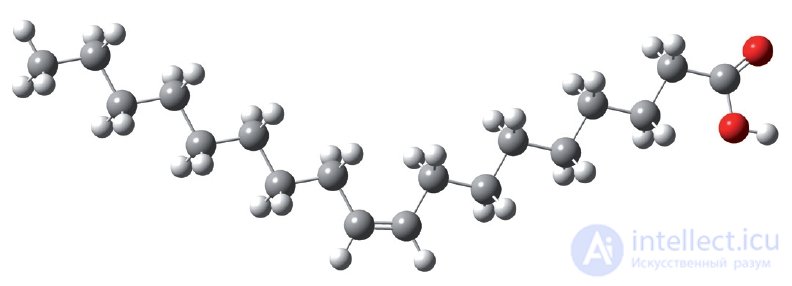
can exist in the form of two spatial isomers. The cis-isomer is oleic acid, and the trans-isomer is elaidic acid. Give the formulas of oleic acid and elaidic acid. The ball-and-stick model of which of these acids is shown in the figure?

Comments