
Lecture
Fats are widespread in nature. Along with carbohydrates and proteins, they are part of the composition of all living organisms.
The basis of fats consists of esters formed by the trihydric alcohol glycerol and carboxylic acids. Such esters are called triglycerides.
The general formula of triglycerides:
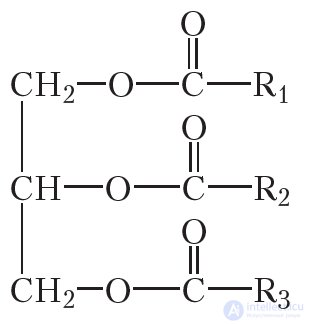 The symbols R1, R2, and R3 denote the hydrocarbon radicals that were part of the carboxylic acids. The hydrocarbon radicals in the triglyceride molecule can be identical or different. For example, if a triglyceride is formed from stearic acid residues, it is called glyceryl tristearate: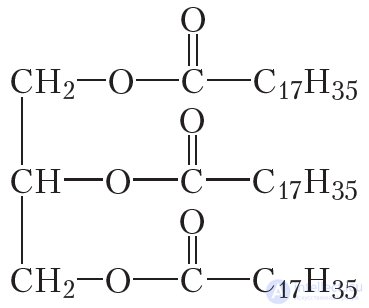
Let us give the formula of a triglyceride containing two palmitic acid residues and one oleic acid residue: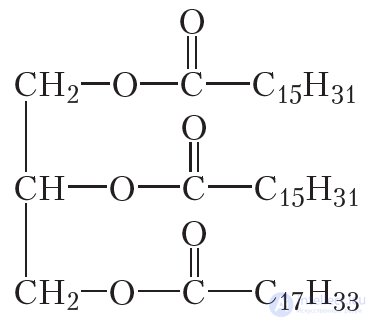
Fat is a mixture of various triglycerides. Thus, the properties of a fat largely depend on the structure of the carboxylic acids whose residues make up the triglycerides, as well as on the relative content of these residues in the fat. Most often, fats contain residues of the following acids: palmitic, stearic, oleic, linoleic, and linolenic. Table 39.1 shows the formulas and melting points of these acids.
Table 39.1. Formulas, names, and melting points of higher fatty carboxylic acids
|
Name |
Formula |
Class |
tm, °C |
|
Palmitic acid |
C15H31—COOH |
saturated |
63 |
|
Stearic acid |
C17H35—COOH |
70 |
|
|
Oleic acid |
C17H33—COOH |
unsaturated |
14 |
|
Linoleic acid |
C17H31—COOH |
–5 |
|
|
Linolenic acid |
C17H29—COOH |
–11 |
As can be seen from the table data, unsaturated acids have lower melting points than saturated ones. Therefore, fats containing a large amount of unsaturated carboxylic acid residues are liquid. Such fats are of plant origin and are called vegetable oils. Fats containing a large amount of saturated carboxylic acid residues are solid. These are animal fats.
Table 39.2 shows the approximate content of saturated and unsaturated carboxylic acid residues in various liquid and solid fats.
Table 39.2. Approximate content of carboxylic acid residues (in % by mass) in fats
|
Name of fat |
Residues of saturated acids |
Residues of unsaturated acids |
|||
|
palmitic |
stearic |
oleic |
linoleic |
linolenic |
|
|
Olive oil |
5 |
3 |
78 |
10 |
< 1 |
|
Sunflower oil |
4 |
4 |
34 |
54 |
< 1 |
|
Beef fat |
28 |
24 |
40 |
3 |
1 |
|
Mutton fat |
27 |
26 |
35 |
4 |
3 |
As can be seen from Table 39.2, olive and sunflower oil (vegetable fats) have a high content of unsaturated acid residues — more than 85 %. The content of saturated acid residues in these fats is low — less than 10 %. In beef and mutton fat (animal fats), on the contrary, the content of saturated acid residues is high — more than 50 %.
The presence of a large amount of unsaturated acid residues in vegetable fats accounts for their particular value as components of a healthy diet. In a living organism, the presence of these substances blocks harmful processes involving free radicals due to the presence of reactive double bonds C  C. This prevents premature aging and prevents the development of many diseases. Therefore, one of the principles of healthy eating is to consume predominantly vegetable fats rather than animal fats (olive, sunflower, and other oils).
Fats are insoluble in water but dissolve in organic solvents.
1. Hydrogenation
Liquid fats can be converted into solid fats by carrying out an addition reaction of hydrogen across the double bonds C  C of the unsaturated acid residues. This process, called the hydrogenation of fats, is widely used in industry to obtain solid fats — starting materials for the synthesis of detergents and margarine.
As an example, let us give the equation for the hydrogenation reaction of oleic acid triglyceride to stearic acid triglyceride:

2. Hydrolysis
Since triglycerides are esters, they undergo acidic and alkaline hydrolysis.
Acidic hydrolysis
When heated in the presence of acids, fats hydrolyze to glycerol and the corresponding carboxylic acids. Let us give the equation for the acidic hydrolysis reaction using palmitic acid triglyceride as an example: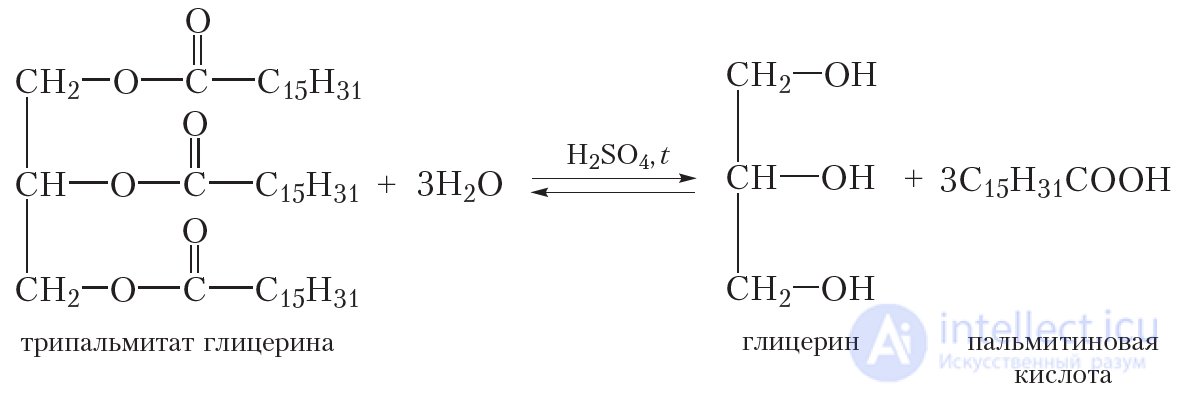
Since fat is a mixture of triglycerides, hydrolysis of a fat produces a mixture of carboxylic acids and glycerol.
Alkaline hydrolysis
The alkaline hydrolysis process is of particular importance because it produces salts of carboxylic acids along with glycerol. For example, hydrolysis of stearic acid triglyceride with a sodium hydroxide solution produces the sodium salt of stearic acid — sodium stearate:
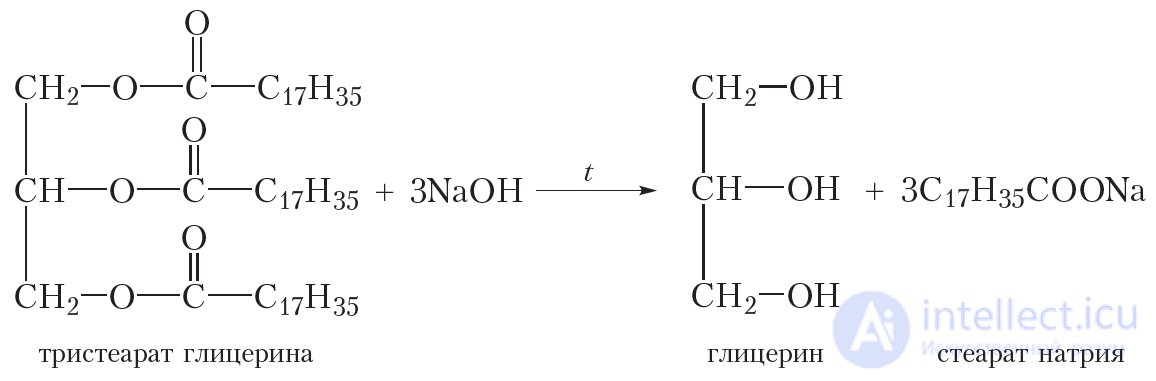
Sodium and potassium salts of higher fatty acids are the basis of soap. For this reason, the alkaline hydrolysis reaction is sometimes called saponification.
From the reaction mixture formed as a result of the alkaline hydrolysis of the fat, the salts of the higher carboxylic acids are extracted by adding sodium chloride while stirring. As the solution becomes saturated with sodium chloride, the solubility of the salts of the higher carboxylic acids decreases, the solution begins to turn cloudy, and finally the salts of the higher fatty acids rise above the clear liquid in the form of curd-like flakes, which are separated, washed with water, mixed with dyes and fragrances, and pressed into ordinary bars of soap.
Let us consider how the cleaning effect of soap is manifested. In water, potassium and sodium salts of carboxylic acids dissociate into ions:

The anion of a higher carboxylic acid is a long hydrocarbon radical bonded to a —COO– group. These two fragments have opposite properties with respect to water. The practically nonpolar hydrocarbon radical does not dissolve in water — it is hydrophobic. The polar —COO– group, on the contrary, interacts strongly with water — it is hydrophilic: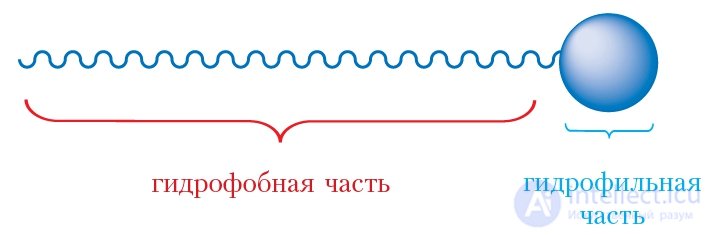 Since the hydrophobic part tends to be pushed out of the water, the anions of the higher carboxylic acids arrange themselves on the water surface as follows:
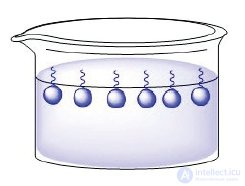 Due to the hydrophobic part being located above the surface, the carboxylic acid anions interact with contaminant particles, such as fat, which also have low polarity («like dissolves like»). This results in the formation of droplets in which the hydrophilic parts of the soap face outward and interact with water, while the hydrophobic parts interact with the contaminant located inside the droplet. In other words, soap acts as a kind of carrier that transfers water-insoluble contamination into solution. The process described can be clearly represented as follows: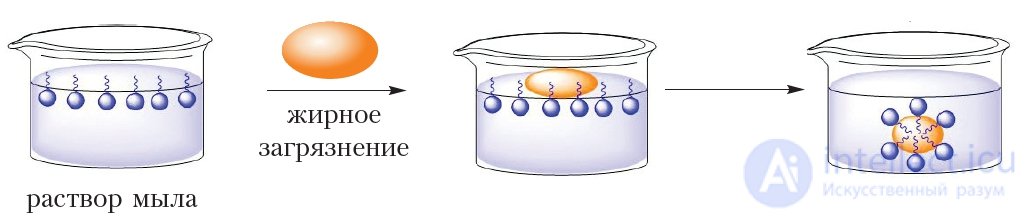

Synthetic detergents have now been developed that have a cleaning action even in hard water, since they do not form precipitates with Ca2+ and Mg2+ ions. An example of such a compound is sodium lauryl sulfate C12H25OSO2ONa.
Modern detergents are multicomponent mixtures that include salts of carboxylic acids and synthetic detergents, as well as fragrances, anti-caking agents, foam-regulating substances, and others.
|
The basis of fats consists of triglycerides — esters formed by the trihydric alcohol glycerol and higher fatty acids. Solid fats have a high content of saturated fatty acid residues, while liquid fats predominantly contain unsaturated fatty acid residues. Hydrogenation of liquid fats produces solid fats. The products of acidic hydrolysis of fats are glycerol and carboxylic acids; the products of alkaline hydrolysis are glycerol and salts of carboxylic acids. Sodium and potassium salts of higher fatty acids are components of detergents. |
1. Write the structural formulas of glyceryl tripalmitate and glyceryl tristearate.
2. Complete hydrogenation of liquid substance A (under standard conditions) produces solid substance B (under standard conditions). Alkaline hydrolysis of substance B produces substance C, which is a component of detergents. Indicate the name of substance A:
| a) glyceryl tripalmitate; | b) glyceryl trioleate; |
| c) glyceryl tristearate; | d) ethyl acetate. |
Write the equations for the reactions taking place.
3. Complete hydrogenation of 10 mol of a certain triglyceride requires a volume of 672 dm3 of hydrogen (under standard conditions). Acidic hydrolysis of the hydrogenation product produces glycerol and only one carboxylic acid (the mass of the acid is 8.52 kg). Give a possible structural formula for the triglyceride.
4. Oleic acid, whose residues are part of natural fats, has a cis-configuration of the double bond. During its hydrogenation in the production of margarine, dehydrogenation of the radicals of the resulting stearic acid occurs alongside hydrogenation, and the unsaturated radical acquires a trans-configuration. Such fats are called trans-fats. Is it healthy to consume them?

Comments