
Lecture
We have become acquainted with saturated monohydric and polyhydric alcohols. These compounds can be regarded as the products of substituting one or more hydrogen atoms in alkane molecules with hydroxyl groups —OH: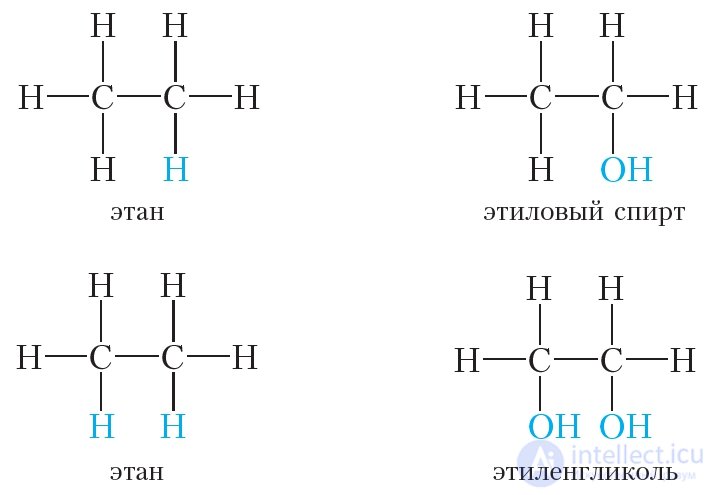
If one hydrogen atom in a benzene molecule is replaced with a hydroxyl group, we obtain a compound called phenol: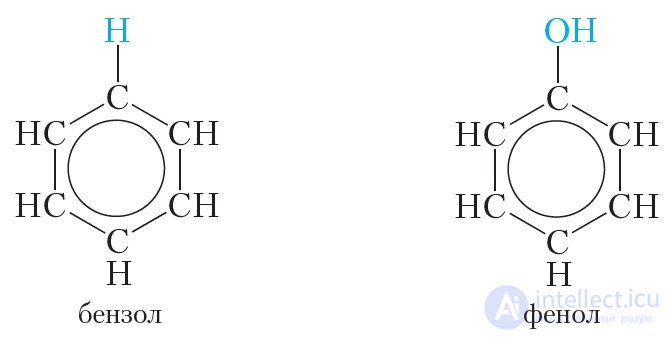
Phenol is a colorless crystalline substance with a characteristic odor and a melting point of 41 °C. Phenol is moderately soluble in water. At room temperature, approximately 6.5 g of phenol can be dissolved in 100 g of water.
Note that in the phenol molecule, the hydroxyl group is directly bonded to the benzene ring. Organic compounds whose molecules contain one or more hydroxyl groups directly bonded to a benzene ring are called phenols. Monohydric phenols contain one hydroxyl group in the molecule:
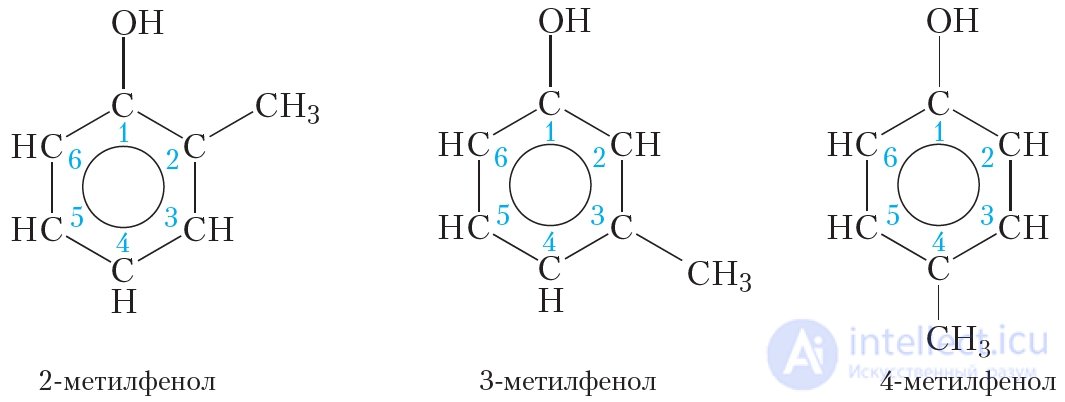
When constructing the names of isomeric methylphenols, numbering begins with the carbon atom to which the hydroxyl group is attached.
Polyhydric phenols contain several hydroxyl groups in the molecule: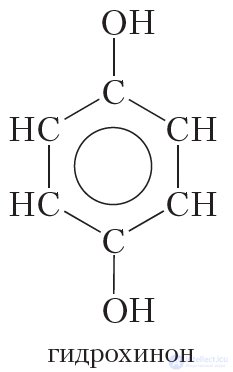 Phenols should be distinguished from aromatic alcohols. In the molecules of aromatic alcohols, unlike phenols, the hydroxyl groups are attached not to the benzene ring but to the side chain:
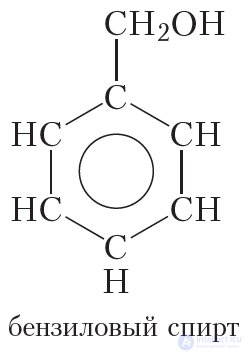
Benzyl alcohol is a liquid with a freezing point of –15 °C and a boiling point of 205 °C. Although the composition of the phenol and benzyl alcohol molecules differs by a CH2 group, they are not homologs, since they belong to different classes of compounds — phenols and alcohols. As we will see later, the chemical properties of phenols and alcohols differ noticeably.
|
Phenols are organic compounds whose molecules contain one or more hydroxyl groups directly bonded to a benzene ring. Monohydric phenols contain one hydroxyl group in the molecule, while polyhydric phenols contain several hydroxyl groups. Phenols should be distinguished from aromatic alcohols. In the molecules of aromatic alcohols, unlike phenols, the hydroxyl groups are attached not to the benzene ring but to the side chain. |
1. Are phenol and benzyl alcohol homologs? Write the formulas of the isomers of benzyl alcohol that belong to the class of phenols, and give them names.
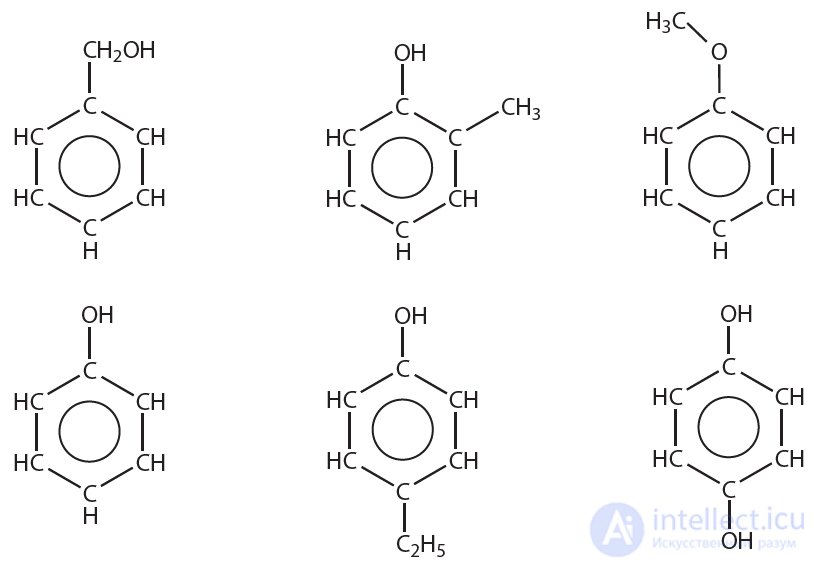
2. Among the listed substances, find the homologs and isomers.
3. Depict the formation of hydrogen bonds between phenol molecules.
4. How many trihydric phenols with six carbon atoms in the molecule exist? Write their structural formulas, and find their trivial names in the literature. What are some of these compounds known for?

Comments