
Lecture
The main type of chemical bond in organic compounds is the covalent bond. Let us consider the mechanism of its formation and its main characteristics.
The simplest example of a compound with a covalent bond — the hydrogen molecule H2. A hydrogen atom consists of a positively charged nucleus and one unpaired electron occupying the 1s-orbital. When two hydrogen atoms approach each other, their electron clouds overlap:
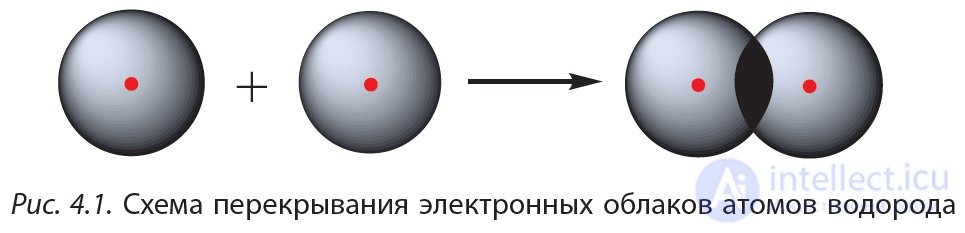
As a result, the electron density increases in the space between the nuclei, meaning a negative charge is concentrated in that region. This negative charge attracts the positively charged nuclei, and a chemical bond forms between the atoms. A hydrogen molecule is formed 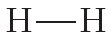 , or H2. Such a bond is called covalent. The greater the overlap of the electron clouds of the atoms, the stronger the covalent bond.
The scheme of covalent bond formation between hydrogen atoms can be represented as follows:

or:

From the scheme shown, it is clear that the covalent bond is formed by means of a shared electron pair. In electron formulas, the electron pair is usually denoted by two dots placed between the atoms. If circles are drawn around such atoms, it becomes clear that each hydrogen atom in the molecule has a complete electron shell, like a helium atom:

In structural formulas, a covalent bond is denoted by a dash:
Using the concept of a shared electron pair, we can give a brief definition of the covalent bond.
| A covalent bond is a chemical bond formed by means of shared electron pairs. |
In a hydrogen molecule, the shared electron pair is formed from the unpaired electrons of two hydrogen atoms. It can therefore be concluded that the number of covalent bonds an element can form is equal to the number of unpaired electrons in its atom.
For example, a hydrogen atom has one unpaired electron, so hydrogen can form only one covalent bond. The number of covalent bonds that a given atom forms in a chemical compound is called its valence. For example, since the valence of hydrogen is one, a single dash should be drawn from the symbol H in structural formulas: 
Let us consider the main characteristics of the covalent bond.
The outer shell of a fluorine atom has one unpaired electron, so the valence of fluorine in compounds is one.
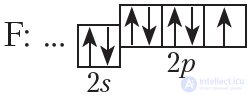
A single dash should be drawn from the symbol F in structural formulas: 
Figure 4.2 shows the scheme of covalent bond formation in the fluorine molecule:
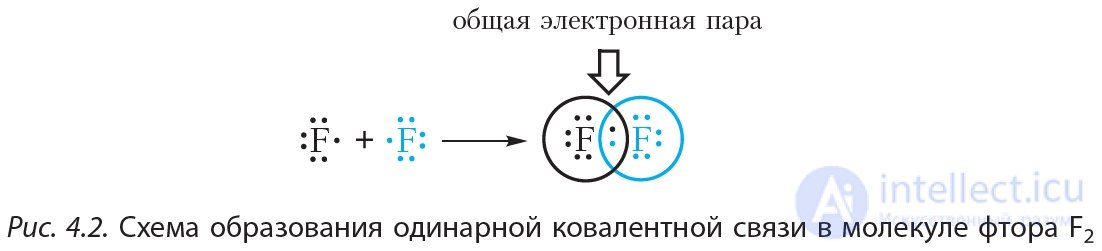
In the fluorine molecule, the atoms are bonded by one shared electron pair. Such a bond is called a single bond.
The outer shell of an oxygen atom has two unpaired electrons, so the valence of oxygen in compounds is two.
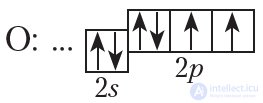
Two dashes should be drawn from the symbol O in structural formulas: 
Figure 4.3 shows the scheme of covalent bond formation in the oxygen molecule:
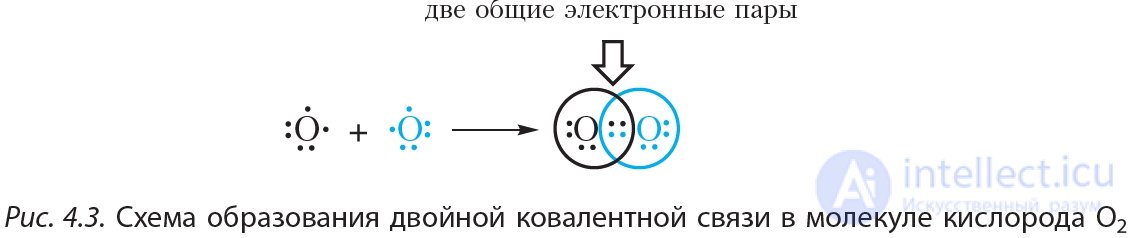
In the oxygen molecule, the atoms are bonded by two electron pairs. Such a bond is called a double bond. A double bond is stronger than a single bond.
The outer shell of a nitrogen atom has three unpaired electrons, so the valence of nitrogen in compounds is three.
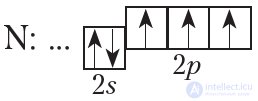
Three dashes should be drawn from the symbol N in structural formulas:
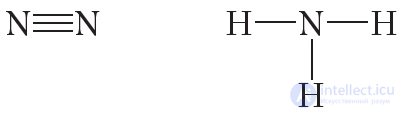
Figure 4.4 shows the scheme of covalent bond formation in the nitrogen molecule:

In the nitrogen molecule, the atoms are bonded by three electron pairs. Such a bond is called a triple bond. A triple bond is stronger than a single or a double bond.
Double and triple bonds share the common name multiple bonds.
In the ground state, the outer shell of a carbon atom has two unpaired electrons. However, a carbon atom readily transitions to an excited state, in which it has four unpaired electrons:

Because of this, the valence of carbon can be equal to four. In most compounds carbon is tetravalent. Therefore, four dashes should be drawn from the symbol C in structural formulas:
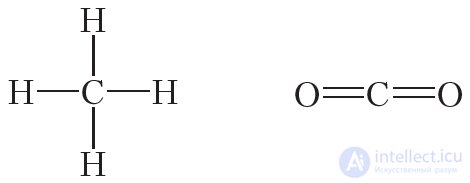
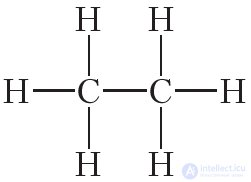
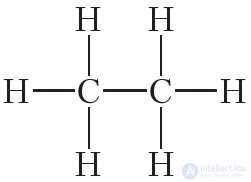
Carbon atoms can bond with each other by both single and multiple bonds. For example, in the molecule of ethane, which has the composition C2H6, the carbon atoms form only single bonds:
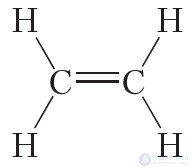
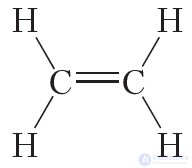
The carbon atoms are joined by a double covalent bond in the molecule of ethylene (C2H4):
 A triple bond between carbon atoms is present in the molecule of acetylene (C2H2):

The most important characteristics of a covalent bond are its energy and length.
The energy that must be expended to break a chemical bond is called the bond energy. Bond energy is measured in kJ/mol. The stronger the bond, the more energy must be expended to break it, and therefore the greater the bond energy.
The energy of multiple bonds is greater than that of single bonds (Table 4.1). This is quite understandable, since breaking two or three bonds requires more energy than breaking one bond.
Atoms joined by a chemical bond are located at a certain distance from each other. The distance between the nuclei of the atoms forming the bond is called the bond length.
From the data in Table 1.4 it is clear that in the series ethane — ethylene — acetylene, as the bond order increases, the carbon-carbon bond length decreases. That is, atoms are attracted to each other more strongly when multiple bonds are formed.
Table 4.1. Energy and length of the carbon-carbon bond in some molecules
|
Substance name |
Structural formula |
Carbon-carbon bond energy, kJ/mol |
Carbon-carbon bond length, nm |
|
Ethane |
 |
370 |
0,154 |
|
Ethylene |
 |
612 |
0,134 |
|
Acetylene |
|
833 |
0,120 |
In the hydrogen molecule H2, the covalent bond forms between atoms of the same element, so the shared electron pair is located symmetrically (in the middle) between the atomic nuclei. Such a bond is called nonpolar covalent.
Example 1. Covalent nonpolar bonds join together the atoms of nonmetals in simple substances 
In addition, a nonpolar covalent bond forms between carbon atoms in ethane 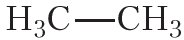 , ethylene
 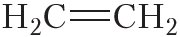 and acetylene
  .
.
When a covalent bond forms between atoms of different chemical elements, the shared electron pair shifts toward the more electronegative atom. Such a bond is called polar covalent.
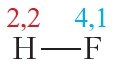
Recall that electronegativity is the ability of an atom in a chemical compound to attract the electrons of other atoms toward itself. The most electronegative element — fluorine (EN — 4,1).
Example 2. Polar covalent bond in the hydrogen fluoride molecule HF. The molecule  is formed by atoms of hydrogen and fluorine. The electronegativity of fluorine is higher than that of hydrogen, so the shared electron pair is shifted toward the more electronegative fluorine atom (Fig. 4.5).

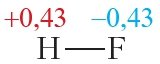
As a result, a partial negative charge arises on the fluorine atom, and a partial positive charge on the hydrogen atom. Partial, rather than full, charges arise because the shared electron pair shifts toward the fluorine atom, but a complete transfer of the electron from one atom to the other does not occur. The partial charge is denoted by the Greek letter δ (delta):
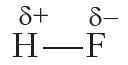
The bond between the hydrogen and fluorine atoms is polar covalent.
A polar covalent bond arises between atoms of nonmetals with different electronegativities, for example in the molecules of hydrogen chloride, water, and ammonia:

The more the electronegativities of the atoms forming the covalent bond differ from each other, the greater the partial charges on the atoms will be, and the more polar the bond will be.
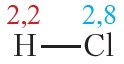
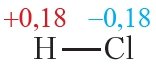
Example 3. Polar covalent bonds in the molecules of hydrogen fluoride HF and hydrogen chloride HCl.
Table 4.2. Electronegativities and partial charges on atoms in the molecules HF and HCl
|
Substance name |
Electronegativities of the elements |
Partial charges on atoms |
||
|
Hydrogen fluoride |
 |
 |
||
|
Hydrogen chloride |
 |
 |
||
From Table 4.2 it is clear that the partial charges on the atoms in the HF molecule are significantly greater than in the HCl molecule. Therefore, the bond in the HF molecule is more polar than in HCl.
|
A covalent bond is formed by means of shared electron pairs. In electron formulas, the shared electron pair is denoted by two dots placed between the atoms. In structural formulas, a covalent bond is denoted by a dash. A covalent bond forms between atoms of nonmetals. Between atoms of the same nonmetal, a nonpolar covalent bond arises. Between atoms of different nonmetals — a polar covalent bond. A covalent bond can be single, double, or triple. Double and triple bonds are called multiple bonds. The stronger the bond, the greater the bond energy. The energy of multiple bonds is higher than the energy of single bonds. Multiple bonds are shorter than single bonds. |
1. Using electron formulas, show the formation of covalent bonds in the molecules HCl, H2O, NH3, CH4. Indicate the valences of the elements in these substances.
2. Given that the valence of hydrogen and chlorine is one, of carbon — four, and of oxygen — two, write the structural formulas of the molecules: CCl4, CO2, CH3Cl, C2H6, C2H4, C2H2, C2H5Cl.
3. In which molecule, H2O or NH3, are the covalent bonds more polar? Write the structural formulas of these molecules and indicate the signs of the partial charges on the atoms.
4. Write the structural formula of hydrogen peroxide H2O2. Indicate the polar and nonpolar bonds.
5. In which molecule, O2 or H2O2, is the oxygen-oxygen bond energy greater?
6. Upon strong heating, bonds in molecules can break. In this case the molecules decompose into atoms. Which substance, Cl2 or N2, will be more resistant to heating (more thermally stable)?


Comments