
Lecture
You already know that oxygen atoms in the molecules of organic compounds can act as "bridges" between an alkyl radical and a hydrogen atom (alcohols):
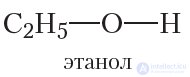
or between two alkyl groups (ethers):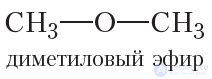 In addition, an oxygen atom can be joined to a carbon atom by a double bond:
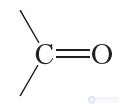 This formula reflects the structure of a new functional group found in many organic compounds. This group is called the carbonyl group.
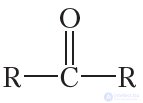
Such organic compounds belong to the class of ketones. The hydrocarbon radicals in ketone molecules can be either identical or different. In the molecule of the simplest ketone, both radicals are methyl groups. This ketone is called acetone: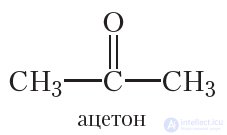 Acetone is a low-boiling liquid (tb.p. = 56 °C) with a characteristic odor that is miscible with water in all proportions. It is used as a solvent and in organic synthesis.
Another well-known ketone — raspberry ketone — also contains a carbonyl group in its molecule; this is a compound of more complex structure:
Raspberry ketone is naturally found in raspberries and is responsible for their characteristic aroma. Synthetic raspberry ketone is used as an additive in food products and cosmetics.
If a carbonyl group is joined to a hydrogen atom, the result is an aldehyde group: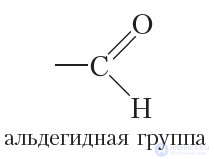 Compounds containing the aldehyde group belong to the class of aldehydes. In the molecule of the simplest member of this class of compounds, the aldehyde group is bonded to a hydrogen atom:
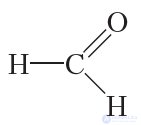 This compound is called formic aldehyde, or formaldehyde, and is a colorless, toxic gas with a pungent odor that is highly soluble in water. A 40% aqueous solution of formaldehyde is called formalin and is used to preserve biological tissue.
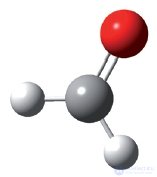 In the molecule of the nearest homolog of formaldehyde, the aldehyde group is bonded to a methyl radical: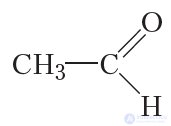
The name of this compound is acetic aldehyde, or acetaldehyde. Under standard conditions, acetic aldehyde is a colorless liquid with the smell of apples. The boiling point of acetic aldehyde is 21 °C.
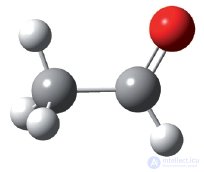 The presence of the group
 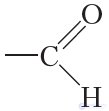 (or —CHO) in aldehyde molecules accounts for their characteristic chemical properties. This is why the aldehyde group is called the functional group. Thus, aldehydes are organic compounds whose molecules contain the group —CHO bonded to a hydrogen atom or a hydrocarbon radical.
Let's derive the general formula for the homologs of acetic aldehyde. In the molecules of such aldehydes, the group —CHO is bonded to an alkyl radical or to hydrogen. As you already know, an alkyl radical is formed by removing one hydrogen atom from an alkane molecule. The general formula of alkyl radicals is CnH2n+1. Then the general formula of the homologs of acetic aldehyde is:
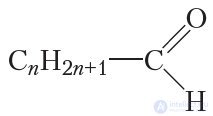
Note that for formic aldehyde, n = 0.
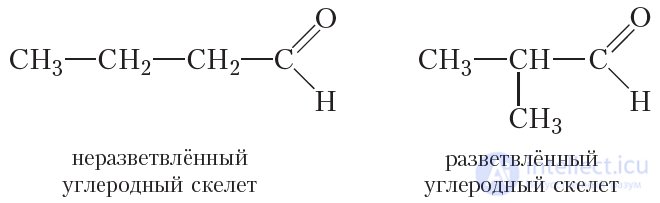
Aldehydes can exhibit carbon-skeleton isomerism. This type of isomerism first appears with the substance containing four carbon atoms in its molecule:
Since the aldehyde group is always located at the end of the molecule, isomerism related to the position of the aldehyde group is not possible. However, aldehydes can be isomeric with ketones:
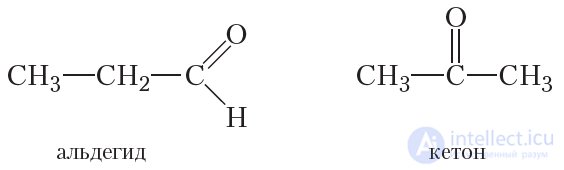
It is easy to verify that both compounds shown have the same molecular formula C3H6O, that is, they are isomers.
Formic aldehyde and acetic aldehyde are trivial, that is, historically established, names. According to systematic nomenclature, the names of aldehydes are formed by adding the suffix -al, which denotes the aldehyde group, to the name of the corresponding alkane. Numbering of the carbon atoms of the main chain always starts from the carbon atom of the aldehyde group.
Let's name all the aldehydes mentioned above: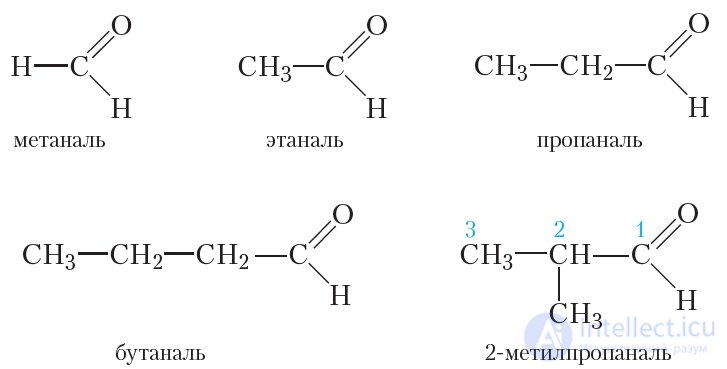
Let's consider a more complex case. Let's name the aldehyde with the following structure: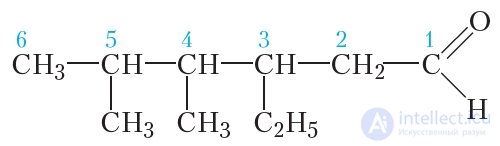 The main chain consists of six carbon atoms. The corresponding alkane is called hexane. The third, fourth, and fifth carbon atoms of the main chain are bonded to alkyl radicals, whose names are listed in alphabetical order. We indicate that the compound belongs to the class of aldehydes by means of the suffix -al. Then the name of the aldehyde is 4,5-dimethyl-3-ethylhexanal.
Table 29.1 shows the formulas, names, and boiling points of some aldehydes.
Table 29.1. Formulas, names, and boiling points of some aldehydes
|
Formula |
Name |
tb.p., °C |
|
H—CHO |
methanal |
–20 |
|
CH3—CHO |
ethanal |
21 |
|
CH3—CH2—CHO |
propanal |
49 |
|
CH3—CH2—CH2—CHO |
butanal |
76 |
|
CH3—CH2—CH2—CH2—CHO |
pentanal |
103 |
As the table shows, the boiling points of aldehydes are significantly lower than those of alcohols with the same number of carbon atoms in the molecule. For instance, the boiling point of methanol is +65 °C, while that of methanal is –20 °C. This indicates that the interaction between aldehyde molecules is weaker than between alcohol molecules.
Recall that the reason for the high boiling points of alcohols is the presence of hydrogen bonds between their molecules. Hydrogen bonds hold alcohol molecules quite strongly close to one another, hindering their transition into the gaseous state. Between aldehyde molecules, unlike alcohols, hydrogen bonds do not form, since aldehydes lack hydrogen atoms bonded to an oxygen atom.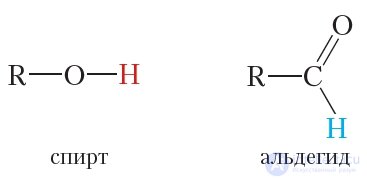 The C—H bond of the aldehyde group is weakly polar, so the positive charge on the hydrogen atom of the aldehyde group is not sufficient to form a hydrogen bond with the oxygen atom of a neighboring molecule. As a result, the boiling points of aldehydes are lower than those of alcohols with the same number of carbon atoms.
The simplest aldehydes — methanal, ethanal, propanal — are highly soluble in water. As the size of the hydrocarbon radical increases, solubility in water decreases.
 Interesting to know
Aldehydes whose molecules contain an unbranched chain of 8–12 carbon atoms have pleasant scents when highly diluted (in pure form they are very harsh) and are found in some of the best-known perfume compositions. The exact composition of these blends is a trade secret; it is known only that the perfumes Chanel No. 5, Lancome Climat, and Givenchy L'Interdit contain octanal (C8H16O), nonanal (C9H18O), and lauric aldehyde (C12H24O) (fig. 29.1).
We have become acquainted with organic compounds whose molecules contain a carbonyl group — aldehydes and ketones. In the next section, we will examine the chemical properties of aldehydes, their preparation, and their uses.
|
Aldehydes are organic compounds whose molecules contain an aldehyde group bonded to a hydrogen atom or a hydrocarbon radical. The general formula of the homologs of acetic aldehyde is CnH2n+1—CHO. The names of aldehydes are formed by adding the suffix -al, which denotes the aldehyde group, to the name of the corresponding alkane. The boiling points of aldehydes are lower than those of alcohols because hydrogen bonds cannot form between their molecules. |
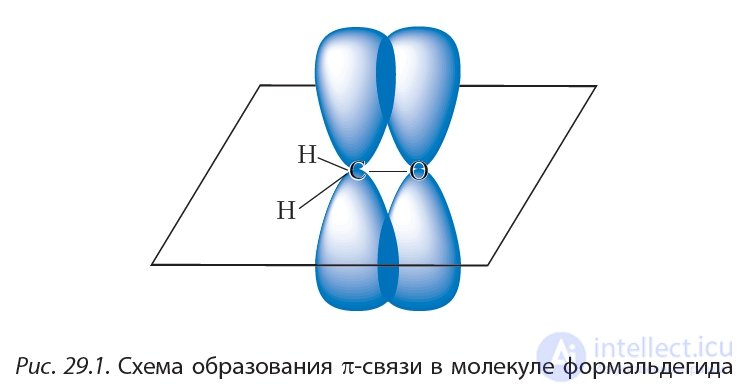
1. Give the structural formula of formic aldehyde. How many σ- and π-bonds are in the molecule of this aldehyde?
2. Write the structural formula of the simplest ketone. What is this compound called? Where do you encounter it in everyday life? Write the structural formula of a ketone containing four carbon atoms in its molecule.
3. Write the structural formulas of all isomeric aldehydes of composition C4H9—CHO and give them names.
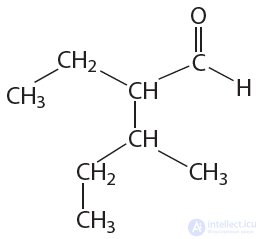
4. Name the aldehyde with the following structure:
5. What accounts for the rise in boiling point in the series of substances: methanal, ethanal, propanal?
6. Why is the boiling point of ethanal (21 °C) significantly lower than the boiling point of ethanol (78 °C)?
7*. The relative vapor density of an aldehyde with respect to air is 2. Determine the formula of the aldehyde.

Comments