
Lecture
Amino acid molecules contain both an amino group —NH2 and a carboxyl group —COOH. Let us try to construct such a molecule. To do this, we attach a carboxyl group and an amino group to a carbon atom: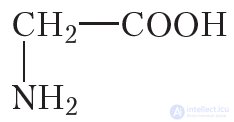 The result is the simplest amino acid — aminoacetic acid, or glycine.
The nearest homolog of glycine is the amino acid alanine:
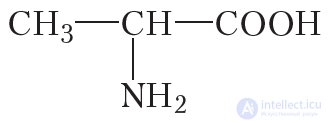
The names of amino acids consist of the name of the corresponding carboxylic acid with the prefix amino-, preceded by an indication of the position of the amino group: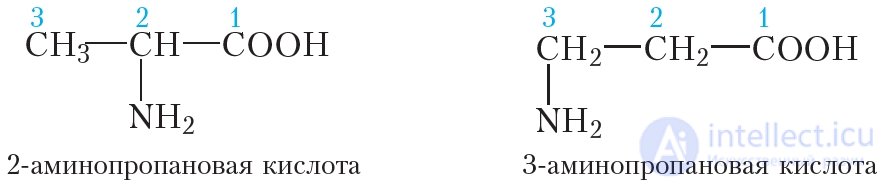
Sometimes, when constructing the names of amino acids, the position of the amino group is indicated not by numbers but by letters of the Greek alphabet: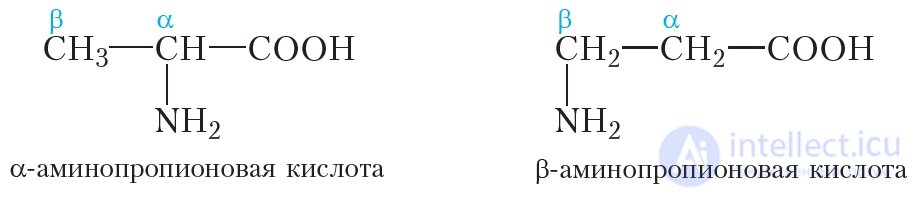
Some amino acids have trivial names; for example, aminoethanoic acid is called glycine, and 2-aminopropanoic acid — alanine.
Amino acids — colorless crystalline substances, highly soluble in water; many of them have a sweet taste. The melting points of amino acids are quite high; thus, the tmp of aminoacetic acid is 233 °C. This indicates that there is very strong interaction between amino acid molecules.
Amino acid molecules contain both an amino group —NH2 and a carboxyl group —COOH, so they possess the properties of both amines and carboxylic acids.
1. Reaction with acids
Like amines, amino acids form salts when reacting with acids:

Interesting to know
In the instructions for medicines bought at a pharmacy, you can often read the long name of the drug's active substance along with the note «hydrochloride». What does this mean? The molecules of many pharmaceutical drugs contain amino groups, which are easily oxidized even by atmospheric oxygen. If the amino group is converted into its salt form, it becomes much more resistant to oxidation, and, as a rule, the solubility of the drug also increases. In practice, neutralization of amino groups is carried out by reaction with hydrogen chloride HCl. Hence the name «hydrochloride».
2. Reaction with alkalis
Like carboxylic acids, amino acids react with alkalis to form salts: Consequently, amino acids form salts with both acids and alkalis. That is, amino acids are amphoteric organic compounds.
Solutions of amino acids do not change the color of indicators. This is explained by the fact that the amino and carboxyl groups in amino acids neutralize each other.
3. Formation of esters
Like carboxylic acids, amino acids form esters when reacting with alcohols. The catalysts for this reaction are inorganic acids (for example, HCl):

Note that during the reaction, HCl not only plays the role of a catalyst but also reacts with the amino group, forming a salt.
4. Formation of peptides
Under certain conditions, amino acid molecules can react with each other:
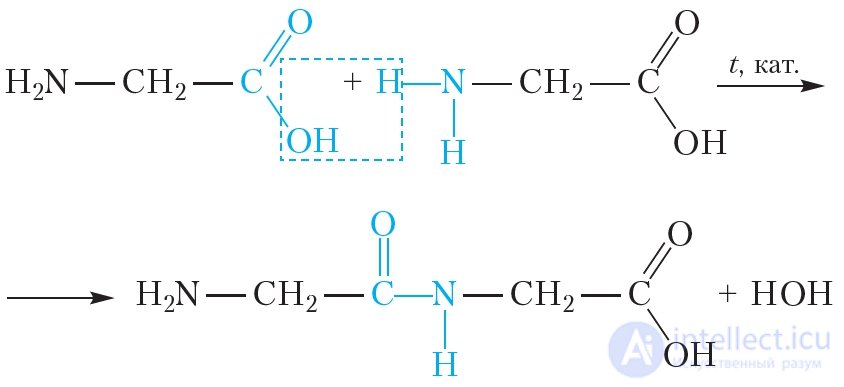
During the reaction, the —OH group is split off from the carboxyl group of one amino acid molecule, and a hydrogen atom is split off from the amino group of another molecule. As a result, a covalent bond forms between the two amino acid residues, and a water molecule is formed. The group of atoms 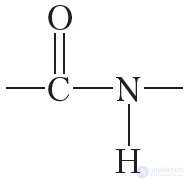 is called the peptide, or amide, group, and the bond between amino acid residues — the peptide, or amide, bond.
When two amino acid molecules react, a dipeptide is formed. A dipeptide can react with another amino acid molecule to form a tripeptide and so on.
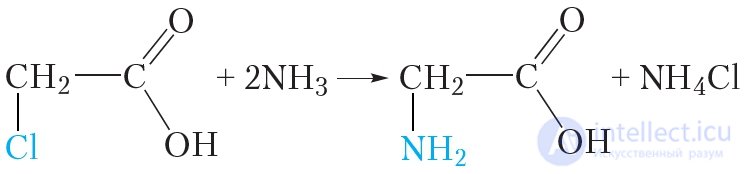
α-Amino acids can be obtained from the corresponding carboxylic acids. To do this, first the hydrogen atom of the α-carbon atom of the carboxylic acid is replaced with a halogen (§ 33):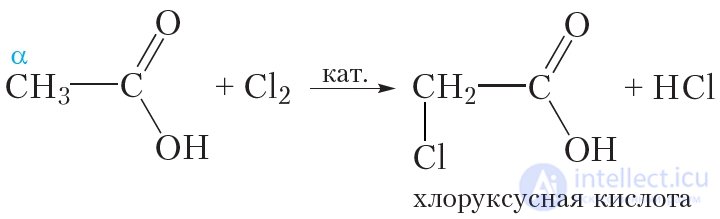
Then the halogen atom in the molecule of the α-halo-substituted carboxylic acid is replaced by an amino group: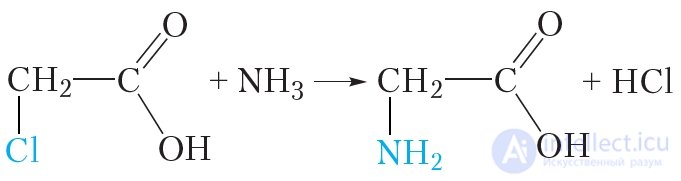
The hydrogen chloride released during the reaction reacts with ammonia molecules:

therefore, the reaction with 1 mol of chloroacetic acid requires 2 mol of ammonia:
In living organisms, including the human body, proteins are formed from amino acids. Some amino acids are used as medicines and food additives. Amino acids are used to produce high-molecular-weight compounds, from which fibers and plastics are made.
Let us consider the production of the synthetic fiber kapron. The formation of the polymer from which the fiber is produced can be represented by the following scheme:
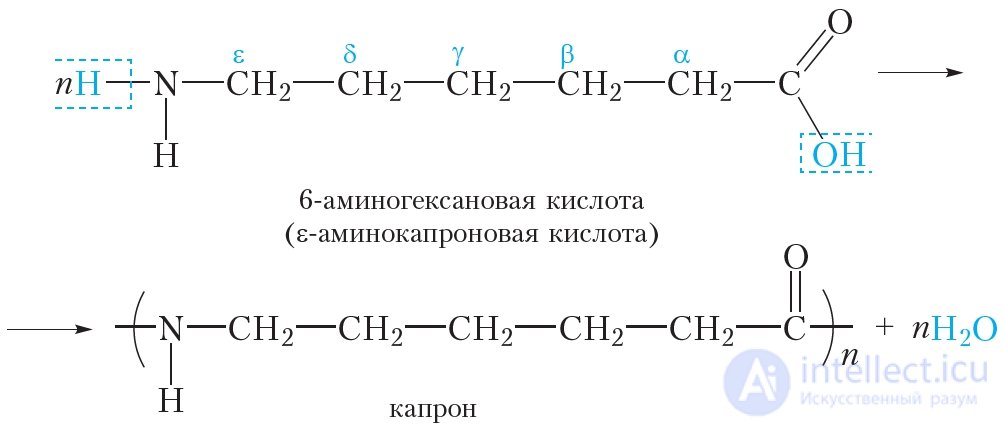
The residues of 6-aminohexanoic acid in kapron are linked by amide bonds, so kapron fiber belongs to the polyamide fibers. Since kapron macromolecules are produced synthetically, kapron is a synthetic fiber. In our country, kapron is produced at the «Khimvolokno Plant» branch of OJSC «Grodno Azot». Another example of a synthetic fiber is the polyester fiber lavsan (§ 38).
 You will learn about the synthetic fiber nylon by following the link in the QR code.
|
Amino acids are organic compounds whose molecules contain an amino group —NH2 and a carboxyl group —COOH. Amino acids possess the properties of both amines and carboxylic acids. Amino acids form salts when reacting with both acids and alkalis. Consequently, amino acids — are amphoteric organic compounds. Solutions of amino acids do not change the color of indicators, because the amino and carboxyl groups in amino acids neutralize each other. Amino acid molecules can react with each other, forming peptides. The synthetic fiber kapron is obtained by polycondensation of 6-aminohexanoic acid. |
Nylon is formed by the polycondensation of hexamethylenediamine (an amine whose molecule contains two amino groups and six methylene  CH2 groups) with adipic acid, whose molecule contains two carboxyl groups and four methylene groups:
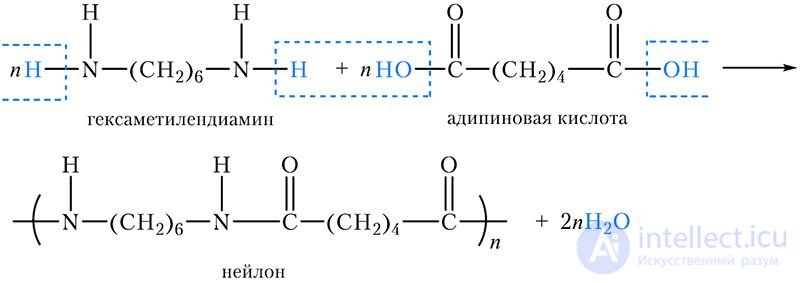
Fibers made from nylon are characterized by high strength and wear resistance.
1. Organic substance A forms salts when reacting with both acids and alkalis. Indicate the formula of substance A.

2. Give the equations for the reactions of alanine: a) with hydrochloric acid; b) with a solution of sodium hydroxide.
3. Write the structural formula of the dipeptide formed by alanine residues.
4. Write the equations for the reactions corresponding to the following transformation scheme:

5. How many different dipeptides will be obtained by heating a mixture of glycine and alanine? Give the formulas of these dipeptides.
6. How many amino acid residues and peptide bonds are contained in a molecule of a linear (non-cyclic) tetrapeptide?
7. Give the equations for the reactions used to obtain kapron, lavsan, polyethylene, and synthetic rubber from the corresponding monomers. Which of the reactions you gave are polymerization reactions, and which are polycondensation reactions?
8. Organic substance A contains 11.97 % nitrogen, 9.40 % hydrogen and 27.35 % oxygen by mass and is formed by the reaction of organic substance B with propan-1-ol, saturated with hydrogen chloride, and subsequent displacement from the salt. It is known that substance B is of natural origin and is capable of reacting with both acids and alkalis.
a) Determine the molecular formula of substance A.
b) Write the equations for the reactions taking place.
9*. As a result of burning 3.045 g of a tripeptide in oxygen, 1.755 g of water, 4.620 g of carbon dioxide and 504 cm3 (STP) of nitrogen were obtained. Determine the molecular formula of the tripeptide, given that its molecule contains three atoms of nitrogen. How many isomeric tripeptides correspond to the molecular formula you determined? Give their structural formulas. Take into account that the tripeptide contains only residues of α-amino acids.

Comments