
Lecture
Pour 1–2 cm3 of alkali solution into a test tube, then a little copper(II) sulfate solution. A precipitate of copper(II) hydroxide forms. After that, pour into the test tube 1–2 cm3 of glycerol solution. The copper(II) hydroxide precipitate dissolves and a clear, cornflower-blue solution forms.
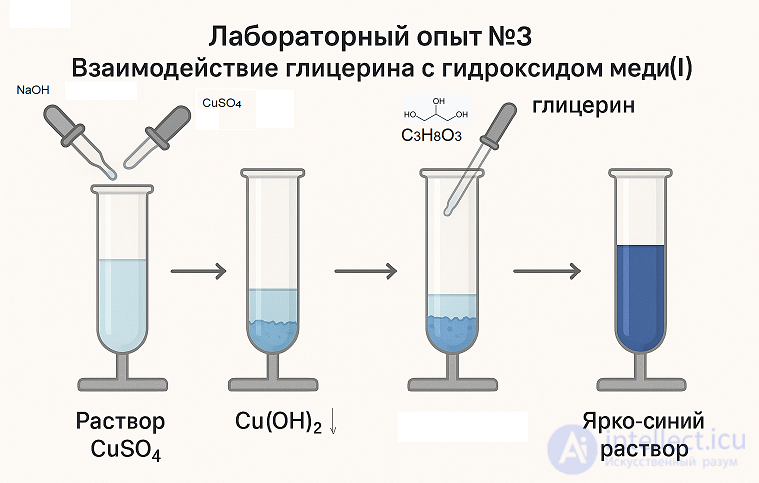
Study the chemical reaction of polyhydric alcohols (using glycerol as an example) with copper(II) hydroxide and determine the nature of the reaction.
Test tubes
Stand
Pipette
Spirit lamp
Glycerol (C₃H₅(OH)₃)
Copper(II) sulfate solution (CuSO₄)
Alkali solution (NaOH or KOH)
Preparation of copper(II) hydroxide:
Pour 1–2 mL of CuSO₄ solution into a test tube.
Add alkali solution dropwise until a blue precipitate — copper(II) hydroxide — has fully formed:
CuSO4+2NaOH→ Cu(OH)₂↓ + Na₂SO₄ Reaction with glycerol:
Add 1–2 mL of glycerol to the resulting Cu(OH)₂ precipitate.
Carefully warm the test tube in a water bath or over a spirit lamp.
Observations:
The precipitate dissolves.
The solution takes on a bright blue (blue-violet) color.
Glycerol, as a polyhydric alcohol, forms a bright blue complex compound with copper(II) hydroxide.
This indicates the presence of two or more hydroxyl groups on adjacent carbon atoms, capable of coordinating with copper(II) ions.
Cu(OH)2+glycerol→complex compound(bright−blue color)

Comments