
Lecture
Organic compounds belonging to the class of carbohydrates are widespread in nature. They are found in living organisms. We frequently encounter many of them in everyday life — these are the well-known sucrose (ordinary sugar), glucose, and starch.
The composition of most carbohydrates conforms to the general formula Cn(H2O)m. Concentrated sulfuric acid, being a strong dehydrating agent, is able to remove water from carbohydrate molecules. Let us give the scheme of the reaction that occurs when concentrated sulfuric acid acts on sucrose:


Video 40.1.
Dehydration of Sucrose
This reaction can be carried out as follows. About 4–5 g of powdered sugar is placed in a narrow chemical beaker. Then approximately 10 cm3 of concentrated sulfuric acid is added to the beaker, and the contents are stirred with a glass rod. After a short time, the mixture darkens, then turns black and transforms into a «black snake» crawling out of the beaker. The «snake» is carbon foamed up by the escaping water vapor.
Despite the fact that the composition of many carbohydrates conforms to the general formula Cn(H2O)m and they char under the action of strong dehydrating agents, carbohydrates are not hydrates of carbon, that is, they are not compounds of carbon with water.
Let us consider the structure and properties of one representative of the class of carbohydrates — glucose.
Glucose — a colorless crystalline substance, readily soluble in water, sweet to the taste. The molecular formula of glucose is C6H12O6. This formula can be represented as C6(H2O)6, that is, it conforms to the general formula Cn(H2O)m at n = m = 6.
Let us now try to determine which functional groups are present in the glucose molecule. The good solubility of glucose in water may be related to the presence of hydroxyl groups in the molecule (recall that the polyhydric alcohols ethylene glycol and glycerol mix with water in all proportions). Let us check whether glucose undergoes the qualitative reaction for polyhydric alcohols. Pour 1–2 cm3 of an alkali solution into a test tube, then add a little copper(II) sulfate solution. A blue precipitate of copper(II) hydroxide forms:

Then add an aqueous solution of glucose to the test tube with the precipitate. The copper(II) hydroxide dissolves and a clear cornflower-blue solution forms. The dissolution of copper(II) hydroxide upon interaction with glucose occurs due to the formation of a water-soluble complex compound, similar to what happened in the case of glycerol (video 25.1). This experiment proves that there are several hydroxyl groups in the glucose molecule. It has been established that the glucose molecule C6H12O6 contains five hydroxyl groups. Then the sixth oxygen atom is part of another functional group. It can be assumed that this functional group is the aldehyde group.
Let us check whether glucose undergoes qualitative reactions for the aldehyde group. Place 1–2 cm3 of glucose solution into a test tube, then add about the same amount of ammoniacal silver oxide solution and heat the mixture. After a while, the walls of the test tube become coated with a thin layer of silver. The «silver mirror» reaction is a qualitative reaction for the aldehyde group; consequently, the glucose molecule contains an aldehyde group (video 30.1).
Thus, glucose is simultaneously a polyhydric alcohol and an aldehyde. The structural formula of glucose:
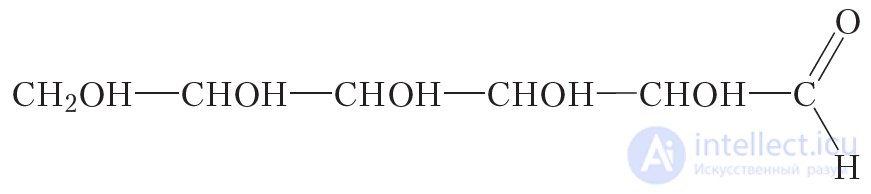
The form shown is called the linear form of glucose. It has been established that, in addition to the linear form, cyclic forms of glucose are also present in an aqueous solution of glucose.
The ability of the glucose molecule to close into a ring is due to the presence of reactive functional groups in it — the hydroxyl groups and the aldehyde group — capable of interacting with each other. We already know that addition reactions across the double bond C  O are characteristic of aldehydes. The scheme shows how such a reaction proceeds in the glucose molecule:
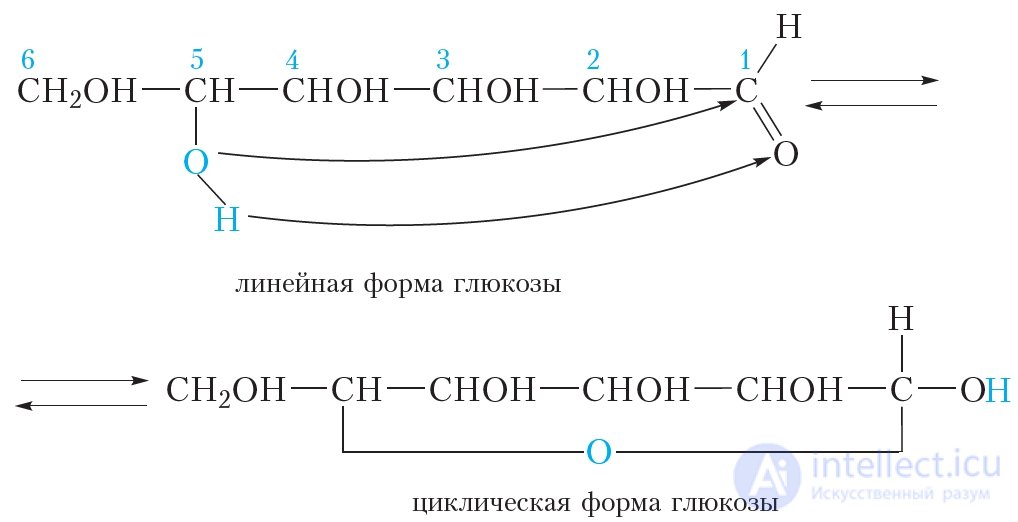
The scheme shows that the hydroxyl group attached to the fifth carbon atom interacts with the aldehyde group. In this process, the π-bond between the carbon and oxygen atoms of the aldehyde group breaks, the oxygen atom of the hydroxyl group attaches to the carbon atom, forming a ring consisting of six atoms (five carbon atoms and one oxygen atom). The hydrogen atom of the hydroxyl group attaches to the oxygen atom of the aldehyde group. As a result, the cyclic form of glucose is formed.
The cyclic form of glucose, like the linear form, has five hydroxyl groups. At the same time, the cyclic form of glucose has no aldehyde group.
The cyclization process is reversible. Therefore, both the linear and cyclic forms are simultaneously present in an aqueous solution of glucose.
The scheme of glucose cyclization shown above clearly illustrates the interaction of which atoms of the molecule leads to the formation of the ring. Let us now consider the spatial arrangement of the atoms in the cyclic form of glucose. To do this, let us examine the process of intramolecular cyclization in more detail.
Due to rotation around the single C—C bonds, the carbon chain of the linear form of glucose can adopt various spatial forms (§ 7, Laboratory Experiment 1). In one of these forms, the hydroxyl group of the fifth carbon atom becomes spatially close to the aldehyde group:
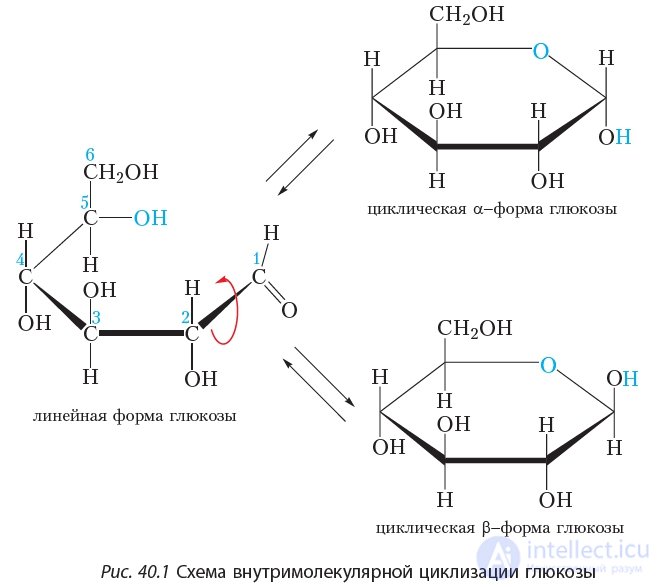 The scheme shows that cyclization can occur either at the moment when the oxygen atom of the aldehyde group is at the bottom, or at the moment when, due to rotation around the C1—C2 bond, the aldehyde group turns 180° and the oxygen atom of the aldehyde group ends up at the top. Depending on this, two cyclic forms of glucose can form (α- and β-), which differ from each other in the spatial arrangement of the hydroxyl group at the first carbon atom. In the cyclic α-form, this hydroxyl group is below the ring, while in the cyclic β-form it is above the ring (Fig. 40.1). The spatial arrangement of the other substituents relative to the ring is the same in the α- and β-forms of glucose.
Thus, the group CH2OH at the fifth carbon atom is located above the ring, the hydroxyl group of the fourth carbon atom is below the ring, that of the third is above the ring, and that of the second is below the ring: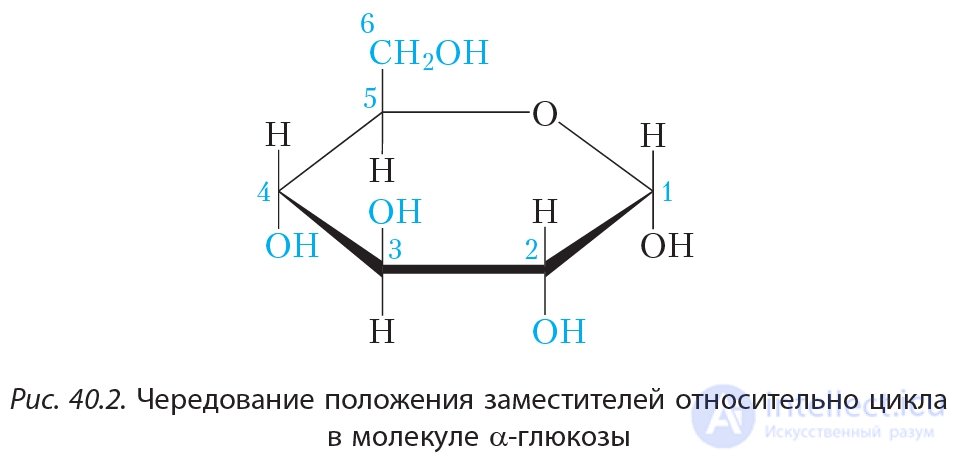 Thus, in the cyclic forms of glucose, the positions of the substituents relative to the ring alternate at carbon atoms numbered 2–5 (Fig. 40.2).
 Interesting to Know
The «silver mirror» reaction can be used to make New Year tree ornaments. To do this, a mixture of ammoniacal silver oxide solution and glucose is poured into a glass ornament blank, and the blank is then heated. If only one side of the blank was heated, the corresponding part of the ornament became silvered; when heated on all sides, the entire ornament became silvered (Fig. 40.3). Nowadays this technology is rarely used.
|
Glucose is a representative of the class of carbohydrates. The molecular formula of glucose is C6H12O6. Glucose can exist in linear and cyclic forms. Both the linear form and the cyclic α- and β-forms are simultaneously present in an aqueous solution of glucose. A dynamic equilibrium exists between the different forms of glucose in solution, meaning that rings are continuously forming and opening. The linear form of glucose has one aldehyde group and five hydroxyl groups. Therefore, glucose undergoes the qualitative reactions for aldehydes (the «silver mirror» reaction) and for polyhydric alcohols (formation of a cornflower-blue solution with copper(II) hydroxide). |
1. Which organic compounds known to you belong to the class of carbohydrates?
2. Write the molecular and structural formulas of glucose. What functional groups are present in the glucose molecule?
3. Mannose is a spatial isomer of glucose. The mannose molecule differs from the glucose molecule in the spatial arrangement of the hydroxyl group at the second carbon atom. Give the cyclic forms of mannose. Note that, like glucose, mannose can exist in α- and β-forms.
4. Describe the experiments that can be carried out to prove which functional groups are present in the glucose molecule.

Comments