
Lecture
Carbon atoms can be linked to one another not only by single bonds but also by double bonds. The simplest hydrocarbon containing a double bond is ethylene 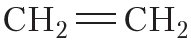 . Let us consider the structure of its molecule.
As with alkanes, carbon in the ethylene molecule is tetravalent. The formation of four bonds occurs through four atomic orbitals:
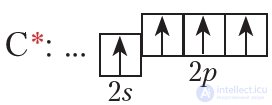
Recall that in the molecules of alkanes we have already studied, each carbon atom is in a state of sp3-hybridization (§ 7). That is, one s- and three p-orbitals of the carbon atom mix, forming four identically shaped sp3-hybrid orbitals. These orbitals are arranged in space at the maximum distance from one another, at an angle of about 109°.
The double bond in the ethylene molecule is formed between carbon atoms that are in a state of sp2-hybridization. sp2-hybridization involves: one s- and two p-orbitals (fig. 12.1).
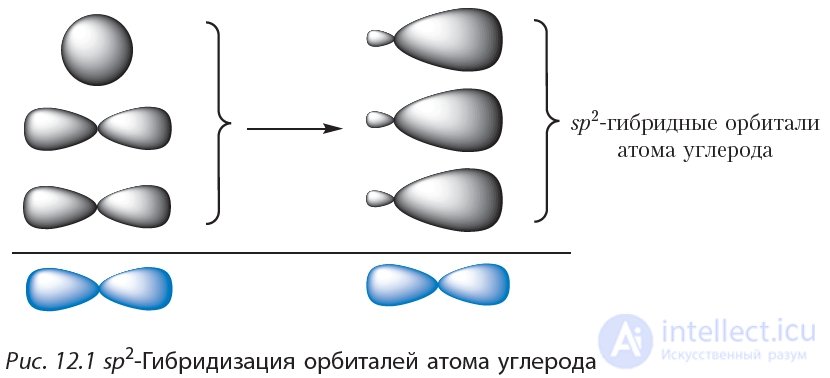 Three sp2-hybrid orbitals are positioned at the maximum distance from one another. This is achieved when they lie in the same plane at an angle of 120° (fig. 12.2).
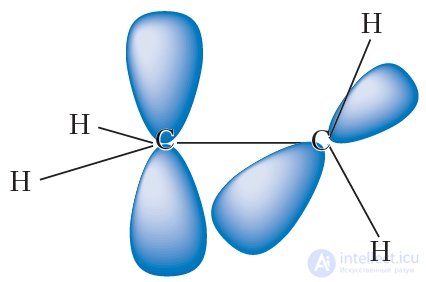
One p-orbital of the carbon atom (fig. 12.3, shown in blue) retains its original shape and is positioned perpendicular to the plane in which the three sp2-hybrid orbitals lie.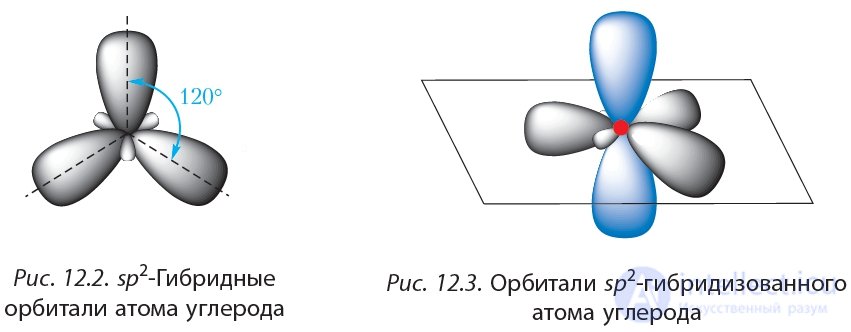
Owing to the overlap of the hybrid orbitals, each carbon atom forms three bonds — one with the neighboring carbon atom and two — with hydrogen atoms (fig. 12.4).
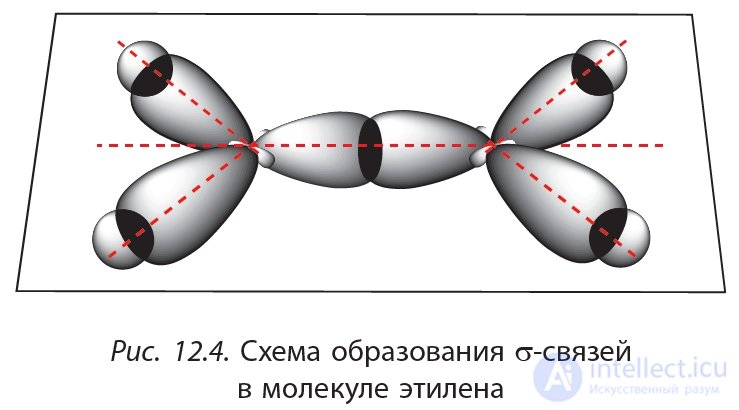 As can be seen from figure 12.4, when these bonds form, the electron clouds overlap along the line connecting the atomic nuclei. Such bonds are called σ-bonds (sigma bonds). The second bond between the carbon atoms in the ethylene molecule is formed through the sideways overlap of non-hybridized p-orbitals (12.5).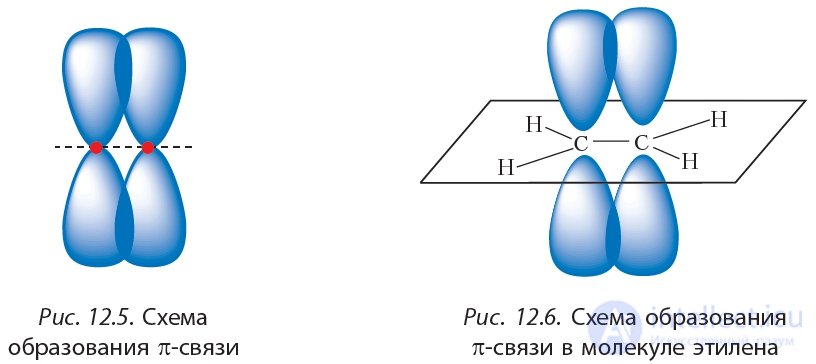
Such a bond is called a π-bond.
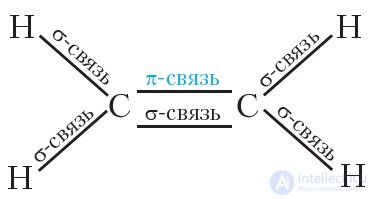
Thus, the carbon atoms in the ethylene molecule are joined by a double bond, one component of which is a σ-bond, and the other — a π-bond.
All single bonds are σ-bonds. A double bond consists of one σ- and one π-bond. In total, the ethylene molecule has five σ-bonds and one π-bond:
Because the π-bond is formed through weak sideways overlap of the orbitals, it is less strong than the σ-bond, which is formed through the overlap of orbitals extended directly toward one another. Nevertheless, carbon atoms joined by a double bond are drawn more closely together.
 In the ethylene molecule, the distance between the carbon atoms is 0,134 nm, which is noticeably less than in the ethane molecule (0,154 nm).
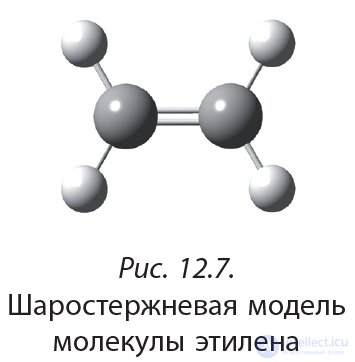
The structure of the ethylene molecule can be represented using a ball-and-stick model (fig. 12.7).
The ethylene molecule is planar, and the bond angles are approximately equal to 120°. The system of σ-bonds lies in the plane of the molecule, while the π-bond is formed as a result of the overlap of electron clouds above and below the plane of the molecule (fig. 12.6).
As you already know (§ 7), in alkane molecules rotation around single C — C bonds occurs easily. Around a double bond  such rotation is impossible, since it would cause the electron clouds of the π-bond to separate, thereby destroying the π-bond:
Ethylene is the simplest representative of the alkenes — non-cyclic hydrocarbons whose molecules contain one double bond.
The nearest homolog of ethylene — propylene  . The molecular formula of propylene is C3H6. Neighboring members of the homologous series, as in the case of alkanes, differ in composition by a CH2 group. It is quite obvious that the next homolog must have the composition C4H8. From this it is easy to derive the general formula of alkenes — CnH2n.
|
Non-cyclic hydrocarbons whose molecules contain one double bond are called alkenes. The general formula of alkenes is CnH2n. The carbon atoms forming the double bond are in a state of sp2-hybridization. A covalent bond formed through the overlap of electron clouds along the line connecting the atomic nuclei is called a σ-bond. A covalent bond formed through the sideways overlap of non-hybridized p-orbitals is called a π-bond. A double bond includes one σ- and one π-bond. π-Bonds are less strong than σ-bonds. |
1. Draw a diagram of the overlap of atomic orbitals in the formation of the σ- and π-bonds in the ethylene molecule.
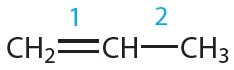
2. Which of the carbon-carbon bonds in the propylene molecule is shorter?
Which of the indicated bonds is stronger?
3. Alkenes are characterized by addition reactions at the site of the double bond. Which bond, σ- or π-, is broken in this process, and why?
4. How many σ-bonds are there in the ethane molecule? Are there any π-bonds in the ethane molecule or in other alkanes?
5. 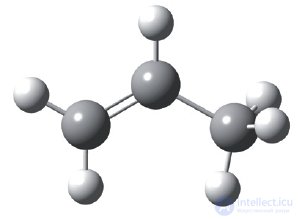 The figure shows a ball-and-stick model of the propylene molecule. How many σ- and π-bonds are in the propylene molecule? In what state of hybridization are the carbon atoms joined by the double bond in the propylene molecule? In what state of hybridization is the carbon atom of the methyl group in the propylene molecule?

Comments