
Lecture
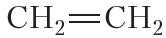
In terms of physical properties, alkenes differ little from alkanes with the same number of carbon atoms in the molecule. Thus, alkenes with 2—4 carbon atoms in the molecule are colorless gases at room temperature. Alkenes with 5 to 17 carbon atoms in the molecule are liquids. Alkenes with an even greater number of carbon atoms in the molecule (18 or more) are solid substances. The boiling points of some unbranched alkenes are given in Table 15.1.
Table 15.1. Boiling points of alkenes
|
Name |
Structural formula |
Boiling point (tb, °C) |
|
Ethene |
|
–104 |
|
Propene |
|
–48 |
|
Butene-1 |
|
–6 |
|
Pentene-1 |
|
30 |
|
Hexene-1 |
|
64 |
|
Heptene-1 |
|
93 |
|
Octene-1 |
|
122 |
Like alkanes, alkenes are insoluble in water but dissolve well in organic solvents.
The density of alkenes is lower than that of water.
Because the molecule contains a π-bond, alkenes are much more reactive than alkanes. Recall that substitution reactions are typical of alkanes. Addition reactions are typical of alkenes:
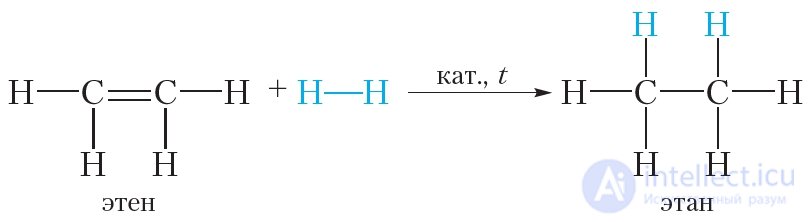
These reactions are accompanied by cleavage of the π-bond, since it is weaker than the σ-bond.
Alkenes undergo addition reactions under milder conditions than alkanes undergo substitution reactions. Substitution reactions are not typical of alkenes.
1. Halogenation. Addition of Halogens
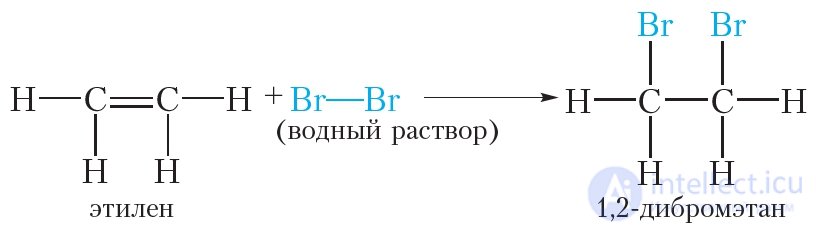
Like alkanes, alkenes react with halogens. However, in the case of alkenes an addition reaction occurs rather than a substitution reaction. Let us compare these reactions.
Bromination of ethylene (an addition reaction):
Bromination of ethane (a substitution reaction):
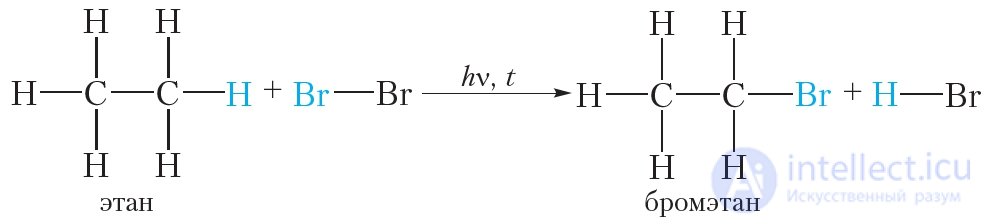
Ethylene reacts with an aqueous solution of bromine (bromine water) under ordinary conditions, whereas the reaction of ethane with bromine is possible only under harsh conditions — heating or ultraviolet irradiation.
When ethylene is passed through bromine water, an addition reaction of bromine across the double bond takes place. As a result, the orange bromine solution becomes colorless.
The ethane molecule contains no double bonds, so when ethane is passed through bromine water no chemical reaction occurs and the bromine solution remains orange.
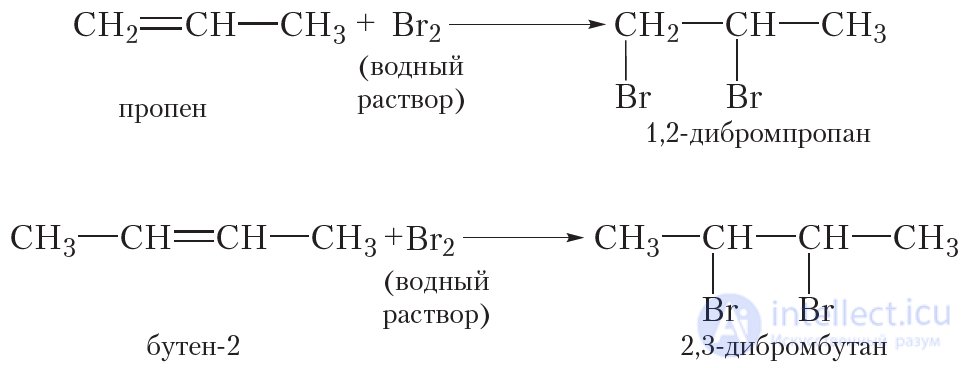
Consequently, the reaction with bromine water is a qualitative test for the double bond.
Like ethylene, other alkenes readily add bromine, decolorizing bromine water:
2. Hydrogenation. Addition of Hydrogen
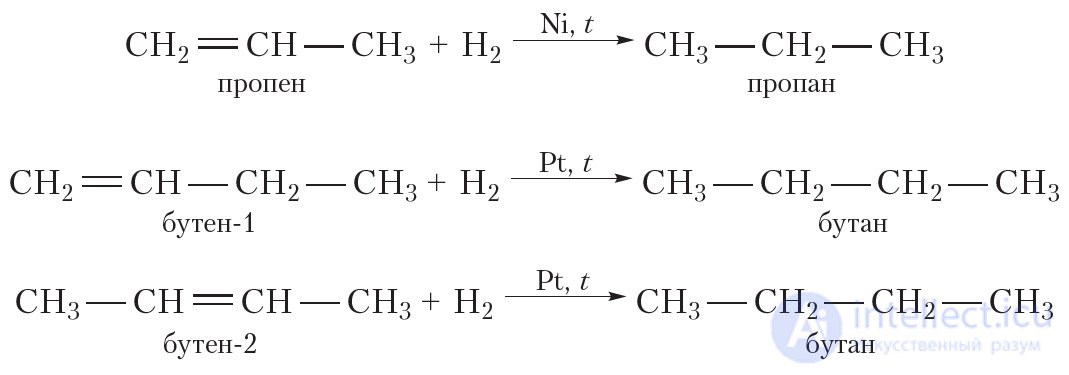
The addition of hydrogen to an organic substance is called a hydrogenation reaction. Under ordinary conditions, alkenes do not add hydrogen. A catalyst (Pt or Ni) is required for the reaction to proceed.
Hydrogenation of alkenes produces alkanes. The equation for the hydrogenation reaction of ethene was given at the beginning of this section. Let us give the equations for the hydrogenation reactions of some other alkenes:
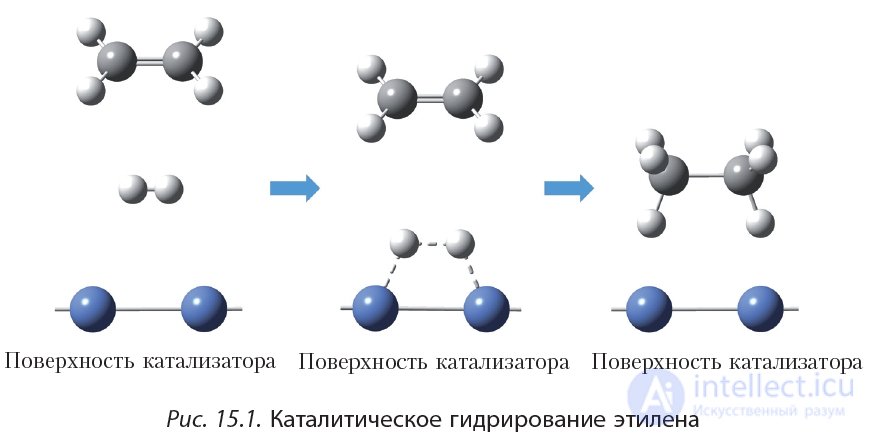
As you already know, a catalyst speeds up a chemical reaction without being consumed in the process. The role of the catalyst in the hydrogenation reaction is to weaken the chemical bond in the hydrogen molecule and thereby activate this molecule for the addition reaction:
3. Hydrohalogenation. Addition of Hydrogen Halides
Alkenes can undergo addition reactions not only with simple substances but also with complex ones. For example, ethylene readily adds hydrogen bromide:
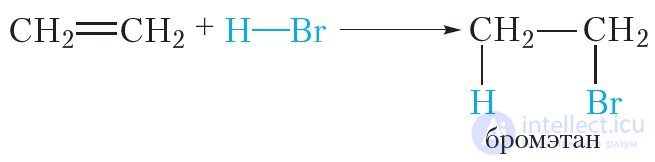
Addition reactions of hydrogen halides to organic substances are called hydrohalogenation. These reactions proceed under ordinary conditions.
4. Hydration. Addition of Water
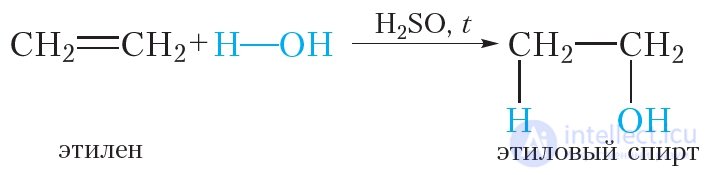
Hydration is the name given to the addition reaction of water to an organic substance. When heated in the presence of a catalyst (H2SO4), ethylene adds water. This produces ethyl alcohol:
Owing to the opening of double bonds, individual ethylene molecules can combine with one another to form long chains. This process can be represented schematically as follows:
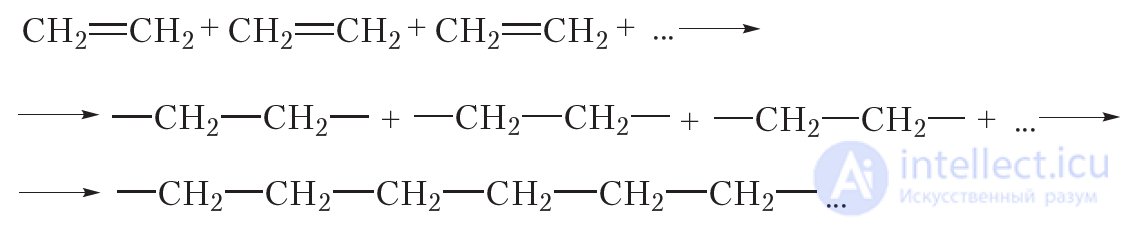
The combination of hundreds or even thousands of ethylene molecules produces one giant molecule — a polymer. The reaction that takes place is called a polymerization reaction.
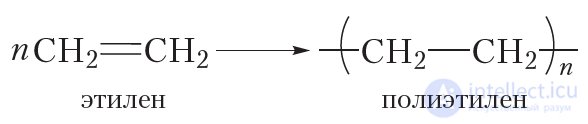
More concisely, the polymerization process of ethylene can be expressed by the following equation:
Other alkenes can also polymerize, in particular propylene: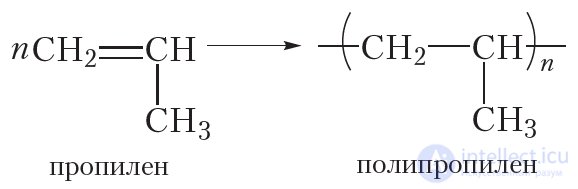
The starting substance in a polymerization reaction is called the monomer, and the product is called the polymer. Polymer molecules are also called macromolecules.
The number of monomer units in a polymer molecule is called the degree of polymerization. In the polymer formula, the degree of polymerization is denoted by the index «n».
Polyethylene and polypropylene are well known to us. Polyethylene is used to make plastic film, containers, household items, and so on. Polypropylene closely resembles polyethylene and differs from it only in having greater strength and heat resistance. Polypropylene is used to make greenhouse film, automobile battery casings, and much more. You will become acquainted with many more polymers later on.
1. Combustion. Reaction with Oxygen
Like alkanes, alkenes burn to form carbon dioxide and water:

Let us give the general equation for the combustion reaction of alkenes:

2. Partial Oxidation. Reaction with KMnO4
Oxidation of alkenes can also proceed without breaking the carbon skeleton. Thus, when ethylene is passed through a dilute aqueous solution of potassium permanganate (KMnO4), the violet color disappears. Potassium permanganate cleaves the π-bond in the ethylene molecule, while the σ-bond between the carbon atoms is retained. We will represent this reaction not by an equation, but in simplified form as a scheme. The scheme for the oxidation reaction of ethylene by an aqueous solution of potassium permanganate is as follows:
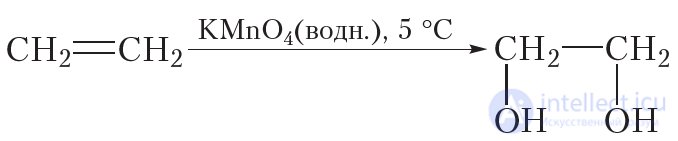
The scheme shows that the π-bond opens during this reaction, and two oxygen-containing groups — OH, add to the carbon atoms, that is, ethylene is oxidized. This produces ethylene glycol, a representative of the polyhydric alcohols.

Video 15.1.
Qualitative reactions
for the double bond
Writing schemes is often more convenient than writing equations, which is why they are widely used in organic chemistry.
Like the reaction with bromine water, the reaction with a solution of potassium permanganate is a qualitative reaction for the double bond. As a result of this reaction, decolorization of the violet potassium permanganate solution is observed.
|
Addition reactions across the double bond are characteristic of alkenes. In this process, cleavage of the π-bond occurs. Alkenes can add halogens, hydrogen, hydrogen halides, and water. Polymerization is an addition reaction that repeats many times over. This reaction produces giant polymer molecules that are widely used in our everyday life. The low-molecular-weight substance from which a polymer is synthesized is called the monomer; the number of monomer units in a polymer macromolecule is called the degree of polymerization. The decolorization reactions of bromine water and potassium permanganate solution are qualitative reactions for the double bond. |
1. Write the equations for the addition reactions to ethylene and propylene of: a) hydrogen; b) chlorine. Name the products of the reactions. How can methane and ethylene be distinguished experimentally?
2. Write the equation for the reaction of hydrogen bromide with butene-2. Name the product of the reaction.
3. An excess of a solution of hexene-1 in heptane was added to bromine water. What phenomena will be observed? Write the equation for the reaction that takes place.
4. Write the scheme for the reaction of propylene with an aqueous solution of potassium permanganate.
5. Polymerization of ethylene produced a polymer with a mass of 140 g, containing 1,505 ∙ 1022 macromolecules. Calculate: a) the average molar mass of the polymer; b) the degree of polymerization.
6. After passing 20 dm3 (S.T.P.) of a mixture of ethane and ethylene through a flask containing bromine water (in excess), the mass of the flask increased by 20 g. Determine the volume (S.T.P.) of ethane in the gas mixture.
7*. Write the reaction schemes by which 2,2,3,3-tetramethylbutane can be obtained from 2-methylbutene.







Comments